Health, pharmacies and insurance in Georgia
Do I need travel insurance for Georgia?
Yes, and it should specifically cover mountain activities if you plan to hike above Kazbegi, Svaneti or Tusheti, since standard policies sometimes exclude trekking above a certain altitude or terrain difficulty. Georgia has no reciprocal free healthcare agreement with most Western countries, so a hospital visit without insurance is paid out of pocket, at prices that are moderate by Western standards but still real money.
Georgia doesn’t require special health prep, but altitude and remoteness change the calculation
Most visitors to Georgia never think about health beyond packing the usual holiday basics, and for a trip centred on Tbilisi, Kakheti’s wineries and a couple of easy day trips, that’s a reasonable approach — the country presents no unusual disease risk, tap water in the cities is generally safe, and street food is prepared to standards comparable to most of Southern Europe.
What changes the picture is altitude and remoteness: a hike toward Gergeti Trinity Church, a multi-day trek in Svaneti or Tusheti, or any attempt on Mount Kazbek itself moves you well outside the reach of Tbilisi’s private hospitals, and that gap is where planning actually matters. This guide covers travel insurance, what Georgian healthcare is actually like, pharmacies, and the specific health issues — altitude, sun, water, and rabies from stray animals — worth knowing about before you go.
Travel insurance: what to actually buy
Georgia has no reciprocal public healthcare arrangement with the UK, the EU, the US, Canada or Australia, which means a hospital visit without insurance is billed directly and paid out of pocket. Prices are moderate by Western European or North American standards — a private clinic consultation or a short emergency department visit rarely reaches the sums a comparable visit would cost in the US — but a serious injury, a multi-day hospital stay, or a helicopter evacuation from a mountain trail can still run into thousands of dollars, which is exactly the scenario insurance exists for.
Three things matter more than the headline price when comparing policies for a Georgia trip:
-
Altitude and activity cover. Standard travel insurance policies frequently cap covered activities at a certain altitude (often 2,500–3,000 m) or exclude “trekking” and “mountaineering” as categories requiring an upgrade. Gergeti Trinity Church sits at roughly 2,170 m, which is usually fine on a standard policy, but the Chaukhi massif near Juta, the Abudelauri lakes, and anything approaching Kazbek’s slopes push well past that threshold — check the policy wording specifically, not just the marketing page, before assuming you’re covered.
-
Winter sports cover, a separate add-on on most policies, needed for skiing or snowboarding at Gudauri or Bakuriani.
A standard policy without this add-on typically excludes ski injuries entirely, which is a common and expensive gap for visitors who add a ski day to a trip that wasn’t originally planned around it.
-
Medical evacuation, specifically covering transport from a remote area (a mountain trailhead, a village without road access in bad weather) to a hospital capable of treating a serious injury. This is the cover that matters most for anyone heading into Svaneti, Tusheti or the high Kazbegi region, where the nearest adequately equipped hospital may be several hours away by road even in good conditions.
Buying insurance before you commit to a specific itinerary, then checking it against the activities you actually end up booking, is safer than assuming a generic policy covers everything — read the exclusions section, not just the summary, since that’s where altitude and activity caps are usually buried.
What Georgian healthcare is actually like
Tbilisi’s private hospital and clinic sector has expanded substantially over the past decade, partly driven by a deliberate push into medical tourism, and the result is a set of well-equipped, modern facilities with many doctors trained in Europe, Israel or the US and a reasonable expectation of English being spoken, at least at the reception and consultation level. For anything beyond routine care — a broken bone, a bad stomach bug, a minor accident — Tbilisi’s private clinics are a genuinely good option, and most travel insurers have direct billing arrangements with the larger ones, which avoids paying up front and claiming later.
Batumi and Kutaisi have smaller but functional private healthcare options, adequate for common travel ailments and minor injuries. Rural Georgia is a different picture: small towns typically have a basic clinic or a Soviet-era polyclinic with limited equipment and no guarantee of English-speaking staff, and anything serious that happens in Kazbegi, Svaneti, Tusheti or similarly remote areas means either a long drive to Tbilisi or, in a genuine emergency, evacuation — which loops back to why evacuation cover on your insurance policy matters specifically for anyone planning mountain time.
Public hospitals exist throughout the country and are used by Georgians daily without incident, but they are generally not where a foreign visitor’s insurer will direct you for anything beyond genuinely urgent stabilisation, given language barriers and equipment differences compared to the private sector.
Pharmacies: more available over the counter than you might expect
Pharmacies (apteka, written აფთიაქი in mkhedruli, usually marked with a green cross like much of Europe) are common in every town of any size, and Tbilisi has several open 24 hours, useful for anything that comes up outside normal hours. A notable difference from some Western countries: a meaningfully wider range of medication, including some antibiotics, is available without a prescription, which is convenient for minor infections but not a substitute for actually seeing a doctor if symptoms are serious or don’t improve — self-medicating with antibiotics for the wrong condition is a bad idea regardless of how easy it is to buy them.
Central Tbilisi pharmacies, particularly around Rustaveli Avenue and Vake, are more likely to have staff with functional English than pharmacies in smaller towns, where showing a translated symptom list or a phone translation app bridges the gap reasonably well for common ailments.
Altitude sickness: the health risk most visitors underestimate
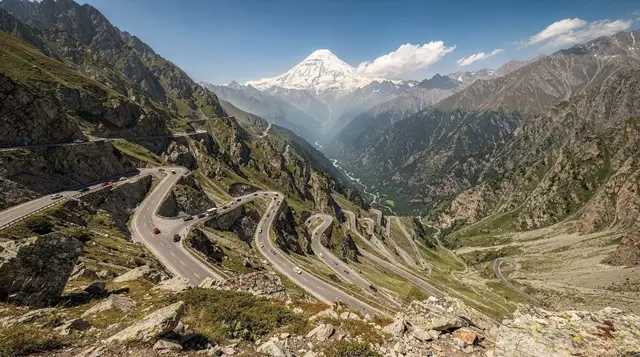
Georgia’s mountains are the country’s single biggest draw and its single biggest overlooked health risk. Altitude sickness becomes a genuine possibility above roughly 3,000 m, and the routes most likely to take a visitor there — the trek to the Chaukhi massif and Abudelauri lakes above Juta, the approach toward Mount Kazbek’s base camp, and multi-day treks in upper Svaneti and Tusheti — are popular precisely because they’re accessible without technical climbing experience, which can lull people into underestimating them.
Early symptoms — headache, nausea, dizziness, unusual fatigue — are the body’s warning signal to stop ascending, rest, and descend if symptoms worsen rather than push through. Acclimatising gradually over a couple of days before a serious ascent, staying well hydrated, and avoiding alcohol the night before a high-altitude hike all reduce the risk meaningfully.
Fitness level correlates with altitude tolerance less than most people assume — a very fit hiker can still get altitude sickness, while a less fit one who ascends slowly may not. See Climbing Mount Kazbek: what it takes for what a serious attempt on the mountain specifically requires, and Hiking season in Georgia for when conditions are safest more broadly.
If you would rather see the high Caucasus without committing to a hard ascent, a guided day trip to the mountains around Kazbegi lets someone else handle the driving and the timing, which removes two of the variables that most often turn a pleasant outing into a problem. The Kazbegi day trip guide and the Kazbegi destination page explain what the day looks like, and Gergeti Trinity hike is the natural first step for anyone who wants to test how they feel at height before going further. For the gear side of the same question, see Hiking gear and guides in Georgia, and for the wider trekking picture, Tusheti trekking and the Svaneti hiking itinerary show where the remote stretches begin.
Sun, heat and hydration
Georgia’s summer sun, particularly at altitude where the atmosphere offers less filtering, is stronger than the temperature alone suggests — a mountain hike in Svaneti or Tusheti on a cool, overcast-feeling day can still produce significant sunburn. Reapplying sunscreen through the day, carrying more water than feels necessary for exposed trails such as the walk into the shadeless open ground around Vardzia or the longer Svaneti routes, and pacing exertion during the hottest hours (roughly 11am to 4pm in July and August) all matter more in the mountains than the coast.
Rabies, stray dogs and animal contact
Tbilisi has a large, visible population of stray dogs, most of which are part of a municipal vaccination and ear-tagging programme (a coloured tag in the ear indicates the dog has been through it) and are generally calm, used to people, and not a practical threat.
That said, rabies exists in Georgia’s wider animal population, including in rural and mountain areas where the municipal programme has less reach, and the standard precaution — don’t approach or feed stray or farm animals, and if bitten or scratched, wash the wound thoroughly and seek medical attention promptly rather than waiting to see if symptoms appear — applies here as it would in most countries where rabies is present. This is a low-probability but serious-consequence risk, which is exactly the category insurance and prompt medical attention are built for.
Food and water precautions
Tap water in Tbilisi, Batumi and most cities is generally safe and often good — much of it comes from mountain and spring sources rather than heavily treated municipal supplies, which is part of why Georgians are often unbothered by drinking it directly. In smaller towns and rural guesthouses, where water sources are less consistently monitored, bottled water is the more cautious default, particularly for visitors with a sensitive stomach or travelling with small children.
Street food and market produce are prepared to reasonable hygiene standards in most of the country, and the genuine risk from Georgian food is less about contamination than about the sheer richness and volume of a proper supra — see The supra and the tamada explained for what that actually involves, and pace yourself accordingly if you have a sensitive stomach or are not used to rich, cheese- and butter-heavy food in quantity.
Travellers with dietary restrictions will find practical help in Vegetarian and vegan Georgia and Family food in Georgia, and anyone who wants a gentler introduction to the cuisine can start with a small group village wine and bread experience rather than a full-scale feast. Khinkali guide and Georgian breakfast are good places to learn what to expect on the plate, and Georgia with a hangover covers the morning after honestly.
Easy outings when you want low physical risk
Not every good day out in Georgia involves altitude. Travellers who want scenery without a demanding route can look at the lowland and mid-height options around Kutaisi, such as a guided day through the canyons and caves west of Kutaisi, where boardwalks and short walks replace long climbs. See Day trips from Kutaisi, Martvili Canyon and Prometheus Cave for what each stop involves, and Georgia with kids or Tbilisi with kids if you are travelling with children. For a restful break, Thermal springs in Georgia and Sulphur baths guide cover the spa side of the country, and Solo travel in Georgia is worth reading if you will be handling any medical question on your own.
Accessibility and health considerations for less able-bodied travellers
Georgia’s older infrastructure — cobbled old-town streets, limited lift access in some historic buildings, uneven pavements outside central Tbilisi — creates real accessibility challenges that are worth planning around specifically rather than discovering on arrival. See Accessible travel in Georgia for a fuller picture of what to expect and how to plan a trip that accounts for it, alongside the general safety context in Is Georgia safe? An honest answer.
Emergency numbers and what actually happens if something goes wrong
Georgia’s general emergency number is 112, which connects to police, fire and ambulance services and has at least some English-language capability, though response quality and English fluency vary more outside Tbilisi than within it. For anything beyond a genuine emergency, most travel insurers provide a 24-hour assistance line as part of the policy, and calling that number before heading to a hospital — rather than after — is usually the faster route to direct billing and guidance on which specific clinic to use, since insurers maintain relationships with particular Tbilisi hospitals that streamline the paperwork considerably.
If you’re driving yourself, whether on a self-drive rental or navigating Georgia’s roads more generally, knowing that mountain roads can leave you without phone signal for stretches — particularly toward Tusheti or the more remote parts of Svaneti — is worth factoring into how much you rely on a phone for emergency contact versus telling someone your route and expected return time before you set off, the same basic precaution covered in Mountain safety in Georgia: rescue, weather and signal.
Long stays, digital nomads and ongoing prescriptions
Anyone planning a longer stay in Georgia — covered in more detail in Remote work and long stays in Tbilisi — faces a slightly different set of health considerations than a two-week holiday. Standard travel insurance policies often cap the length of a single trip they’ll cover (frequently 30, 60 or 90 days), so a stay longer than that needs either a specific long-stay travel policy or, for anyone spending most of a year in the country, private health insurance registered locally, which several international providers now offer specifically for Tbilisi’s growing remote-work community.
Bringing an adequate supply of any regular prescription medication, along with a doctor’s letter explaining the prescription (useful both for customs and for a Georgian pharmacist if a refill or substitute becomes necessary), avoids a genuinely awkward situation partway through a long stay. Tbilisi’s private clinics are equipped to manage ongoing care for common chronic conditions, and several have become accustomed to a growing base of long-term foreign residents, though continuity of care with a doctor back home is worth discussing before an extended stay rather than after arriving.
Before you fly: a short pre-departure checklist
A travel health clinic visit two to four weeks before departure is worth the appointment for anyone with an existing condition, anyone planning serious mountain time, or simply anyone who hasn’t checked their routine vaccinations in a while — it costs little and resolves most of the uncertainty covered on this page in a single conversation. Confirming your visa and entry situation at the same time, since entry requirements and any associated health declarations do shift periodically, rounds out the basic admin worth handling before departure rather than at the airport.
What to pack for basic health needs
A modest travel medical kit covers most situations that come up: rehydration salts (useful after a long hiking day or a heavy supra), basic pain relief, plasters and antiseptic for minor cuts on uneven old-town cobbles or mountain trails, and any personal prescription medication carried in its original packaging with a copy of the prescription, since customs and pharmacy staff may ask about unfamiliar medication. Packing for Georgia, season by season covers the wider packing list, including altitude- and season-specific gear that indirectly reduces health risk — proper layers reduce exposure-related illness on a cold mountain day more effectively than any medication would.
The realistic bottom line
For the ordinary Tbilisi-Kakheti-Kazbegi-day-trip version of a Georgia holiday, health risk is low and comparable to most of Southern or Eastern Europe: decent tap water, reasonable food hygiene, accessible pharmacies, and good private healthcare in the capital if something does go wrong. The risk profile changes meaningfully once altitude, multi-day trekking or genuinely remote travel enters the plan, and that’s specifically where insurance with proper evacuation and altitude cover, sensible acclimatisation, and a realistic sense of your own fitness and experience matter far more than any other precaution on this page.
Frequently asked questions about health and insurance in Georgia
Is healthcare good in Georgia?
Private hospitals and clinics in Tbilisi, and to a lesser extent Batumi and Kutaisi, are modern and well-equipped, with many doctors trained in Europe or fluent in English. Rural areas have far more limited facilities, which is why evacuation cover matters for mountain trips.
Do I need vaccinations to travel to Georgia?
No mandatory vaccinations exist for most travellers arriving from Europe or North America, and Georgia is not a yellow fever risk country. Being up to date on routine vaccinations is sensible general practice rather than a Georgia-specific requirement.
Is altitude sickness a real risk in Georgia?
Yes, for anyone hiking to Gergeti Trinity Church, into the Chaukhi massif near Juta, or attempting Mount Kazbek (5,054 m), where the risk becomes real above roughly 3,000 m. Ascending gradually and recognising early symptoms matters more than fitness level alone.
Can I buy medication over the counter in Georgian pharmacies?
Many pharmacies sell a wider range of medication without prescription than is typical in Western Europe or North America, including some antibiotics. Convenient for minor issues, but not a substitute for seeing a doctor for anything serious.
Is the tap water safe to drink in Georgia?
In Tbilisi and most cities, yes, generally good quality mountain water. In some rural areas, bottled water is the more cautious default, particularly for a sensitive stomach or young children.
What should my travel insurance cover for a Georgia trip?
Medical treatment and evacuation as a baseline, extended to cover trekking at altitude if you plan any mountain activity, plus the usual cancellation and baggage cover. Winter sports need a separate add-on for skiing at Gudauri or Bakuriani.
Are there English-speaking doctors in Tbilisi?
Yes, at the main private clinics and hospitals used by expatriates and international visitors, several built with international patients in mind. Outside Tbilisi and Batumi, English-speaking medical staff become less common.
Trip-planning essentials on GetYourGuide
Verified deep-linked GetYourGuide tours. Book through these links and we earn a small commission at no cost to you.
Photo: our own image of the location, not the operator’s product photo.