Day trips from Kutaisi
What is the best day trip from Kutaisi?
Martvili Canyon for most first-time visitors, Tskaltubo's abandoned Soviet sanatoriums for a genuinely different kind of day, and Racha for anyone with a second or third day who wants mountains and wine without the coast. Svaneti and Batumi are both reachable but really deserve an overnight rather than a single rushed day.
Kutaisi as a base, not just a stop
Most visitors reach Kutaisi as part of a wider Georgia route, but treating it purely as a stop between Tbilisi and Batumi undersells how much sits within a comfortable radius of the city once you are actually there. This guide is the full menu — every genuinely worthwhile day trip reachable from a Kutaisi base, honestly ranked by how well each one suits a single day versus how much it really wants an overnight. For the natural-sites cluster specifically, Canyons and caves in one day from Kutaisi goes into far more depth on pacing that particular loop; this guide places it in context alongside everything else within reach.
The canyon and cave cluster: still the headline draw
Martvili Canyon, Okatse Canyon, Prometheus Cave and Sataplia Nature Reserve remain the best-known reason to base yourself in Kutaisi, and for good reason — nowhere else in Georgia clusters this many distinctive natural sites within an hour-and-a-half radius. Canyons and Cave Tour from Kutaisi covers a leaner version built around two sites rather than attempting all four in a single rushed day, the approach recommended in detail above.
Tskaltubo: the day trip most visitors haven’t heard of
Abandoned Sanatoriums of Tskaltubo Group Tour from Kutaisi covers what is, for many recent visitors, the most memorable single day trip from Kutaisi: Tskaltubo, a Soviet-era spa town roughly 20 minutes away, once a prestigious destination for the Soviet elite built around naturally radon-rich thermal springs, now largely abandoned and left to decay in place. The abandoned sanatoriums of Tskaltubo covers what to expect in full — grand Stalinist-era buildings with peeling murals and empty pools, now partly repurposed as informal housing for displaced families, a genuinely complicated site that rewards a guided visit over an unguided wander. Tskaltubo: radon baths among Soviet ruins — the spa’s more conventional side — also still operates in a handful of restored bathhouses, for visitors who want the wellness angle alongside the urban-exploration one.
Chiatura and the Katskhi Pillar: Soviet engineering meets solitary faith
Katskhi Pillar Chiatura Mgvimevi Convent from Kutaisi covers a different kind of day, roughly 90 minutes from Kutaisi: Chiatura’s cable cars, a network of Soviet-era ropeway lines still in daily use by residents of this manganese-mining town built across steep ravines, paired with the Katskhi Pillar, a natural limestone column topped by a tiny monastery where a single monk has lived a life of isolated devotion. The pairing gives a single day both a slice of functioning Soviet industrial infrastructure and one of Georgia’s more unusual religious sites, a genuinely distinctive combination unlike anything else on this list.
Racha: mountains and wine without the coast or the crowds
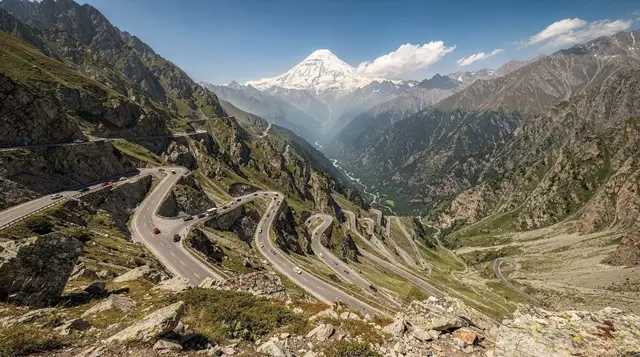
One Day Trip in Racha from Kutaisi covers the option most visitors skip simply because they have not heard of it: Racha, a mountainous region north-east of Kutaisi known for dramatic scenery along winding roads and its own distinctive semi-sweet wine tradition, built around the Alexandreuli and Mujuretuli grapes rather than Kakheti’s more familiar varieties. Racha and Khvanchkara: Georgia’s semi-sweet outlier covers the wine side specifically. Racha sees a fraction of the visitor numbers that the canyon cluster or Tskaltubo attract, making it the pick on this list for anyone who has already covered Kutaisi’s headline sights and wants something quieter.
Batumi: further than it looks, but doable as a long day
A private day tour from Kutaisi to the Black Sea coast covers the option of reaching Batumi directly from a Kutaisi base — around two hours each way, meaning roughly four hours of driving for a day that also needs real time on the coast to be worthwhile. Batumi in two days makes the case that Batumi rewards a proper multi-day stay more than a single squeezed-in day; treat this option as a genuine long day for visitors with no spare night to give the coast, rather than the recommended way to experience Batumi.
Svaneti: technically possible, honestly not a day trip
Shared transfers between Kutaisi and Mestia exist and run daily, which occasionally leads visitors to assume a Svaneti day trip is realistic from a Kutaisi base. It is not, in any meaningful sense: Mestia alone is 4-4.5 hours each way, meaning close to nine hours of driving for a single day, before any time actually spent seeing Svaneti’s mountains, towers or villages. Getting to Svaneti covers the transport options in full. If Svaneti interests you, treat it as its own multi-day leg of your Georgia trip, with a proper multi-night itinerary, rather than trying to squeeze it into a Kutaisi-based day trip schedule.
Sequencing multiple day trips from a Kutaisi base
For visitors spending three or four nights in Kutaisi specifically to explore the surrounding region, a sensible sequence starts with the canyon cluster on day one (the leaner two-site version), Tskaltubo on day two given its short distance and different character, and Racha or the Chiatura-Katskhi pairing on a third day depending on whether mountain wine or Soviet-era engineering appeals more. Overnight vs day trip covers the broader logic behind spacing demanding days out rather than stacking several full driving days back to back, which applies as much to a multi-day Kutaisi stay as to any single long day trip elsewhere in Georgia.
Group tours versus a rental car for this region
Kutaisi’s surrounding sights sit at varying distances and varying degrees of accessibility by public transport — Tskaltubo has reasonable marshrutka links given its proximity, while Racha and the route to Chiatura are considerably less served. A rental car adds real flexibility for the more remote options, particularly Racha, where the scenic drive itself is part of the appeal and a fixed group schedule limits how much you can simply pull over and look. For the closer, more established routes — the canyon cluster, Tskaltubo — a group tour remains the simpler, and often cheaper, choice. Renting a car in Georgia covers what to expect if self-driving any of these routes.
Cost overview across the different day trips
The canyon cluster remains the most heavily toured option and prices accordingly — a group tour covering two sites typically runs 60-100 ₾ per person, rising toward 120-150 ₾ for the full four-site version. Tskaltubo, being closer and requiring less driving, is often the cheapest option on this list at 40-70 ₾ per person for a guided group tour. Chiatura and the Katskhi Pillar sit in a similar range, 50-90 ₾, reflecting the roughly 90-minute drive each way.
Racha, given the greater distance and more specialised guiding it benefits from, typically costs more — 80-130 ₾ per person on a group tour, more again for a private driver given how much the scenic driving itself is part of the day. Batumi, as the longest single-day option, runs toward 150-200 ₾ given the four hours of round-trip driving involved.
Photography and the ethics of visiting Tskaltubo
Tskaltubo’s abandoned sanatoriums have become a genuine draw for photographers, and it is worth being clear-eyed about what that means before visiting: parts of several buildings are informally inhabited by displaced families who have lived there for years, a legacy of Georgia’s 1990s conflicts rather than a curated ruin.
A respectful visit means sticking to areas a guide identifies as appropriate, not photographing residents or their living spaces without clear consent, and understanding that the striking decay drawing visitors here also represents an unresolved housing situation for real people. Guided tours generally handle this well, routing visitors through the more clearly abandoned buildings rather than inhabited ones, which is one of the stronger arguments for choosing a guided visit over an independent wander here specifically.
The mining history behind Chiatura’s cable cars
Chiatura’s ropeway network was built from the Soviet era onward to move manganese ore and workers across the town’s dramatic ravine-cut terrain, at one point comprising dozens of separate lines connecting the valley floor to mining settlements on the surrounding cliffs. Many of the original cars have been replaced or restored in recent years, though a handful of older, distinctly Soviet-era carriages remain in service on certain lines, prized by visitors specifically for that unrestored, slightly rattling authenticity over the newer replacements.
The manganese industry that built the town has declined sharply since Soviet times, and Chiatura today feels like a place still organised around infrastructure built for a much larger workforce than currently uses it — part of what makes a visit here feel different from Georgia’s more conventionally scenic day trips.
Racha’s wine in more depth
Unlike Kakheti’s dry, often intensely tannic reds, Racha’s signature wine — Khvanchkara — is naturally semi-sweet, a style that occurs because the region’s short, cool growing season sometimes does not allow the Alexandreuli and Mujuretuli grapes to fully convert their sugar during fermentation, rather than through any deliberate sweetening.
It became closely associated with Soviet leadership circles in the twentieth century, reportedly a favourite of Stalin, a Georgian himself, which helped cement its reputation nationally well beyond Racha’s small production volumes. Visiting a Racha winery as part of a day trip here offers a genuinely different tasting experience from a Kakheti day out, worth doing specifically for the contrast if wine is a through-line of your Georgia trip.
Which day trip suits which kind of traveller
For a first Georgia visit with limited time, the canyon cluster remains the safest, most reliably rewarding choice. For visitors specifically drawn to Soviet history and urban exploration, Tskaltubo and the Chiatura-Katskhi pairing both deliver more distinctively than anywhere else in the country. For wine-focused travellers who have already covered Kakheti, Racha offers a genuinely different style worth the detour. For visitors principally chasing beach time or nightlife, Batumi deserves a dedicated multi-day stay rather than being squeezed in as a long day trip from Kutaisi at all.
Family suitability across these options
The canyon cluster and Racha both work reasonably well with children, given manageable walking and scenic rather than physically demanding days. Tskaltubo requires more caution given genuine structural hazards in the more deteriorated buildings, and is better suited to older children capable of following a guide’s instructions closely. Chiatura’s cable cars are a genuine novelty for children, though the ropeway experience itself, suspended high above the ravine, is worth checking against a child’s comfort with heights beforehand. Family travel considerations more broadly across the country are covered in this site’s dedicated family-travel guide.
Seasonal timing across the region
Spring and autumn are the most comfortable seasons for almost every day trip on this list, avoiding both summer’s heat at exposed sites like Sataplia and Chiatura’s shadeless ravine, and winter’s shorter daylight hours which particularly affect the longer drives to Racha and Batumi. Racha’s mountain roads see occasional snow in the coldest months, which can complicate a winter visit beyond what the driving distance alone suggests — worth checking recent conditions before committing to a winter Racha day trip specifically. Tskaltubo and Chiatura, both largely indoor or urban experiences, are the most weather-resilient options on this list, reasonable choices even on a day when rain rules out the more outdoor-focused canyon cluster.
What to pack across these different day trips
Sturdy, closed shoes matter across almost every option here — Tskaltubo’s uneven interior floors, Chiatura’s steep streets, and Racha’s rural paths all reward proper footwear over anything more casual. A torch or phone light is genuinely useful for Tskaltubo’s darker interior spaces, where lighting is minimal to non-existent. Warmer layers matter more for Racha and Chiatura, both at higher elevation than Kutaisi itself, than for the lower-lying canyon cluster or Tskaltubo. Cash in lari is worth carrying for all of these day trips, since smaller family-run guesthouses, wineries and rural cafés encountered along any of these routes are less likely to take cards than businesses in Kutaisi itself.
Where Kutaisi itself fits into all this
It is worth remembering that Kutaisi has its own worthwhile sights that a schedule packed with day trips can easily crowd out entirely. Bagrati Cathedral and why UNESCO delisted it and Gelati Monastery and its mosaics both sit within a short drive of the centre and take a combined half-day at a reasonable pace, easily fitted into a rest day between two more demanding excursions rather than needing its own dedicated day away from the wider region. Visitors planning three or four full day trips from a Kutaisi base should budget at least one additional day for the city itself, rather than treating Kutaisi purely as a launchpad for everything around it.
A city day also gives legs and feet a break from several consecutive days of driving and walking at the outlying sites, which is worth building into the schedule deliberately rather than leaving to chance.
Local restaurants around Kutaisi’s central square also make for a more relaxed evening than the guesthouse dinners available in some of the smaller towns near the outlying day trips, another reason to keep at least one evening free in the city itself across a longer stay, particularly after a long day out in Racha or Chiatura where dinner options along the route are limited, and after Tskaltubo’s more sombre atmosphere, when a familiar, comfortable meal back in Kutaisi is often the better way to close the day, rather than pushing straight on to plan the next outing without a proper pause in between.
Frequently asked questions about day trips from Kutaisi
What is the single best day trip from Kutaisi for a first-time visitor?
Martvili Canyon, as part of a leaner two-site version of the canyon cluster, remains the strongest single choice for anyone with only one spare day.
Is Tskaltubo appropriate for children?
It can be, with supervision, though the abandoned buildings have genuine structural hazards in places, and a guided visit is considerably safer and more informative than an unguided wander through the more deteriorated sections.
How far is Racha from Kutaisi?
Roughly two to two and a half hours by road, on a scenic but winding mountain route.
Should I do Svaneti as a day trip if it’s the only chance I’ll get?
No — the driving alone consumes almost the entire day. If genuinely pressed for time, an overnight rather than a rushed day trip still delivers a dramatically better experience.
Can I combine Tskaltubo with the canyon cluster in one day?
It is possible given Tskaltubo’s short distance from Kutaisi, but doing so compresses time at both and is not the recommended pairing — better to give the canyon cluster its own focused day.
What is the quietest, least touristy day trip from Kutaisi?
Racha, by a clear margin, given how few visitors make the detour compared with the canyon cluster or Tskaltubo.
Do I need a guide for Chiatura’s cable cars?
Not strictly, since several lines are still in public use and can be ridden independently, but a guided visit adds context on the mining history and helps navigate which lines are currently operating, since maintenance schedules vary.
Best day trips from Tbilisi on GetYourGuide
Verified deep-linked GetYourGuide tours. Book through these links and we earn a small commission at no cost to you.
Photo: our own image of the location, not the operator’s product photo.