Prometheus Cave near Kutaisi
Is Prometheus Cave near Kutaisi worth visiting?
Yes, for most first-time visitors to Imereti. Prometheus Cave combines an easy, well-lit walking route past large stalactite chambers with a short boat ride on an underground river, and the whole visit takes under two hours. It suits families and anyone without hiking gear far better than Georgia's more remote natural attractions.
Kutaisi’s most reliable rainy-day attraction
Georgia has a lot of natural attractions that depend on weather, road conditions or a long walk to pay off. Prometheus Cave is not one of them. It sits about 20 minutes by car from Kutaisi, near the village of Kumistavi, and delivers a fixed, paved, well-lit route through several large limestone chambers followed by a short boat trip on an underground river — regardless of what the weather is doing outside. That reliability, more than any single formation inside it, is why it has become one of the most-visited sites in Imereti.
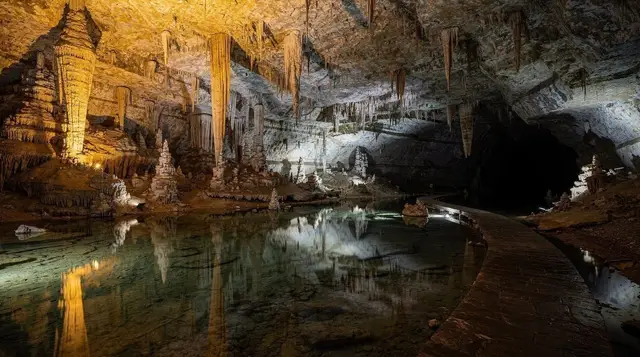
The cave was mapped and opened to tourism in the 1980s, though local knowledge of its entrances goes back much further. What you actually walk through today is a sequence of chambers strung along a concrete and metal walkway, each lit with coloured floodlighting that picks out stalactites, stalagmites, flowstone curtains and a scatter of small underground pools. The lighting is the one point of genuine debate among visitors: some find it atmospheric, others find the coloured washes gimmicky next to the more subdued white lighting used at comparable caves elsewhere in Europe. Go in expecting a show-cave experience rather than a purist’s geology tour and you will not be disappointed.
The walking route and what you actually see
The main circuit runs a little over a kilometre through a series of connected chambers, taking most visitors 40 to 60 minutes at an unhurried pace. It is flat, paved and handrailed for almost its entire length, which makes it one of the more accessible cave visits in the country — pushchairs generally cope, though a section or two involves a shallow ramp rather than stairs. The largest chamber is tall enough that the ceiling formations disappear into shadow above the floodlights, and several sections of flowstone have built up into shapes locals have given names to, which your guide or the accompanying signage will point out along the way.
Photography is allowed and the lighting is bright enough for a phone camera to manage reasonably well, though a tripod or a steadier hand helps with the darker side-chambers. The temperature inside sits at a fairly constant, cool level year-round, noticeably different from a Kutaisi summer afternoon, so a light layer is worth carrying even in July.
The boat ride on the underground river
The walking route ends at a jetty, where — water levels permitting — a short boat ride carries small groups along a stretch of underground river back toward the entrance. This is the part most visitors remember afterwards: a slow, quiet float past low-lit rock walls with none of the walkway underfoot, a genuinely different sensation from the paved circuit that precedes it. The boat section only runs a few hundred metres and lasts a matter of minutes, so treat it as a coda to the walk rather than the main event, but it is the detail that separates Prometheus from a simple cave walk.
Two honest caveats. First, the boat section is sometimes closed after heavy rain, when the underground river rises too high for safe passage — if you are visiting during a wet stretch of spring or after a storm, it is worth checking ahead rather than assuming it will be running. Second, queueing for the boat is where the site’s popularity shows: on a summer weekend with several tour buses arriving in sequence, the wait at the jetty can stretch well beyond the time the walk itself took, which is the main argument for visiting early or on a weekday.
Getting there from Kutaisi
The most straightforward way to reach Prometheus Cave without your own car is a taxi from central Kutaisi, a short enough drive that a return trip with waiting time is a realistic option for anyone not planning to combine it with anything else. Most visitors, though, pair it with Sataplia Nature Reserve, which sits close enough by road to make a natural second stop on the same half-day, or fold it into a longer loop that also takes in Martvili Canyon and Okatse Canyon further west.
Prometheus Cave Martvili Canyon from Kutaisi covers exactly that pairing — transport, entrance and a guide for both sites in a single day, which removes the logistics of arranging a driver and negotiating waiting time yourself. For a shorter half-day focused purely on the two Kutaisi-adjacent caves, Kutaisi: Day Tour to Caves Sataplia Park Monastery covers Prometheus and Sataplia together with a nearby monastery stop, without the longer drive out to Martvili and Okatse.
What it costs and when to go
Entrance is sold at the site itself, with the walking route and the boat ride typically priced separately or as a combined ticket — expect a moderate fee, broadly comparable to a sit-down taverna meal in Kutaisi rather than a token entrance charge. Tour packages that bundle transport, a driver and entrance fees cost more but remove the need to arrange a taxi and negotiate a return time yourself, which matters more here than at sites with easier public transport links.
The cave is open year-round, since the temperature inside barely changes with the seasons, which makes it a genuinely useful option in the depths of a Georgian winter or during a rainy stretch of spring when outdoor plans in Svaneti or Kazbegi are off the table. The trade-off is crowding: July and August afternoons, and any day a large group tour lands at the same time as you, mean a longer wait for the boat. Arriving close to opening time, or visiting on a weekday outside peak season, cuts the wait noticeably.
Is it a tourist trap?
Not in the sense of being overpriced for what it delivers, but it is heavily marketed, and the coloured lighting and gift-shop entrance area do give it a more commercial feel than some of Georgia’s less-developed natural sites. The honest comparison is with Sataplia Nature Reserve nearby, which pairs a smaller cave with dinosaur footprints and a genuinely different draw, and with the natural caves further afield mentioned in The waterfalls worth the drive and Canyons and caves in one day from Kutaisi.
If you only have time for one show cave in Imereti, Prometheus remains the strongest single choice on accessibility and the boat ride alone; if you are trying to avoid the busiest single attraction in the region, Sataplia or Okatse Canyon will feel noticeably calmer on the same day.
Wild Caving Experience in Melouri Cave Near Kutaisi is worth flagging for anyone who has already done the show-cave circuit and wants something with actual scrambling and headlamps involved — a genuinely different, unlit caving trip rather than a paved walkway.
Combining it with the rest of Imereti’s caves and canyons
Prometheus Cave rarely sits alone on an itinerary, and most Kutaisi-based operators sell it as part of a wider loop.
Kutaisi: Martvili and Okatse Canyons Prometheus Cave is the fullest version of that loop, covering all three of the region’s headline natural sites — Prometheus, Martvili and Okatse — in a single long day, which works if you only have one day free but means an early start and a fair amount of time in the vehicle between stops. A more relaxed alternative is to split the sites across two half-days if your schedule allows it, pairing Prometheus with Sataplia on one day and Martvili with Okatse on another, which avoids the fatigue of cramming four separate entrance queues and drives into a single trip. See Canyons and caves in one day from Kutaisi for how the honest version of that single-day loop actually plays out, and The best day trips from Tbilisi, ranked honestly for how Kutaisi’s caves compare against day trips based out of the capital instead.
Travellers coming from Batumi rather than Tbilisi or Kutaisi have their own version of this same loop, running the same three sites from the coast — a longer day by distance but a genuine option if Batumi is your base for the Black Sea leg of a trip.
Family suitability and accessibility
Of every natural attraction covered in this guide series, Prometheus Cave is the easiest for families with young children and for visitors with limited mobility. The paved walkway, handrails and absence of scrambling put it well ahead of Okatse Canyon’s hanging walkway or Birtvisi on accessibility, and the boat ride adds a genuine highlight that keeps younger children engaged through what could otherwise be a fairly repetitive sequence of stalactite chambers. That said, a pushchair will need help over one or two short ramped sections, and strollers are generally left at the jetty rather than taken onto the boat, so plan for someone to carry a small child through that final stretch.
How it compares with Georgia’s cave cities
It is worth being clear that Prometheus is a natural show cave, not a rock-cut settlement — a different category entirely from Vardzia or Uplistsikhe, the rock town near Gori, which are man-made cave complexes carved into cliffs by people rather than shaped by water over millennia. Visitors sometimes arrive expecting the same kind of historical, walk-through-a-medieval-city experience and are surprised to find geology instead of archaeology. Georgia’s cave cities compared sets out that distinction properly if you are trying to decide which type of “cave” experience actually suits your trip.
A short history of the site
Locals in the Kumistavi area knew of cave entrances in the hillside long before any formal survey, but it was only in 1984 that Georgian speleologists mapped the full system and began preparing it for public access, opening the walkway and lighting over the following years. The name Prometheus refers to the Greek myth in which Prometheus was chained to a Caucasus peak for stealing fire — a piece of branding rather than a claim about the cave’s actual age, though the formations themselves have built up over hundreds of thousands of years of mineral-rich water dripping through limestone.
Compared with some of Europe’s oldest documented show caves, Prometheus is a relatively recent addition to the tourist map, which shows in its more modern infrastructure — poured concrete paths, metal handrails and electric floodlighting throughout, rather than the older wooden walkways found at some longer- established sites.
What to bring and what to wear
The temperature inside stays cool and slightly damp year-round, several degrees below whatever Kutaisi is doing outside, so a light jumper or jacket is worth carrying even on a hot July day — without one, the walk can feel uncomfortably chilly by the final chamber. Footwear matters less than at Georgia’s outdoor canyons since the entire route is paved, but the boat jetty and its immediate surroundings can be genuinely wet underfoot, so trainers rather than sandals are the sensible choice.
Camera batteries drain faster in the cool, damp air than most visitors expect, and there is no charging point inside, so start with a full charge if photography is the priority. The site has a small shop and café near the entrance for anyone who wants a coffee before or after the walk, though it is not a destination for eating in its own right — save that for Kutaisi itself.
Getting there without your own car
Kutaisi does not have a direct marshrutka service running specifically to the cave, which is the practical reason most independent travellers either negotiate a return taxi fare from central Kutaisi or book a seat on a shared group tour rather than attempting public transport. A taxi arranged through a hotel or a ride-hailing app is the simplest option for a standalone visit, particularly if you agree a waiting fee upfront so the driver holds the car rather than leaving you to find a return ride from a fairly quiet stretch of road.
If Prometheus is one stop among several — Sataplia, Martvili, Okatse, or a look at Kutaisi’s own Bagrati Cathedral and Gelati Monastery — a private driver hired for the full day works out more efficient than arranging separate taxis between each stop, and is effectively what the bundled tours above already provide.
How it compares with show caves elsewhere
Visitors who have been to well-known show caves in other parts of Europe sometimes find Prometheus’s coloured lighting more theatrical than they expected, closer to a designed visitor experience than a quiet geological site. That is a fair observation rather than a criticism: the cave was developed specifically as a tourist attraction with the boat ride as its headline feature, and it delivers that brief efficiently rather than aiming for scientific minimalism. Anyone who prefers a starker, less-lit presentation of natural cave formations may find Sataplia’s smaller cave section, included alongside the dinosaur footprints, a closer match to that preference, even though it lacks the boat ride that makes Prometheus distinctive.
Frequently asked questions about Prometheus Cave
How long does a visit to Prometheus Cave take?
Budget 90 minutes to two hours for the walking route and boat ride together, plus transport time from Kutaisi and any queueing at busy periods. As a standalone visit it fits comfortably into a half-day.
Is the boat ride always included?
The boat section runs water levels permitting, and is occasionally suspended after heavy rain when the underground river rises. It is normally included in the entrance ticket when it is operating, but worth confirming on the day if you are visiting during a wet spell.
Can you visit Prometheus Cave without a tour?
Yes — a taxi from Kutaisi is straightforward, and the site sells entrance tickets on arrival. A tour mainly saves you arranging transport and, if you want to combine it with Sataplia, Martvili or Okatse in one day, coordinating multiple stops yourself.
Is Prometheus Cave suitable for young children?
Generally yes. The route is flat, paved and handrailed, and the boat ride is a genuine highlight for children old enough to sit still for a short river crossing. A pushchair will need help over one or two short ramps.
How does Prometheus Cave compare with Sataplia?
Prometheus is larger, more developed and centred on the boat ride; Sataplia Nature Reserve is smaller, includes genuine dinosaur footprints under a glass viewing platform, and involves more time outdoors in the surrounding forest. Many visitors do both on the same half-day since they sit close together.
Is Prometheus Cave open in winter?
Yes, year-round, since the cave’s internal temperature barely shifts with the seasons outside. It is a reliable option when mountain passes or coastal plans elsewhere in Georgia are weather-dependent.
How much does it cost to visit Prometheus Cave?
Entrance is charged on-site, with the walking route and boat ride priced either separately or as a combined ticket, at a moderate level roughly comparable to a restaurant meal in Kutaisi. Tour packages that include transport cost more but remove the need to arrange a driver yourself.
Is Prometheus Cave the same as Prometheus Nature Monument?
Yes — you may see the site referred to both ways; it is officially a nature monument built around the Kumistavi cave system, commonly shortened to Prometheus Cave in English-language material.
Cave and canyon tours on GetYourGuide
Verified deep-linked GetYourGuide tours. Book through these links and we earn a small commission at no cost to you.
Photo: our own image of the location, not the operator’s product photo.