Is Georgia safe? An honest answer
Is Georgia safe to visit?
Yes, for the overwhelming majority of travellers. Violent crime against tourists is rare, and Tbilisi's Old Town, Kazbegi, Kakheti and Batumi all see heavy tourist traffic without incident. The two real risks are traffic (Georgian driving is aggressive) and the occupied territories of Abkhazia and South Ossetia, both of which sit outside safe, government-controlled Georgia and should not be entered.
The short version, before the detail
Georgia is, by most measures that matter to a visitor, a safe country to travel in. Violent crime against tourists is rare, the police response in Tbilisi’s main visitor areas is visible and quick, and the things that actually cause problems for travellers are mundane: traffic, altitude weather, and the two occupied territories that sit outside the area any visitor should be travelling in at all. This guide works through each of those in turn, honestly, rather than either dismissing safety questions as overblown or exaggerating risks that do not match what actually happens to the millions of tourists who visit Georgia every year without incident.
Everyday crime: low, but not zero
Petty theft — pickpocketing in crowded markets, bag-snatching at outdoor cafés, opportunistic theft from unattended belongings on a beach in Batumi or Kobuleti — happens in Georgia at roughly the level you would expect in any country that receives large numbers of tourists, which is to say occasionally, and mostly preventable with ordinary caution. Violent crime against visitors is genuinely uncommon; Georgia has consistently ranked among the safer countries in the wider region on most international crime indices, a legacy in part of a deliberate, aggressive police reform carried out in the 2000s that dramatically reduced everyday corruption and street crime.
Dezerter Bazaar and other crowded markets are the kind of place where a bag left open on your shoulder is worth zipping shut, the same as any busy market anywhere in the world. Nightlife areas around the Old Town and Fabrika get lively late at night, and the standard advice — watch your drink, know how you are getting home, keep valuables split between bag and pocket — applies without Georgia being a particular outlier in any direction.
Tbilisi: Old Town Sololaki 4 Hours Private Walking Tour is a reasonable way to get comfortable with the Old Town’s layout on a first day with a guide, before exploring independently later in the trip, which some first-time visitors find reassuring regardless of the actual risk level.
Traffic is the real everyday risk
If there is one safety topic that deserves more attention than it typically gets, it is Georgian roads. Overtaking on blind bends, following distances that would be considered reckless in Western Europe, and inconsistent use of indicators are common, and the accident rate on Georgian roads is higher than in most of the EU. This matters more for visitors who plan to self-drive than for anyone using taxis, marshrutkas or private drivers, since it changes who is making the split-second decisions.
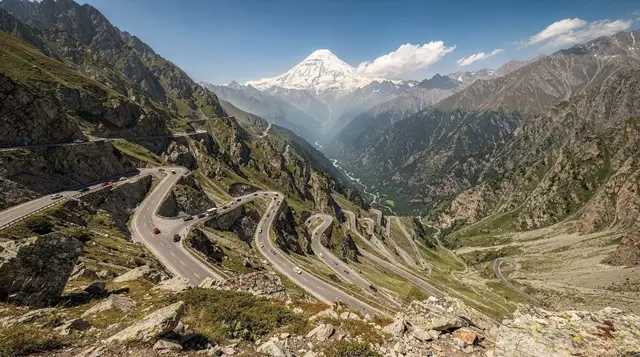
The Georgian Military Highway, the main route north toward Kazbegi, is a particular case: a spectacular drive through mountain passes, popular with tour buses and private cars alike, but with sections of poor surface, occasional rockfall, and heavy truck traffic queuing for the Russian border at Verkhny Lars. Driving in Georgia: rules, roads and habits covers what actually differs from driving at home, and is worth reading in full before you decide whether to self-drive or hire a driver, since the calculation is different for a confident driver used to mountain roads than for someone whose usual driving is on flat, well-marked motorways.
Private Transfer from Tbilisi International Airport and similar private transfers remove the self-driving question entirely for anyone who would rather not navigate Tbilisi traffic straight off a long flight, and are worth considering for at least the first journey into the city even if you plan to rent a car later in the trip.
Abkhazia and South Ossetia: not part of the trip
This is the one safety topic on which there is no ambiguity. Abkhazia, in the northwest, and South Ossetia, in the north-central part of the country, are both occupied territories currently outside the control of the Georgian government, following conflicts in the early 1990s and again in 2008. Neither is accessible from Georgian-controlled territory, and there is no legal crossing point into either from the Georgian side of the administrative boundary line. Entering either region via Russia is illegal under Georgian law, and travellers who have done so have faced being formally barred from re-entering Georgia.
Nothing about a normal Georgia itinerary — Tbilisi, Kazbegi, Kakheti, Svaneti, Batumi, Borjomi, Vardzia — brings you anywhere near either boundary line in a way that requires any special planning or caution beyond simply knowing they exist and are not part of the trip. Occasional day-trip itineraries advertised online that claim to visit “Abkhazia” from the Russian or Abkhaz side are not compatible with keeping a valid Georgian visa status, and should be disregarded entirely regardless of how they are marketed.
Mountains, weather and signal
Georgia’s high-altitude regions — Svaneti, Tusheti, Kazbegi, the Truso valley — are some of the most rewarding parts of the country and also the ones where preparation genuinely matters. Weather at altitude changes fast, cloud can roll in within an hour and cut visibility to almost nothing, and mobile signal disappears entirely in a lot of the valleys, particularly in Tusheti and around the Chaukhi massif. Guides, gear and mountain rescue in Georgia covers what a realistic kit list looks like and how mountain rescue actually works if something goes wrong, since it is not automatically free and not instantaneous given the terrain.
None of this makes the mountains unsafe for a well-prepared hiker on a well-marked route like Gergeti Trinity or the Mestia to Ushguli trek in season. It does mean that unguided attempts at higher, less-trodden routes without checking the weather window, telling someone your plan, and carrying appropriate layers are where the genuine incidents happen, almost always avoidable with basic preparation rather than bad luck.
Cols and passes that simply close
A specific and easily overlooked safety point: several of Georgia’s mountain roads are seasonally closed rather than merely difficult. The Abano Pass into Tusheti and the Goderdzi Pass toward Adjara are both closed by snow from roughly October to June, and attempting either outside that window, even in a capable 4x4, is a genuine and unnecessary risk rather than an adventurous shortcut. Gudauri, by contrast, is built around exactly this closed season, operating as a ski resort from December to April. Checking current pass status before setting off, rather than trusting an old blog post, is the simplest safety habit for anyone planning a mountain route outside peak summer.
Health, water and altitude
Tap water in Tbilisi and most of Georgia is generally safe to drink, sourced from mountain springs rather than treated river water in many areas, though bottled water remains the more cautious choice in rural guesthouses on private wells. Pharmacies are common in Tbilisi and reasonably well stocked; outside the capital, particularly in mountain villages, options thin out fast, which matters for anyone on regular medication who should carry enough for the whole trip rather than assuming they can restock.
Altitude sickness is a real, if usually mild, consideration for anyone heading up toward Kazbegi, Gergeti Trinity Church at around 2,170 metres, or further onto Mount Kazbek itself at 5,054 metres. Most visitors feel nothing beyond mild breathlessness at Gergeti’s altitude, but anyone attempting Kazbek itself is undertaking a genuine mountaineering objective, not a hike, and should treat it as such — see climbing Mount Kazbek: what it takes for the realistic picture.
Political protest and public gatherings
Tbilisi periodically sees political demonstrations, most commonly along Rustaveli Avenue and around Freedom Square, reflecting an active and vocal civil society. These are worth avoiding as a bystander even when they appear calm, not because Georgia is unusually volatile but because any large gathering can shift quickly and a foreign tourist caught in the middle of one gains nothing from being there. Checking local news or asking your accommodation before heading toward the city centre on a day when something is planned is a sensible five-minute habit rather than genuine cause for concern about the trip as a whole.
Scams and overcharging, not danger
Most of what catches first-time visitors out in Georgia falls under mild financial annoyance rather than actual danger: an unmetered taxi quoting a wildly inflated fare outside the airport, a menu without prices in a tourist-street restaurant, or a currency exchange kiosk offering a poor rate. None of these put anyone at physical risk, and all of them are avoidable with basic awareness — the specific patterns to watch for are covered in full in scams, overcharging and minor annoyances.
From Tbilisi: Tbilisi City Tour and other guided options sidestep most of this category entirely for a first day or two, since transport, entry fees and meals are already arranged rather than negotiated on the spot.
Georgia compared with its neighbours and with Western Europe
Set against its immediate neighbours, Georgia is generally regarded as the more straightforwardly safe option for casual tourism, with a more developed tourism infrastructure and a longer track record of independent travellers moving freely around the country without incident. Set against Western Europe, Georgia’s violent crime rate is comparable or lower in most categories, while its road safety record is worse — a genuinely different risk profile rather than simply “less safe” or “more safe” in a single direction.
Tbilisi: Hopon Hopoff Discovery Bus Tour offers a low-effort way to see Tbilisi’s main sights spread across the city without navigating traffic or unfamiliar bus routes yourself, useful on a first day while you are still getting a feel for how the city works.
LGBTQ+ travellers: the honest picture
Georgia’s legal position and its social reality are two different things, and both matter to know before you travel. Homosexuality is not criminalised, and the country has no law against same-sex relationships, but Georgian society remains socially conservative on the subject in many places, and the Georgian Orthodox Church holds significant public influence, which shapes attitudes more than the law itself does. Public displays of affection between same-sex couples can draw hostile attention in a way that heterosexual couples would not experience, particularly outside Tbilisi’s more liberal pockets, and organised anti-LGBTQ+ demonstrations have occurred around Pride-related events in past years.
Tbilisi has a small, low-profile LGBTQ+ scene, including venues such as Bassiani, which has built an international reputation partly through its association with queer club culture, without this translating into broad social acceptance across the country. This is not a reason to avoid Georgia, but it is a reason to travel with the same situational awareness that applies in a number of countries around the region — the fuller picture, drawn from readers who have actually made the trip, is in LGBTQ+ travellers in Georgia: the honest picture.
Natural hazards worth knowing about
Georgia sits in a seismically active zone, and small earthquakes are recorded periodically, though damaging ones are infrequent and building codes in Tbilisi have improved substantially since Soviet times. It is not something that should shape your itinerary, but it is worth knowing the basic advice — move away from windows and heavy furniture, do not use lifts — in the unlikely event you feel one. Flash flooding after heavy summer storms occasionally affects mountain roads and river crossings, most relevant in Svaneti, Tusheti and the Borjomi-Kharagauli area, where a normally placid stream can rise fast after rain higher up the valley; local guesthouse owners are generally a better source of same-day advice than any app.
Borders, checkpoints and land crossings
Georgia shares land borders with Armenia, Azerbaijan and Turkey that are straightforward and heavily used by tourists and traders alike, with none of the complications attached to the occupied territories described above. Land borders with Armenia, Turkey and Azerbaijan covers what crossing each actually involves, useful for anyone extending a Georgia trip into a wider Caucasus itinerary rather than flying home directly.
Money and card safety
Card skimming and card-not-present fraud exist in Georgia as they do everywhere, but are not noticeably more common than in most of Europe, and Tbilisi’s banking infrastructure is modern. Withdrawing from ATMs attached to a recognised bank branch rather than a standalone kiosk, and covering the keypad when entering a PIN, are the same sensible habits worth applying anywhere — see lari, ATMs and paying by card for the practical side of managing money day to day.
Who should think a little harder before this trip
Solo hikers heading into remote mountain areas without local knowledge, self-driving visitors uncomfortable with aggressive overtaking and mountain roads, and anyone assuming they can improvise a route toward Abkhazia or South Ossetia out of curiosity are the three groups genuinely worth extra caution.
Everyone else — the family doing Tbilisi, Mtskheta and Kazbegi; the couple on a Kakheti wine week; the backpacker moving between guesthouses on marshrutkas — fits comfortably within Georgia’s ordinary, low-incident tourism experience. Travel insurance and health and Solo travel Georgia both go further into the specific preparation worth doing depending on how you are travelling.
Practical habits that cover most of the risk
A short list of ordinary precautions accounts for most of the difference between an uneventful trip and a bad story to tell afterwards. Keep a photo of your passport and visa stamp somewhere separate from the document itself. Agree a fare or confirm the meter is running before an unmetered taxi pulls away, particularly from the airport or near major landmarks — taxis, Bolt and Yandex Go explains which apps avoid this problem entirely.
Keep a local eSIM or a downloaded offline map active before heading into mountain valleys where signal drops, since asking a stranger for directions is harder without at least basic connectivity nearby. Georgia’s single emergency number, 112, connects to police, ambulance and fire services and is staffed with English-speaking operators in Tbilisi, though response times outside the capital and major towns are understandably slower given the terrain.
What past visitors actually report
Traveller forums and reviews for Georgia skew heavily toward safety being a pleasant surprise rather than a source of anxiety — a common comment from first-time visitors, particularly those arriving with lower expectations shaped by the country’s Soviet-era reputation or its proximity to conflict zones on a map, is that Tbilisi feels calmer and more walkable at night than they expected.
The complaints that do surface consistently are about taxi overcharging, aggressive driving as a passenger rather than a target of crime, and the odd unlicensed tour operator cutting corners on a mountain excursion — none of which amount to Georgia being a dangerous place to visit, but all of which are worth planning around using the guides linked throughout this page.
The honest bottom line
Georgia earns its reputation as one of the more welcoming, low-hassle countries in the wider region to travel through, and the statistics back that up for violent crime and general visitor safety. The genuine risks are traffic, unprepared mountain excursions, and the small number of border areas that simply are not part of any legitimate Georgian itinerary. Respect those three, use ordinary caution around bags and unmetered taxis, and Georgia is a country that consistently surprises first-time visitors with how relaxed it feels rather than how careful they had to be.
Frequently asked questions about Is Georgia safe? An honest answer
Is Tbilisi safe to walk around at night?
Yes, in the main tourist areas — the Old Town, Vera, Vake and Saburtalo are all well used at night and see a heavy police presence around the main squares. As in any city, poorly lit backstreets and empty areas late at night are worth avoiding, and the usual precautions around bags and valuables in busy nightlife areas apply.
Can I visit Abkhazia or South Ossetia from Georgia?
No. Both regions are occupied territories not under the control of the Georgian government, and there is no legal crossing into either from Georgian-controlled territory. Entering either region via Russia is also illegal under Georgian law and can result in being barred from re-entering Georgia.
Is it safe to drive in Georgia?
Driving is the single biggest safety consideration for most visitors, more than crime. Overtaking on blind corners, tailgating and inconsistent lane discipline are common, particularly on the Georgian Military Highway and mountain roads. Many visitors choose a private driver or shared transport over self-driving for exactly this reason.
Are Georgia’s mountains dangerous for hikers?
Not inherently, but weather changes fast at altitude and mobile signal disappears in many valleys, so unguided hikes above the treeline need real preparation. Routes like Chaukhi Pass, the Mestia to Ushguli trek and anything near Kazbegi are well trodden but not risk-free without the right gear and a realistic sense of the weather window.
Do I need to worry about scams in Georgia?
Minor overcharging — unmetered taxis, inflated restaurant bills in heavily touristed streets — happens, but outright scams targeting tourists are uncommon compared with many other popular destinations. See Scams, overcharging and minor annoyances for the specific situations to watch for.
Is Georgia safe for women travelling alone?
Most solo female travellers report feeling safe in Georgia’s main tourist areas, though the country’s social culture is more conservative than Western Europe in places, and unwanted attention can happen, particularly late at night. See Solo female travel in Georgia for a fuller picture from readers who have done it.
Is there a risk of terrorism or political unrest in Georgia?
Georgia is not considered a high-risk country for terrorism. Political protests do occur periodically in central Tbilisi, usually around Rustaveli Avenue and Freedom Square, and are worth avoiding as a bystander even when peaceful, simply because crowd situations can shift quickly.
Trip-planning essentials on GetYourGuide
Verified deep-linked GetYourGuide tours. Book through these links and we earn a small commission at no cost to you.
Photo: our own image of the location, not the operator’s product photo.