Climbing Mount Kazbek: what it actually takes
Can you climb Mount Kazbek without mountaineering experience?
Not safely on your own. Kazbek's summit at 5,054m is reached by glacier travel with crevasse risk, and while it is one of the more accessible 5,000m peaks technically, it is still alpinism, not hiking. Going with a certified mountain guide who provides rope, crampons and route judgement is standard practice, including for people with limited prior climbing experience.
A mountain, not a hike
Everything else in this guide’s category is a walk — long in some cases, at altitude in others, occasionally over rough or unmarked ground, but fundamentally a walk that ends when your legs decide it should. Mount Kazbek is different. At 5,054m, its summit sits above the glacier line, and the standard route crosses genuine crevassed terrain that requires a rope, crampons and an ice axe, and the judgement to know when a slope is safe to cross and when it is not.
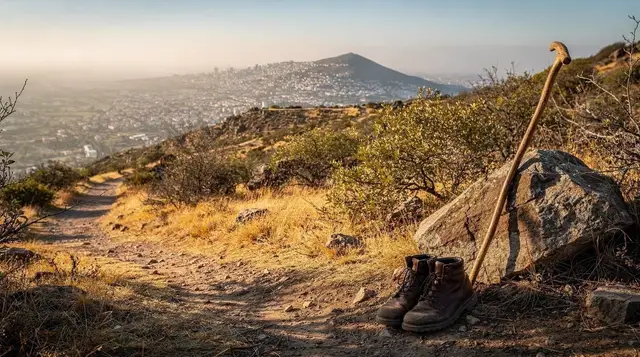
This is alpinism, and treating it as a bigger version of the hike to Gergeti Trinity Church that sits in Kazbek’s foothills is the single most common mistake first-time visitors make when they see the mountain from Stepantsminda and assume the summit is a longer version of the same walk. It is not.
That said, Kazbek has a reputation among mountaineers as one of the more approachable 5,000m peaks technically — no sustained steep ice or rock climbing on the standard route, mostly a long, glaciated snow slope. That relative accessibility is exactly why so many people without a mountaineering background attempt it each year, usually with a guide, and why it is worth being precise about what “approachable” does and does not mean here.
A mountain with its own mythology
Kazbek looms over Stepantsminda and the Georgian Military Highway so completely that it has never just been scenery — in Georgian legend it is tied to the myth of Amirani, a Prometheus-like figure chained to the mountain for defying the gods, a story that predates and parallels the Greek Prometheus myth by enough that the two are often discussed together.
Caves on the mountain’s slopes have long been associated with hermits and religious retreat, and the presence of Gergeti Trinity Church, perched on its own ridge with the glaciated peak rising directly behind it, is no accident of geography — the church has sat in Kazbek’s shadow, literally and symbolically, for centuries. None of this changes the technical realities of climbing the mountain, but it is worth knowing why Kazbek carries a weight in Georgian culture that goes beyond its height on a map.
The standard route, stage by stage
Climbers start from Stepantsminda (Kazbegi town), at around 1,740m, and the first stage is a steep hike up to the Meteo Station, a former Soviet-era weather station at roughly 3,675m that now serves as the main hut on the mountain. This climb alone gains close to 2,000m and takes most of a day, following broadly the same lower valley as the walk to Gergeti Trinity Church before branching off onto steeper ground. Most itineraries build in a rest or acclimatisation day at or near the hut before attempting the summit, since altitude sickness is a real risk moving this fast from Tbilisi’s roughly 490m.
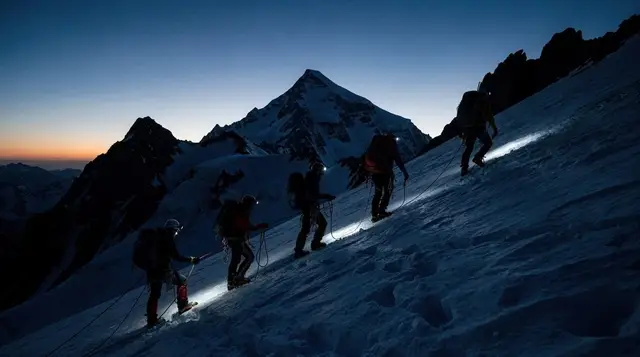
The summit day itself starts in the dark, typically two or three in the morning, to reach the top and begin the descent before the snow softens in the afternoon sun, which increases crevasse and rockfall risk. From the hut it is a long push — commonly ten to fourteen hours round trip — across glaciated terrain with rope teams, up a final steep snow slope to the summit ridge. Weather can shut this down entirely: high wind, low visibility or fresh snow are all reasons a guide will call off a summit attempt, and turning back partway up is a normal, sensible outcome rather than a failure of the trip.
From Stepantsminda Mount Kazbek Guided Climb with Meals covers a guided climb built around this structure — hut stay, acclimatisation, guided summit push — with meals included, which matters given how little is available to buy once you are above Stepantsminda.
What you actually need
A certified mountain guide is the baseline for almost everyone attempting Kazbek, including climbers with real experience elsewhere who may not know the current state of this particular glacier — routes shift year to year as crevasses open and close. Equipment includes crampons, an ice axe, a climbing harness and helmet, layered clothing for temperatures well below freezing at altitude even in July, and physical fitness built up well before arriving in Georgia rather than tested for the first time on the mountain. Most guiding operations rent or provide the technical kit; clothing and boots are usually the climber’s own responsibility.
From Tbilisi: Kazbegi Mountain Tour with Professional Guide is a lower-commitment way to work with a professional guide in the same area without the full summit attempt, useful for building confidence on Kazbek’s lower slopes or simply seeing the mountain up close before deciding whether the full climb is realistic on this trip.
Altitude and acclimatisation
The jump from Tbilisi’s roughly 490m to the Meteo Station’s 3,675m in a single day, followed by a summit push to over 5,000m, is fast by mountaineering standards, and altitude sickness is a real risk that has nothing to do with general fitness — strong, experienced hikers can still be hit hard by it, while others acclimatise with little trouble. Headache, nausea, disturbed sleep and unusual breathlessness at rest are the standard warning signs, and the correct response is always to stop ascending and, if symptoms do not improve, to descend rather than push on.
A guide experienced on Kazbek will factor acclimatisation into the itinerary and take symptoms seriously rather than treating a summit date as fixed regardless of how the group is coping, which is one more reason a good guide is worth more than just route knowledge on this particular mountain. Arriving in Georgia a few days before the climb, rather than flying in and heading straight up, gives a small but genuine buffer for the body to start adjusting.
What to actually pack
Beyond the technical kit a guiding operation typically provides — crampons, ice axe, harness, rope — climbers need their own mountaineering boots rated for glacier travel, several layers capable of handling temperatures well below freezing at the summit even in July, a warm hat and gloves, sunglasses or glacier goggles for the intense reflected light off snow, and high-factor sun protection, since UV exposure at altitude on snow is far stronger than it feels.
A headlamp is essential given the pre-dawn start on summit day. None of this needs to be expensive specialist equipment bought solely for this trip, but it does need to be tested and broken in beforehand — a Kazbek summit attempt is the wrong place to discover that a jacket is not warm enough or boots do not fit with thick socks.
Season and weather
July through September is the main climbing season, when the glacier is most stable and weather patterns most settled, though “settled” on a 5,000m Caucasus peak still means storms can build with little warning. May and June carry more snow cover and a higher avalanche risk on some slopes; by October, deteriorating weather and shortening daylight effectively close the season.
None of this means a July attempt is guaranteed good conditions — a multi-day weather window with no summit chance at all is a real possibility even in peak season, which is why flexible dates matter more here than for almost anything else in this guide’s category. See When the Georgian hiking season actually opens for how Kazbek’s season compares with Georgia’s other mountain regions.
Training before you arrive
Physical preparation matters more for Kazbek than technical climbing practice for most travellers, since the standard route does not demand advanced rope skills so much as sustained cardiovascular fitness, leg strength for a long summit day, and the ability to keep moving efficiently for ten-plus hours at altitude. Regular hill walking with a loaded pack in the months before the trip, ideally including some multi-day back-to-back efforts to simulate the hut-to-summit-to-descent structure, does more to prepare most climbers than short bursts of gym training.
Anyone with no prior high-altitude experience at all is well served by a shorter acclimatisation trek elsewhere in Georgia first — a few days on Trekking in Tusheti or in Svaneti above 2,500m gives a useful sense of how your own body responds to altitude before committing to a summit attempt at over 5,000m.
What a guided climb costs and involves
Guided Kazbek climbs are typically sold as multi-day packages covering the guide, technical equipment hire, hut fees and meals from Stepantsminda onward, with group sizes kept small given the terrain and the need for close supervision on the glacier.
Costs vary with group size, season and how much personal gear needs to be rented rather than brought from home, but the summit push itself — the guide’s knowledge of the current glacier conditions, crevasse locations and turnaround decision-making — is the part worth paying for, more than the equipment rental, which can often be arranged separately if preferred. Multi-day weather buffers built into a package are worth having: a guide who allows one or two spare days for a weather window is offering something genuinely valuable that a rigid, fixed-date itinerary cannot.
How Kazbek compares to other accessible high peaks
Kazbek is often mentioned in the same breath as Kilimanjaro (5,895m) and Mont Blanc (4,809m) as one of the more approachable high peaks for climbers without extensive Himalayan-level experience, though the comparison only goes so far. Kilimanjaro is a trek rather than a technical climb, with no glacier crossing required on its standard routes; Mont Blanc involves more sustained technical terrain and significantly more crowded huts in peak season.
Kazbek sits in between: genuinely glaciated and requiring rope work and crevasse awareness, but without the sustained steep ice or rock sections that make some other 5,000m peaks considerably harder. That relative accessibility is real, but it should not be mistaken for easy — every year sees climbers turn back, and a small number of serious accidents, almost always tied to weather, fatigue or inadequate acclimatisation rather than the technical difficulty of the route itself.
If you are not ready for the summit
Plenty of visitors to Kazbegi have no intention of standing on the summit and still want to feel the scale of the mountain. The hike to Gergeti Trinity Church, with the church framed against Kazbek’s glaciers behind it, is the classic lower-altitude version, reachable in a half-day round trip without any technical gear. Kazbegi: Region Day Hikes covers a set of easier trails around Kazbegi for anyone who wants a mountain day without the alpine commitment, and Gveleti: Waterfall Guided Hike is a shorter, gentler option nearby for a half-day outing.
Kazbegi as a day trip: is it too much? is worth reading before deciding how much time to allow — a genuine climbing attempt needs several days based in or near Stepantsminda, not a single long day from Tbilisi, so anyone planning to climb should build the trip around Kazbegi rather than treating it as a day out from the capital.
What the Meteo Station hut is actually like
The Meteo Station’s Soviet-era origins are visible in its architecture — a squat, functional concrete building rather than an alpine chalet — and conditions inside are basic: shared bunks, no showers, and heating that depends on the season and how busy the hut is. What it does provide is a genuinely sheltered base at nearly 3,700m with reliable walls against the wind, which matters considerably more than comfort once you understand what the alternative (a tent at the same altitude) would mean for sleep quality before a summit push.
Most climbers spend at least one night here before the attempt and often a second on the way back down, and it functions as a natural meeting point for guides, porters and climbers heading up from different operators, giving a reasonable read on current mountain conditions from people who were higher up only hours earlier.
Weighing the decision honestly
Not every visitor to Kazbegi who feels drawn to Kazbek’s glaciers should attempt the summit, and a good guide will say so plainly if fitness, acclimatisation or weather do not line up. The honest questions worth asking before committing are whether you have genuinely tested your own response to altitude above 3,000m, whether your fitness supports a ten-to-fourteen-hour summit day on top of several preceding days of exertion, and whether you are travelling with enough flexibility in your schedule to wait out a poor weather window rather than being forced into a single fixed summit date.
None of these questions have a wrong answer — plenty of people reasonably decide the mountain is not right for this particular trip — but going in with a clear-eyed view of what is being asked of you, physically and logistically, makes for a far better experience than discovering the scale of it partway up the Meteo Station trail.
Getting to Stepantsminda
Stepantsminda sits roughly three hours from Tbilisi along the Georgian Military Highway, the main road north toward Russia, which is also the access route for climbing logistics and supply. The road can close temporarily for avalanche control or landslides, particularly earlier and later in the season, so building a spare day into travel plans either side of a climb is sensible.
See Mountain roads and passes for how this compares with Georgia’s other seasonal mountain routes, and Health, pharmacies and insurance for what travel insurance needs to cover — altitude and mountaineering activities are commonly excluded from standard policies and need a specific add-on.
Kazbek versus Georgia’s other big mountain trips
For travellers deciding between a serious mountain objective and a demanding but non-technical trek, Kazbegi or Svaneti? covers the broader comparison, though it is worth being clear that climbing Kazbek and trekking in Svaneti are different categories of activity altogether — one needs mountaineering equipment and a rope, the other needs fitness and good boots. Anyone drawn to Kazbek for the challenge but unsure about committing to a full glaciated climb might also consider Trekking in Tusheti or the Mestia to Ushguli trek as demanding, multi-day alternatives that stay below the glacier line throughout.
Standing on the summit, and what comes after
Climbers who do reach the top describe a narrow, exposed summit ridge with views across the Caucasus in every direction on a clear day — the Georgian Military Highway a thin ribbon far below, Russia visible to the north — though most spend only a short time there before beginning the long descent, since altitude, fatigue and the softening snow all argue against lingering.
The descent itself is often harder on concentration than the climb up, simply because tiredness sets in exactly when careful footwork over crevassed ground still matters. Reaching the Meteo Station again, and eventually Stepantsminda, tends to bring a mix of exhaustion and genuine satisfaction that most climbers describe as disproportionate to the mountain’s technical difficulty — a reminder that altitude and effort, not technical grade alone, are what make Kazbek feel like a real achievement.
Frequently asked questions about climbing Mount Kazbek
The questions below cover difficulty, timing and what separates Kazbek from Georgia’s other mountain routes.
How hard is it to climb Kazbek?
Technically moderate for a 5,000m peak — mostly a snow and glacier walk with a rope rather than sustained rock or ice climbing — but altitude, weather and glacier crevasses make it a serious undertaking, not an extension of the region’s day hikes. Physical fitness and prior time at altitude both matter more than technical climbing skill.
How long does climbing Kazbek take?
Most guided trips budget three to four days from Stepantsminda: a day to reach the Meteo Station hut, a rest or acclimatisation day, a long summit day starting well before dawn, and a descent day. Weather delays can add a day or two to that plan.
Do you need a guide to climb Kazbek?
It is not legally mandatory, but climbing without a certified guide is not something to attempt without genuine glacier travel and crevasse rescue experience of your own. Most climbers, including many with mountaineering backgrounds elsewhere, hire a local guide who knows the current state of the glacier and the route.
What is the Meteo Station on Kazbek?
A former Soviet weather station at around 3,675m that now functions as the main mountain hut on the standard route, with bunks, basic facilities and a base for the summit push. Almost every climbing itinerary spends at least one night there before and often after the summit attempt.
When is the best time to climb Kazbek?
July to September is the main season, when the glacier is most stable and weather windows are most reliable, though never guaranteed. May and June see more snow and a higher avalanche risk on some sections; the season effectively closes by October as conditions deteriorate.
What is the success rate for climbing Kazbek?
It varies year to year and trip to trip depending mostly on weather rather than climber fitness — a clear, calm summit day is not guaranteed even in peak season, and turning back is a routine, sensible outcome rather than a failure.
Is Kazbek higher than Kilimanjaro?
No — Kilimanjaro is 5,895m, Kazbek is 5,054m. Kazbek is technically harder because of the glacier and crevasse terrain, even though it is the lower of the two peaks.
Mountain hikes on GetYourGuide
Verified deep-linked GetYourGuide tours. Book through these links and we earn a small commission at no cost to you.
Photo: our own image of the location, not the operator’s product photo.