Thermal springs across Georgia
Where can you find thermal springs in Georgia besides Tbilisi?
Tskaltubo, near Kutaisi, has radon-carbonate springs alongside dozens of abandoned Soviet sanatoriums. Borjomi is better known for its bottled mineral water than for bathing, though it does have an outdoor mineral pool. Sairme and Vani, both in the west, have smaller, quieter thermal and sulphur springs that see far fewer visitors than Tbilisi or Tskaltubo.
More than one kind of hot water
Georgia’s geology puts mineral springs under a surprising number of its towns, and the water isn’t uniform from place to place — sulphur in Tbilisi, radon-carbonate in Tskaltubo, an alkaline carbonated mineral water at Borjomi, and smaller sulphur and thermal springs scattered through western towns like Sairme and Vani that see a fraction of the visitors the bigger names do.
Treating “Georgian hot springs” as one experience misses most of what’s actually on offer, and worse, sends people to the wrong town for what they’re actually after. This guide works through each of the main spring towns honestly, so you can pick based on what you actually want — a quick soak, a strange Soviet-ruin backdrop, a bottle of water at the source, or a quiet corner with almost nobody else around.
Why Georgia has so much mineral water
Georgia sits on geologically active ground where the Caucasus mountains meet older volcanic terrain, and that combination pushes a wide range of mineral-rich water to the surface across the country, from the hot sulphur springs under Tbilisi to the cooler, still-carbonated water bottled at Borjomi.
This isn’t a coincidence of a few isolated spots; it’s a broad geological feature that happens to surface in enough different towns that bathing and drinking mineral water became genuinely woven into Georgian daily life rather than staying a niche tourist activity. That long history is part of why the experience differs so much by town — each developed its own local bathing or drinking culture around its specific water, rather than a single national “spa industry” imposing the same format everywhere.
Quick comparison: distance, cost and crowd
For a fast overview before you read the detail on each: Tbilisi needs no extra travel since it’s in the capital, costs roughly ₾60-150 an hour for a private room, and is the busiest and most visitor-oriented option. Tskaltubo, about 3.5 hours from Tbilisi, costs noticeably less for the bath itself and draws a smaller, more mixed crowd of history-focused visitors and locals.
Borjomi, 2.5 hours from Tbilisi, charges only a modest park and pool entry rather than a private-room rate, and gets busiest on summer weekends with day-trippers from the capital. Sairme and Vani, both roughly 3-4 hours from Tbilisi via Kutaisi, see the fewest visitors of any of these towns and are realistically only worth the detour if you’re already in Imereti for other reasons.
Tbilisi: sulphur, and the easiest option by far
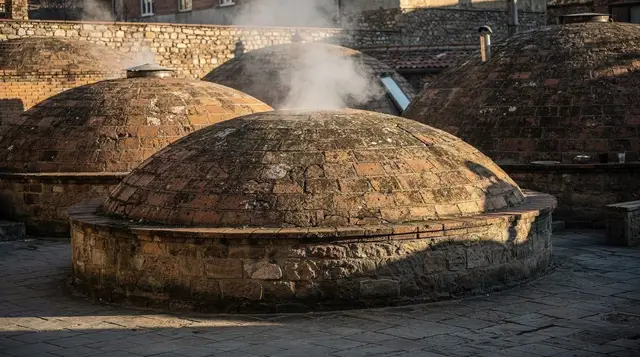
Abanotubani, in the heart of the capital, is where most visitors have their only Georgian bathing experience, and for good reason — it needs no extra travel, has private rooms set up specifically for visitors, and the water itself, hot sulphur springs, is what gives Tbilisi its name. The full breakdown of cost, booking and which bathhouse to choose is in Tbilisi’s sulphur baths: prices, private rooms and what to expect and Which Tbilisi bathhouse to choose. If you only have time for one spring town in Georgia, this is almost always the right default, and it needs no extra planning beyond a normal stay in Tbilisi itself.
The trade-off is that Tbilisi’s baths are also the most visitor-adapted of any on this list, which some travellers experience as a downside if they’re specifically looking for something less polished. If that’s you, weigh Tbilisi’s convenience against Tskaltubo’s rougher, more unusual character before assuming the capital is automatically the right choice simply because it’s the easiest.
Tskaltubo: radon water and Soviet ruins
Near Kutaisi, Tskaltubo pairs still-functioning radon-carbonate bathhouses with dozens of abandoned Soviet sanatorium buildings, a combination that makes it a genuinely different visit from Tbilisi rather than a lesser version of the same thing. Tskaltubo: Sulfur Bath Experience with Pick Up covers a straightforward bath session here. The full picture, including the town’s Soviet history and what to know before exploring the abandoned buildings, is in Tskaltubo: radon baths among Soviet ruins.
Cost is one of Tskaltubo’s real advantages over the capital: a private bath session here typically runs well under what an equivalent room costs in Tbilisi, since the town’s bathhouses were never rebuilt around visitor pricing the way Abanotubani’s have been. That gap narrows if you book through a packaged tour that bundles transport from Tbilisi or Kutaisi, but even then it tends to compare favourably against a comparable Tbilisi visit plus its own separate transport costs.
Borjomi: water to drink more than water to bathe in
Borjomi is a slightly different case — it’s famous primarily for its bottled mineral water rather than for bathing, though Central Park does have an outdoor mineral water pool alongside the free drinking fountains. Borjomi: Mineral Water Park and Mtsvane Monastery Tour covers the park and its water directly. The full detail on taste, cost and the pool is in Borjomi water at the source.
Sairme and Vani: quiet, low-key and easy to miss
West of Kutaisi, Sairme has its own thermal spa resort, quieter and far less touristed than Tskaltubo or Tbilisi, historically valued for treating digestive conditions, with a modest spa complex and surrounding forest walks.
Kutaisi: Sairme Spa Resort Zipline Aventure Tour pairs a visit here with a zipline, an unusual but genuine combination if you’re passing through the region. Nearby Vani, better known for its archaeological museum and ancient Colchian ruins, also has small sulphur baths that draw a mostly local crowd, and a similar day trip from Kutaisi covers both towns’ springs in a single outing. Neither town is worth a dedicated trip from Tbilisi purely for the water, but both are reasonable additions if you’re already exploring Kutaisi and Imereti more broadly.
Sairme’s spa complex leans toward a genuinely medical, treatment-oriented atmosphere rather than a leisure one — historically it drew visitors specifically for digestive and metabolic conditions, and that character persists in how the resort is set up today, quieter and more clinical than a leisure spa elsewhere in the country. Vani, by contrast, is really an archaeology stop with a small bath attached rather than the other way round; most visitors come for the museum and the ancient Colchian gold finds, and treat the sulphur baths as an unplanned bonus rather than the main event.
A guided walking tour of the history, if you want context first
If you’d rather understand the history behind Tbilisi’s baths — why the city is built where it is, and how the sulphur springs shaped the district — before deciding whether to bathe at all, Tbilisi: History of Sulphur Baths Walking Tour covers that context on foot through Abanotubani, with time built in to book a bath afterwards if you decide you want one.
Booking logistics across the different towns
Booking in Tbilisi is the most straightforward of any of these towns, with English-speaking staff at most houses that regularly take visitors and same-day availability outside peak weekend evenings. Tskaltubo, Sairme and Vani are more likely to require either a prebooked tour or some patience and a translation app if you’re arranging things independently on arrival, since fewer staff at these smaller-town bathhouses are used to dealing with foreign visitors day to day.
Borjomi sits in between — the park itself needs no booking beyond simply paying at the gate, but if you want a guided visit that also covers the Mtsvane Monastery or a wider Samtskhe day trip, prebooking through an operator removes the need to arrange transport and entry separately.
For a straightforward first bath with no extra travel: Tbilisi. For something stranger, cheaper and tied to Soviet history: Tskaltubo. For drinking mineral water at the source rather than bathing in it: Borjomi. For a quiet, low-key stop few visitors bother with: Sairme or Vani, if you’re already in the area. None of these is objectively “the best” — they answer different questions, and picking the wrong one for what you actually want (a quick soak versus a half-day excursion, a crowd versus solitude) is the main way people end up disappointed.
What the water is actually made of
The differences between these springs aren’t just marketing — they’re genuinely different mineral profiles. Sulphur water, as found in Tbilisi, contains dissolved hydrogen sulphide, responsible for both the characteristic smell and, historically, its use for skin and joint complaints. Radon-carbonate water, as at Tskaltubo, contains naturally occurring radon gas dissolved in the water at low, generally considered safe concentrations for occasional bathing, alongside carbonation.
Borjomi’s water is an alkaline carbonated mineral water without the sulphur or radon content of the other two, which is why it’s drunk rather than primarily used for bathing. None of these should be treated as medical advice — they’re descriptions of what makes each town’s water distinct, not claims about what any of them will cure.
What Georgians actually think of “spring tourism”
It’s worth being honest that most Georgians don’t think of visiting these towns as “wellness tourism” in the marketed, international sense of the phrase. A weekly sulphur bath in Tbilisi is, for many residents, closer to a habit than an experience — no different in spirit from a regular gym visit elsewhere. Tskaltubo carries more weight locally as a place tied to family memories of Soviet-era sanatorium stays, sometimes bittersweet given how the town’s fortunes changed after 1991, than as a photogenic backdrop. Keeping this in mind doesn’t mean visitors shouldn’t enjoy these places as tourists — they’re genuinely worth visiting — but it’s a useful corrective against treating any of them purely as an exotic spa circuit built for outsiders.
Turning this into a trip
If more than one of these appeals, several operators now package Georgia’s spa towns into multi-day wellness routes rather than leaving you to string them together yourself. A wellness weekend from Tbilisi covers a shorter version built around a single weekend, and Spa hotels worth the money in Georgia covers where to stay if you want the trip to be about more than day visits.
The wider category of baths and spa activities across the site is at Things to do: baths and spas, and The kisa scrub: what a Georgian bath attendant actually does is worth reading regardless of which town you end up choosing, since the scrub is common to most of them.
A route that actually works logistically
If you want to see more than one of these towns without excessive backtracking, the natural route runs from Tbilisi west through Borjomi and on toward Kutaisi, taking in Tskaltubo, Sairme and Vani as a cluster around the same base, rather than trying to visit Tskaltubo and Borjomi on separate trips from Tbilisi.
This mirrors the standard west-Georgia road trip route many visitors already take for Kutaisi’s caves and canyons, which makes adding a spa stop or two a relatively small addition to an itinerary rather than a special detour. Attempting all five towns — Tbilisi, Borjomi, Tskaltubo, Sairme and Vani — in a single trip is possible but demanding; most visitors do better picking two, at most three, and giving each proper time rather than rushing between all of them.
Packing for a spa-focused trip
A swimsuit, flip-flops or sandals for wet floors, and a lightweight towel (even where towels are provided, having your own as backup avoids any awkwardness if a house runs short on a busy day) cover the basics for any of these stops. For Tskaltubo specifically, add sturdy closed shoes for walking through the sanatorium buildings. Cash in lari is worth carrying regardless of destination, since card acceptance is less consistent outside Tbilisi, particularly in smaller towns like Sairme and Vani where you may be paying at a small, informally run bathhouse rather than a business set up for card payments.
Temperatures, and what each actually feels like
Sulphur water in Tbilisi runs genuinely hot — close to 40°C in the private rooms at Abanotubani, enough that most visitors manage twenty to thirty minutes before needing to step out and cool down rather than a long soak. Tskaltubo’s radon-carbonate water runs noticeably cooler, closer to body temperature or a little above, which is part of why it reads as a gentler, longer experience than a Tbilisi sulphur room rather than an intense short one.
Borjomi’s outdoor pool sits warmer than a swimming pool but well short of Tbilisi’s private rooms, comfortable for a longer sit in the sun rather than a quick, sweat-inducing soak. Sairme and Vani’s smaller baths vary house to house, since neither town has standardised its water temperature the way Tbilisi’s commercial bathhouses have, so asking on arrival is more useful than assuming a fixed figure.
Who should think twice before a soak
Hot mineral water is not risk-free for everyone, whatever the marketing around any of these towns implies. Pregnant visitors, anyone with a diagnosed heart condition, and anyone who has been drinking alcohol are generally advised against a long soak in genuinely hot water, sulphur or otherwise, and Tskaltubo’s radon content specifically is best avoided by pregnant visitors as an added precaution even though normal recreational exposure is considered low-risk for most other visitors.
Open cuts, active skin infections and recent sunburn are also worth mentioning to bathhouse staff before booking, since some conditions are made worse rather than better by prolonged contact with mineral-rich hot water. None of this should put off a healthy adult from a normal bath, but it is worth a moment’s honest thought rather than assuming hot water is automatically fine for anyone.
Bathhouse etiquette, town by town
Tbilisi’s private rooms are the most visitor-adapted of any option here, and etiquette is straightforward — a private room is yours alone or shared only with whoever you booked with, swimwear is optional but entirely normal to wear, and staff are used to explaining the kisa scrub to first-timers without being asked twice.
Shared public halls, in Tbilisi or elsewhere, are usually single-sex and often expect nudity rather than swimwear, which surprises visitors used to a Western spa’s more covered norms; watching what other bathers do on arrival is the simplest way to avoid an awkward moment. Tskaltubo, Sairme and Vani’s smaller, more local bathhouses tend to be more informal again, and a visitor who is polite, follows the lead of any locals present, and asks rather than assumes generally has no trouble regardless of which town they are in.
Common mistakes when planning a spring-hopping trip
The single most common mistake is treating all of these towns as interchangeable stops on a checklist, which usually means rushing through Tskaltubo’s sanatoriums in an hour to make a Borjomi booking the same afternoon, seeing neither properly. A second common mistake is booking a private Tbilisi room for a large group without checking the room’s actual capacity first, since rooms are priced and sized differently and a group of six can arrive to find a room built for four.
A third is skipping Tskaltubo specifically because “it’s just baths,” when the town’s real draw for most visitors is the abandoned sanatorium buildings alongside the water — going only for the bath and skipping the buildings, or the reverse, misses half of what makes the town worth the 3.5-hour trip from Tbilisi in the first place.
Frequently asked questions about Georgia’s thermal springs
The comparisons above cover the main trade-offs between towns; the questions below fill in details that come up when planning which one, or ones, to actually visit.
Which Georgian thermal springs are best for a first-time visitor?
Tbilisi’s Abanotubani is the easiest to reach and the most set up for visitors, with private rooms and no need to travel outside the capital. If you’re already heading toward Kutaisi, Tskaltubo adds a genuinely different, stranger experience alongside its abandoned sanatoriums.
Are Sairme and Vani worth visiting for the water alone?
Not really as a dedicated trip from Tbilisi — they’re worth adding if you’re already in the Imereti region for other reasons, such as canyons or wine, since neither has enough on its own to justify a long detour purely for a bath.
Is Georgian thermal water actually different chemically between towns?
Yes. Tbilisi’s springs are sulphur-based, giving the characteristic smell around Abanotubani; Tskaltubo’s are radon-carbonate; Borjomi’s is an alkaline carbonated mineral water known mainly for drinking rather than bathing. They’re not interchangeable experiences even though all three get loosely described as ‘hot springs.‘
Can you visit more than one of Georgia’s thermal spring towns in one trip?
Yes, and several tour operators now package exactly this as a multi-day wellness route. See A wellness weekend from Tbilisi for a shorter version, or look at multi-day options if you want to cover Tskaltubo, Borjomi and Sairme together.
Is Georgian thermal water safe to drink as well as bathe in?
Borjomi’s water is specifically bottled and sold for drinking and is safe in normal quantities. The bathing springs at Tbilisi, Tskaltubo, Sairme and Vani are used for soaking, not drinking, and shouldn’t be treated as the same thing even where the water comes from a related source.
Do any of these springs have proper spa hotels attached?
Yes, a growing number, particularly around Tskaltubo where several derelict sanatoriums are being restored into hotels, and in Borjomi. See Spa hotels worth the money in Georgia for which ones are actually worth the higher price.
Sulphur bath and spa experiences on GetYourGuide
Verified deep-linked GetYourGuide tours. Book through these links and we earn a small commission at no cost to you.
Photo: our own image of the location, not the operator’s product photo.