Kazbegi as a day trip: is it too much?
Is Kazbegi doable as a day trip from Tbilisi?
Yes, but it means roughly six hours of driving for two to three hours at Gergeti Trinity Church and the surrounding area. It works well for travellers with only one spare day; anyone with two nights to spare gets meaningfully more out of staying overnight in Stepantsminda.
The honest question this page answers
Kazbegi is the single most asked-about day trip from Tbilisi, and the honest answer to “is it too much” is: it depends on how many days you have, not on whether the trip itself is unpleasant. A day trip to Kazbegi means roughly six hours in a vehicle for two to three hours on the ground, and it works well precisely because it is the only option for travellers with a single spare day. Anyone with two nights free gets a meaningfully better version of the same trip by staying over. This page lays out both versions honestly rather than pretending one is obviously correct for everyone.
What a Kazbegi day trip actually looks like, hour by hour
Most organised day trips leave Tbilisi between 9am and 10am, reaching Ananuri Fortress after roughly an hour for a 20-30 minute stop at the 17th-century fortress complex on the Aragvi river. From there the road climbs toward Gudauri, usually a brief photo stop rather than a full visit unless the itinerary is built specifically around the ski resort or paragliding, then over the Cross Pass and down into Stepantsminda, arriving around 1pm to 2pm depending on traffic and how long the earlier stops ran.
From Stepantsminda, the 4x4 taxi ride up to Gergeti Trinity Church takes 20-30 minutes each way on a rough track, leaving perhaps an hour at the church itself before the group needs to head back down and begin the three-hour return drive, typically arriving back in Tbilisi around 8pm to 9pm. That is the realistic shape of the day: a lot of driving, a genuinely spectacular hour at altitude if the weather cooperates, and very little slack for anything else.
A standard day trip to Kazbegi from Tbilisi follows close to this schedule, with Ananuri and Gudauri stops included as standard. For travellers who want a guide with deeper local knowledge of the route and its history rather than a purely transport-focused day, a Kazbegi tour with a professional mountain guide covers the same ground with more context along the way.
The one real risk: Kazbek hides itself
Mount Kazbek is a genuinely shy mountain. Even on days that look entirely clear from Tbilisi, cloud frequently builds around the 5,054m summit by mid-morning, and a day trip gives you exactly one viewing window, arriving whenever the itinerary happens to reach the church, with no second chance the following morning if the peak stays hidden. This is the single biggest argument for an overnight rather than a day trip: staying in Stepantsminda gives you an early-morning attempt, typically the clearest window of the day, plus a second try if the first one fails. A day trip is, in this specific sense, a gamble that an overnight is not.
A day trip built specifically around Gergeti Trinity Church times the church visit as close to the middle of the day as the schedule allows, which is a reasonable compromise but still well after the early-morning window that overnight visitors get for free.
What you skip by doing Kazbegi in a single day
A day trip realistically covers Gergeti Trinity Church and little else. The Gveleti waterfalls, a short drive north of Stepantsminda near the Russian border crossing at Dariali, do not fit into a standard day-trip schedule without cutting time somewhere else — the smaller of the two falls is an easy add-on in principle, but few day tours build in the extra hour it costs. The Truso valley, a genuinely different landscape of travertine springs and an abandoned village southwest of town, requires a 4x4 and enough time that it essentially rules out a same-day return to Tbilisi entirely; it is one of the clearest arguments for an overnight or even a dedicated two-day Kazbegi visit.
A guided hike to the Gveleti waterfalls and a Truso valley trip with a professional driver are both realistically overnight additions rather than day-trip add-ons, given the extra time each requires on top of the church visit itself.
The case for staying overnight instead
Stepantsminda’s guesthouses run 40-70 ₾ a night, cheap enough that an overnight rarely strains a budget meaningfully more than a day tour’s transport cost already does. Staying over buys three things a day trip cannot: an early-morning shot at a clear Kazbek view before afternoon cloud builds, enough time to add Gveleti or even Truso without an impossibly long single day, and a walk up to the church on foot rather than only the 4x4 option, for anyone who wants the two to three hour hike as part of the experience rather than a rushed alternative.
The trade-off is Stepantsminda’s genuinely limited evening options — a small restaurant scene built mostly around feeding day-trippers before the drive back, rather than a town with much nightlife of its own.
What you lose by staying overnight instead
The honest counterpoint: an overnight in Kazbegi costs a full extra day somewhere else in Georgia, and Stepantsminda itself has limited standalone appeal beyond its function as a base — it is not a destination for its own architecture or atmosphere the way Sighnaghi is. For a first-time visitor with a tight one-week schedule trying to also fit Kakheti wine country and Tbilisi itself, a Kazbegi day trip that sacrifices Gveleti and Truso but preserves a day elsewhere is a completely reasonable trade, not a compromise to feel bad about.
Getting there: tour, private driver or marshrutka
A marshrutka from Tbilisi’s Didube station runs directly to Stepantsminda for a low fare and takes roughly three hours, a genuinely workable independent option for visitors happy to explore the church and immediate surroundings on their own once there. The marshrutka guide covers ticket logistics in detail.
The catch is that reaching Gveleti or Truso without a private vehicle or organised tour afterwards is considerably harder, and the marshrutka does not stop at Ananuri or Gudauri along the way. A private driver or an organised day tour remains the simplest way to cover all three — Ananuri, Gudauri and Kazbegi itself — in a single day without juggling separate connections, and is the option most first-time visitors choose for exactly that reason.
Weather and season
Summer offers the best odds of hiking conditions and the highest odds of the mountain being at least partly visible, though afternoon storms build quickly at altitude and rain gear is worth carrying even on a day that starts clear in Tbilisi. Winter transforms Kazbegi into something closer to an alpine destination — the church trail is often snow-covered, 4x4 taxis become the only realistic way up, and the road itself can close temporarily near the Cross Pass after heavy snow.
Late September into October is a genuine sweet spot: autumn colour on the lower slopes, thinner crowds than peak summer, and still-reasonable odds of a clear view, though nights turn cold enough that layers matter regardless of what Tbilisi’s own weather is doing that day.
Crowds, and when to go if you have flexibility
Gergeti Trinity Church gets genuinely crowded from mid-morning through early afternoon in peak summer, with a queue of 4x4 taxis at the base and a packed viewpoint that undercuts the tranquillity the photographs promise. Day-trip visitors arrive squarely inside this window by the nature of the schedule, which is a real trade-off worth naming rather than pretending away — overnight visitors who start walking up before the taxis begin running get a genuinely different, quieter version of the same view. If your dates are flexible, a weekday visit outside the July-August peak reduces the crowding noticeably at the church itself.
How Kazbegi compares to other day trips from Tbilisi
Kazbegi is the longest and most weather-dependent of the popular day trips near Tbilisi, but also the one with the single most striking payoff view. The best day trips from Tbilisi, ranked honestly places it below Mtskheta on pure time-to-payoff terms but ahead of most other options for scenery alone. Travellers deciding between a highland detour here versus committing more days to Svaneti further west should read the Kazbegi or Svaneti comparison guide for an honest breakdown of what each actually offers relative to the time it costs.
The road itself is part of the trip
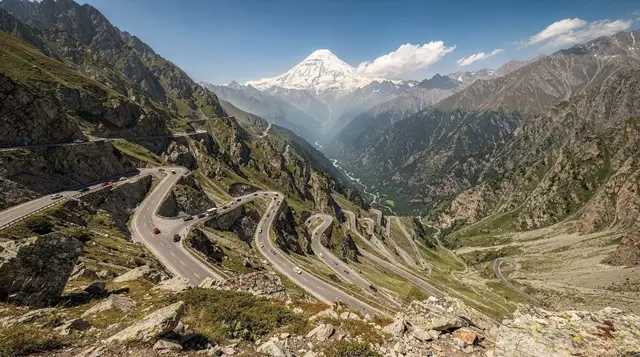
The Georgian Military Highway connecting Tbilisi to Kazbegi is not incidental scenery on the way to the destination — it is one of the oldest and most historically significant routes through the Caucasus, and the drive itself, past Ananuri’s fortress walls and up through Gudauri’s high mountain pastures, is worth treating as part of the day rather than dead time between two points. The Georgian Military Highway guide covers the route kilometre by kilometre, including the Russia-Georgia Friendship Monument, a Soviet-era mosaic arch just before Gudauri that has become a popular stop in its own right.
What a day trip actually costs
A seat on a shared-group day tour is the cheapest organised option and typically includes transport, an English-speaking driver or guide, and stops at Ananuri and Gudauri, with the 4x4 taxi up to the church usually charged separately at the base of the trail. A private driver or private tour costs meaningfully more but removes the fixed group schedule, letting you linger at the church if the weather is good or turn back early if it is not.
Independent travel by marshrutka is cheapest of all — roughly 15-20 ₾ each way from Didube — but excludes the 4x4 taxi fare up to the church and any stops along the highway, which have to be arranged separately if wanted. Food in Stepantsminda runs close to the rest of rural Georgia, 20-35 ₾ for a full meal, cheaper than equivalent food in central Tbilisi, though a handful of places with a direct valley view charge a premium that is arguably worth paying once for the setting.
What to pack for a Kazbegi day trip
Kazbegi’s altitude means genuinely different conditions from Tbilisi, even in high summer — layers matter more here than almost anywhere else on a standard Tbilisi day trip. A warm layer and a waterproof shell are worth carrying regardless of how clear the morning looks in the capital, since afternoon cloud and sudden temperature drops at altitude are the norm rather than the exception. Sturdy footwear matters if there is any chance of walking part of the church trail rather than taking the 4x4 the whole way, since the track is rough and can be muddy after rain. Sunscreen and a hat are worth adding even on an overcast day, since UV exposure increases with altitude regardless of cloud cover overhead.
Photographing Gergeti Trinity Church
The most reproduced image of Kazbegi — the small church silhouetted against Kazbek’s glaciated bulk — depends entirely on light and cloud cooperating at the exact hour you happen to be there, which for most day-trip visitors falls somewhere in the early-to-mid afternoon. Morning light is generally softer and the mountain’s odds of being visible are statistically better before midday cloud has time to build, one more argument in favour of an overnight for anyone who cares specifically about the photograph rather than simply the visit.
A wide-angle lens or phone panorama captures the church-and-mountain composition better than a standard portrait framing, and stepping back from the immediate crowd around the church itself, toward the ridge either side, usually finds a clearer, less crowded angle than the spot directly in front of the entrance where most visitors cluster.
Combining Kazbegi with the rest of a Georgia itinerary
Kazbegi rarely needs to stand entirely alone in a wider trip. The five-day Georgia itinerary and one-week itinerary both build a Kazbegi day or overnight into a broader Tbilisi-based trip that also covers Kakheti wine country, treating the Military Highway leg as one component of a longer route rather than an isolated outing. Travellers who prefer more general outdoor time before or after Kazbegi can also look at day hikes from Tbilisi, which covers shorter walking options closer to the capital for days when a full Kazbegi round trip does not fit the schedule.
Signal and connectivity along the route
Mobile signal along the Georgian Military Highway is reasonably consistent for most of the drive, with the main gaps occurring in the deeper sections of the pass near the Cross Pass itself, where terrain rather than network coverage is usually the limiting factor. Stepantsminda town has decent 4G coverage from the major Georgian carriers, and most guesthouses and cafés offer wifi, so staying briefly out of contact is more a feature of the high mountain stretches than of Kazbegi itself. See SIM cards, eSIM and mobile data for setting up connectivity before the trip, worth doing in Tbilisi rather than trying to sort out on arrival in a small mountain town.
The honest bottom line
A Kazbegi day trip is not “too much” in the sense of being unpleasant or badly paced — organised tours have refined the route enough that the logistics work smoothly. It is a lot for one day, and the honest trade-off is a real chance of a cloud-covered summit, no Gveleti or Truso, and a long drive home after a short window at altitude. For a single spare day, it remains worth doing. For anyone who can spare a second night, staying in Stepantsminda turns the same trip into a considerably better one for a modest extra cost.
Frequently asked questions about a Kazbegi day trip
How long does a Kazbegi day trip from Tbilisi actually take?
Budget 10 to 12 hours door to door: roughly three hours each way on the Georgian Military Highway, plus two to three hours around Stepantsminda and Gergeti Trinity Church, plus stops at Ananuri Fortress and Gudauri that most tours build into the route.
What is the biggest risk of doing Kazbegi as a day trip?
Cloud cover. Mount Kazbek is frequently hidden even on days that look clear from Tbilisi, and a day trip gives you exactly one viewing window with no chance to try again the next morning the way an overnight stay allows.
Is it better to take a tour or go independently to Kazbegi?
A marshrutka from Didube station reaches Stepantsminda directly and cheaply, but leaves you without transport to Gveleti or Truso. An organised tour or private driver covers Ananuri, Gudauri and the church hike logistics in a single planned day, which suits most first-time visitors better.
Can you walk to Gergeti Trinity Church on a day trip, or do you need the 4x4?
You can walk the roughly 6km trail in two to three hours each way if your schedule allows it, but most day-trip itineraries build in only enough time for the 20-30 minute 4x4 taxi ride up and down, since the full walking round trip eats most of a day on its own.
Does the Kazbegi day trip include Ananuri and Gudauri?
Most organised day trips do, since both sit directly on the Georgian Military Highway route north. Ananuri Fortress is a short stop on the way; Gudauri is usually a brief photo and toilet stop rather than a full visit unless you are there specifically for skiing or paragliding.
Is the Kazbegi road ever closed?
Occasionally in winter, due to snow or avalanche risk on the higher sections near the Cross Pass. It is worth checking conditions the morning of a winter trip rather than assuming the road is guaranteed open, since closures can happen with little notice.
Best day trips from Tbilisi on GetYourGuide
Verified deep-linked GetYourGuide tours. Book through these links and we earn a small commission at no cost to you.
Photo: our own image of the location, not the operator’s product photo.