Hiking to Gergeti Trinity from Stepantsminda
How hard is the hike to Gergeti Trinity Church?
It is a steady but non-technical climb of roughly 6 km and 700-800 m of elevation gain from Stepantsminda, taking most walkers 2-2.5 hours up and 1.5 hours down on a clear path. No ropes, crampons or guide are needed in summer; a shared 4x4 covers the same ground in 15-20 minutes for anyone who would rather skip the climb.
Two very different ways up the same hill
Everyone who has seen a photograph of Georgia’s mountains has seen this one: a small stone church on a green shoulder of land, with the glaciated cone of Mount Kazbek rising behind it. Reaching Gergeti Trinity Church is not complicated, but there are two genuinely different ways to do it, and confusing them causes most of the disappointment travellers report about this stop.
One is a walk of a few hours that almost anyone reasonably fit can manage. The other is climbing Kazbek itself, a multi-day glaciated ascent that has nothing in common with the walk except sharing a view. This guide covers the first. If you came here looking for the second, skip ahead to the section on Kazbek below, or go straight to Climbing Mount Kazbek: what it takes.
Why this particular church
Gergeti Trinity Church, known locally as Tsminda Sameba, dates to the 14th century and sits at 2,170 m specifically because medieval Georgians chose defensible high ground for a church meant to hold relics safely through centuries of invasion from the south. That history explains the site’s isolation better than the view alone does: there was never a village up here, only the church, a separate bell tower, and later a small monastic cell, all built from the same undressed stone that makes the whole complex blend into the hillside rather than stand out against it.
Understanding that the site was chosen for defensibility rather than scenery makes the climb feel less like a detour to a photo opportunity and more like retracing a genuinely practical medieval route, even though nearly everyone today comes for the view rather than the relics.
What people get wrong before they arrive
The single most common mistake is assuming the walk to the church is a warm-up for something bigger, or conversely that reaching the church means you have “done” Kazbek in some meaningful sense. Neither is true. A second common error is underestimating how exposed the upper section is: the treeline ends well before the church, and wind that felt mild in Stepantsminda can be sharp and constant on the open hillside, even in July. A third is timing the whole day around a leisurely late-morning start, which all but guarantees Kazbek will already be in cloud by the time you reach the top — this is a hike where the earliest reasonable start beats a longer, more relaxed one almost every time.
The route, step by step
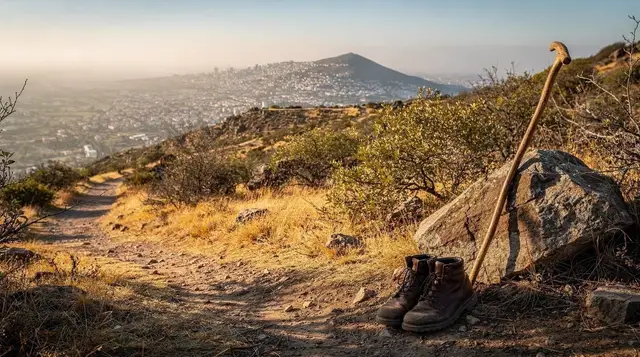
The trailhead sits at the edge of Stepantsminda, the small town most people still call Kazbegi, roughly 3 hours from Tbilisi along the Georgian Military Highway. From the main square, a track drops toward the Chkheri river, crosses a footbridge, and then begins climbing in earnest through birch woodland on the lower slopes of the ridge. This first stretch is the steepest section of the whole walk and the one that puts off anyone who started too fast.
Above the treeline, the path opens onto grassy hillside with the Terek valley and Stepantsminda falling away below. From here the gradient eases slightly and the church becomes visible ahead, sitting on its own promontory with Kazbek behind it. The final approach curves around the hillside rather than climbing straight at the church, which makes the last 15 minutes feel longer than the distance suggests. Total distance is roughly 6 km one way with about 700-800 m of elevation gain, starting from Stepantsminda at around 1,740 m and finishing at the church’s plateau near 2,170 m.
Coming down is faster but harder on the knees, particularly on the loose gravel of the upper switchbacks; trekking poles help more on the descent than the ascent for anyone prone to sore knees.
How long it actually takes
Budget 2 to 2.5 hours for the climb at a normal walking pace with a couple of short breaks, and 1 to 1.5 hours for the way down. Fit hikers who do not stop for photographs manage the full round trip in well under 3 hours; most visitors, stopping repeatedly for the view back down the valley, take closer to 4 to 5 hours total including time at the top. Starting by 9am gives a comfortable margin to be back in Stepantsminda for a late lunch and improves the odds of catching Kazbek before afternoon cloud rolls in, which happens on most days even in clear summer weather.
The 4x4 alternative, honestly assessed
A dirt track, separate from the walking trail, also climbs to the church and is covered by shared or private 4x4s — almost always the boxy Soviet-era Delica vans that queue near Stepantsminda’s main square — in 15 to 20 minutes. This is the right choice for anyone short on time, travelling with young children, or simply not up for a sustained climb; it is not a lesser way to see the site, and plenty of Georgians take it themselves.
Shared vans fill up through the day and cost noticeably less per person than chartering a vehicle privately; either way, agree the price with the driver before setting off, since it is not metered. As a rough order of magnitude, a private return trip runs somewhere in the 100-150 ₾ range depending on the season and how much bargaining you do, while a seat in a shared van costs a fraction of that once it fills up — the trade-off being that a shared van waits until it has enough passengers before leaving, which can mean standing around the square for a while on a quiet morning.
Crowds, and how to avoid the worst of them
Because the 4x4 track makes the church reachable without any real physical effort, Gergeti Trinity absorbs the bulk of Kazbegi’s day-trip traffic from Tbilisi, and the church plateau can feel more like a car park than a mountain summit between roughly 11am and 3pm in July and August, when several tour minivans tend to arrive within the same half-hour window.
Walking up sidesteps most of this: hikers set off earlier and spread out along the trail rather than arriving in the same block as the vans, so the church itself is noticeably quieter for anyone who reaches it on foot before mid-morning. Staying overnight in Stepantsminda and walking up at first light is the single most effective way to have the site close to yourself, with the added benefit of the best odds all day of an unclouded Kazbek.
Stepantsminda Gergeti Trinity Church Mountain Tour packages the transfer with a guide who explains the church’s history and the wider Kazbegi landscape, useful for travellers who would rather not negotiate a shared jeep themselves.
What you should not do is drive an ordinary rental car up: the track’s steeper switchbacks and loose surface catch out low-clearance cars regularly, and recovery from the hillside is neither quick nor cheap. If you are self-driving in Georgia more generally, see Driving in Georgia: rules, roads and habits for what the roads are actually like beyond this one stretch.
Combining the hike with a day trip from Tbilisi
Most visitors see Gergeti Trinity as part of a longer day out along the Military Highway rather than a dedicated overnight to Stepantsminda, and the driving time from Tbilisi (about 3 hours each way) makes that the honest default for most schedules.
From Tbilisi: Gergeti Beyond the Cross Pass Private Tourcovers the whole route from Tbilisi, including the Jvari Pass viewpoint on the way, and builds in enough time at Kazbegi to either walk up or take the 4x4, depending how the day is going. If a full day trip feels rushed for a hike this satisfying, Kazbegi as a day trip: is it too much? weighs that trade-off directly, and staying overnight in Stepantsminda is the better call for anyone who wants to hike up at a relaxed pace and still have daylight left for Truso Valley or Juta the next day.
Kazbegi: Gergeti Gveleti Waterfalls Sno Tour is a reasonable variant for a second day in the area, pairing a shorter waterfall walk with the Gveleti and Sno valleys rather than repeating the church climb.
Season and conditions
June through September is the reliable window for a comfortable walk, with July and August the warmest but also the busiest, since Gergeti Trinity draws day-trip traffic from Tbilisi on a scale few other Georgian hikes see. May and early October can still work but bring a real chance of mud, residual snow patches on the upper track, or an unexpectedly cold and windy summit even when Stepantsminda itself feels mild.
From November through April, snow and ice make the walking trail genuinely hazardous without proper winter gear and experience; the 4x4 track stays passable for longer into the cold season with a capable driver and snow tyres, which is when it earns its keep as more than a convenience. For the wider picture on when Georgia’s mountain routes open and close, see When the Georgian hiking season actually opens and When the mountain passes open and close. A local guide’s read of that day’s snow and wind conditions is worth having in the shoulder months, when settled midsummer assumptions no longer apply.
Kazbek itself: a different mountain entirely
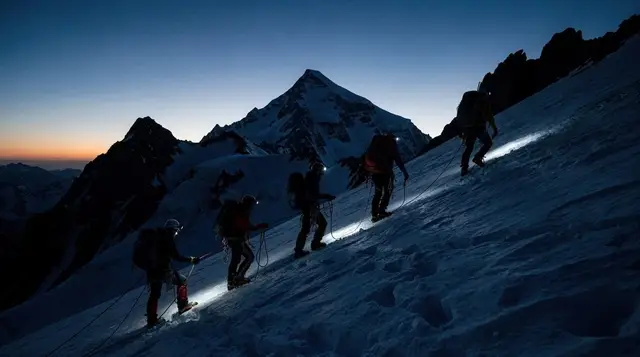
It bears repeating because the confusion is common: the church sits at 2,170 m; Kazbek’s summit is 5,054 m, a glaciated peak that requires crampons, rope, a rope team, and multiple days of acclimatisation with a certified mountain guide out of Stepantsminda. It is not an extension of this walk, not something to attempt on a whim after reaching the church, and not comparable in risk.
Every year brings stories of underprepared attempts on Kazbek ending badly; if the mountain itself is what draws you rather than the church below it, read Climbing Mount Kazbek: what it takes before you plan anything further than this walk, and treat mountain rescue and insurance as non-negotiable rather than optional. Mountain safety in Georgia: rescue, weather and signal covers the practical side of what happens if conditions change fast, which they do here more often than the postcard photos suggest.
Ride a Horse to Gergeti Trinity Church and Summit a Mountain is the other honest alternative worth knowing about: horses covering the same ground as the walking trail, a genuinely different experience from either the hike or the 4x4, and one some travellers with knee or hip problems specifically ask for.
Photographing the church and the mountain
The classic composition — church, bell tower and Kazbek’s summit all in one frame — works best from the approach path on the north side, roughly 10-15 minutes before you reach the church itself, where the ground drops away enough to separate the buildings from the ridge behind them. Midday light flattens the scene considerably; early morning and the couple of hours before sunset both give the stone more texture and a better chance of clean air, since haze tends to build through the day in summer. None of this matters, however, if Kazbek is not out, and it frequently is not: treat a clear view of the summit as a bonus rather than something to plan around, and have a plan for a satisfying day even if the cloud does not lift.
Extending the trip into the wider Kazbegi valley
Gergeti Trinity is very often the only stop travellers make around Stepantsminda, which undersells how much else sits within a short drive. Truso Valley and its travertine springs lie in the opposite direction from the church, reachable by 4x4 in under an hour, and make a genuinely different half-day out for anyone staying overnight rather than rushing back to Tbilisi.
Juta, the Chaukhi massif and the Abudelauri lakes sit further along a side valley and suit hikers who found this walk comfortable and want something longer the next day. Travellers building a full itinerary around this region rather than a single day trip should also weigh Kazbegi or Svaneti?, since both regions compete for the same block of days on a typical two-week Georgian trip and few visitors manage both without cutting something else.
Where to stay if you would rather not rush
Doing this hike as a rushed add-on to a Tbilisi day trip is possible but not the best version of it. Stepantsminda has a wide spread of guesthouses and small hotels, many run by local families with home-cooked dinners included, and staying even one night changes the hike from a box-ticking stop into a properly paced morning walk with an early start and no minivan waiting at the bottom. It also opens up a second day for Truso Valley or Juta without adding another 6-hour round trip from Tbilisi.
Food, facilities and what to expect at the top
A small café-kiosk near the church sells tea, coffee, khachapuri and simple snacks at prices a little above what you would pay in Stepantsminda, which is fair given everything is carried up. There is no reliable fresh water source on the trail itself, so carry what you need rather than counting on buying it en route. Toilets exist near the church but are basic; do not expect anything beyond the essentials. The church itself, along with the separate bell tower, remains an active monastery rather than a museum piece, so quiet, modest dress and respect for anyone praying inside matter more here than at a purely secular viewpoint.
Getting to Stepantsminda in the first place
However you plan the hike itself, getting to the trailhead means getting to Stepantsminda first, almost always along the Georgian Military Highway from Tbilisi. See The Georgian Military Highway, kilometre by kilometre for what that drive actually involves, including the Ananuri fortress and Gudauri ski town most people pass through on the way, and Is Georgia safe? An honest answer if road conditions and mountain weather are part of a wider safety question for your trip.
The honest bottom line
For most travellers, the walk up to Gergeti Trinity is one of the best half-day efforts in Georgia: no technical difficulty, a genuine sense of achievement, and one of the country’s defining views if the weather cooperates. It rewards an early start more than almost anything else in this guide, since Kazbek’s summit disappears into cloud on a majority of afternoons even in good weather. Do not let the postcard photograph convince you the summit itself is part of the same outing — it is a serious mountain requiring its own planning, guide and gear, and conflating the two is where most of the bad decisions in this valley start.
Frequently asked questions about hiking to Gergeti Trinity
How long does it take to hike to Gergeti Trinity Church?
Budget 2 to 2.5 hours up at a normal pace and 1 to 1.5 hours back down. Fitter hikers who skip photo stops do it faster; anyone stopping often for the view over the Terek valley should allow closer to 3 hours each way.
Can you drive to Gergeti Trinity Church?
Yes. A dirt-and-gravel track climbs from Stepantsminda’s main square and is covered by shared or private 4x4s, mostly Soviet-era Delica vans, in 15-20 minutes. Ordinary cars struggle with the steeper switchbacks, which is why almost nobody drives their own rental car up.
Is the hike to Gergeti Trinity Church difficult?
It is unrelentingly uphill with no technical sections, so the difficulty is mostly about sustained effort rather than skill. Reasonably fit walkers with no hiking experience manage it, but anyone unused to a continuous climb should treat it as a genuine workout, not a stroll.
What should I bring for the hike?
Sturdy shoes with grip, a few litres of water since there is no reliable source on the trail, layers for wind at the top, sun protection, and cash for the church-side café that sells tea, coffee and simple snacks.
Do I need a guide to hike to Gergeti Trinity Church?
No. The trail is a single obvious track with no route-finding difficulty in clear weather. A guide is unnecessary for this hike specifically, which is a different undertaking from climbing Kazbek itself.
Can you see Mount Kazbek from Gergeti Trinity Church?
On a clear day, yes, and it is the main reason people make the climb. Kazbek is often wrapped in cloud by mid-morning, so an early start improves the odds of an unobstructed view considerably.
Is Gergeti Trinity Church open to visitors?
Yes, it functions as an active monastery and is open most of the day, though services and religious calendar events take priority over sightseeing. Modest dress is expected: covered shoulders and knees, and a headscarf for women, available to borrow at the entrance if you arrive without one.
Mountain hikes on GetYourGuide
Verified deep-linked GetYourGuide tours. Book through these links and we earn a small commission at no cost to you.
Photo: our own image of the location, not the operator’s product photo.