Accessible travel in Georgia
Is Georgia accessible for travellers with reduced mobility?
Unevenly. Tbilisi's newer buildings, malls and metro stations increasingly include ramps and lifts, and step-free options exist for some major sights via cable car and funicular, but a lot of the country's charm — cobbled Old Town streets, mountain villages, historic monasteries — was never built with accessibility in mind, and infrastructure outside Tbilisi and Batumi remains patchy at best.
An honest starting point
Guides written for accessible travel too often fall into one of two traps: either glossing over genuine obstacles to avoid discouraging anyone, or treating every historic destination as automatically unsuitable and steering readers away from it entirely. This guide tries to avoid both, by describing what specifically works, what specifically does not, and where a bit of advance planning closes a gap that might otherwise ruin a day.
Georgia is not, on the whole, a country built with accessibility in mind, and it would be doing readers a disservice to suggest otherwise. Much of what draws visitors here — a medieval Old Town of cobbled lanes and steps, mountain villages reached by unpaved roads, monasteries perched on hilltops for reasons of medieval defence rather than modern convenience — was shaped centuries before accessible design was a consideration anywhere in the world.
At the same time, Tbilisi in particular has modernised quickly over the past two decades, and a genuinely workable trip is achievable for many travellers with reduced mobility if you plan around the gaps rather than discovering them on arrival. This guide sets out, honestly, where Georgia works and where it does not.
Tbilisi’s streets and pavements
Central Tbilisi is a mix of eras, and it shows in the pavements as much as anywhere. Rustaveli Avenue and the newer developments around it have wide, mostly even pavements with dropped kerbs. The Old Town and Sololaki, by contrast, are built on genuine slopes with cobbled surfaces, narrow pavements that sometimes disappear into the road entirely, and steps built into the terrain itself rather than added as an afterthought.
Where to stay in Tbilisi, neighbourhood by neighbourhood covers this same unevenness from an accommodation angle — Vake and Vera, both comparatively flat, tend to be the more manageable bases for anyone who finds cobbles or hills difficult, at the cost of a longer trip into the historic core for sightseeing.
Public transport: improving, but inconsistent
The Tbilisi metro is the fastest way across the city, and a growing number of its stations, mostly newer or recently renovated ones, have lifts alongside the standard escalators. A meaningful number of the older Soviet-era stations, however, rely entirely on long, steep escalators with no step-free alternative, which makes the system unreliable rather than unusable for a wheelchair user or anyone with significant mobility limitations — checking the specific stations on your planned route in advance, rather than assuming universal access, is essential.
Tbilisi metro, buses and the Metromoney card covers the system in general, worth reading alongside this guide for the transport basics before layering on the accessibility caveats.
City buses are gradually being replaced with newer, low-floor vehicles in Tbilisi, though the older fleet and most intercity marshrutkas remain step-entry with no ramp or lift, and marshrutka drivers are not generally equipped or prepared to assist with wheelchairs or significant mobility aids.
Private Transfer Tbilisi Airport and similar private transfers sidestep most of this uncertainty entirely, and are, in practice, the most reliable way for anyone with mobility limitations to move around Georgia without gambling on a given metro station or bus having step-free access on the day. Specialist wheelchair-accessible vehicles are limited in number, so requesting one specifically well ahead of arrival, rather than assuming a standard private transfer includes one, matters more here than in countries with a larger dedicated accessible-taxi fleet.
Sights: some genuinely work, others genuinely do not
Narikala Fortress, one of Tbilisi’s signature sights, is reachable without the steep walking path via the Rike Park cable car, which removes the hardest part of the climb.
Tbilisi: Private Tour to Mother of Georgia Narikala Castle is worth considering for exactly this reason — a private guide can plan the visit around the cable car and the more level sections of the fortress grounds, rather than defaulting to a standard walking route that assumes everyone can manage steps and uneven stone underfoot. The fortress grounds themselves still include some uneven surfaces and short stepped sections once you are up there, so this is a genuine improvement over the alternative rather than a complete solution.
Tbilisi: Old Town Sights Funicular Ride to Mtatsminda Park offers a similar step-free route up to Mtatsminda Park’s viewpoint over the city, a comfortable, seated alternative to any walking route up the hill.
Tbilisi: Kura River Sightseeing Boat Tour is one of the more straightforwardly accessible ways to see central Tbilisi, since it involves boarding a boat rather than navigating streets, steps or uneven ground at all, and gives genuine views of the Old Town, the Peace Bridge and Metekhi from the water.
Beyond Tbilisi, accessibility varies sharply by sight. Svetitskhoveli Cathedral, Mtskheta sits on relatively flat, paved ground and is one of the more manageable major monasteries to visit. Jvari Monastery above the confluence, by contrast, sits on a hilltop with a car park close to the entrance but uneven ground once inside, and David Gareja: the cave monastery on a contested border involves genuine climbing over rock to reach its most significant cave complexes, which is not realistically accessible for wheelchair users or anyone with significant walking limitations.
Accommodation: request specifics, do not assume
International hotel chains in Tbilisi and Batumi generally offer rooms described as accessible, but it is worth confirming the actual specifics directly with the property — roll-in shower versus a bath with a rail, door width, distance from an accessible entrance to the room itself — rather than trusting a generic accessibility icon on a booking platform, which does not always reflect a consistent standard in Georgia the way it might in a market with stricter regulatory enforcement.
Guesthouses, hostels and hotels: what you get covers the wider accommodation landscape; the practical reality for accessibility is that purpose-built accessible rooms are far more likely in a hotel than in a family-run guesthouse, where older buildings, narrow stairwells and a lack of lifts are the norm rather than the exception, particularly in the Old Town and Sololaki’s converted historic townhouses.
The mountains: the hardest part of Georgia to make accessible
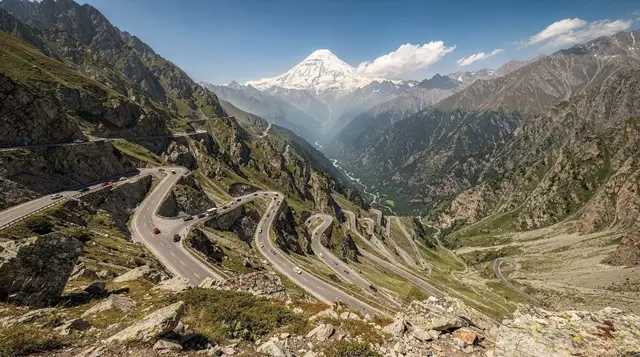
Georgia’s mountain regions — Kazbegi, Svaneti, Tusheti — are the parts of the country where accessibility is hardest to engineer around, given unpaved roads, guesthouses without lifts, and sights like Gergeti Trinity Church that involve either a genuine hike or a 4x4 ride over rough terrain to reach. This does not mean the mountains are entirely out of reach — the Georgian Military Highway itself, the main route toward Kazbegi, is a paved road that can be experienced by car with stops at accessible viewpoints along the way, giving a genuine sense of the scenery without requiring any walking at all. Ambitious hiking routes and remote village stays, however, remain realistically limited to travellers without significant mobility restrictions.
Batumi and the coast
Batumi’s newer seafront development along the Boulevard is flat, wide and considerably easier to navigate than Tbilisi’s Old Town, with modern pavements and a promenade built for pedestrian and cycle traffic rather than historic foot traffic squeezed between old buildings.
Batumi Boulevard end to end covers the layout in more detail, and it is one of the more comfortable stretches of Georgia to explore for anyone who finds Tbilisi’s hills and cobbles genuinely difficult. Batumi’s beaches themselves, however, are pebble rather than sand, which is worth knowing regardless of mobility level, and getting from the promenade down to the water’s edge over loose pebbles is a separate challenge from the flat boulevard walking above it.
Airports and getting into the country
Tbilisi, Kutaisi and Batumi’s international airports all have step-free access from arrivals through to ground transport, and wheelchair assistance can generally be requested through your airline ahead of the flight, the same as at most international airports. Tbilisi airport to the city centre and Kutaisi airport: the low-cost gateway both cover the onward transport options once you land, worth reading with accessibility specifically in mind since not every option listed — a public bus versus a private transfer, for instance — offers the same ease of boarding.
Wine country and flatter day trips
Kakheti’s wine region, one of the most popular day trips from Tbilisi, is largely flat, cultivated land, and a number of the larger wine estates have invested in visitor-friendly, paved courtyards and tasting rooms specifically because they host large tour groups regularly.
A wine tour of Kakheti: how to plan it is worth reading with an eye toward choosing estates that mention step-free cellars or ground-floor tasting rooms specifically, since some historic qvevri cellars are below ground and reached only by stairs. A private driver for a Kakheti day, rather than a standard shared coach tour, gives the flexibility to skip any specific stop that turns out to be inaccessible on arrival and substitute another.
Restaurants and everyday accessibility
Tbilisi’s newer restaurants, particularly in Vera and around Rustaveli, increasingly have step-free entrances and reasonably spaced seating, but a genuine number of atmospheric older restaurants, especially in the Old Town, occupy converted historic buildings with a step or two at the entrance and narrow internal stairs to further seating areas.
Phoning ahead to ask specifically about step-free access, rather than assuming a restaurant listed as centrally located is automatically easy to enter, avoids an awkward moment at the door. Where to eat in Tbilisi is a reasonable starting point for choosing where to go, worth cross-checking with a direct accessibility question before booking a table for a group that includes a wheelchair user.
Sensory considerations, not just mobility
Accessibility is not only about mobility, and Georgia’s sights vary considerably in how manageable they are for travellers with sensory sensitivities or conditions like autism. Tbilisi’s Old Town and Dezerter Bazaar are loud, crowded and visually intense at peak times, while Mtatsminda Park, Vake Park and most of the country’s monasteries offer genuinely calmer, quieter environments. Visiting popular sights early in the morning, a habit worth adopting regardless of any specific sensory need, consistently produces a calmer, less overwhelming experience across almost every major sight in the country, from Narikala to the sulphur baths of Abanotubani.
Deaf, hard-of-hearing and blind travellers
Georgia has no widely available Georgian Sign Language interpretation service built into standard tourist infrastructure, and audio description or braille signage at museums and sights remains rare outside a small number of larger Tbilisi institutions. This is an honest gap rather than a solvable workaround, and travellers with these specific needs are best served by arranging a private guide in advance who can adapt their communication style, rather than expecting standard tour infrastructure to accommodate it on the day.
Mobility equipment: bring what you rely on
Rental or purchase of specialised mobility equipment — wheelchairs, mobility scooters, specific walking aids — is limited in Georgia compared with Western Europe or North America, concentrated almost entirely in Tbilisi where a small number of medical supply shops carry basic equipment. Travelling with your own equipment, including spare parts or a repair kit for anything more specialised than a standard manual wheelchair, is the more reliable approach than assuming local rental or repair options will be available, particularly outside the capital.
Airlines flying into Georgia generally handle mobility equipment as standard checked or gate-checked items, but confirming your specific airline’s policy and Georgia’s airport handling procedures before departure avoids any surprise on arrival, when there is little recourse if equipment has been mishandled in transit.
Health, insurance and mountain evacuation
Anyone travelling with a health condition that could require specialist care should read health, pharmacies and insurance closely before departure, since Georgia’s medical infrastructure, while reasonably capable in Tbilisi, thins out fast in rural and mountain areas, and evacuation from a remote village is neither instantaneous nor automatically covered by a standard travel policy. Carrying documentation of any relevant medical conditions, in English and ideally Georgian, is a sensible precaution regardless of the specific nature of a mobility limitation.
Pushchairs and travelling with young children
Many of the same obstacles that affect wheelchair users also affect anyone navigating Tbilisi with a pushchair — cobbled Old Town streets, escalator-only metro stations, and stepped entrances at older restaurants all apply equally. A lightweight, collapsible pushchair that can be carried up a short flight of stairs or an escalator generally works better in practice than a larger, more robust model that assumes flat, step-free ground throughout. Georgia with children covers this from a family-travel angle more broadly, including which sights and neighbourhoods work best for exactly this kind of everyday mobility challenge, distinct from but overlapping with the concerns of an adult wheelchair user.
Planning a realistic itinerary
The most workable accessible Georgia trip leans toward Tbilisi and Batumi, both of which have invested more in accessible infrastructure than the rest of the country, supplemented by day trips built around driving rather than walking — the Georgian Military Highway, a wine estate visit in Kakheti with level ground, a boat trip on the Mtkvari. What a week in Georgia actually costs is worth reading alongside this guide, since private transport, which does most of the practical work of making a Georgia trip accessible, is also the single biggest cost variable in any Georgian itinerary, solo or otherwise.
Who to contact before you travel
Because published accessibility information for individual Georgian hotels, restaurants and sights is inconsistent, direct contact ahead of arrival consistently produces better results than relying on listings alone. Emailing or messaging a hotel directly about specific accessibility features, confirming with a tour operator whether a private guide can adapt a route around steps and uneven ground, and asking your accommodation host about the nearest accessible metro station or a reliable private transfer contact are all worth the extra effort before the trip rather than discovering gaps once you have already arrived.
The honest bottom line
Georgia rewards a traveller who plans around its accessibility gaps rather than expecting them not to exist. Tbilisi and Batumi offer a genuinely workable, if imperfect, base, private transport does most of the heavy lifting that public transport and walking cannot, and a handful of major sights — Narikala via cable car, Mtatsminda via funicular, Svetitskhoveli in Mtskheta, a Kura river boat trip — offer real, step-free ways to experience the country’s best-known landmarks.
The mountains and a number of historic monasteries remain genuinely difficult, and being honest about that in advance, rather than discovering it at the base of an unreachable hilltop fortress, is what makes the difference between a frustrating trip and a well-planned one.
None of this changes the country’s broader safety picture, covered separately in is Georgia safe? An honest answer — the accessibility gaps described here are a question of convenience and infrastructure rather than risk, and a well-planned itinerary built around private transport, a handful of step-free landmark sights, and realistic expectations about the mountains and older monasteries can still add up to a genuinely rewarding trip, just a differently shaped one from the standard independent-travel itinerary this site otherwise assumes.
Frequently asked questions about Accessible travel in Georgia
Is the Tbilisi metro wheelchair accessible?
Only partially. Some newer or renovated stations have lifts, but many of the older Soviet-era stations rely on long escalators with no step-free alternative, so checking a specific station in advance rather than assuming access is essential.
Can wheelchair users visit Narikala Fortress?
The cable car up from Rike Park is the realistic route, avoiding the steep walking path, but the fortress grounds themselves have uneven surfaces and some stepped sections once you are up there, so it is a partial rather than complete solution.
Are Georgian hotels equipped for accessible travel?
International chain hotels in Tbilisi and Batumi generally offer accessible rooms on request, and it is worth confirming specifics like roll-in showers directly rather than trusting a generic accessibility icon on a booking site. Smaller guesthouses, especially outside the two main cities, very rarely have purpose-built accessible rooms.
Is it possible to visit Georgia’s monasteries with mobility limitations?
Some, like Svetitskhoveli Cathedral in Mtskheta, sit on relatively flat, accessible ground. Others, like Jvari Monastery on its hilltop or David Gareja’s cave complex, involve genuine climbs or uneven terrain that are difficult or impossible for wheelchair users without assistance.
Are taxis and private transfers a good option for accessible travel in Georgia?
Yes, generally the most practical way to move around for anyone who finds public transport or walking difficult, since a private car removes the accessibility gaps of buses, marshrutkas and metro escalators. Specialist wheelchair-accessible vehicles are limited, so requesting one specifically and confirming in advance matters more than in countries with a larger accessible-taxi fleet.
Does Georgia have accessible toilets in public places?
Increasingly in newer developments, malls and international hotels, but far from universal, particularly around historic sights and older parts of towns. Planning routes around known accessible facilities, rather than assuming they will be available, remains sensible.
Trip-planning essentials on GetYourGuide
Verified deep-linked GetYourGuide tours. Book through these links and we earn a small commission at no cost to you.
Photo: our own image of the location, not the operator’s product photo.