Tbilisi's sulphur baths: prices, private rooms and what to expect
How much do Tbilisi's sulphur baths cost?
A private room at one of the historic bathhouses in Abanotubani runs roughly ₾60-150 an hour (about €20-50) depending on the house, the room and the day of the week. The shared public hall costs only a few lari per person. Add a kisa scrub and massage and a couple of hours for two people usually lands around ₾150-250 in total.
The baths that gave Tbilisi its name
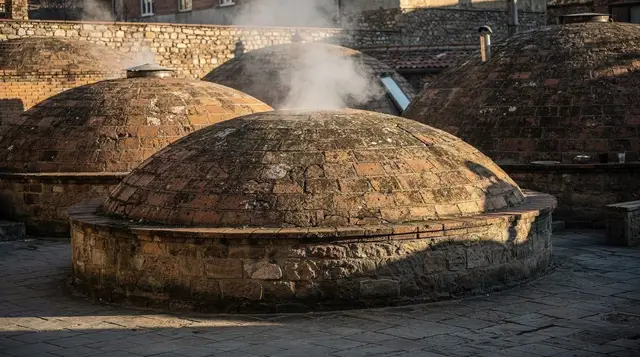
Tbilisi means, roughly, “warm place” in Old Georgian, and the reason is under your feet in Abanotubani: a field of sulphur springs that surface at 40°C or hotter and have kept the district’s brick-domed bathhouses running for something like fifteen centuries. This is one of the few things in the Old Town that tourists and Tbilisi residents actually do the same way — a lot of the people soaking next to you on a Tuesday evening aren’t visitors, they’re locals who bathe here weekly.
The practical part — what it costs, whether to book a private room, and what actually happens once you’re inside — is what trips people up, since almost none of it is signed in English and the houses vary a lot in price and condition. For the history and architecture of the district itself, see Abanotubani: the sulphur bath district explained; this guide sticks to the practical side of actually bathing.
Private room or public hall
Every bathhouse in Abanotubani splits its offer into private rooms — a tiled chamber with your own sulphur pool, usually a small plunge pool and sometimes a steam room, rented by the hour — and a public hall, split by gender, where you pay a small entry fee and share the water with whoever else is there. Private rooms are the version aimed at visitors and cost roughly ₾60-150 an hour depending on the house, the size of the room and whether it has extras like a sauna or a massage table built in. The public hall is a few lari per person and is, by a wide margin, the more local experience: plainer tiles, no frills, and usually a smaller crowd of regulars who know exactly how long to stay in before stepping out.
Most first-time visitors do better with a private room. Beyond the obvious privacy, you control the water temperature, you’re not rushed, and you can bring a partner or friends into the same room rather than being separated by gender. Tbilisi: Private Sulfur Bath Experience with Tea or Wine is a straightforward way to book one without guessing which house has availability, and it bundles a pot of tea or a glass of wine into the room price, which most houses charge separately if you ask for it on the day.
What a typical visit actually costs
Budget roughly ₾60-150 for an hour in a private room for up to four people, which works out cheaper per person the more of you there are. A kisa scrub and massage, if you add it, typically runs another ₾30-60 per person and takes 20-30 minutes; see The kisa scrub: what a Georgian bath attendant actually does for what that actually involves before you agree to it at the counter. Towels and slippers are usually included in the room price; ask before assuming. Tipping the attendant a few lari for a scrub or massage is normal and appreciated, in cash.
Two hours in a mid-range private room with a scrub for two people lands somewhere around ₾150-250 total — noticeably cheaper than a comparable spa treatment almost anywhere in Western Europe, which is part of why the baths show up on so many Tbilisi itineraries.
Booking ahead or walking in
Walking in works on a weekday afternoon at most houses, but Friday and Saturday evenings fill up with locals as well as visitors, and a queue for a private room isn’t unusual on a warm weekend. Tbilisi: Luxury Sulfur Bath Ritual with Pickup Wine and similar prebooked options guarantee you a slot and a hotel pickup, which removes the uncertainty if your schedule in Tbilisi is tight. If you’d rather just turn up, mid-morning to early afternoon on a weekday is the quietest window at almost every house in the district.
English is spoken at most houses that regularly take visitors, though not universally, and a prebooked tour or transfer sidesteps any language uncertainty entirely since the operator handles the booking on your behalf. If you’re travelling as a group larger than four, check the room capacity before booking — most private rooms comfortably fit two to four people, and a larger group may need either two rooms or a house with a larger pool, which not every bathhouse in the district has.
A first-timer’s walkthrough, step by step
If you’ve never done this before, the sequence at most houses runs roughly the same way, and knowing it in advance removes most of the awkwardness. You’ll be shown to your room or, in the public hall, a changing area, where you leave your clothes and belongings — private rooms usually lock, the public hall has open lockers or hooks, so don’t bring anything you’d be upset to lose track of.
Inside the room, the pool itself is smaller than you might expect, often just large enough for two to four people to sit rather than swim, and the water runs consistently hot, typically somewhere in the high 30s to low 40s Celsius. Most visitors alternate between sitting in the water for ten to fifteen minutes and stepping out to cool down on the tiled surround, rather than staying submerged for the whole session — the heat is more intense than a typical hotel hot tub, and pacing yourself matters more than it might seem walking in.
If you’ve booked a kisa scrub, this is usually offered partway through or toward the end of the session, once your skin has had time to soften in the heat — see The kisa scrub: what a Georgian bath attendant actually does for exactly what that involves. Towards the end of your booked hour, an attendant will typically knock or check in to let you know time is running short, since rooms are often booked back to back on busy days. Budget a few minutes to dry off and change before you’re expected to hand the room back, and don’t be surprised if the whole experience feels quicker than the hour you paid for once you factor in changing at both ends.
Health, heat and who should be cautious
Sitting in near-40°C mineral water for an extended period raises your heart rate and blood pressure, which is worth taking seriously if you have any cardiovascular condition — check with a doctor before booking rather than finding out mid-soak that it doesn’t agree with you. Pregnant visitors are generally advised to keep sessions shorter and the water on the cooler side, something most attendants will accommodate if you ask, since a cooler private room is simple enough to arrange.
Alcohol and hot water are a genuinely bad combination — if wine is included in your package, it’s sensible to drink it after you’re out of the pool rather than during, and to drink plain water throughout regardless. Anyone who feels light-headed, unusually short of breath or nauseated should get out immediately rather than push through it; this happens occasionally to first-time visitors who underestimate how much the heat alone can affect them, independent of anything being wrong with the water itself.
How this compares to a Turkish hammam
Visitors who’ve done a Turkish hammam sometimes expect something similar in Tbilisi, and the honest answer is that the two share a general concept — hot water, exfoliation, an attendant — but differ in the details. A hammam is typically built around a heated marble slab and steam rather than a mineral pool, with the scrub and wash performed on that slab.
Tbilisi’s baths centre on the sulphur pool itself, with the kisa scrub usually done on a flat surface beside it rather than a dedicated heated stone. Neither is objectively better; they’re different traditions that happen to get compared because both involve hot water and a scrub. If you’ve done a hammam elsewhere and are curious how the two differ, the pool-centred format in Tbilisi is the biggest practical difference you’ll notice.
There’s also a genuine architectural difference worth knowing: Abanotubani’s brick domes were built specifically to work with a natural underground spring rather than a heated municipal water supply, so the whole district sits directly over its water source rather than piping it in from elsewhere. That’s part of why the smell of sulphur is strongest here and fades within a few streets — you’re standing on top of the source itself, not at the end of a pipe.
Which bathhouse to pick
Abanotubani has several distinct houses, from the domed Chreli-Abano with its Persian-style tiled facade to plainer, cheaper options tucked into the same street, and they differ meaningfully in price, room condition and how recently they’ve been renovated. Picking blind usually means either overpaying at the most photogenic house or ending up somewhere tired and overdue a refit.
The comparison is worth five minutes of reading before you commit: see Which Tbilisi bathhouse to choose for a house-by-house honest breakdown. If you’d rather see the district on foot with someone explaining which is which before you decide, Tbilisi: Sulfur Baths District Walking Tour does exactly that, ending with time free to book a room in whichever house you liked best.
Etiquette, what to bring and what to skip
Bring a swimsuit if you’d rather wear one — private rooms don’t require it, but the public hall does. Flip-flops help on the wet tiled floors. Most houses rent or include a towel; check when you book so you’re not caught without one. Keep sessions to 20-30 minutes at a time in the hottest pools if you’re not used to sitting in near-40°C water, and drink water afterwards rather than heading straight for a heavy meal. The baths sit right by the Narikala Fortress cable car and the start of a walk through the Old Town, so plenty of visitors combine the two, though bathing before a long walk in summer heat is more tiring than it sounds.
Tourist traps to watch for
Touts near the entrance to Abanotubani sometimes quote inflated prices to visitors who look like they haven’t checked the going rate, and a room advertised as “renovated” isn’t always. Ask the price per hour before you’re shown a room, confirm whether towels are included, and don’t feel pressured to add a scrub or massage on the spot if you haven’t decided you want one. If a price quoted on the street is noticeably above the ₾60-150 range for a standard private room, it’s worth walking to the next house and comparing before committing. None of this makes the baths not worth doing — it just means treating the first quote as a starting point, not a fixed price, the way many Tbilisi residents already do.
Baths across the seasons
Abanotubani works year-round, since the springs themselves don’t change temperature with the weather outside, but the experience shifts noticeably with the season. In summer, stepping from a near-40°C pool into Tbilisi’s own summer heat outside removes some of the contrast that makes the baths feel special in colder months, and the domes’ interiors can feel stuffy on the hottest days if a house doesn’t ventilate well.
Winter is, by most accounts, the better season for a first visit — walking out of a hot bath into cold air is the most dramatic version of the experience, and it’s also the quieter season for booking, with fewer visitors competing for rooms than in July and August. Spring and autumn split the difference, generally pleasant either way, though autumn tends to be Tbilisi’s busiest tourist season overall, which can mean the same weekend booking pressure as summer even though the outdoor temperature is milder.
What locals do differently
Watching how Tbilisi residents use the baths is instructive if you want to bathe like more than a first-time visitor. Regulars tend to favour the public hall over a private room, treat the visit as a weekly routine rather than a one-off event, and rarely linger for a full hour in the hottest water, alternating short soaks with longer breaks on the tiled surround.
Many bring their own kisa mitt rather than using one supplied by the house, and few add extras like wine or a photo session, treating the visit as closer to a sauna habit than a spa outing. None of this means visitors should copy the routine exactly — a private room and a slower pace are entirely reasonable choices for a first visit — but it’s a useful corrective if the marketing around Tbilisi’s baths makes the whole thing sound more elaborate than it needs to be for most people who actually use it.
Combining the baths with the rest of Abanotubani
A sulphur bath rarely needs to be the whole outing. The domes themselves are worth a look even if you don’t bathe, and the surrounding lanes have some of the better casual restaurants in the Old Town for khinkali and khachapuri afterwards — see Where to eat in Tbilisi for options within a short walk.
If you’re staying nearby, Where to stay in Tbilisi, neighbourhood by neighbourhood covers why Old Town hotels put you closest to the baths but not necessarily to everything else. And if lari, cards and ATMs are still unfamiliar by the time you’re standing at a bathhouse counter, Lari, ATMs and paying by card clears up what most houses actually accept.
A sensible order for a first visit: walk the district itself first, since seeing the domes and the small mosque nearby gives the baths some context before you go in; bathe mid-afternoon rather than right after a big meal, since a heavy stomach and near-40°C water don’t mix well; and leave the evening free for dinner nearby rather than planning anything strenuous straight afterwards, since most people feel noticeably drowsy for an hour or two after a proper soak and scrub. Pack a change of clothes if you’re not returning to a hotel first — you’ll want something loose and breathable rather than whatever you arrived in, particularly in summer.
Beyond Tbilisi: other sulphur and thermal water in Georgia
Abanotubani isn’t the only hot water in the country. Further west, Tskaltubo: radon baths among Soviet ruins offers a stranger, quieter experience in a town of abandoned Soviet sanatoriums, and the wider picture of where else Georgia’s mineral springs surface — Borjomi, Sairme, Vani — is in Thermal springs across Georgia.
If you’d rather turn a bath into a full weekend away from the city, A wellness weekend from Tbilisi strings several of these together, and the wider list of options for actual overnight stays is in Spa hotels worth the money in Georgia. For everything else worth doing in this corner of the Old Town, Things to do: baths and spas rounds up the full category, and Tbilisi covers the city more broadly.
Frequently asked questions about Tbilisi’s sulphur baths
The questions below cover the practical points that come up most often — booking, cost, and what to actually expect once you’re through the door.
Do I need to book a Tbilisi sulphur bath in advance?
For a private room at a well-known house, yes, especially on Friday and Saturday evenings and any weekend in high season, when locals also come to bathe. The public hall usually takes walk-ins, but you can still queue on a busy afternoon.
Is it better to book a private room or use the public bath?
A private room gets you your own tiled pool, a lockable changing area and no pressure to keep pace with strangers, which is worth the extra lari for most first-time visitors. The public hall is the cheaper, more local experience, split by gender, and closer to how Tbilisians actually use the baths day to day.
What should I bring to a Tbilisi sulphur bath?
A swimsuit if you want one (private rooms don’t require it, the public hall does), flip-flops, and a towel, though most houses rent or include towels and slippers in the room price. Bring cash in lari for tips and any extras such as the kisa scrub, since not every counter takes cards smoothly.
Does the sulphur smell as strong as people say?
Yes, noticeably, particularly around the domes of Abanotubani itself where the springs surface. It fades once you’re a few streets away and most visitors stop registering it within the first ten minutes in the water.
Is a Tbilisi sulphur bath worth it if I only have one day in the city?
It’s a reasonable use of ninety minutes to two hours if you enjoy hot water and don’t mind the smell, but it isn’t essential the way Old Town or Narikala are. See our honest one-day plan in Tbilisi in one day: a realistic plan for how it fits.
Can children go to the sulphur baths?
Most private rooms will take families, since you have the pool to yourselves, but the water runs hot (often 38-42°C) and isn’t especially entertaining for young children beyond a few minutes. The public hall is less practical with kids in tow.
Are the baths safe if I have a heart condition or am pregnant?
Hot mineral water raises heart rate and blood pressure, so anyone with a cardiovascular condition should check with a doctor first, and pregnant visitors are generally advised to keep sessions short and the water on the cooler side. Staff at the houses are used to the question and will point you to a cooler room if you ask.
Sulphur bath and spa experiences on GetYourGuide
Verified deep-linked GetYourGuide tours. Book through these links and we earn a small commission at no cost to you.
Photo: our own image of the location, not the operator’s product photo.