Georgia with children
Is Georgia a good country to visit with children?
Yes, with caveats: Tbilisi is compact and stroller-manageable in the flat parts, food is generally mild and bread-heavy, and Georgians are openly warm to children in restaurants. The main friction is transport for longer distances, since marshrutkas are not built for car seats and mountain roads are winding, so private drivers are worth the extra cost for anything beyond Mtskheta.
What actually makes a Georgia trip harder or easier with kids
Georgia is not a country built around child tourism the way parts of Western Europe are, so there is no swarm of stroller-friendly museums or dedicated kids’ menus everywhere you look. What it does have is a lot going for it by accident: mild bread-and-cheese food that children generally accept without a fight, warm and unbothered attitudes to noisy toddlers in restaurants, a compact capital where the main sights sit within a few kilometres of each other, and prices low enough that a private driver for a whole day costs less than a single museum ticket in many Western cities.
The friction, when it shows up, is almost always about distance and roads rather than culture or food: Georgia’s regions are further apart than the small size of the country on a map suggests, and a lot of them are reached along winding mountain roads that are fine for adults and rough for a carsick five-year-old.
The honest starting point is to plan around Tbilisi as a base and decide how far you actually want to push day trips, rather than trying to see all eight regions in one visit. A slower, Tbilisi-heavy week works better with young children than a fast loop through Kazbegi, Kakheti and Svaneti in the same ten days, however tempting the itinerary looks on paper.
Getting around with a family: marshrutkas, private drivers and taxis
Georgia’s marshrutkas — the shared minibuses that connect every town — are cheap, frequent and completely unsuited to travelling with young children. They are not equipped with car seats, they leave when full rather than on a fixed schedule, and the driving style on winding roads is brisk. For a couple with a toddler or a group with more than one child, a private driver is worth the extra cost for anything beyond a short in-city hop: expect to pay somewhere in the region of 250 to 400 GEL for a full day trip with a car and driver from Tbilisi, split between however many people are travelling. Ask specifically for a car seat when booking, since it is not standard equipment and many drivers will not think to offer one unprompted.
Inside Tbilisi itself, Bolt and Yandex Go are the easiest way to move around with a stroller and bags, typically costing 5 to 12 GEL for an in-city ride, and both apps let you flag whether you need extra space in the notes field even though neither guarantees a car seat. The metro is fast and cheap at 1 GEL a ride but involves long, steep escalators that are awkward with a stroller — folding the stroller and carrying a toddler is often more practical than fighting the escalator with it open. See Tbilisi metro, buses and the Metromoney card and Taxis, Bolt and Yandex Go for the full detail on both options.
Where to base a family trip: Tbilisi first, then how far to push
Tbilisi earns its place as the obvious base: it has the widest spread of family activities within walking or short taxi distance, the best pharmacies and clinics if something goes wrong, and enough flat, walkable streets in Vake and along the river to make stroller days realistic. See Tbilisi with children for the full local breakdown, including which parks and walks actually work with a stroller and which cobblestone streets do not.
From Tbilisi, Mtskheta is the easiest possible day trip at only 25 minutes away, with two UNESCO churches and a compact old town that a young child can walk without wearing out. Gori, at about an hour and fifteen minutes, and Sighnaghi, at around two hours, are both manageable as a single long day, though Sighnaghi works better as an overnight if you can spare it, since the drive back after a full day of sightseeing is a lot for a tired toddler.
Kazbegi and the mountains with children: how far is too far
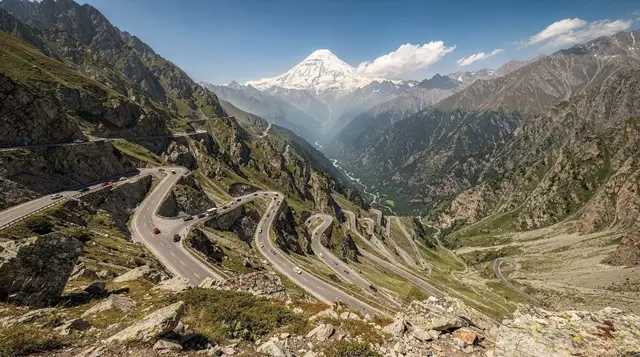
Kazbegi sits roughly three hours from Tbilisi along the Georgian Military Highway, and the drive itself is the main obstacle rather than anything at the destination. The road climbs over the Jvari Pass with genuine switchbacks and altitude gain, which is a normal scenic mountain drive for an adult and a recipe for motion sickness for some young children. If Kazbegi is a priority, doing it as an overnight rather than a single very long day trip gives everyone a break from the car and lets you actually enjoy Gergeti Trinity Church and the village rather than turning straight around.
Tbilisi: Kazbegi Mountains Tour with Family Lunch is built specifically around a family pace, with a proper sit-down lunch stop rather than a rushed photo-and-go schedule, which matters more with children than the scenery does. Note that Gudauri’s ski season runs December to April and the road can close briefly in bad winter weather, so check conditions before committing to a winter visit with young kids.
Kakheti wine country with kids: yes, really
Kakheti is Georgia’s wine region and sounds like an adults-only itinerary, but in practice it works well with children because the pace is slow, the towns are small and walkable, and most wineries are relaxed about kids wandering a courtyard while the adults taste. Sighnaghi’s fortress walls and flat main square are genuinely pleasant for a family to wander, and Telavi’s estates often have enough open space for a child to burn energy while wine tasting happens.
Telavi: Family Winery Tour Wine Tasting and Cooking Class pairs the wine side with a hands-on cooking class, which keeps children engaged with something of their own rather than standing around a tasting table. Distances are real, though: Sighnaghi is about two hours from Tbilisi and Telavi a little less, both reasonable as a single long day but better as an overnight if your children nap or need a slower pace.
Batumi and the coast as an add-on, not a starting point
Batumi is a genuine option for a family trip, but it works better tacked onto the end of a Tbilisi-based itinerary than as the place you fly into and base yourselves. The drive from Tbilisi is five to six hours, or a one-hour domestic flight, and the beaches themselves are pebble rather than sand, which matters for anyone picturing a soft-sand toddler holiday. What Batumi does have is a genuinely flat, stroller-friendly boulevard running the length of the seafront, a cable car with sweeping views that most children enjoy regardless of the scenery, and a noticeably more relaxed pace than Tbilisi’s old town. See Batumi with children for the specific detail on what works and what does not.
If Batumi is on the itinerary, flying one way and driving the other cuts the total driving time in half, which is worth the extra cost with young children who do not sit well for six hours. Kutaisi’s airport, a roughly three-and-a-half hour drive from Tbilisi, is also worth checking for flight timings, since it sometimes has better connections than Batumi’s own airport depending on your starting point; see Flying into Tbilisi or Kutaisi? for the comparison.
What Georgian hospitality means in practice for a family
Georgian hospitality culture treats a visiting family with children as a mild event rather than an inconvenience, and it shows up in small practical ways: restaurant staff who will happily hold or walk a fussing baby for a few minutes, waiters who bring bread immediately without being asked, older Georgians who strike up conversation with children on the street or on a marshrutka regardless of language barriers.
The formal side of hospitality, the supra feast with its toasts led by a tamada, is an adult institution that children are welcome to sit through but are not expected to participate in beyond eating; see The supra and the tamada explained if you are likely to be invited to one, which happens more often than most visitors expect.
This warmth does not extend automatically to infrastructure: expect very few dedicated changing tables outside newer shopping malls, expect staff to occasionally pick up and hold your child without asking first in a way that some parents find intrusive, and expect steps and cobblestones rather than ramps in the old parts of every town. None of it is a serious obstacle, but it is worth knowing before you land rather than being surprised by it on day one.
Food: what actually works for pickier eaters
Georgian food is, by accident, one of the easier cuisines in the region for children: bread, cheese-filled pastry, plain grilled meat and corn-based mchadi are all familiar-tasting and mild. The main things to steer around are the tkemali and adjika condiments, both sharp and sour, and coriander-heavy dishes, all of which are easy to ask a restaurant to leave off the plate. The full breakdown of what to order, what to skip and how supermarkets can fill the gaps on a hard day is in Feeding fussy eaters in Georgia.
Boshuri Khinkali Cooking Class with Local Family is a genuinely good family activity in its own right rather than just a meal: children fold their own khinkali dumplings under supervision in a real family kitchen near Gori, which tends to land better with school-age kids than a restaurant tasting menu would.
Health, pharmacies and safety for families
Tbilisi and Batumi both have 24-hour pharmacies and private clinics used to dealing with travellers, and standard childhood medicines and thermometers are easy to find without a prescription. Smaller towns like Sighnaghi, Kazbegi and Mestia have far thinner medical infrastructure, so it is worth carrying a basic first-aid kit and any prescription medication with you rather than assuming a local pharmacy will have it. Comprehensive travel insurance that covers mountain evacuation is worth having if Kazbegi, Svaneti or any hiking is on the itinerary; see Health, pharmacies and insurance for specifics.
Crime against tourists, including families, is low by regional standards, and central Tbilisi feels safe walking after dark with children. The bigger practical risks are road conditions on mountain day trips and, in summer, sun and heat rather than anything related to personal safety; see Is Georgia safe? An honest answer for a fuller picture including the handful of genuine scams to watch for.
Nappies, formula, and other logistics
Nappies, wipes and both international and local formula brands are stocked in Tbilisi and Batumi supermarkets — Goodwill, Nikora and Carrefour are the reliable chains — and in most pharmacies. Stock up before heading to Kazbegi, Sighnaghi, Mestia or other smaller towns, where selection drops sharply and prices for what is available tend to be higher. Sterilising equipment for bottles is less commonly stocked outside Tbilisi, so bring your own if you rely on it, along with a car adaptor or travel kettle if you need boiled water on the road.
Rainy days, sulphur baths and other fallback plans
Tbilisi has a reasonable spread of indoor options for a rained-out day, from the sulphur baths of Abanotubani, which children generally find more novel than boring once the initial heat surprise wears off, to cooking classes and covered market halls. The dedicated guide, What to do in Tbilisi when it rains, covers the specific venues, opening hours and which are genuinely suited to children rather than adults looking for a spa afternoon. For an outdoor fallback that still works if the weather turns light rain rather than a downpour, Mtatsminda amusement park has a funicular ride that most children enjoy regardless of the sightseeing on top.
A sample week with children
A realistic first week looks like three or four nights in Tbilisi covering the old town, Mtatsminda and a rainy-day option in reserve, one long day trip to Mtskheta and Ananuri that does not require an overnight, and either a Kazbegi overnight or a Kakheti overnight depending on whether mountains or wine country appeals more, with the last two or three nights back in Tbilisi to avoid ending the trip on a long drive day. The full structured version of this, with suggested nights per stop, is in A week in Georgia with children.
Georgians travelling with their own extended families tend to build in more downtime between sightseeing than foreign itineraries often assume, and following that instinct — fewer stops per day, longer lunches — tends to make the trip more enjoyable for everyone rather than less.
Seasonal timing for families
Late spring, from April into June, and early autumn, September into October, both give comfortable temperatures without the sharpest summer heat, which matters more with young children who overheat faster than adults do walking around Old Town Tbilisi at midday. High summer works fine if you plan around the heat with an early start and an indoor midday break, and winter is workable in Tbilisi itself but rules out Kazbegi and most mountain day trips unless conditions are unusually mild. See The best time to visit Georgia for the month-by-month detail behind this.
Frequently asked questions about visiting Georgia with children
How many days in Georgia are enough with young children?
A week gives you Tbilisi plus one or two easy day trips without rushing, which is a realistic pace with toddlers or preschoolers. Ten to fourteen days lets you add Kakheti or a short Black Sea stop in Batumi without back-to-back long drives.
Do I need a car seat in Georgia, and will taxis provide one?
Legally cars must carry children under school age in a restraint, but in practice most taxis and even some private drivers do not carry one as standard. Book a driver in advance and ask specifically for a car seat, or bring a lightweight travel seat from home rather than assume one will be waiting.
Is the food in Georgia easy for children who are picky eaters?
Mostly yes: khachapuri, plain khinkali, bread, corn mchadi and grilled meat are all mild and familiar-tasting. The main things to watch are the tkemali and adjika condiments, which are sharp and sour, and the amount of coriander in some dishes, both easy to ask to leave off. See Feeding fussy eaters in Georgia for the full breakdown.
Are Georgia’s mountain roads safe for a family trip to Kazbegi?
The Georgian Military Highway to Kazbegi is well paved but has genuine hairpin sections and altitude gain, and can trigger motion sickness in small children on the three-hour drive. A private driver who will stop for breaks is a better choice than a shared marshrutka for this specific route with young kids.
Can I get baby formula, nappies and wipes easily in Georgia?
Yes, in Tbilisi and Batumi: pharmacies and supermarket chains such as Goodwill, Nikora and Carrefour stock familiar international and local nappy and formula brands. Stock up before heading to smaller towns like Sighnaghi or Kazbegi, where the selection is far thinner.
What is the best base for a family trip: Tbilisi, Batumi or both?
Tbilisi is the stronger single base, since it has the most family activities within walking or short taxi distance and the best medical infrastructure if anything goes wrong. Batumi is a reasonable add-on for a beach stop but the pebble beaches and five to six hour drive from Tbilisi make it a second stop, not a starting point.
Is Georgia safe for a family in terms of crime and health risks?
Yes, violent crime against tourists is low and Tbilisi’s central districts feel safe for families after dark, though pickpocketing exists at crowded markets like Dezerter Bazaar. The bigger practical risk is road safety and altitude on mountain day trips rather than crime; see Is Georgia safe? An honest answer for the full picture.
Family-friendly tours on GetYourGuide
Verified deep-linked GetYourGuide tours. Book through these links and we earn a small commission at no cost to you.
Photo: our own image of the location, not the operator’s product photo.