One view, and everything built around reaching it
Kazbegi — the town’s Soviet-era name, officially reverted to Stepantsminda but still the name most visitors and most tour listings use — exists in most travellers’ minds as a single image: Gergeti Trinity Church, a small 14th-century church standing alone on a ridge at 2,170m, with the glaciated bulk of Mount Kazbek rising behind it to 5,054m. That view has become one of the most reproduced images of Georgia, and it earns the reputation — on a clear day, with the peak free of cloud, it is a genuinely striking sight rather than an overhyped photo-stop.
The catch is the qualifier: Kazbek is a shy mountain, frequently wrapped in cloud even in clear weather elsewhere, and visitors who build a tight one-day itinerary around seeing the peak sometimes arrive to find it hidden. Building in flexibility, or simply accepting the odds and enjoying the church and surrounding scenery regardless, is the more realistic approach.
The town itself sits roughly three hours from Tbilisi along the Georgian Military Highway, the historic road connecting Georgia to the North Caucasus, and functions as the practical base for everything covered on this page — the church hike, Gveleti’s waterfalls, the Truso valley, and onward trips to Juta and Gudauri. It is one of the most visited single destinations outside Tbilisi in the entire country, and that popularity shows in high-season crowding at the church itself, covered honestly in the Kazbegi crowds piece.
Getting up to Gergeti Trinity Church
There are three realistic ways up to the church: walking the roughly 6km trail from Stepantsminda, which climbs steadily and takes most visitors two to three hours each way depending on fitness; taking a 4x4 taxi from town, which covers the same distance on a rough track in around 20-30 minutes and is the choice for most day-trippers on a tight schedule; or hiking a shorter, steeper direct route favoured by fitter visitors who want the exercise without the full loop.
None of the three requires technical skill, but the walking trail is a genuine uphill effort rather than a stroll, and visitors underestimating it in poor footwear are a common sight on the mountain. The Gergeti Trinity hike guide covers the trail conditions, timing and what the church itself is actually like once you arrive, since the building’s interior is modest compared with the setting around it.
A day trip from Tbilisi built around the church itself is the standard way most visitors do this, typically combining the drive up the Military Highway with stops at Ananuri Fortress along the way and transport to and from the church included. For travellers who want more time at altitude beyond just the church, a private tour continuing past the Cross Pass extends the day further into the high mountain terrain north of town.
Gveleti waterfalls, an easier add-on
The Gveleti waterfalls — two separate falls, a smaller one reachable on an easy short walk and a larger one requiring a longer, more demanding hike with a river crossing — sit a short drive north of Stepantsminda, near the village of Gveleti itself close to the Russian border crossing at Dariali.
The smaller waterfall makes a genuinely easy add-on to a Kazbegi day that does not add meaningful time or effort, while the larger one is a proper half-day hike in its own right. A guided hike to the Gveleti waterfalls is worth booking for the larger fall specifically, since the trail crosses the river and benefits from local knowledge of current conditions, which vary with recent rainfall and snowmelt.
Truso Valley, the quieter alternative
The Truso valley, running southwest from Kazbegi toward the closed border area, offers a genuinely different kind of landscape from the glacier-and-church view most visitors come for — a wide, largely empty valley studded with travertine mineral springs, an abandoned village, and dramatic canyon walls, with a fraction of the foot traffic that Gergeti Trinity Church sees even in peak season. It requires a 4x4 and, for the full experience, a guide familiar with the border-zone rules that apply near the valley’s upper reaches.
A Truso valley trip with a professional driver is the practical way to see it, and the Truso valley guide covers what the travertine springs and the valley’s history actually involve, including why the upper valley remains sparsely populated after conflict in the area decades ago.
The Georgian Military Highway itself
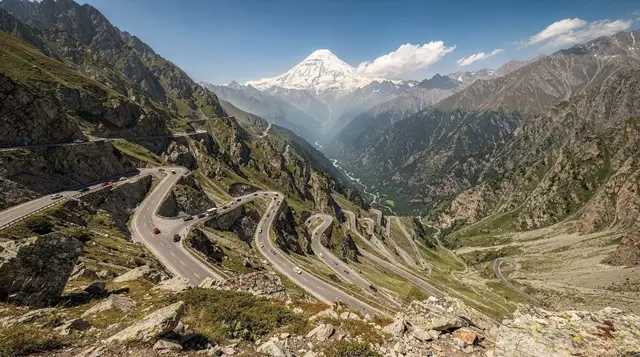
The road connecting Tbilisi to Kazbegi and onward to the Russian border is not incidental scenery — it is one of the oldest and most historically significant routes through the Caucasus, used for centuries as the main crossing point between Georgia and the North Caucasus, and its modern route still follows much of the historic path. Along the way, most Kazbegi day trips stop at Ananuri Fortress, a 17th-century fortress complex on the Aragvi river, and pass through or near Gudauri, the ski resort roughly two hours from Tbilisi and an hour before Kazbegi itself.
The Georgian Military Highway guide covers the full route kilometre by kilometre, including the Russia-Georgia Friendship Monument’s mosaic arch just before Gudauri, a Soviet-era structure with a viewpoint that has become a popular stop in its own right regardless of its original commemorative purpose.
Mount Kazbek’s place in Georgian and Caucasian culture
Kazbek is not just scenery — it carries real weight in regional mythology and history. In Georgian folklore the mountain is associated with the legend of Amirani, a Prometheus-like figure chained to its slopes for defying the gods, a story with clear parallels to the Greek myth and one frequently retold by local guides at the church itself. The mountain has also drawn serious mountaineers for well over a century; its first recorded ascent dates to 1868 by a British expedition, and it remains a genuine, if demanding, climbing objective today, distinct from the church hike that most visitors actually undertake.
The climbing Mount Kazbek guide covers what an actual summit attempt requires for the small number of visitors who come specifically for that rather than the church view — proper mountaineering experience, acclimatisation and typically a guided expedition of several days, nothing like the walk to Gergeti Trinity Church.
Weather and when to actually go
Kazbegi’s high altitude means its weather runs cooler and more changeable than Tbilisi’s at any time of year — summer days are comfortable for hiking but afternoon storms build quickly, and visitors on the church trail or Gveleti’s longer hike should carry rain protection even on a day that starts clear. Winter transforms the region into something closer to an alpine destination, with the church trail often snow-covered and 4x4 taxis becoming the only realistic way up, while the town itself takes on the atmosphere of a snowbound highland outpost rather than a bustling day-trip hub.
Late September into October offers a genuine sweet spot for many visitors: autumn colour on the lower slopes, thinner crowds than peak summer, and still-reasonable odds of a clear mountain view, though nights turn cold enough that proper layers matter regardless of what Tbilisi’s weather is doing that same day.
Stepantsminda, the town itself
Stepantsminda is small and functional — a main street, a market, a scatter of guesthouses and a handful of restaurants — built almost entirely around servicing day-trippers and the smaller number who overnight here. It is not a destination for its own architecture or atmosphere the way Sighnaghi or Telavi are; its value is entirely as a base for reaching the surroundings. Guesthouses here run 40-70 ₾ a night, and restaurant meals are in line with the rest of rural Georgia at 20-35 ₾ a head, generally cheaper than what similar food costs in central Tbilisi.
Where to eat in Stepantsminda
The town’s restaurant scene is small but functional, built primarily around feeding day-trippers a solid Georgian meal before the drive back to Tbilisi — khinkali, khachapuri and mtsvadi appear on most menus, alongside the mountain-region speciality of khinkali made with a slightly different, often more generously seasoned filling than the Tbilisi standard. Prices run close to what the rest of rural Georgia charges, generally 20-35 ₾ for a full meal, though a handful of places directly overlooking the valley charge a premium for the view that is arguably worth paying once for the setting alone. Few visitors come to Kazbegi for its food specifically, and that is a fair reflection of where the town’s priorities sit.
When Kazbek actually shows itself
Visibility of the mountain’s summit is genuinely variable and worth setting expectations around before committing to a tight single-day schedule. Early morning tends to offer the clearest views before afternoon cloud builds around the peak, a pattern common across the Caucasus in summer specifically. Visitors staying overnight in Stepantsminda have a meaningfully better chance of catching a clear window than a single-day tour arriving mid-morning and departing by early afternoon, since a second attempt the following morning is simply not available on a day trip. The trade-off, as with anywhere this popular, is that overnighting also means dealing with the town’s limited evening options rather than returning to Tbilisi’s wider choice.
Getting to Kazbegi
Kazbegi is roughly three hours from Tbilisi by road along the Georgian Military Highway, one of the more straightforward major drives in the country on a well-maintained, if occasionally congested, road. Marchroutkas run from Tbilisi’s Didube station directly to Stepantsminda for around 15-20 ₾ each way, a reasonable option for travellers happy to explore the church and immediate surroundings independently, though reaching Gveleti or Truso without a private vehicle or tour is considerably harder. A private driver or organised day tour remains the simplest way to cover Ananuri, Gudauri’s viewpoints and Kazbegi itself in a single day without juggling separate marchroutka connections.
Combining Kazbegi with the rest of the Military Highway region
Kazbegi rarely stands entirely alone in an itinerary — most visitors pair it with at least one of Gudauri, for the ski resort or the paragliding depending on season, or Juta, the smaller, higher village further into the mountains that serves as the trailhead for hikes into the Chaukhi massif.
The five-day Georgia itinerary and one-week itinerary both build a Kazbegi day or overnight into a wider Tbilisi-based trip, and travellers deciding between a highland detour here versus further west should read the Kazbegi or Svaneti comparison guide for an honest breakdown of what each actually offers for the time invested.
What to be honest about
Kazbegi’s popularity is a real trade-off. The church itself gets genuinely crowded from mid-morning through early afternoon in peak summer, with a queue of 4x4 taxis and a packed viewpoint that undercuts some of the tranquillity the image promises — arriving early, or specifically choosing a less crowded shoulder-season month, makes a measurable difference. The town’s tourism infrastructure has also grown quickly enough that some restaurants and shops now cater almost entirely to one-day visitors, with pricing to match, and the more interesting, quieter experiences — Truso, the longer Gveleti hike, an early-morning walk up to the church before the taxis start running — take deliberate planning rather than showing up and following the crowd.
Practical costs for a Kazbegi day
A rough budget for an independent day trip: a marchroutka each way runs 15-20 ₾ per person, a 4x4 taxi to the church around 100-150 ₾ shared among however many passengers fit the vehicle, entry to the church itself is free, and a meal in town runs 20-35 ₾ a head. An organised day tour from Tbilisi covering Ananuri, Kazbegi and the church transport bundled together typically costs more overall than the independent route but removes the need to coordinate marchroutka timing and taxi negotiation, which is worth the premium for many visitors on a single tight day. Travellers overnighting should budget guesthouse costs on top, generally the cheapest single line item of the whole trip at 40-70 ₾ a night.
Frequently asked questions about visiting Kazbegi
Is Kazbegi worth visiting as a day trip from Tbilisi, or does it need an overnight?
A day trip covers the church, and often Ananuri along the way, reasonably well. An overnight adds a real chance at clearer mountain views and time for Gveleti or Truso, which a single day struggles to fit in alongside the church itself.
How difficult is the hike up to Gergeti Trinity Church?
It is a genuine uphill walk of roughly 6km each way, manageable for most moderately fit visitors in decent footwear, but not a casual stroll — budget two to three hours up.
Do I need a 4x4 to reach the church, or can I walk?
Both are viable. Walking is free but demanding; a 4x4 taxi from town costs a set fare, generally shared among passengers, and takes 20-30 minutes each way.
What is the actual difference between Kazbegi and Stepantsminda?
They are the same town — Stepantsminda is the official post-Soviet name, while Kazbegi remains the more commonly used name among tour operators and most visitors, and both appear interchangeably in practice.
Is Mount Kazbek visible year-round?
The mountain itself is there year-round, but cloud cover frequently obscures the summit, particularly in the afternoon. Early mornings and the shoulder seasons generally offer better odds of a clear view.
Can Kazbegi be combined with Gudauri in the same day?
Yes, easily — Gudauri sits roughly an hour before Kazbegi on the same road, making it a natural stop either on the way up or the way back for travellers with a full day.
Is the Truso valley worth the extra time if I’ve already seen Gergeti Trinity Church?
Yes for travellers who want a genuinely different, quieter landscape and don’t mind the extra cost of a 4x4 and guide. It is not a must-see for a single tight day trip, but it rewards a second day in the area well.