Five days in Georgia: Tbilisi, Kazbegi and Kakheti
The two day trips that define a Georgia first-timer’s week
Ask any Tbilisi-based tour operator which two day trips sell the most, and the answer is always the same: Kazbegi along the Georgian Military Highway, and Kakheti for wine. Five days is exactly enough to do both properly, alongside two full days in Tbilisi itself, without the itinerary becoming three long car rides strung together by short sleeps.
This plan does not attempt Svaneti, Batumi or Vardzia — all of them need either an extra day or a flight to reach sensibly, and grafting one onto a five-day trip usually means arriving somewhere exhausted and leaving before you have understood it. If a longer country-wide route is what you are after instead, see One week in Georgia or Ten days in Georgia, east to west.
No car is required for any of this. Kazbegi and Kakheti are both comfortably covered by shared day tours or marshrutka, and Tbilisi itself does not benefit from a rental car at all — see Marshrutka or private driver? for the trade-offs if you are deciding how to book the two day trips. Budget roughly 350–500 € per person for the five days at a mid-range level, including two paid day tours, mid-range accommodation and normal meals; see What a week in Georgia actually costs for a fuller breakdown that this trip roughly tracks, minus two days.
Day 1: arrival and the Old Town
Land in Tbilisi, settle into a guesthouse in or near the Old Town, and spend the afternoon walking Sioni Cathedral, the Bridge of Peace and up into Betlemi — see A self-guided walking route through Tbilisi’s Old Town for the order that works best on tired legs after a flight. Ride the Narikala cable car up from Rike Park for the sunset view (2.5 ₾ each way), and finish with khinkali and Saperavi at a no-frills khinkali house rather than a tourist-menu restaurant. See Narikala Fortress and the cable car: what it costs and when to go and Khinkali: how to order and how to eat them.
Day 2: the sulphur baths and Rustaveli
Spend the morning in the Abanotubani bath district — a private room with a sulphur pool runs 60–150 ₾ an hour, and weekday mornings are the cheapest, least crowded slot. The full pricing and which houses are worth booking is in Tbilisi’s sulphur baths: prices, private rooms and what to expect.
In the afternoon, walk Rustaveli Avenue for the Soviet-era public buildings, then head into Fabrika and Chugureti for the courtyard scene and street art — see Rustaveli Avenue: what is actually worth stopping for and Street art, Fabrika and the courtyards of Chugureti. This is also a reasonable evening to fit a cooking class if you have not already eaten your fill of khinkali — see our guide to Tbilisi cooking classes.
Day 3: the Georgian Military Highway to Kazbegi
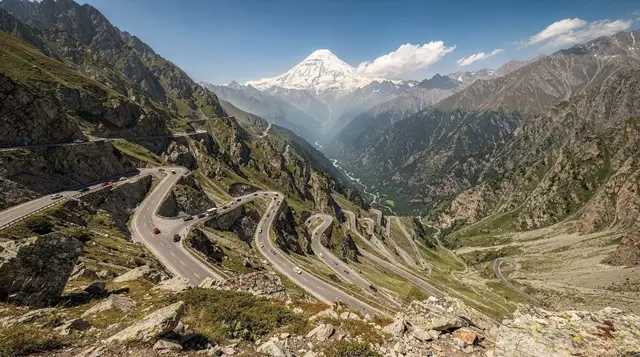
This is the longest day of the trip and the one worth setting an early alarm for. The road north from Tbilisi climbs through Ananuri Fortress on the Zhinvali reservoir, over the Jvari Pass at around 2,400 m, and down into Stepantsminda (Kazbegi) beneath the 5,054 m cone of Mount Kazbek — roughly three hours each way without stops, more like four with them.
Most visitors join a shared tour rather than arranging marshrutkas both ways, since the return leg from Kazbegi in the afternoon is far less predictable than the outbound morning departures from Didube. Explore Ananuri Gudauri Kazbegi Guided Day Tour covers the full route including Ananuri and a stop in Gudauri; alternatively From Tbilisi: Day Trip to Kazbegi focuses the day more tightly on Kazbegi itself, useful if Ananuri does not interest you as much as extra time at Gergeti.
From Stepantsminda, most people take a 4x4 taxi (roughly 25–30 ₾ per person, shared) up the steep track to Gergeti Trinity Church, perched on a ridge below the Kazbek massif — walking up takes two to three hours each way and eats badly into a day-trip schedule, so unless you are staying overnight, the taxi is the practical choice. See Gergeti Trinity Church: how to reach it for the walking option if you do have more time, and Ananuri Fortress and the Zhinvali reservoir for what the stop on the way up actually involves.
Lunch in Stepantsminda is simple mountain Georgian food — khinkali again, or a mountain-style shashlik — at 20–30 ₾ a head. Be honest with yourself about the season: the pass over Gudauri can close briefly after heavy snow between November and March, and cloud regularly hides the summit even in summer, so treat a clear view of Kazbek as a bonus rather than a guarantee.
Day 4: Kakheti wine day
Kakheti, Georgia’s main wine region, sits roughly two hours east of Tbilisi and rewards a full day rather than a rushed half-day squeezed in before a flight. The standard combination is Sighnaghi, the walled hill town known as the City of Love, Bodbe Monastery just outside it, and one or two wineries for tastings — either a family cellar producing wine in buried qvevri jars, or a larger estate with a proper tasting room.
Kakheti: City of Love Sighnaghi Bodbe Monastery Tourcovers Sighnaghi and Bodbe with wine stops included; if you would rather weight the day more heavily toward tasting than sightseeing, Wine Tour to Kakheti Sighnaghi Bodbe Wine Tasting does the same towns with more time at the cellar. See A wine tour of Kakheti: how to plan it for how the region breaks down between Sighnaghi, Telavi and the smaller villages, and Qvevri wine explained: 8,000 years in a clay pot for what makes Georgian winemaking different from anywhere else, before you taste it yourself.
If wine is less the point than the towns themselves, Telavi’s old fortress and the Alazani valley views are a reasonable substitute stop — see Telavi and its Alazani valley wineries. A day tour with two or three tastings and lunch typically runs 60–90 € per person including transport; travelling independently by marshrutka to Telavi and a taxi onward is cheaper but slower and harder to time around winery opening hours, which is why most visitors book a tour for this particular day even if they have avoided tours everywhere else in the trip.
Day 5: a slower morning, then departure
With four active days behind you, keep the last day light. A late breakfast, a final walk through whichever Tbilisi neighbourhood you have not yet covered — Vera or Vake if you spent days one and two entirely in the Old Town — and a stop at Dezerter Bazaar for spices, churchkhela or wine to take home before an afternoon or evening flight. See Dezerter Bazaar: how to shop it and souvenir guide for what is actually worth buying versus what is aimed purely at tourists. If your flight is not until evening, Mtskheta is a manageable half-day add-on at 25 minutes from the centre — see Mtskheta in half a day.
What to drop if you only have four days
Cut Kakheti before you cut Kazbegi, or vice versa, rather than trying to compress both into shorter half-days — Kazbegi’s drive alone is six to seven hours round trip, and rushing it means missing Gergeti Trinity Church, the single most photographed site on the route. If you drop Kakheti, replace it with a slower second day in Tbilisi rather than nothing, since Tbilisi itself absorbs an extra day comfortably. If you drop Kazbegi instead, Mtskheta is the natural substitute: much shorter, still historically significant, and it does not need a full day, freeing time for a longer Kakheti trip instead.
Where this trip sits on a longer itinerary
This five-day route is effectively the eastern half of One week in Georgia and the first third of Ten days in Georgia, east to west. If Kutaisi, Svaneti or Batumi turn out to interest you once you are already in the country, both of those longer itineraries pick up from exactly where this one ends, using Tbilisi as the same base for the first five days before heading west.
Where to stay for this itinerary
Because you return to Tbilisi every night on this plan, the choice of base matters more than it would on a route that changes city each day. The Old Town or lower Sololaki keeps you within walking distance of days one and two, and close to the pickup points most Kazbegi and Kakheti tours use on the edge of the centre. Vera and Vake are quieter and often better value, at the cost of a short taxi to reach the Old Town in the evenings. A mid-range double runs roughly 80–150 ₾ a night in shoulder season and noticeably more in July and August, when both Kazbegi and Kakheti tours also sell out further in advance. See Where to stay in Tbilisi, neighbourhood by neighbourhood for the full comparison.
Best time of year for this itinerary
Late April through June and September through mid-October are the strongest months for this specific combination, because both day trips depend on weather in ways the city days do not. Kazbegi’s pass rarely causes problems outside the coldest weeks of winter, but a clear view of Kazbek’s summit is genuinely more likely in late spring and autumn than in the hazier heat of July and August.
Kakheti’s grape harvest, rtveli, runs through September and October and is worth timing a trip around if you want to see wineries at their most active rather than just tasting the previous year’s bottling. Winter still works for Tbilisi and Kakheti — wineries operate year-round — but treat Kazbegi as weather-dependent between December and March. See The best time to visit Georgia and our harvest-season guide for more detail.
A more detailed day-by-day budget
Day one (arrival) is light: a taxi or bus from the airport (0.5–35 ₾ depending on choice), and a simple dinner, typically 40–60 ₾ for two. Day two, with the baths, is the most expensive city day at 100–150 ₾ for a private room split between two people, plus a similar amount again for meals and an optional cooking class. Days three and four, the two tours, are the biggest single costs of the trip at 60–90 € per person each, all-inclusive of transport and a guide; add 20–30 ₾ for lunch on each of those days if it is not already included.
Day five is the cheapest, covering little more than a final breakfast, a market stop and transport to the airport. Across the full five days, a mid-range traveller should plan on 350–500 € per person including both tours, mid-range accommodation, and normal meals — budget travellers who skip the baths and choose group rather than private tours can bring this down closer to 250–300 €.
Common mistakes on this specific route
The most frequent mistake is booking a Kazbegi tour that also tries to squeeze in Gudauri, Ananuri and Juta in a single day — on paper it looks efficient, in practice it leaves 30–40 minutes at Gergeti Trinity Church, the one stop most people actually came for. If a tour’s itinerary lists four or five named stops for a single Kazbegi day, check how much time is allocated to Gergeti specifically before booking.
The second common mistake is treating Kakheti as a wine-tasting pub crawl rather than a day with two or three unhurried stops — cramming in five wineries mostly means five rushed pours and one queasy afternoon in the car. The third is skipping Bodbe Monastery because it “is just a monastery” — its garden terrace has one of the better views over the Alazani valley in the whole region, and it costs nothing extra to add onto a Sighnaghi stop.
A subtler mistake is assuming Georgian Military Highway traffic is like a European motorway: it is a single carriageway shared with heavy freight trucks heading to and from the Russian border at Verkhny Lars, and delays of 30–60 minutes are not unusual on a bad day, particularly in poor weather. Build a little slack into the Kazbegi day rather than booking a tight onward flight or dinner reservation for that same evening. See The Georgian Military Highway, kilometre by kilometre for what the road itself actually looks like and where the truck queues tend to form.
Frequently asked questions about five days in Georgia
Is five days enough to see Tbilisi, Kazbegi and Kakheti?
Yes, comfortably, if you accept that Kazbegi and Kakheti are each a full day trip rather than a half-day. Two days in Tbilisi plus one day each for Kazbegi and Kakheti, with a slower final day, is a realistic and unrushed pace.
Do I need to rent a car for this itinerary?
No. Both day trips are well served by shared tours or organised transport, and Tbilisi itself is walkable. A rental car becomes more useful on longer, multi-region routes such as the ten-day or two-week itineraries, where public transport connections are less frequent.
Can I do Kazbegi and Kakheti on the same day?
Not sensibly. They are in opposite directions from Tbilisi — Kazbegi north along the Military Highway, Kakheti east — and each already takes most of a day on its own. Combining them into one day means arriving everywhere late and leaving early.
What if it is cloudy at Kazbegi — is the trip still worth it?
Yes. Ananuri Fortress, Gudauri’s mountain scenery and Gergeti Trinity Church’s setting are worth the trip even without a clear view of Kazbek’s summit, which is often in cloud regardless of season. Treat the mountain view as a bonus.
Should I book Kazbegi and Kakheti as tours or do them independently?
Kazbegi is worth booking as a tour for most visitors, since coordinating the pass, Gergeti’s 4x4 track and a reliable return leg independently adds real complexity. Kakheti can be done either way; a tour is simpler for tasting logistics, while independent travel by marshrutka to Telavi or Sighnaghi is cheaper if you already know which winery you want to visit.
Is this itinerary suitable in winter?
Kazbegi remains reachable most winters, though snow can occasionally close the Gudauri pass for a few hours after heavy falls, and Gergeti’s summit view is less reliable. Kakheti’s wineries operate year-round, though the harvest season (September–October) is the most atmospheric time to visit. Winter still brings its own rewards in the city, just fewer guarantees on the mountain.
How much should I budget for the two day tours specifically?
Expect 60–90 € per person for each of the Kazbegi and Kakheti day tours, including transport, guide and (for Kakheti) tastings — entrance fees and lunch are usually extra. Booking independently can save some money but adds planning time and risk, particularly for the Kazbegi return leg.
Is this itinerary suitable for a first visit to the Caucasus generally?
Yes — it is deliberately built around the two experiences most first-time visitors come to Georgia for, without assuming any prior familiarity with the region, its food, or its road conditions. Nothing on this route requires previous mountain-travel or wine-tasting experience.
Trip-planning essentials on GetYourGuide
Verified deep-linked GetYourGuide tours. Book through these links and we earn a small commission at no cost to you.
Photo: our own image of the location, not the operator’s product photo.