Ten days in Georgia, east to west
Why this route needs a car, and why ten days is the right length
Ten days is the first point in a Georgia trip where a rental car pays for itself. Below this length, tours and trains cover the highlights efficiently enough that a car mostly sits parked and costs money; above it, the country opens up enough regions — Kartli, Kakheti, Samtskhe, Imereti, Adjara — that stitching them together on public transport means long waits for the right marshrutka rather than driving straight through.
This itinerary runs a genuine east-to-west arc: Tbilisi and its two big day trips first, then south to Borjomi and Vardzia, then west to Kutaisi and on to Batumi on the coast, before looping back to Tbilisi to return the car. If you would rather not drive, One week in Georgia covers the eastern half of this route without a car; if you have more time and want to add Svaneti, see Two weeks in Georgia, which extends this exact loop.
Renting a car in Georgia is straightforward and inexpensive by European standards — a small manual runs roughly 25–40 € a day in shoulder season — but the driving itself deserves respect: mountain passes, unmarked speed cameras and a national habit of overtaking on blind corners are all real. Read Driving in Georgia: rules, roads and habits before you collect the car, and Renting a car in Georgia for what to check on the rental agreement itself, particularly cross-border restrictions if you are tempted toward Armenia or Turkey.
Budget 900–1,300 € per person for the full ten days at a mid-range level, including the car, fuel, mid-range accommodation throughout and normal meals, plus two or three paid activities; see What a week in Georgia actually costs for the per-day baseline this trip scales up from.
Days 1–2: Tbilisi
Collect the car on arrival but do not drive it in the city — Old Town parking is difficult and unnecessary when everything is walkable. Spend day one in the Old Town, Abanotubani’s sulphur baths and up to Narikala by cable car; spend day two on Rustaveli Avenue, Fabrika and, in the evening, a cooking class or a natural wine bar. See A self-guided walking route through Tbilisi’s Old Town and Tbilisi’s sulphur baths: prices, private rooms and what to expect for specifics. Only collect the car itself on the morning of day three, when you actually need it.
Day 3: Kazbegi via the Military Highway
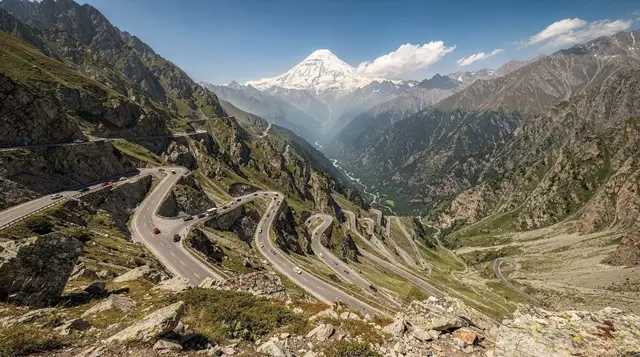
North on the Georgian Military Highway through Ananuri Fortress and Gudauri to Stepantsminda, roughly three hours’ drive each way. Having your own car here means you can stop freely at viewpoints along the pass rather than sticking to a tour’s fixed schedule, though the final stretch up to Gergeti Trinity Church is still best done by shared 4x4 taxi (25–30 ₾ per person) rather than your rental, since the track is steep, rutted and hard on a standard hire car.
See Ananuri Fortress and the Zhinvali reservoir and Gergeti Trinity Church: how to reach it. Return to Tbilisi for the night, or, if you would rather not double back, stay in Stepantsminda and continue toward Kakheti the following day via a longer cross-country route — most drivers find backtracking to Tbilisi simpler given the region’s road layout.
Day 4: Kakheti wine country
East to Sighnaghi, Bodbe Monastery and Telavi, with your own car making it easy to add a second or third winery beyond what a fixed-itinerary tour would include. Wine Tour to Kakheti Sighnaghi Bodbe Wine Tasting is worth booking even with your own car if you want a guided tasting rather than showing up unannounced at cellar doors, since many family wineries prefer arranged visits. See A wine tour of Kakheti: how to plan it and Telavi and the Alazani valley wineries for the geography of the region. If you plan to taste seriously, designate a driver for the day or arrange a local driver instead of self-driving between cellars.
Day 5: Tbilisi to Borjomi and Vardzia
This is the longest driving day of the ten, and the one where having a car earns its keep most clearly: Borjomi, the spa town famous for its mineral water, sits about two and a half hours from Tbilisi, and Vardzia, Queen Tamar’s twelfth-century cave city carved into a cliff face near the Turkish border, is another ninety minutes beyond that.
From Tbilisi: Gori Borjomi Vardzia Rabati Fortress Tourcovers the same route as a guided day tour if you would rather not navigate it yourself, useful on a day when you may be tired from Kakheti the day before. Stop in Borjomi for a walk through Borjomi Central Park to the source itself — see Borjomi water at the source — before continuing to Vardzia. See Vardzia: Queen Tamar’s cave city and our Vardzia timing guide for why many visitors wish they had stayed the night nearby rather than driving back to Borjomi in the dark; consider a guesthouse in Akhaltsikhe or Vardzia itself rather than pushing on.
Day 6: Akhaltsikhe, Rabati Fortress and on to Kutaisi
From Vardzia or Akhaltsikhe, the road continues northwest toward Kutaisi, roughly three and a half hours depending on your starting point. Break the drive at Rabati Fortress in Akhaltsikhe, a heavily restored citadel that divides opinion among Georgians — some see a valuable rescue of a crumbling site, others an overly polished reconstruction — but is worth the stop regardless; see Rabati Fortress: a restoration that divides Georgians for both sides of that argument. Arrive in Kutaisi by evening and settle in for two nights.
Day 7: Kutaisi’s monasteries and canyons
With a full day and a car, this is the one day of the trip where you can realistically combine what the shorter itineraries have to choose between: Gelati Monastery’s mosaics and Bagrati Cathedral in the morning, then Martvili Canyon or Prometheus Cave in the afternoon, all within about ninety minutes’ drive of Kutaisi and of each other.
Bagrati Gelati Motsameta Monasteries Tourcovers the monastery half if you would rather have a guide explain the mosaics’ history than read about them afterward. See Gelati Monastery and its mosaics and Martvili Canyon by boat for what each stop involves, and pace the day realistically — trying to add Sataplia on top of both usually means rushing at least one stop.
Day 8: Kutaisi to Batumi
Roughly two and a half to three hours west to the Black Sea coast. Batumi is a genuinely different Georgia from everything so far in this itinerary — a subtropical resort city with Belle Époque architecture standing next to Soviet apartment blocks and a skyline of newer casino towers, none of it quite matching the mountain-and-monastery Georgia of the first week. Spend the afternoon walking Batumi Boulevard end to end, the seven-kilometre promenade that is the city’s social centre; see Batumi Boulevard end to end, which covers the redevelopment behind the newer stretches of the promenade alongside the older Belle Époque core.
Day 9: Batumi, beach and old town
Batumi’s beaches are pebble, not sand — a fact worth knowing before you arrive expecting a Mediterranean strip — and the swimming season runs roughly June to September; see our Batumi beaches guide and our Black Sea swimming-season guide. Spend the morning at the beach or the botanical garden just north of the centre, then use the afternoon for the old town’s narrower streets and a proper Adjarian meal — the boat-shaped khachapuri, filled with cheese and a raw egg stirred in at the table, originated here and is worth eating in its home city rather than only in Tbilisi.
See Adjarian food in Batumi, beyond the boat-shaped khachapuri for what else the region’s cuisine offers beyond the famous dish. Best of Batumi Guided City Tour Tasting of Georgian Wine combines a city tour with food tastings if you would rather have both covered in one booking.
Day 10: Batumi to Tbilisi
The return drive to Tbilisi is five to six hours on the direct route, which makes flying a serious alternative if your schedule is tight: domestic flights between Batumi and Tbilisi run under an hour and are often cheaper than a full day lost to driving, especially if you need to return the rental car on time. See Tbilisi to Batumi: plane, train or road for the full comparison. If you do drive, the route runs largely along the coast and then inland through Imereti, giving one last look at the landscape you crossed on day eight, this time in reverse.
Where to stay along the route, night by night
Nights one and two: Tbilisi’s Old Town or Sololaki, close to the walking routes and with easy onward access to the car rental office. Night three: back in Tbilisi after Kazbegi, unless you choose to push on directly — most drivers find it simpler to use Tbilisi as a base for both the Kazbegi and Kakheti days rather than relocating for one night each. Night four: Tbilisi again, after Kakheti. Night five: Akhaltsikhe or a guesthouse near Vardzia itself, rather than driving back to Borjomi in the dark — the road through the gorge is manageable by day but not one to rush after sunset.
Nights six and seven: Kutaisi, central and inexpensive at 60–100 ₾ a night for a mid-range double. Nights eight and nine: Batumi, where prices run higher in July and August than anywhere else on this route — book ahead if travelling in peak summer. See Where to stay in Tbilisi, neighbourhood by neighbourhood and our accommodation-types guide for what to expect at each stop.
A more detailed budget for the ten days
The car itself is the largest fixed cost: 25–40 € a day for a small manual rental plus fuel, which runs roughly 2.6–2.8 ₾ a litre and adds up to perhaps 300–400 ₾ across the full route depending on how much you detour. Accommodation across nine nights at a mid-range level totals roughly 700–1,000 ₾, more in Batumi during peak summer.
The organised activities in this plan — the Kakheti tasting, the Borjomi–Vardzia day if you choose the tour over self-driving it, the monastery tour in Kutaisi and the Batumi food tour — each run 50–90 € per person, and you do not need all four; two or three is a realistic mix for most travellers. Add ordinary food at 30–50 ₾ per person per day for mixed restaurant and market eating, and the total for a mid-range couple sharing a car comes to roughly 900–1,300 € per person for the full ten days, including the car, fuel, accommodation and a reasonable number of paid activities.
Common mistakes on a first Georgia road trip
The most frequent mistake is underestimating mountain driving times — Google Maps’ estimate for the Vardzia and Kutaisi legs assumes a pace few visitors are comfortable holding on unfamiliar, switchbacked roads, so add 20–30% to any estimate for those two specific days. The second is skipping travel insurance that covers a rental car excess; Georgian rental agreements often carry a higher standard excess than European drivers are used to, and a supplementary policy bought before the trip is usually far cheaper than the agency’s own excess-waiver add-on.
The third is trying to add Svaneti onto this itinerary without extending it — Mestia is a further four to five hours past Kutaisi each way, which does not fit inside ten days alongside everything else here; see Two weeks in Georgia if Svaneti is a priority.
What to drop if you only have eight days
Cut Vardzia before you cut Borjomi — Borjomi is on the direct route west and costs little extra time, while the detour south to Vardzia and back adds most of a day on its own. The other honest cut, if the coast matters less to you than the mountains and wine, is Batumi: fly directly out of Kutaisi instead of continuing to the coast, and use the two days saved to slow down in Kakheti or Svaneti instead. Neither cut damages the logic of the trip; both simply trade one region for more time in another.
Frequently asked questions about ten days in Georgia
Do I really need a car for this itinerary, or could I use tours and trains?
You could substitute tours and trains for most individual legs, but stitching together Borjomi, Vardzia, Akhaltsikhe and Kutaisi on public transport specifically involves long waits and indirect routes that a car avoids entirely. This is the itinerary where a car makes the biggest practical difference of any route in this series.
Is it safe to drive yourself in Georgia?
Broadly yes, though standards differ from Western Europe — overtaking on blind corners and inconsistent lane discipline are common, and mountain roads like the Vardzia and Kutaisi legs deserve a slower pace than the distance alone suggests. See Driving in Georgia: rules, roads and habits for specifics before you set out.
Should I fly back from Batumi instead of driving to Tbilisi?
If your schedule is tight or you need to return the rental car precisely on time, yes — the flight is under an hour against five to six hours of driving. If you have a spare day, driving back gives one more look at Imereti’s landscape and costs only time, not much money.
Is Vardzia worth the detour from Borjomi?
Yes, for most visitors — it is one of the more striking sights in the country, a cliffside cave city with hundreds of rooms carved into rock. The honest caveat is the extra driving time it adds; stay overnight near Akhaltsikhe rather than pushing back to Borjomi the same evening.
How does Batumi compare to Tbilisi — is it worth the extra two days?
They are different enough that comparing them directly undersells both: Tbilisi is history, churches and mountains within reach; Batumi is coastline, subtropical gardens and a very different, newer skyline. See Tbilisi or Batumi? for a fuller comparison if you are deciding whether the coast earns its place on a first Georgia trip.
What is the best time of year to drive this specific route?
Late April to June and September to October, for the same reasons as shorter itineraries — clearer mountain views at Kazbegi, comfortable driving and walking temperatures, and Batumi’s beach season without peak-July crowding. Winter closes some higher mountain viewpoints but does not affect the Borjomi–Vardzia–Kutaisi–Batumi leg significantly. Snow does occasionally affect the Gudauri stretch of the Military Highway between November and March, so build a spare day into the schedule around day three if you are driving in that window, in case the pass closes briefly and you need to wait it out rather than push through.
Can I do this route in the opposite direction, starting in Batumi?
Yes, and it can make sense if your flights land into Kutaisi or Batumi rather than Tbilisi — simply run the same ten days in reverse, ending in Tbilisi for an easy car return and departure. The driving distances and logistics are identical either way; only the order of your evenings in each town changes.
Trip-planning essentials on GetYourGuide
Verified deep-linked GetYourGuide tours. Book through these links and we earn a small commission at no cost to you.
Photo: our own image of the location, not the operator’s product photo.