Narikala Fortress and the cable car: what it costs and when to go
How much does the Narikala cable car cost?
A single ride is about 5 GEL (roughly 1.70 euros), paid with a Metromoney card at the Rike Park station, the same card used on Tbilisi's metro and buses. It runs from around 10am to 10pm and takes under three minutes to reach the fortress ridge.
A fortress mostly in ruins, and that is the point
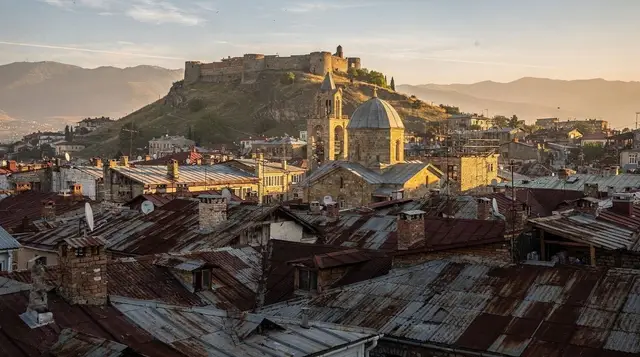
Narikala Fortress sits on the ridge above Tbilisi’s Old Town, and has done in some form since at least the fourth century, rebuilt and extended by Persian, Arab and Georgian rulers over thirteen centuries before an 1827 earthquake left much of it in the state it is in today: broken walls, a couple of watchtowers you can climb, and long stretches of crumbling stone with weeds growing through the joints.
There is no ticket booth, no reconstructed throne room, no museum inside the walls. What draws people up here is not the fortress as a building but the fortress as a platform — the single best panorama over the Old Town’s tiled roofs, the Mtkvari River, the Bridge of Peace, and the Mtatsminda ridge across the city, all from one spot without paying for entry.
Anyone arriving expecting a preserved castle will be mildly disappointed. Anyone arriving for the view, and prepared for uneven ground and no handrails on some of the wall sections, gets exactly what the reputation promises.
A brief history: why the walls look the way they do
The name Narikala is generally traced to a Persian or Mongol-era phrase meaning something close to “small fortress,” though the site itself long predates that name — the earliest defensive structure here is usually dated to the fourth century, built by Persian rulers to control the river crossing and the trade routes running through what became Tbilisi. Over the following centuries the fortress changed hands repeatedly as Arab, Georgian, Mongol, Persian and briefly Ottoman forces fought over control of the city, each occupation adding or rebuilding sections of wall, which is part of why the fortifications you see today are a patchwork rather than a single coherent design.
The decisive blow was not war but an accident: in 1827, a gunpowder store inside the fortress exploded, destroying a large section of the upper walls and the original church on the site. By that point Tbilisi was under Russian imperial control and the fortress had lost its military purpose, so it was never seriously rebuilt — the explosion essentially fixed Narikala in the half-ruined state it has been in for the last two centuries, with only St Nicholas Church rebuilt, and that only in the 1990s after Georgian independence.
The cable car: cost, hours and how it actually works
The easiest way up is the cable car from Rike Park, on the east bank of the river near the Bridge of Peace. It opened in 2012, runs a short but steep line up over the river and the Old Town rooftops, and reaches the fortress ridge in under three minutes.
Fares run about 5 GEL per ride, paid by tapping a Metromoney card at the turnstile — the same transport card used across Tbilisi’s metro and bus network, which is worth having loaded before you arrive since there is no separate cash desk at the cable car station. Operating hours are broadly 10am to 10pm, though this shifts seasonally and the service suspends in high wind, which happens often enough on this exposed hillside that it is worth having the walking route as a backup plan rather than a last resort.
The ride itself is one of the better things to do in Tbilisi purely as an experience — the cabins are glass-sided, the climb is steep enough to feel dramatic without being unsettling, and the view opens up fast once you clear the rooftops.
Finding the Rike Park station is straightforward: it sits at the base of the park on the east side of the river, a short walk from the Bridge of Peace and easy to combine with a stroll through Rike Park itself, which has a small amphitheatre and a chess-themed public space worth five minutes if you are early for your ride. The station can be reached on foot from Freedom Square in about fifteen minutes, or by Bolt for 5 to 12 GEL if you would rather not walk the flat but unshaded riverside approach in summer heat.
Anyone comparing this ride to Georgia’s other cable cars — the one at Gudauri for skiing, or the Argo cable car in Batumi that runs to a hilltop park above the Black Sea — should know Narikala’s is by far the shortest and cheapest, and the only one built purely as a sightseeing shuttle rather than serving a ski resort or amusement park at the top.
Tbilisi: 2 Cable Cars 2 Peaks 2 Faces Old and New City pairs this ride with the separate cable car up to Mtatsminda on the other side of the city in a single guided day, which is a reasonable way to cover both of Tbilisi’s cable-car viewpoints without working out the connections yourself.
Walking up instead: the free option
If the cable car is closed, queued, or simply not appealing, the fortress is reachable on foot in two ways. The shorter route climbs from Betlemi Street in the Old Town, a steep but brief ascent of roughly 15 to 20 minutes on stone steps and a dirt path — covered as part of the full route in A self-guided walking route through Tbilisi’s Old Town. The second option approaches from near the Botanical Garden entrance, longer but gentler in gradient, and worth combining with a visit to the garden itself if time allows.
Neither walking route costs anything, which matters if you are visiting on a tight budget or simply prefer not to queue for the cable car in peak season, when waits can build up on weekend afternoons.
Inside the walls: what there actually is to see
Once inside, the fortress splits into a lower and upper section connected by a path along the ridge. The upper section has the better-preserved watchtower, climbable via a narrow internal staircase with no lighting and no handrail — manageable for most adults but worth skipping if you are uneasy on tight, dark stairs or travelling with young children. St Nicholas Church, a small brick chapel with frescoed interior walls, was rebuilt in the 1990s on the footprint of an earlier church destroyed in a 1827 gunpowder explosion inside the fortress; it is modest but worth the two-minute look inside.
Most of the site is simply walking the wall line for the view, and this is genuinely where the value is. Bring water in summer — there is no shade and no kiosk selling drinks inside the fortress itself, only at the base near the cable car station.
Kartlis Deda: the Mother of Georgia statue
A five-to-ten-minute walk further up the ridge from the fortress is Kartlis Deda, the Mother of Georgia — a 20-metre aluminium statue erected in 1958 for the 1500th anniversary of Tbilisi’s founding, holding a sword in one hand for the city’s enemies and a bowl of wine in the other for its guests. Visitors regularly assume it is part of the fortress complex; it is a separate, much later monument, and the walk up to its base is worth the extra time for an even wider view back over the whole city, including a first look toward Holy Trinity Cathedral on the far ridge.
Tbilisi: Private Tour to Mother of Georgia Narikala Castle covers both the fortress and the statue with a private guide, useful if you want the history explained on the spot rather than pieced together from signage, which is minimal.
Combining Narikala with the rest of a visit
Narikala sits directly above Abanotubani, the sulphur bath district, which makes the two a natural pair: climb or ride up for the view, then descend into the Old Town to finish with a sulphur bath. Both together, plus a walk through the lower Old Town, make a realistic half-day plan; see Tbilisi in one day: a realistic plan for how this fits alongside Rustaveli Avenue and a food stop.
For photography specifically, the fortress ridge is one of the entries in Where to photograph Tbilisi, hour by hour, and it is worth timing a visit for the hour before sunset if a clear view over the city with warm light is the priority — the same view exists at midday, but the light is flatter and the haze more noticeable. For a wider comparison of Tbilisi’s viewpoints, including ones that do not require a cable car at all, see The best viewpoints in Tbilisi.
If Narikala is one stop among several on a longer stay, Tbilisi in three days and Mtatsminda Park and the funicular — the city’s other main hillside viewpoint — both build naturally around it, and the walk down from the fortress connects easily into Sololaki: Art Nouveau doorways and painted stairwells if you still have energy for another neighbourhood afterwards.
Old Tbilisi Private Walking Tour and Cable Car is worth considering if you would rather have the Old Town walk and the fortress covered together in one booking with a guide, rather than piecing the two together yourself.
When to go: crowds, weather and wind
Weekday mornings are the quietest time at the fortress; weekend afternoons, especially from June through September, bring the heaviest queues at the cable car station, sometimes a wait of fifteen minutes or more at the base. The exposed ridge also means wind matters more here than almost anywhere else in the city — gusts strong enough to suspend the cable car are not rare, particularly in late autumn and winter, so building in a backup plan (the walking route) is sensible rather than overcautious. For a broader sense of what the seasons do to outdoor sightseeing across the city, see Georgia in summer, and how to escape the heat and Tbilisi weather month by month.
St Nicholas Church inside the fortress is a working Orthodox church, so the same dress expectations apply as anywhere else — see Visiting a Georgian Orthodox church: dress and etiquette if you plan to go inside rather than just view it from the courtyard.
What to skip
The small souvenir stalls near the upper cable car station sell largely generic magnets and prints at prices above what the same items cost at Dry Bridge Market — fine for convenience, not worth a special stop. The Botanical Garden connector cable car, when it is running, is a nice add-on rather than a reason on its own to visit; its operating hours are inconsistent enough that building a schedule around it is a mistake.
Accessibility and who should skip the climb
The cable car itself is step-free at both stations and reasonably manageable for wheelchair users and anyone with limited mobility, though the paths inside the fortress grounds are uneven gravel and broken stone with no ramps, which limits how far into the site a wheelchair can realistically go. The watchtower stairs are the clearest no: narrow, dark and steep, with nothing to hold onto partway up. Visitors with knee or balance problems are generally better served sticking to the main courtyard level and the outer wall path, which still delivers the main view without the harder sections.
For anyone travelling with very young children, the drop-offs along parts of the wall are unfenced, which matters more here than at most sights in the city — worth keeping a hand free rather than relying on a child to stay back from the edge on their own.
Frequently asked questions about Narikala Fortress and the cable car
How much does the Narikala cable car cost?
About 5 GEL per ride, paid by tapping a Metromoney card at the turnstile — the same card used for the metro and city buses, topped up at any station kiosk or machine. There is no separate cash ticket booth at the cable car station itself.
What time does the Narikala cable car open and close?
Generally from around 10am to 10pm, though the exact hours shift with the season and it closes in high wind, which happens more often than visitors expect on this exposed ridge. If it is closed, the walking path from Abanotubani or Betlemi Street is the only way up.
Is Narikala Fortress worth visiting, or is it just ruins?
It is mostly ruins — walls, watchtowers and a small restored church — rather than an intact fortress with rooms to explore. What it is genuinely worth visiting for is the view: the best single panorama over the Old Town, the river and the Mtatsminda ridge on the opposite side of the city.
Can you walk up to Narikala instead of taking the cable car?
Yes, on foot from Betlemi Street in the Old Town or from a path near the Botanical Garden, both free. The Betlemi route is a steep but short climb, roughly 15 to 20 minutes; expect proper footwear rather than sandals.
Is there an entrance fee for Narikala Fortress itself?
No. The fortress grounds are free to walk once you are up there, whether you arrive by cable car or on foot. The cable car fare is a transport cost, not an entry ticket.
What is the statue next to Narikala Fortress?
Kartlis Deda, the Mother of Georgia — a large aluminium statue on the ridge above the fortress, holding a sword for enemies and a bowl of wine for guests. It is a five-to-ten-minute walk further up from the fortress itself and is often mistaken for part of Narikala, though it is a separate Soviet-era monument from 1958.
How long should I spend at Narikala Fortress?
Forty-five minutes to an hour covers the fortress walls and the walk up to the Mother of Georgia statue at a relaxed pace, including time to take photographs from the main viewpoint.
Does the cable car connect to the Botanical Garden?
Not directly. A separate short cable car link exists between the fortress ridge and the Botanical Garden entrance in some seasons, but it has a history of inconsistent operation — check locally rather than planning around it.
Old Town walking tours on GetYourGuide
Verified deep-linked GetYourGuide tours. Book through these links and we earn a small commission at no cost to you.
Photo: our own image of the location, not the operator’s product photo.