Ananuri Fortress and the Zhinvali reservoir
Is Ananuri Fortress worth stopping for?
Yes, and briefly: Ananuri is a 15-20 minute stop, not a destination in itself, but its combination of a 17th-century fortress complex, two working churches and the turquoise Zhinvali reservoir directly below makes it the best-value stop on the Georgian Military Highway between Tbilisi and Kazbegi.
A fortress that outgrew its original job
Ananuri was built from the thirteenth century onward as the seat of the Aragvi dukes (eristavis), a local ruling family who controlled this stretch of the Aragvi valley and the route north into the mountains — the same corridor the Georgian Military Highway follows today. What stands now is mostly seventeenth-century work, added after the complex was fought over repeatedly, including a particularly brutal episode in 1739 when a rival duke burned the fortress with much of the ruling family still inside.
The Aragvi dukes were eventually stripped of their power by the Georgian crown later in the eighteenth century, and Ananuri passed out of active use as a residence, which is part of why the complex has survived reasonably intact rather than being rebuilt into something else.
Today the site is really three things stacked together: a defensive fortress with two stone towers, a walled courtyard, and two working Orthodox churches inside the walls. It is compact enough to see properly in twenty minutes, which is exactly the role it plays for almost every visitor — a stretch-your-legs stop on the way to somewhere else, not a destination that justifies its own trip from Tbilisi.
What to see inside the walls
The larger of the two churches, the Assumption Church (sometimes called the Mkhedni or Virgin church), dates to 1689 and has the most elaborate stonework at Ananuri: a carved cross on the south facade is the single most photographed detail at the site, along with faded but still legible fresco fragments inside. The smaller, plainer church nearby is older and less decorated, and the two make an easy contrast if you are trying to get a feel for how Georgian ecclesiastical carving changed over a few centuries.
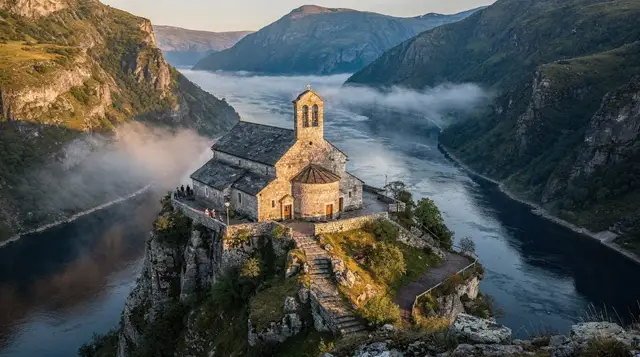
Both defensive towers can be climbed via narrow stone stairs — the larger one, Sheupovari Tower, has the better view but the steps are steep and uneven, worth skipping if mobility is a concern. From the top, or even from ground level near the walls, the main reason people stop here becomes obvious: the Zhinvali reservoir spreads out immediately below the fortress, an unusually saturated turquoise-green from mineral content in the water, with the fortress walls and towers framing it from above. It is one of the more reliably photogenic views on the whole route north, and it works in most light, though morning tends to be calmer and less hazy than afternoon.
The reservoir itself was created in 1985 by damming the Aragvi River for hydroelectric power and Tbilisi’s water supply, which means the fortress’s current lakeside setting is a twentieth-century addition to a seventeenth-century building — worth knowing if a guide does not mention it, since the lake is often assumed to be original to the landscape.
Visiting: timing, cost and what is nearby
Ananuri has no fixed opening hours in the way a museum does — it is an open site with a car park, open roughly from early morning to early evening, and there is no entry fee to the grounds or either church. The car park charges a small fee. A handful of stalls near the entrance sell honey, dried fruit, churchkhela and local wine, priced similarly to other roadside stops along this route rather than inflated for the location.
Almost every visitor arrives as part of a longer trip north: Ananuri sits directly on the Georgian Military Highway, about an hour from Tbilisi and roughly two hours before Kazbegi, which makes it the natural first stop on nearly any day trip to Kazbegi or a trip up to Gudauri for skiing in winter.
A Kazbegi day tour that includes Ananuri is by far the most common way to see it, since almost no independent traveller makes the fortress a dedicated round trip on its own — the marshrutka to Kazbegi passes right by it, but does not generally stop long enough to visit properly without a private arrangement.
Crowds follow the Kazbegi traffic pattern: buses and shared taxis heading north cluster here between roughly 09:30 and 11:00, and again on the return leg from around 16:00. Visiting early, or as a first stop before 09:30, gives noticeably more space to walk the walls and photograph the reservoir without other groups in frame.
If you would rather not manage the timing yourself, a private day out that pairs the reservoir with Gergeti lets the driver decide when to leave Tbilisi, so the fortress is reached before the shared groups arrive. Travellers who prefer a set group programme can look at a shared mountain day that starts at the fortress, which keeps the cost down but follows the group’s schedule at each stop. Either way, the guided versions are best judged by how much time they leave at Ananuri itself and at the Gergeti Trinity Church, the two places where a rushed itinerary shows most. Our guided tour or independent comparison and the marshrutka or private driver guide help weigh the options.
Continuing north or looping back
Beyond Ananuri, the Military Highway climbs toward Gudauri and the Jvari Pass before dropping into the Kazbegi valley — see our mountain roads and passes guide for when this route can close in winter. For hikers continuing further into the mountains, our climbing Mount Kazbek guide covers what a serious ascent from Stepantsminda actually involves, well beyond what a day trip like this one reaches, and our seven day Georgia itinerary shows where a stop like this fits into a longer trip.
Some itineraries combine Ananuri with a stop at Jvari Monastery near Mtskheta on the same day, since both sit on routes north from Tbilisi, though this makes for a long day if Kazbegi itself is also on the list — our Kazbegi or Svaneti comparison is a useful read if you are deciding which mountain region deserves more of your time. For travellers weighing whether the whole Military Highway route is worth a full day versus a shorter loop, best day trips from Tbilisi ranks it against the other options.
The Aragvi dukes and why the fortress was built here
Ananuri’s history is really the history of a single powerful family, the Aragvi eristavis (dukes), who controlled this stretch of the valley from the medieval period through the eighteenth century. Their position was strategically valuable precisely because of the geography: the Aragvi valley is the natural corridor connecting Tbilisi and the Georgian lowlands to the mountain passes leading north into the Caucasus and beyond, the same route the Georgian Military Highway follows today. Whoever controlled Ananuri controlled trade, troop movement and communication along that entire corridor, which made the Aragvi dukes wealthier and more independent-minded than most regional nobility answering to the Georgian crown.
That independence eventually became a liability. Rivalry between the Aragvi eristavis and a neighbouring noble family, the Ksani eristavis, escalated over generations into open conflict, and in 1739 the Ksani duke Shanshe led an attack on Ananuri that ended with the fortress burned and much of the ruling Aragvi family killed inside it, including women and children who had taken refuge in the Assumption Church.
It is a genuinely dark episode in the fortress’s history, and one that local guides will often mention when explaining why Ananuri, despite its scenic setting, has a harder historical edge underneath the postcard view. The Georgian crown used the resulting instability as grounds to formally strip the Aragvi eristavis of their hereditary authority later in the century, folding their territory more directly under royal control and ending Ananuri’s role as an independent power centre.
What the towers and walls tell you about medieval defence
Ananuri’s defensive layout rewards a slower look if military architecture interests you. The complex uses a double-walled design: an outer wall enclosing a larger courtyard area, and an inner, higher wall protecting the core buildings and the two towers, a common medieval Georgian approach that gave defenders a fallback position if the outer perimeter was breached. Sheupovari Tower, the taller and better-preserved of the two, has narrow window-slits positioned for archers rather than for light or view, and the stonework at its base is noticeably thicker than higher up, a standard medieval technique for withstanding the battering and mining tactics used against a tower’s foundation.
The positioning relative to the river and the road is also deliberate: Ananuri sits on a natural promontory that would originally have overlooked the Aragvi’s original course before the valley was flooded for the Zhinvali dam, giving defenders visibility up and down the valley in both directions — towards Tbilisi and towards the mountain passes — which is exactly the kind of sightline a medieval garrison controlling a trade corridor needed. None of this is obvious from a quick walk through today, since the modern reservoir has changed the immediate landscape substantially, but it explains why this particular spot, rather than any other point along the valley, became the seat of regional power for several centuries.
A realistic stop, not a destination: setting expectations
It is worth being direct about what kind of stop this is, since some travellers arrive expecting more than a fortress this size can deliver on its own. Ananuri is genuinely worth the fifteen to twenty-five minutes it takes to see properly, and the reservoir view is one of the better photo opportunities on the whole Georgian Military Highway route, but it is not a destination that justifies a dedicated round trip from Tbilisi by itself.
Almost every visitor sees it as one stop among several on a longer day heading toward Gudauri and Kazbegi, and that is the right way to think about it: a well-placed, genuinely interesting break in a longer drive, not a half-day attraction in its own right. Setting that expectation before arriving avoids the mild disappointment some first-time visitors report after building up a stop that, however scenic, is fundamentally brief.
Seasonal notes and what to bring
Ananuri is exposed and largely unshaded, which matters more in summer (June-August) than at other times of year — bring water and sun protection if visiting in the middle of the day, and expect the climb up Sheupovari Tower’s stone steps to be genuinely hot work in July heat. Spring and autumn give the most comfortable conditions for the climb and the walk around the walls, and autumn in particular brings good light for the reservoir photographs, with the turquoise water contrasting well against the changing colours on the surrounding hillsides.
Winter visits are entirely possible — the site does not close — but snow and ice on the tower steps can make the climb genuinely risky in bad weather, and some visitors choose to skip the tower interior in favour of ground-level photos when conditions are poor. Since Ananuri sits on the direct route toward Gudauri and the higher passes, checking the wider mountain road conditions before setting out is sensible regardless of whether you plan to stop at the fortress itself, since a closure further up the highway would affect the whole day’s plan.
What locals actually think of the stop
Ask a Georgian driver or guide who has done the Kazbegi route dozens of times, and most will describe Ananuri in similar terms: a genuinely good, quick stop that earns its place on the itinerary without needing to be oversold. Unlike some heavily promoted stops elsewhere in the country, Ananuri has not attracted the kind of tourist-trap pricing or aggressive vendor presence that can make a scenic stop feel like a hassle — the honey and churchkhela stalls near the entrance sell at broadly fair prices, and there is no pressure to buy.
That straightforward, unfussy character is part of why it remains a reliable first stop on almost every Kazbegi itinerary rather than a site travellers increasingly try to skip, which has happened to some other well-known stops in Georgia as visitor numbers have grown.
How Ananuri compares with Georgia’s other fortresses
Georgia has no shortage of fortress sites, and it is worth placing Ananuri against the alternatives if you are deciding how many to fit into a trip. Rabati Fortress in Akhaltsikhe is far larger and more heavily restored, closer to a polished heritage complex with a hotel and museum than a working medieval ruin — worth visiting for a different reason than Ananuri, and roughly four hours further from Tbilisi.
Narikala Fortress in Tbilisi gives a comparable defensive-hilltop feel within the capital itself, but without the reservoir and without the same depth of documented family history. Uplistsikhe near Gori is a cave city rather than a stone fortress in the conventional sense, an entirely different kind of defensive site built into rock rather than built up from it.
Ananuri’s particular value is that it delivers a genuine, largely unrestored medieval fortress experience — walls you can touch, towers you can climb, a documented and fairly brutal history — in under twenty-five minutes and without detouring from the most popular route north out of Tbilisi. That efficiency, more than any single feature, is why it remains the fortress most visitors to Georgia actually see, even if Rabati or others might individually be more visually striking or historically extensive. For a trip with limited time, Ananuri is close to the best return on a short stop that the country offers.
A note on the drive itself
The road between Tbilisi and Ananuri runs through the Aragvi valley and is in reasonably good condition for most of its length, generally an easy hour of driving without the switchbacks and altitude that make the stretch beyond Gudauri more demanding. This makes Ananuri a low-stress first stop even for travellers nervous about mountain driving conditions further along the same route — the approach to the fortress itself involves nothing more challenging than a short, well-paved turn off the main highway into a car park.
If altitude or winding mountain roads are a concern for the rest of a Kazbegi day trip, Ananuri is a safe, easy stop to plan around regardless of what conditions look like further ahead toward Gudauri and the Jvari Pass. Drivers coming from Tbilisi generally treat the fortress car park as the natural halfway marker before the road begins climbing in earnest, which makes it a sensible point to stretch, use the toilets available near the car park, and take stock before the more demanding driving further north.
Frequently asked questions about Ananuri Fortress
How much time do I need at Ananuri Fortress?
Fifteen to twenty-five minutes covers the towers, both churches and the reservoir viewpoint at a comfortable pace — it is a brief stop, not a half-day destination.
Is Ananuri Fortress free to enter?
Yes, there is no entry fee to the grounds or churches. The car park charges a small fee.
How far is Ananuri Fortress from Tbilisi?
About 60-70 km, roughly one hour by car along the Georgian Military Highway, directly on the route to Gudauri and Kazbegi.
Can you swim in the Zhinvali reservoir near Ananuri?
Technically yes in summer, but it is not set up for swimming — no beach infrastructure, cold water and steep banks in most places. It is best seen from the fortress viewpoint above.
What is the difference between the two churches at Ananuri?
The larger Assumption Church (1689) has elaborately carved stonework and is the more photographed of the two; the smaller, older church nearby is plainer inside and out.
Should I stop at Ananuri on the way to Kazbegi or on the way back?
Either works, but morning light suits the reservoir photos better and the site is quieter before the main wave of Kazbegi day-trip traffic builds from around 10:00.
Monastery and fortress tours on GetYourGuide
Verified deep-linked GetYourGuide tours. Book through these links and we earn a small commission at no cost to you.
Photo: our own image of the location, not the operator’s product photo.