A self-guided walking route through Tbilisi's Old Town
How long does it take to walk Tbilisi's Old Town?
A focused walk from Freedom Square down to Narikala Fortress and Abanotubani takes three to four hours at an unhurried pace, including the cable car up to the fortress. Add another hour if you climb the fortress walls fully or stop for khinkali along the way.
What “Old Town” actually covers
Tbilisi’s Old Town is not one neighbourhood with clean edges. It is a wedge of the city squeezed between the Mtkvari River and the ridge that carries Narikala Fortress, running roughly from Freedom Square in the north down to the sulphur bath district of Abanotubani in the south, with the leafier streets of Sololaki climbing the hillside to the west.
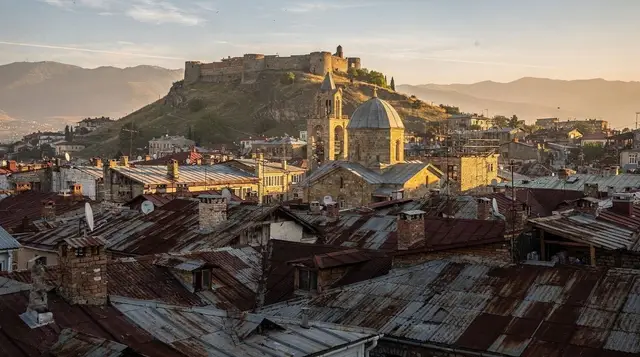
It survived the twentieth century in patches rather than as a whole: some blocks were restored heavily before Tbilisi hosted European Youth Olympic events, others were left to sag quietly, and a handful of the finest carved-balcony buildings on Betlemi and Sioni streets are still propped up with scaffolding rather than repaired. That unevenness is part of what makes the area worth walking rather than just photographing from Narikala — the ordinary streets between the landmarks tell you more about the city than the landmarks do.
This route takes three to four hours walked at an unhurried pace, covers everything most first-time visitors want to see, and flags the two or three detours worth the extra time. If you only have a single day in the city, this walk plus the fortress and the baths is a realistic full-day plan — see Tbilisi in one day: a realistic plan for how the timing works alongside food stops and a rest.
Starting point: Freedom Square
Begin at Freedom Square (Tavisuplebis moedani), a wide roundabout dominated by a gilded statue of St George on a column, unveiled in 2006 to replace a Lenin statue that stood on the same spot for decades. It is not an attractive square in its own right — mostly traffic and municipal buildings — but it sits directly on the metro’s red line, which makes it the easiest place to start if you are coming from a hotel outside the centre. See Tbilisi metro, buses and the Metromoney card for how the transport card works.
From the square, walk south down Sioni Street. Within a few minutes the modern city recedes and the buildings narrow into two- and three-storey stone facades with wooden balconies overhanging the pavement, some of the oldest wooden balcony work left in Tbilisi.
Sioni Cathedral and Anchiskhati Basilica
Sioni Cathedral, on the street of the same name, was the seat of the Georgian Orthodox Patriarchate until Holy Trinity Cathedral (Sameba) was completed on the opposite hillside in 2004. It has been rebuilt several times since its sixth-century founding — most of what stands now dates from the thirteenth century onward, with later Persian and Russian-era damage repaired piecemeal. It is a working church, not a museum, so cover shoulders and knees before entering; see Visiting a Georgian Orthodox church: dress and etiquette if you are unsure what is expected.
A short walk further south, set back from the road, is Anchiskhati Basilica, generally reckoned the oldest standing church in Tbilisi, with a sixth-century core beneath later additions. It is smaller and plainer than Sioni and easy to walk past without noticing — worth the two-minute detour rather than a destination in itself.
Down to the river: Bridge of Peace and Metekhi
Continue toward the river and you reach the Bridge of Peace, a curved glass-and-steel pedestrian bridge completed in 2010, designed by an Italian architect and disliked by a fair number of Tbilisi residents for how sharply it breaks with the Old Town’s stone and tile. Whatever the opinion on its looks, it is the easiest crossing to Rike Park and gives one of the better photo angles back toward the Old Town’s rooftops — see Where to photograph Tbilisi, hour by hour for the timing that suits it best.
On the opposite bank, above a cliff over the river, stands Metekhi Church with the equestrian statue of King Vakhtang Gorgasali, the fifth-century founder of Tbilisi according to city legend (a legend involving a wounded pheasant and a hot spring that is worth asking a guide about rather than taking as settled history). The terrace beside the church is one of the reliable viewpoints over the Old Town rooftops and the fortress — see The best viewpoints in Tbilisi for the full list.
Chardin Street, Erekle II and Shardeni: the restored core
Back on the Old Town side, the streets of Erekle II, Shardeni and Chardin form the most heavily restored and most touristed stretch — pedestrianised lanes lined with restaurants, wine bars and souvenir stalls, all under strings of café lights. They are genuinely pleasant to walk through in the evening, but be clear-eyed about the restaurants here: prices run noticeably above what the same khinkali or khachapuri costs two streets over, and quality is inconsistent given the tourist turnover. Treat this stretch as good for a drink and people-watching rather than the meal of the trip; see Where to eat in Tbilisi for places worth the detour instead.
Tbilisi: Old Town Guided Walking Tour covers this stretch and the streets around it with a local guide who can point out which buildings are original and which were rebuilt from photographs during the 2000s restoration push — useful here specifically, because from street level it is genuinely hard to tell.
Rezo Gabriadze’s Clock Tower and the puppet theatre
A short walk from Shardeni is the leaning Clock Tower built by the puppeteer and artist Rezo Gabriadze beside his marionette theatre — a deliberately crooked, fairy-tale structure covered in tile fragments and small figurines, with a mechanical puppet show that plays from a door in the tower at set times each day (worth checking the current time locally, as it shifts). It photographs well and costs nothing to see from outside; the puppet theatre performances inside require a ticket and advance booking in high season.
Betlemi Street and the climb toward Narikala
From the clock tower, head up Betlemi Street, which climbs steeply into the hillside quarter below the fortress. This is where the restoration thins out and the Old Town looks more like it did before the 2000s: leaning wooden balconies, laundry strung between buildings, and steps rather than pavement in places. It is one of the more photogenic stretches precisely because it has not been smoothed over, though footing needs attention, especially after rain.
Betlemi eventually meets the path and steps up to Narikala Fortress. Full detail on the fortress itself, the cable car alternative, and what the ruins actually contain is in Narikala Fortress and the cable car: what it costs and when to go — worth reading before you commit to the climb, since the cable car from Rike Park is faster and avoids the steepest section entirely.
Abanotubani: the sulphur bath district
Below the fortress, in the district known as Abanotubani, brick-domed bathhouses mark the site of the sulphur springs that gave Tbilisi its name (tbili means warm in Georgian). The domes are the most photographed feature of the whole Old Town, and the baths beneath them are a genuine experience rather than a tourist prop — a private room with a hot sulphur pool runs roughly 60 to 150 GEL an hour depending on which bathhouse and how much of the day you want. The full breakdown of prices, which bathhouse to pick and what a kisa scrub involves is in Abanotubani: the sulphur bath district explained.
Behind the bathhouses, a short and easy path leads to Legvtakhevi waterfall, a modest but genuinely pretty cascade tucked into a gorge between the buildings — free to see, and usually quiet since most visitors do not realise it is there.
Tbilisi: Private Sulfur Bath Experience with Tea or Wine is worth booking ahead in peak season (June to September), since the better-known bathhouses fill their private rooms by mid-afternoon on weekends.
Why the Old Town looks patched together
The unevenness is not neglect so much as history stacked in layers. Tbilisi was sacked repeatedly over its history — most devastatingly by the Persian ruler Agha Mohammad Khan in 1795, an event still referenced in local histories of the city — which is why almost nothing standing in the Old Town predates the early nineteenth century except church foundations and fortress stonework. What you are walking through today is mostly Russian imperial-era rebuilding from the 1800s, overlaid with Soviet-period apartment conversions that split grand merchant houses into communal flats, and then a post-independence restoration wave that has moved unevenly street by street since the 2000s.
Some buildings were fully rebuilt from old photographs for the 2015 European Youth Olympic Festival; others, a few doors down, are still held up with wooden props while ownership disputes between the families now living in subdivided flats go unresolved. Knowing this makes the contrast between a beautifully restored facade and a crumbling one next door make sense, rather than reading as simple neglect.
The tourist Old Town and the lived-in Old Town
It is worth being honest that Erekle II, Shardeni and Chardin are, at this point, largely a tourist product — pleasant, but not where most Tbilisi residents eat or spend an evening. The streets one block back, particularly around Sioni and up toward Betlemi, are still genuinely residential: washing lines strung across courtyards, small grocery shops with hand-written signs, and neighbours talking on stoops rather than serving menus in three languages.
Neither version is more “authentic” than the other — both are real parts of how the district functions now — but if the goal is to see how people actually live in the Old Town rather than how it is presented to visitors, it is worth deliberately wandering one street back from the pedestrianised core rather than staying on it the whole time.
Practical notes: pacing, food and footing
Budget more time than the walking distance suggests. The Old Town is small on a map — under two kilometres end to end — but the surface is almost entirely cobblestone and uneven stone stairs, and the temptation to stop every few minutes for a doorway or a balcony is real. Three to four hours is realistic for the full route including the fortress; treat two hours as the bare minimum if you are skipping Narikala.
Food along the way is easy to find but uneven in quality. A khinkali or khachapuri stop is worth timing for Sioni Street or the streets just off Erekle II rather than directly on it, where prices run higher for the same dumplings. Bakery windows selling fresh shoti bread and pastries are common throughout and make a reasonable, cheap mid-walk snack for a couple of lari.
Public toilets are scarce; cafés generally expect a purchase in exchange for using theirs, which is a fair trade at Georgian café prices. Water is sold everywhere and worth carrying in summer, when the stone streets hold heat well into the evening.
What this route deliberately leaves out
This is a first-visit route, not a complete tour of everything the Old Town contains. It skips the Georgian National Museum and the Parliament building on Rustaveli Avenue, both a short detour north of Freedom Square and covered separately in Rustaveli Avenue: what is actually worth stopping for. It also skips Mtatsminda Park and the funicular, which sits above the Old Town on the same ridge as Narikala but requires a separate approach — see Mtatsminda Park and the funicular for that route on a different day, since combining both in one outing makes for a very long day on your feet.
Nightlife on Erekle II and the wine bars scattered through Sololaki are worth a separate evening rather than folding into a daytime walk — see A night out in Tbilisi and Tbilisi wine bars worth a second glass for where that stretch of streets earns a return visit after dark.
Closing the loop: back to Freedom Square or onward
From Abanotubani you can either retrace your steps north through the Old Town back to Freedom Square, or continue west into Sololaki to see the Art Nouveau apartment buildings and painted stairwells, which adds roughly an hour. If energy is running low, a Bolt back to the centre costs 5 to 12 GEL and takes the climb out of the equation.
For a longer stay, this walk is the spine of both a realistic one-day plan and Tbilisi in three days, which build the rest of a visit around it — Mtskheta as a half-day trip, Kakheti wine country, or simply more time in neighbourhoods like Fabrika and the courtyards of Chugureti that this route does not cover. If you are staying nearby, see Where to stay in Tbilisi, neighbourhood by neighbourhood for which areas put you within walking distance of this whole route.
Tbilisi: Top 20 Highlights Guided Walking Tour with Tastings is the better option if you want the Old Town walk combined with wine and food tastings along the way rather than doing the eating separately — it covers most of this same ground with stops built in.
Frequently asked questions about Tbilisi’s Old Town walking route
Where should I start a walking tour of Tbilisi’s Old Town?
Freedom Square is the most practical start: it sits on the metro line, has the clearest orientation, and puts Sioni Cathedral and the descent into the Old Town within five minutes on foot.
Is Tbilisi’s Old Town walkable in one day?
Yes. The Old Town proper is compact enough to cover on foot in half a day. Most visitors pair it with a Narikala Fortress cable car ride and a stop at the sulphur baths, which fills a full day comfortably without rushing.
Do I need a guide to walk Tbilisi’s Old Town, or can I do it alone?
The route is easy to follow alone with a phone map, since the Old Town is small and hemmed in by the river and the hillside. A guided walk adds context on buildings you would otherwise pass without knowing their story, which is the main argument for booking one rather than a navigation need.
What shoes should I wear for walking in Tbilisi’s Old Town?
Flat, grippy shoes. The lanes around Betlemi and Sololaki are steep cobbled streets, several without proper pavements, and they get slippery when wet.
Is Tbilisi’s Old Town safe to walk at night?
The core tourist streets around Erekle II and Shardeni stay lit and busy well into the evening. Away from those, lighting thins out quickly on the steep residential lanes, so a phone torch is worth carrying if you are walking back after dark.
How much does the Narikala cable car cost as part of this walk?
A single ride costs about 5 GEL, or roughly 1.70 euros, paid with the same Metromoney card used on the metro and buses. It is the easiest way to close the loop between Rike Park and the fortress without retracing your steps uphill.
Can you do this walking route with small children?
Most of it, yes, since the main lanes are flat or gently sloped. The steep switchback path up to Narikala on foot is harder going with a buggy, which is one reason the cable car exists.
What is the best time of day to walk Tbilisi’s Old Town?
Early morning, before nine, or the two hours before sunset. Midday in July and August pushes past 35 degrees Celsius in the shadeless lower streets, and the light at both ends of the day suits the tiled roofs and carved balconies far better than the flat glare of noon.
Old Town walking tours on GetYourGuide
Verified deep-linked GetYourGuide tours. Book through these links and we earn a small commission at no cost to you.
Photo: our own image of the location, not the operator’s product photo.