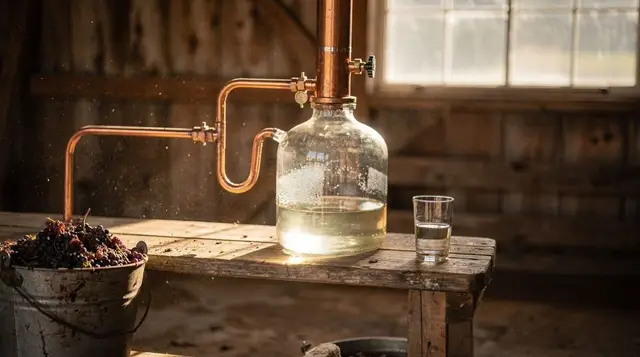
Qvevri wine explained: 8,000 years in a clay pot
What is qvevri wine?
Qvevri wine is made and aged in a large, egg-shaped clay vessel buried in the ground, using a method UNESCO recognised as intangible cultural heritage. For reds and, distinctively, for whites too, the grape skins, stems and sometimes pips ferment together with the juice, which is why traditional Georgian white wine looks amber or orange rather than pale gold.
A clay pot older than most wine regions themselves
Every wine cellar in Georgia will show you a qvevri sooner or later — a tall, egg-shaped clay vessel, usually taller than a person, buried up to its neck in the cellar floor. It looks more like archaeology than equipment, and in a sense it is both: residue analysis on fragments found in Georgia points to winemaking roughly 8,000 years ago, among the oldest such evidence anywhere, which is the foundation of Georgia’s claim, made often enough on tour buses to sound like marketing but backed by real research, to be the birthplace of wine. In 2013, UNESCO added the qvevri method itself to its Intangible Cultural Heritage list, which is why you will see the word qvevri, not just wine, printed on tourism material across the country.
This guide explains what the method actually involves, why it produces such a distinctive style of white wine, and where to see and taste it properly, whether you have a full day in Kakheti wine country or an hour free in Tbilisi.
How the method actually works
A qvevri is filled with crushed grapes — juice, skins, stems and often pips together for reds, and crucially, for whites too — sealed, and left to ferment and age underground, where the surrounding earth holds a steady temperature without any refrigeration or climate control. Reds fermented this way are not unusual internationally; skin contact for red wine is standard practice almost everywhere. What sets Georgian tradition apart is doing the same for white wine: leaving white grape skins in contact with the juice for weeks or months, rather than pressing them off within hours as most of the world’s white winemaking does.
That extended contact is what gives traditional Georgian white wine its colour and texture — a deep amber or orange rather than pale straw, with more tannin and grip than most drinkers expect from a white. This style has its own name and its own guide: see Amber wine: the skin-contact whites Georgia never stopped making for what to expect in the glass and which producers do it well.
Wine Tasting Feel the Difference of Qvevri or Classical Wine is built specifically around that contrast — tasting a qvevri wine alongside a conventionally made one so the difference is obvious rather than described.
Not every qvevri wine is amber
It is worth separating two things that get conflated on tour: the vessel (qvevri) and the style (amber, or orange, wine). Qvevri reds exist and are common — the method applies to red grapes too, just with less novelty since skin contact for reds is standard practice worldwide anyway. Amber wine specifically refers to a qvevri-method white with extended skin contact. Every traditional Georgian amber wine is made in qvevri; not every qvevri wine is amber. If a cellar pours you a qvevri red and calls it amber, that is a mislabel worth a polite question, not a red flag about the wine itself.
For the region’s flagship red grape, distinct from this white-specific conversation, see Saperavi: how to read a Georgian red.
Where to actually see and taste it
Kakheti has the highest concentration of working qvevri cellars, many still family-run, and a Kakheti wine tour is the most thorough way to see the method explained at source, cellar to cellar. Telavi and the Alazani valley wineries and The Khareba wine tunnel at Kvareli both include qvevri cellars as part of a wider visit.
If a full day trip is not on your itinerary, Tbilisi has workshops built specifically around the method for visitors short on time. Tbilisi: Qvevri Painting Workshop with Georgian Wine Tasting and Tbilisi: Qvevri Painting Workshop with Wine Tasting pair a shorter, hands-on explanation — painting a small ceramic qvevri while a host talks through the winemaking side — with a tasting, which suits anyone who wants the context without a day on the road. Wine tasting without leaving Tbilisi covers the fuller range of in-city options if a workshop specifically is not what you are after.
Inside a working marani
The room that holds the qvevri has its own name, marani, and its own logic once you know what you are looking at. Rather than racks of barrels or steel tanks, a marani is usually a low, cool room — sometimes a purpose-built cellar, sometimes little more than a shed over buried vessels — with a row of qvevri necks flush with the floor, each sealed with a wooden lid and often a layer of sand or clay on top to keep the seal airtight. The size of the vessel varies enormously, from small qvevri used by a household for its own wine to some large enough to hold several thousand litres, used by bigger producers or wineries selling well beyond their own village.
Because the qvevri themselves are buried, a marani tour looks different from a conventional winery visit — there is comparatively little to see above ground, and much of what a host explains is happening invisibly, underneath your feet, over months rather than the hours a barrel tasting might cover. This is part of why a guide’s explanation matters more here than at a conventional cellar: without it, a marani can look like an oddly quiet, half-empty room rather than the heart of the operation it actually is.
Workshops built around qvevri painting, such as the ones mentioned above, often pair the hands-on activity with exactly this kind of explanation, since a finished, closed qvevri gives few visual clues to what is fermenting inside. For a broader look at Georgian pottery and craft traditions beyond winemaking specifically, see Pottery and qvevri workshops.
Common misconceptions worth correcting
A few claims about qvevri wine circulate often enough on tours that they are worth addressing directly. First, qvevri wine is not automatically organic or natural in the modern wine-industry sense of those terms — the vessel and method are traditional, but a producer can still use conventional viticulture alongside it, and “qvevri-made” and “natural wine” are related but distinct claims that a label or a host should be able to separate for you if asked.
Second, not all Georgian wine is made in qvevri; a large share of what is sold commercially, including much of what reaches supermarket shelves internationally, is made using conventional steel or oak methods, with qvevri wine representing the more traditional, often smaller-production end of the market.
Third, the widely repeated “8,000 years, birthplace of wine” claim is grounded in real archaeological evidence but remains a subject of ongoing research and, in places, genuine academic debate about exact dating and what counts as “wine” that early — worth knowing before repeating it as an uncontested fact rather than a well-supported but still-debated one. Eight thousand years of wine, and what that claim really rests on goes into this in more detail than a tour guide typically has time for.
The people who still make the vessels
Qvevri are not mass-produced. Specialist potters, working in a small number of villages with a long tradition of the craft, still hand-throw and fire each one from local clay, and a large qvevri takes weeks of work before it is cured and ready to hold wine — a detail most tour guides mention only in passing but that explains why a good qvevri, and the cellar built to hold a row of them, represents a real generational investment for a family winery, not just a rustic aesthetic choice.
Tasting it for the first time
If your only reference point for white wine is pale, clean and cold, a well-made amber wine can be a genuine surprise — more tannin, more weight, sometimes a savoury or nutty edge depending on the grape and the length of skin contact. It is not a fault; it is the method working as intended.
Reds made in qvevri tend to feel closer to what most visitors already expect from red wine, since skin contact for reds is common practice everywhere, which is why amber wine, not qvevri red, is usually the more memorable first taste for a newcomer. Whites in qvevri also tend to age differently than filtered, conventionally made whites, gaining rather than losing complexity over a year or two in bottle, which is part of why some producers deliberately hold back a portion of each vintage rather than releasing everything immediately.
Tbilisi: Individual Wine Tasting with Somellier is worth considering if you would rather have someone talk you through the differences one glass at a time than absorb it all at a group cellar stop.
How long qvevri wine keeps, and how to store it
Once bottled, qvevri wine does not require any special handling beyond what applies to wine generally — keep it away from direct heat and light, store it lying down if it has a cork, and drink younger, fresher styles sooner rather than letting them sit for years in a hot cupboard, which undoes far more Georgian wine than any flaw in how it was made.
Some producers age their qvevri wines for a year or more before release, which shows in a more settled, less fresh-fruit-forward profile than a wine bottled within months of the harvest; ask when you are tasting or buying if this matters to you, since labels do not always state it clearly. None of this is unique to qvevri wine specifically, but the unfamiliarity of the method sometimes leads visitors to assume it needs different treatment than a bottle of any other wine, which it generally does not.
Buying a bottle to take home
Once bottled, qvevri wine travels exactly like any other wine — nothing about the production method affects how you pack or declare it. Buying Georgian wine to take home covers labelling, what to look for if you specifically want a qvevri or amber bottle rather than a conventionally made one, and how airline liquid rules apply.
Qvevri compared with other ancient clay-vessel methods
Georgia is not the only place with a long tradition of fermenting wine in buried clay, and it is worth knowing where the qvevri method sits relative to its neighbours rather than assuming it is entirely without parallel. Armenia has its own tradition of clay-vessel winemaking, using vessels called karas that are broadly similar in concept — buried, egg-shaped, used for both fermentation and ageing — and some archaeologists treat the wider South Caucasus, rather than Georgia alone, as the cradle of this style of winemaking, even as Georgia has been the more successful at turning the tradition into an internationally recognised identity.
Further afield, Roman amphorae served some similar functions in the ancient Mediterranean, though typically above ground and shaped differently, and a handful of small-scale winemakers elsewhere in the world have experimented with clay-vessel fermentation in recent years, directly inspired by seeing the Georgian method firsthand.
None of this diminishes the qvevri tradition specifically — it remains the most continuous, best-documented and most deeply embedded version of this style of winemaking anywhere, which is exactly what UNESCO’s listing recognised — but a host who claims Georgia invented clay-vessel winemaking outright, rather than simply preserving and refining it longer and more completely than anywhere else, is overstating a genuinely strong case.
Qvevri winemaking through the Soviet era and its revival
The qvevri tradition did not have an uninterrupted, straightforward run through the twentieth century. Under Soviet administration, Georgian wine production was increasingly organised around large state enterprises geared toward industrial-scale output for the wider Soviet market, favouring steel tanks and standardised methods that could be replicated and scaled far more easily than the slow, small-batch rhythm of a family qvevri cellar. Qvevri winemaking did not disappear during this period, but it survived largely at the household and village level, made for personal and family use rather than commercial sale, kept alive by families who continued the practice quietly rather than through official production.
Since Georgian independence in 1991, and particularly over the past two decades, qvevri winemaking has moved from a rural household practice back into commercial production, driven partly by growing international interest in natural and low-intervention wine and partly by UNESCO’s 2013 recognition of the method, which gave producers a marketing hook that dovetailed with a wine trend already under way elsewhere. The result is the scene visitors see today: a mix of small family cellars that never stopped, and newer commercial producers who have deliberately revived or scaled up qvevri production specifically because of the renewed demand.
What a hands-on qvevri workshop in Tbilisi actually costs and involves
A hands-on qvevri workshop in Tbilisi, of the kind covered above, is a genuinely different format from a cellar visit and worth understanding before booking. Rather than touring a working marani, you typically sit at a table with a small ceramic qvevri replica, paint or decorate it while a host explains the method step by step, then move into a seated tasting once the activity itself is done. Expect the whole session to run one to two hours and cost somewhere in the region of 60 to 100 GEL per person, food and several wines usually included in that price.
It suits visitors who want the explanation and the tasting without a day trip, and it gives you something to take home — the painted piece — that a standard tasting does not. It is not a substitute for standing in an actual marani over a real, buried qvevri, which is why pairing a workshop like this with even a short cellar stop later in the trip, if your itinerary allows it, tends to leave a fuller impression than the workshop alone.
Frequently asked questions about qvevri wine
What makes qvevri wine different from ordinary wine?
The vessel and the contact time. A qvevri is buried underground for a steady temperature, and skins and stems are often left in contact with the juice for months, which is what gives traditional Georgian white wine its amber colour and firmer structure.
Is qvevri wine the same as amber or orange wine?
Amber wine is specifically a qvevri-method white with extended skin contact. Qvevri reds also exist, but not every qvevri wine is amber.
How old is the qvevri method?
Evidence of wine residue in clay vessels in Georgia goes back roughly 8,000 years. UNESCO added the method to its Intangible Cultural Heritage list in 2013.
Can you visit a qvevri workshop in Tbilisi, or do you need Kakheti?
Both work. Kakheti has the most working cellars, but Tbilisi has visitor-focused workshops that pair a shorter explanation with hands-on painting and a tasting.
Does qvevri wine taste better than regular wine?
Different, not simply better — more texture and tannin in the whites than most visitors expect. Some people love it immediately; others need a second glass.
Are qvevri still handmade?
Yes, by specialist potters using local clay, a process that can take weeks per vessel before it is cured and fit to hold wine.
Can I buy qvevri wine to take home?
Yes — once bottled it travels like any other wine. See Buying Georgian wine to take home for label tips and customs advice.
Qvevri wine tasting and vineyard tours on GetYourGuide
Verified deep-linked GetYourGuide tours. Book through these links and we earn a small commission at no cost to you.
Photo: our own image of the location, not the operator’s product photo.