Batumi Boulevard end to end
How long is Batumi Boulevard?
About 7 km along the Black Sea shore, from the Old Town end near the port up to Miracle Park and the newer hotel strip beyond it. Walking the full length at a relaxed pace, without stopping, takes roughly ninety minutes; with stops at the main landmarks, most visitors spend half a day or more.
Batumi’s one unmissable free attraction
Ask a handful of visitors what they actually remember from Batumi, and the Boulevard tends to come up more often than any single monastery, museum or restaurant. It is a roughly 7 km promenade running the length of the city’s Black Sea shore, built up in stages from the Soviet period through a major post-independence redevelopment, and it packs an unusual density of landmarks, sculpture, fountains and people-watching into a single flat, walkable strip.
Unlike most of the paid attractions scattered around Georgia, the Boulevard itself costs nothing to walk, and it is genuinely possible to spend a full day moving along it without running out of things to look at. This guide works through it landmark by landmark, from the Old Town end to Miracle Park, with what is worth paying for and what is not.
Batumi: City Highlights Batumi Boulevard Walking Tour covers the full route with a guide in a single organised outing, useful for a first visit if you would rather have the landmarks explained in order than work them out from a map.
The southern end: Old Town and the port
The Boulevard’s southern stretch, nearest the Old Town and the working port, is the oldest and least polished section, with a narrower promenade and a rougher, less-groomed beach below it than the sections further north. Europe Square, just inland from this end, is worth a short detour: a café-lined plaza anchored by a statue of Medea holding the Golden Fleece, a nod to the ancient Greek myth that placed Colchis — the historical name for this part of Georgia — as the fleece’s home. This southern section of the Boulevard sees far fewer visitors than the central landmark stretch, which makes it a reasonable choice for an early morning or late evening walk away from any crowds, at the cost of fewer cafés and less to actually stop for.
The central stretch: where the landmarks cluster
Moving north from Europe Square, the Boulevard’s character shifts noticeably, opening into wider paths, denser planting — palms, magnolias and the eucalyptus that gives parts of the route real shade even at midday — and the first of the major sculptures and fountains. This is the busiest section of the promenade by a wide margin, especially in the evening once the heat breaks, and it is where most of the paid beach clubs and sunbed rental concentrate as well, covered in more detail in Batumi’s beaches: pebbles, not sand.
The Alphabetic Tower
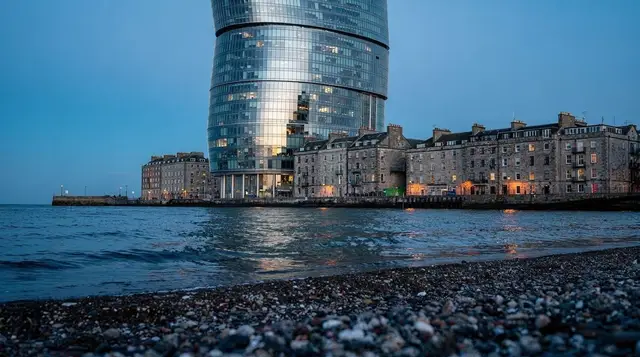
The single most photographed structure on the Boulevard is the Alphabetic Tower, a 130-metre spiral tower completed in 2012 whose facade is built from the 33 letters of the Georgian alphabet, one fused to each turn of the double-helix structure — a deliberate architectural statement about the uniqueness of Georgia’s own script, unrelated to any other alphabet in use anywhere else in the world.
An observation deck near the top gives a genuinely useful overview of the Boulevard’s curve and the mountains rising behind the city, and a small revolving restaurant occupies part of the upper structure as well. The viewing deck charges an entry fee, and while it is not an essential stop, it is one of the few places on the Boulevard that rewards paying for a different vantage point rather than simply walking past.
Ali and Nino: the moving statue
A short walk from the Alphabetic Tower stands one of the Boulevard’s most genuinely affecting landmarks: the Ali and Nino statue, two seven-metre steel figures — a man and a woman — that slide slowly toward each other, merge into a single silhouette, and then separate again, repeating the cycle roughly every ten minutes.
It is based on a 1937 novel of the same name, a love story between an Azerbaijani Muslim man and a Georgian noblewoman set against the collapse of the region’s old order in the early twentieth century, and the statue’s designer built the mechanical embrace and separation as a direct metaphor for the story’s tragic ending. It is best seen after dark, when the figures are lit against the sky, and it draws a genuine crowd at that hour who simply stand and watch a full cycle rather than moving straight past.
Dancing fountains and the evening crowd
Further along, a set of dancing fountains performs a choreographed water-and-light show once darkness falls, timed loosely to music and drawing families and couples who sit on the surrounding benches for a full cycle rather than walking past. Exact performance times shift with the season and are worth confirming on arrival rather than assuming a fixed schedule, since Batumi’s municipal attractions are not always precisely published in advance. This stretch of the Boulevard, taken together with the Alphabetic Tower and the Ali and Nino statue nearby, is where the promenade earns its reputation as something closer to an open-air evening entertainment district than a simple seafront path.
The Ferris wheel and the view from above
A large Ferris wheel, sometimes marketed as the Batumi Eye, sits along this same central stretch and offers a slower, quieter alternative to the Alphabetic Tower’s viewing deck for seeing the Boulevard and the bay from height. It runs into the evening and is a reasonable stop for anyone travelling with children who have had enough walking for one day but still want a view.
Miracle Park and the Boulevard’s northern edge
The Boulevard’s central attractions cluster taper off into Miracle Park, an amusement and entertainment complex that marks a natural point to either turn back or continue on toward the newer hotel strip further north. Miracle Park includes fairground rides, an aquarium and, in some seasons, a dolphinarium, none of which are covered by a single ticket — each charges separately, and the value proposition varies a lot depending on whether you are travelling with children who will actually use the rides.
Families weighing this stop against Batumi’s other child-focused options should also see Zoo, aquarium and dolphinarium and Batumi with children for the fuller picture, including honest notes on which of these attractions are worth the money and which feel dated next to what else Batumi offers.
Beyond Miracle Park, the Boulevard continues past a newer strip of high-rise hotels toward the edge of the city, a stretch with far less to see and correspondingly far fewer people, useful mainly as a quieter place to walk or run rather than a landmark destination in itself.
How the Boulevard got its current shape
The core of the promenade dates to the Soviet period, when Batumi first developed as a resort town for workers from across the union, but the version visitors walk today is largely a product of a major redevelopment pushed through in the years after Mikheil Saakashvili’s government made transforming Batumi into a Black Sea showcase a national priority in the 2000s and 2010s.
The Alphabetic Tower, the Ali and Nino statue, the dancing fountains and much of the current landscaping all date from this period, funded partly by the government and partly by private investment tied to the same wave of hotel and casino construction that reshaped the city’s skyline. Older Batumi residents will sometimes point out how different the seafront looked a generation earlier — a plainer Soviet-era park rather than the landmark-dense strip that exists now — and the pace of change has not entirely stopped, with new sculpture and infrastructure still appearing along the route in most recent years.
Getting to the Boulevard from where you are staying
Most central Batumi hotels and guesthouses sit within easy walking distance of some part of the Boulevard, but which section depends heavily on location: Old Town accommodation puts you nearest the southern, quieter stretch, while the newer hotel towers further north land closer to Miracle Park than to the Alphabetic Tower. A short taxi ride, typically 5-10 lari within the city on Bolt or Yandex Go — see Taxis, Bolt and Yandex Go for how this works in practice — is the simplest way to reach the central landmark stretch directly from anywhere else in the city, and is worth the small cost on a first visit rather than guessing which direction to walk.
Shopping and souvenirs along the route
A handful of craft stalls and small shops sit along the Boulevard’s central stretch, mostly selling the same souvenir magnets, ceramics and Adjarian textiles found elsewhere in the city, generally at a modest premium over what the same items cost a few streets back or at Batumi’s central market. For anything more specific — enamel work, carpets, proper Georgian ceramics — the dedicated shopping guides for the country as a whole, such as Souvenirs from Georgia, cover better sources than the Boulevard’s tourist-facing stalls, which are convenient rather than the best value or selection on offer in the city.
The Boulevard outside summer
Walking the Boulevard in the shoulder months or winter is a genuinely different experience from the July-August version described above: the beach clubs and sunbed rental close down, the crowds thin to a fraction of peak season, and several of the seasonal cafés shut their doors until spring.
The core landmarks — the Alphabetic Tower, the Ali and Nino statue, the fountains — keep operating year-round, and a quiet off-season walk along an empty promenade, mountains visible behind the city under a clear winter sky, has its own appeal distinct from the lively summer version. See When the Black Sea is warm enough to swim for how the swimming season specifically lines up with this seasonal shift, since the Boulevard itself stays walkable and worthwhile well outside the narrow window when the sea is actually warm.
Practical notes: benches, shade and toilets
The Boulevard is generally well equipped for a long walk by Georgian standards — benches at frequent intervals, public toilets near the main landmark clusters (though not evenly spaced along the full 7 km), and enough tree cover along the central stretch to make a midday walk tolerable even in August heat. The southern and northern extensions, away from the landmark cluster, offer considerably less shade and fewer facilities, which is worth factoring in if you are planning to walk the full length rather than sticking to the central hour or two most visitors actually cover.
Getting up the mountain instead of along the coast
For a genuinely different angle on the city, the Argo cable car climbs from a station near the Old Town up to Anuria Hill above Batumi, delivering a panoramic view back down over the full sweep of the Boulevard and the bay that no ground-level vantage point, including the Alphabetic Tower, quite matches. It sits slightly apart from the Boulevard walk itself, requiring a short detour inland to reach the base station, but pairs naturally with a Boulevard day as a way to end it with the whole route laid out below you.
Batumi: Argo Cable Car Ride with Panoramic Views covers the ride itself, best timed for late afternoon when the light picks out the coastline most clearly.
Walking it, cycling it, or picking a section
Covering the full 7 km on foot at a relaxed pace, without stopping, takes about ninety minutes each way, but almost nobody actually walks it that way — most visitors pick a central base near Europe Square or the Alphabetic Tower and radiate outward over a day or two, rather than treating the Boulevard as a single point-to-point walk.
For anyone who does want to cover the whole length in one go, bicycle rental stands, including a city bike-share scheme with docking points at intervals along the route, make the full distance considerably easier than walking it twice. Echoes of Batumi Walking Tour in Batumi offers a guided alternative focused on the Old Town end and the southern Boulevard, a useful complement to a self-guided walk of the central landmark stretch.
Food and drink along the way
Cafés and restaurants line most of the central and southern Boulevard, ranging from simple ice-cream and khachapuri stands to sit-down restaurants with sea views, priced noticeably higher than equivalent food a few streets back from the water — a pattern worth knowing if budget matters, since walking two minutes inland from the Boulevard toward the Old Town typically halves the price of an equivalent meal without much loss in quality. Adjarian food in Batumi, beyond the boat-shaped khachapuri covers what is actually worth ordering here, distinct from the khachapuri and khinkali found in Tbilisi.
Day versus evening: two different Boulevards
The Boulevard genuinely functions as two different places depending on when you visit. By day it is a beach-adjacent promenade, busy with sunbathers, cyclists and people simply walking off a meal, with the landmarks visible but not performing — the fountains still, the Ali and Nino statue slowly cycling but easy to miss in daylight. After dark it becomes something closer to a lit, choreographed evening spectacle, with the fountains, the statue and the Alphabetic Tower all lit and considerably more crowded than during the day. Visitors with limited time and forced to pick one should lean toward evening for the landmark stretch specifically, and toward morning if the goal is simply a quiet walk or swim before the crowds build.
Fitting the Boulevard into a Batumi visit
For a fuller sense of how to split time between the Boulevard, the Old Town, the beach and at least one trip out of the city, see Batumi in two days, which lays out a realistic two-day plan rather than trying to compress everything into a single rushed afternoon. Anyone deciding whether Batumi deserves the detour from Tbilisi at all should also read Tbilisi or Batumi? before committing the travel time covered in Tbilisi to Batumi: plane, train or road.
After the Boulevard: where the evening goes next
Once the fountains finish their cycle and the crowd along the central stretch starts to thin, a good share of it moves inland toward the Piazza and the Old Town’s bars, or further along toward Batumi’s casino strip, a different and considerably louder side of the city covered in Batumi after dark: casinos and clubs. The Boulevard itself does not really have a closing time — it stays open and lit well past midnight through summer — but its character shifts again late in the evening, from families and couples toward a younger, more nightlife-focused crowd drifting between the seafront and the bars a few streets back.
The honest verdict
The Boulevard is Batumi’s best free attraction by a clear margin, and it is worth building real time around rather than treating as a corridor between the beach and dinner. The paid landmarks along it — the Alphabetic Tower, the Ferris wheel, Miracle Park’s rides — are individually optional and vary in value, but the walk itself, especially the Europe Square to Miracle Park stretch after dark, delivers more per free hour than almost anything else on this coast.
Frequently asked questions about Batumi Boulevard
What is the best way to see the whole Boulevard?
On foot for the central landmark section between Europe Square and Miracle Park. For the full 7 km, renting a bicycle is faster and just as pleasant.
Is the Alphabetic Tower worth paying to go up?
For most visitors, yes, at least once — the observation deck gives the clearest overview of the Boulevard’s curve and the mountains behind the city.
What time do the dancing fountains and Ali and Nino statue perform?
The fountains run through the evening once dark, and the statue cycles roughly every ten minutes, also best seen after dusk. Exact times shift by season.
Is the Boulevard free to walk?
Yes, entirely free and open around the clock. The landmarks along it — the Tower, the Ferris wheel, Miracle Park — charge separately.
How does the Boulevard connect to Batumi’s beach?
It runs directly alongside the beach for its full central length, with sunbed rental set up on the shingle below.
Can you cycle the Boulevard?
Yes, and it is a popular way to cover the full 7 km. Bike rental stands, including a bike-share scheme, operate at several points along the route.
Black Sea coast trips on GetYourGuide
Verified deep-linked GetYourGuide tours. Book through these links and we earn a small commission at no cost to you.
Photo: our own image of the location, not the operator’s product photo.