Borjomi water at the source
Can you drink Borjomi mineral water for free in Borjomi?
Yes. Central Park has public fountains where the same naturally carbonated mineral water sold in bottles worldwide flows for free, straight from the source. It tastes strongly of minerals and faint sulphur, which surprises visitors who only know it from a bottle bought at a supermarket abroad.
The water that made the town famous
Long before Borjomi was a stop on a Georgian road trip, it was a water brand. The naturally carbonated, mineral-rich water that surfaces here has been bottled and sold since the late 19th century, once favoured by the Romanov family and still exported across the former Soviet Union and beyond under the Borjomi name. Almost every visitor to Georgia has tasted it from a bottle without necessarily connecting it to this particular town, tucked in a river valley in the Samtskhe region. Coming here to drink it straight from the source, rather than from a shelf, is the whole point of a Borjomi visit for anyone not primarily interested in the surrounding national park.
Why this specific water became famous
Borjomi’s water owes its reputation partly to genuine geology — a naturally carbonated alkaline mineral water is unusual enough to be commercially distinctive — and partly to 19th-century royal patronage that turned a regional curiosity into an empire-wide brand. Once the Romanov family began associating with the water, bottling and export followed, and the Borjomi name became one of the most recognised in the Russian Empire and, later, the Soviet Union.
That commercial history is why the brand still outsells most competitors across the region today, decades after the resort infrastructure built around it fell into the same post-Soviet decline that affected Tskaltubo and other Georgian spa towns. Unlike Tskaltubo, though, Borjomi’s core product — the bottled water — never stopped being commercially viable, which is part of why the town itself has stayed in noticeably better condition than some of Georgia’s other Soviet-era resorts.
Central Park and the free fountains
Borjomi Central Park, along the Mtkvari river, charges a modest entry fee and is built almost entirely around the mineral water itself: several public fountains where the water flows continuously and free once you’re through the gate. It tastes noticeably different from the bottled version — warmer, more strongly mineral, with a faint sulphur edge that fades once the water is chilled and carbonated for sale. Some visitors find it genuinely pleasant; plenty find the first sip unexpected even if they’ve drunk the bottled version for years. Either reaction is normal, and trying it is really the only way to know which camp you’re in.
Borjomi: Mineral Water Park and Mtsvane Monastery Tour covers the park along with the nearby Mtsvane Monastery, a sensible pairing if you’d rather have the practicalities — where to drink, what the funicular costs, when the pool is quietest — handled by a guide rather than worked out on arrival.
The mineral water pool
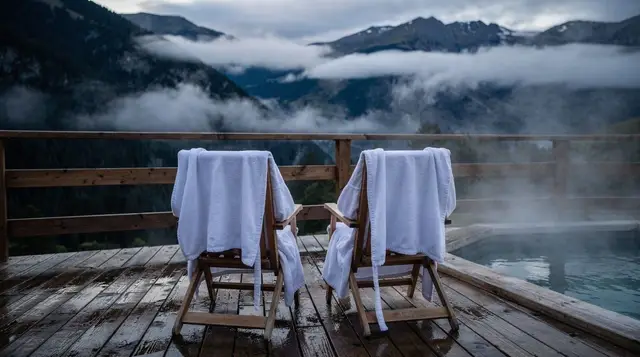
Inside the park is an open-air pool filled with warm mineral water, a genuinely different experience from a sulphur bath in Tbilisi’s Abanotubani — outdoors, less enclosed, and better suited to a sunny afternoon than a quick indoor soak. The kisa scrub isn’t generally on offer here the way it is in Tbilisi’s bathhouses; this is a soak, not a full bath ritual. It charges its own entry fee on top of the park ticket and gets busy with both locals and visitors on summer weekends; a weekday visit, or arriving earlier in the day, makes for a noticeably calmer experience.
Unlike a Tbilisi sulphur bath, there’s no kisa scrub or attendant-led ritual here — you’re paying for pool access and managing your own time in the water, more like a public swimming pool than a private bathhouse room. Bring your own towel; rentals exist but availability isn’t guaranteed on a busy day. The water temperature in the pool runs warm rather than hot, comfortable for a longer soak than you’d manage in one of Tbilisi’s near-40°C private rooms.
The funicular and the upper park
A funicular runs from the lower park up to a viewpoint with a small amusement area, a straightforward way to see the valley from above without a hike. It’s a minor add-on rather than a main reason to visit, worth doing if you’re already spending a couple of hours in the park and want a change of pace before heading back down to the fountains.
The town beyond the park
Borjomi’s centre is modest and easily walkable, with a handful of cafés and restaurants near the park entrance that get noticeably busier around lunchtime as day-trip groups arrive from Tbilisi. The old bottling factory, which processed the water that made the town famous, sits within the town itself rather than inside the park, and its Soviet-era industrial architecture is worth a glance even if you’re not touring the facility.
On the hillside above town, the Likani Palace, once a royal and later a government residence, is visible from various points around Borjomi, though it functions as a state property rather than a public attraction and isn’t generally open for visits — worth knowing before you plan a stop there specifically. The broader town has a slower pace than Tbilisi, and most visitors find a few hours enough to see everything beyond the park itself.
Borjomi the town versus Borjomi-Kharagauli National Park
It’s worth being clear about the difference, since the two get conflated. This guide covers Central Park and the mineral water itself, a half-day activity at most. The Borjomi-Kharagauli National Park, one of the largest protected forest areas in the country, is a separate destination with marked trails ranging from short walks to multi-day treks, and deserves its own planning — see Trails in Borjomi-Kharagauli National Park if hiking rather than drinking mineral water is the actual draw.
Confusingly, both share the same trailhead area near the lower park, so it’s entirely possible to start a national park hike without quite meaning to — signage improves the further you go, but the boundary between “a longer walk within Central Park” and “the start of a marked national park trail” isn’t always obvious at the point where the two meet. If you only intend a short, casual walk, it’s worth confirming with park staff or a map before heading too far up any of the marked paths, since some connect directly into the longer national park network without an obvious change in character.
Getting to Borjomi and what to combine it with
Borjomi sits about 2.5 hours from Tbilisi by car or marshrutka, workable as a day trip on its own but more commonly paired with nearby Bakuriani or extended toward Vardzia and Akhaltsikhe for a fuller day or a two-day loop.
From Tbilisi: Bakuriani and Borjomi Day Trip covers the Borjomi-Bakuriani pairing directly from Tbilisi, while From Tbilisi: Gori Borjomi Vardzia Rabati Fortress Tour extends the same route out to Vardzia’s cave city and the Rabati Fortress for those with a full day to spend. If you’re basing yourself in Kutaisi rather than Tbilisi, Kutaisi: Borjomi Shared Transfer is a lower-cost way to get between the two without booking a private tour. See Borjomi in a day for a full route that fits the park, the pool and a short walk into a single day from Tbilisi.
A marshrutka from Tbilisi’s Didube station runs to Borjomi regularly through the day and is the cheapest way to make the trip independently, though schedules thin out later in the afternoon, so checking a return time before you set off is worth doing rather than assuming there’s always a seat going back. A narrow-gauge train also connects Borjomi with Bakuriani, a slower and more scenic alternative to driving between the two if you have time to spare and want the journey itself to be part of the day rather than just transport.
Best time of year to visit
Borjomi’s park and fountains work in any season, but the experience shifts meaningfully with the weather. Summer brings the heaviest crowds, both from Tbilisi day-trippers and Georgians on their own holidays, and the outdoor mineral pool is at its most appealing exactly when it’s also busiest. Spring and autumn are quieter and more comfortable for walking the park, with autumn foliage adding some genuine scenery to what’s otherwise a fairly low-key town. Winter is quiet and cold, and while the fountains still flow, the outdoor pool is a less obvious draw when the air temperature drops — the water itself stays warm, but getting in and out in cold weather is less appealing to most visitors than a summer or shoulder-season dip.
Does the health claim actually hold up?
Borjomi water has been marketed on its digestive and general wellness benefits since the 19th century, and Georgians commonly drink it, chilled or at room temperature, as a routine part of meals rather than as a rare treat.
Beyond that cultural habit, treat any specific medical claim about mineral water with the same scepticism you’d apply anywhere — it’s a naturally carbonated alkaline water with a distinct mineral profile, genuinely different from ordinary tap or bottled water, but not a documented cure for anything in the way some older marketing implied. If you’re drawn to try it specifically for a digestive issue, it’s reasonable to do so as a low-risk experiment rather than a guaranteed remedy, and there’s no harm in normal quantities for most people.
How Borjomi compares to Georgia’s other mineral waters
Georgia has several other bottled mineral waters beyond Borjomi, though none with quite the same international name recognition, and comparing them side by side is mostly a matter of personal taste in carbonation strength and mineral intensity rather than one being objectively superior. What sets Borjomi apart commercially is less the water’s uniqueness within Georgia and more its 19th-century head start on export markets, which built a brand recognition that’s persisted for well over a century.
If you’re curious how the source water compares to what’s sold at a Georgian supermarket, drinking it straight from the Central Park fountains is the most direct way to judge for yourself, since bottling and carbonation change the taste enough that the two aren’t quite the same experience.
A practical half-day plan
If you’re doing Borjomi as a self-contained half-day rather than folding it into a longer route, a reasonable sequence runs: arrive late morning, walk the lower park and try the fountains first while it’s still relatively quiet, take the funicular up for the view once the sun is higher, come back down for lunch in town, then finish with an hour or two at the mineral water pool in the early afternoon before the return journey.
This fits comfortably into four to five hours on the ground, not counting travel time from Tbilisi, and leaves room to extend into Bakuriani or further south toward Vardzia if you’ve got more than a single day free. Trying to add a proper hike in Borjomi-Kharagauli National Park on the same day as the park and pool is usually too much — better to treat the park and the national park as two separate visits, on two separate days, if both interest you.
What to budget
Beyond the park entry fee and the separate charge for the mineral pool, both modest, the main costs are transport and food. A marshrutka seat from Tbilisi costs little; a private tour or transfer costs considerably more but removes the need to manage timings and connections yourself. A casual lunch in town runs in line with prices elsewhere in provincial Georgia — noticeably cheaper than central Tbilisi — and a bottle of Borjomi water to take home costs the same here as it does anywhere else in the country, which is worth knowing if you were hoping for a discount at the source; there generally isn’t one beyond what small local kiosks near the park entrance charge for freshly bottled water.
Making it part of a longer wellness trip
Borjomi’s water and pool sit naturally alongside Georgia’s other spa towns if mineral water and hot baths are the theme of your trip rather than a single stop. Thermal springs across Georgia covers where else this kind of water surfaces — Tbilisi, Tskaltubo, Sairme, Vani — and A wellness weekend from Tbilisi strings several of them together into one trip. For an overnight stay built around the water rather than just a day visit, Spa hotels worth the money in Georgia covers which properties in and around Borjomi are actually worth the higher price over a standard guesthouse.
Buying water direct, and what the factory tour actually offers
Beyond the free fountains, small kiosks near the park entrance sell freshly bottled Borjomi water alongside the standard supermarket version, though the price difference is minor rather than a genuine bargain worth planning a purchase around. The historic bottling factory itself, within the town rather than the park, is primarily a working industrial site rather than a polished visitor attraction, and casual drop-in tours are not a standard, reliably available option the way they might be at a winery — anyone specifically wanting to see the bottling process should enquire locally rather than assuming walk-in access, and should not build a visit around this as a certainty.
Borjomi with children
Central Park works reasonably well with children, since the fountains themselves are a mildly novel, hands-on stop — most children find the sulphur smell more funny than off-putting — and the funicular ride up to the amusement area adds a genuine change of pace partway through. The mineral pool suits children who are already comfortable in water, though the warm rather than hot temperature and open, supervised layout make it considerably easier to manage with a family than one of Tbilisi’s smaller private bath rooms. The park’s paths are flat and pushchair-friendly near the lower fountains, though they climb more steeply toward the upper sections and the national park boundary.
Where the spring water actually surfaces
The fountains inside Central Park are not the only point where Borjomi’s mineral water reaches the surface — several natural springs exist within the wider valley, some feeding the commercial bottling operation directly rather than the public taps. What visitors drink at the park fountains is the same underlying water, drawn from the same geological source, rather than a different or lesser version, so there is no need to search out a “more authentic” spring elsewhere in the valley; the park’s fountains are the genuine article, made accessible and free specifically for visitors and residents alike.
A common mistake: treating Borjomi as a full day
Central Park, the fountains and the mineral pool realistically fill three to four hours, not a full day, and visitors who block out an entire day for Borjomi alone often find themselves with unplanned time on their hands by early afternoon. Pairing the park with Bakuriani, a short walk through the town itself, or an onward stop toward Akhaltsikhe or Vardzia makes for a far better use of a full day than lingering in the park past the point of real interest. See Borjomi in a day for how this fits together as a complete itinerary rather than a half-finished one.
Frequently asked questions about Borjomi’s mineral water
The practical questions below cover taste, cost and how to fit Borjomi’s water into the rest of a Georgia trip.
Does Borjomi water taste different at the source than from a bottle?
Yes, noticeably. Straight from the park’s fountains it’s warmer, more mineral-forward and has a faint sulphur note that softens once bottled and chilled. Some visitors like it more this way; plenty find it an acquired taste even if they enjoy the bottled version.
Is entry to Borjomi Central Park free?
There’s a small entry fee to the park itself, separate from the mineral water, which is free once you’re inside. The funicular up to the viewpoint and the outdoor mineral pool both charge extra on top of the park entry.
Is the mineral water pool in the park worth visiting?
It’s a genuinely different experience from a sulphur bath in Tbilisi — an open-air pool filled with warm mineral water rather than an indoor tiled room — and worth an hour if the weather’s good. It gets busy on summer weekends, so a weekday or off-peak visit is more relaxed.
How far is Borjomi from Tbilisi?
About 2.5 hours by car or marshrutka, making it a workable day trip, though pairing it with Bakuriani or Vardzia turns it into a longer day or a better two-day trip.
Can I take Borjomi water home with me?
The bottled version is sold everywhere in Georgia and at the airport, so there’s no need to carry water from the fountains themselves. If you want a souvenir bottle filled at the source, small kiosks near the park entrance sell freshly bottled water, though it won’t stay carbonated as long as the commercially sealed version.
Is Borjomi water actually good for you?
It’s a naturally carbonated alkaline mineral water that’s been marketed and used therapeutically since the 19th century, and Georgians commonly drink it for digestion. Beyond that, treat health claims about any mineral water with the same caution you’d apply anywhere — it’s a mineral water, not a medicine.
Should I visit Borjomi for the water or for the national park?
They’re two different trips that happen to share a town. The water and Central Park are an easy half-day; the forested trails of Borjomi-Kharagauli National Park, covered separately in Trails in Borjomi-Kharagauli National Park, need a half-day to several days depending on how far you want to hike.
Sulphur bath and spa experiences on GetYourGuide
Verified deep-linked GetYourGuide tours. Book through these links and we earn a small commission at no cost to you.
Photo: our own image of the location, not the operator’s product photo.