SIM cards, eSIM and mobile data
What is the easiest way to get mobile data in Georgia?
A physical SIM from Magti, Geocell or Beeline, bought at Tbilisi airport or any city-centre shop for around 10-25 GEL including several gigabytes of data, works reliably and needs only a passport. An eSIM bought online before arrival is faster to set up but usually costs more for the same data and can have weaker mountain coverage depending on the provider.
Three networks, one clear answer for most visitors
Georgia has three mobile operators — Magti, Geocell and Beeline — all offering tourist-friendly prepaid SIM packages, plus a growing eSIM market both from these local operators and from international eSIM sellers aimed at travellers. For most visitors, a physical SIM from Magti bought at the airport or a city-centre shop is the simplest, cheapest option that also happens to have the best mountain coverage. This guide covers pricing across all three networks, where eSIM makes sense instead, and which regions of the country actually have a working signal.
None of this is complicated by regional standards — Georgia’s telecoms market is competitive, prices are low compared with most of Europe, and 4G coverage along the country’s populated lowlands is genuinely good. The decisions that actually matter are narrower than they might first appear: which network to pick, whether the convenience of an eSIM is worth its premium over a physical card, and how to plan around the patchy signal that any network delivers once you leave the paved lowland roads for genuinely mountainous terrain.
Physical SIM cards: prices and where to buy
All three networks sell prepaid tourist SIMs at kiosks throughout Tbilisi, including several directly in the arrivals hall at Tbilisi International Airport, open for incoming flights at almost any hour. Expect to pay 10-25 GEL for a starter package including a Georgian phone number and several gigabytes of data, with larger bundles — 15-30 GB — running 15-25 GEL.
Setup takes a few minutes at the counter, with staff generally handling activation for you rather than leaving you to configure APN settings yourself, a genuine convenience compared with self-service SIM machines used in some other countries. Card and cash are both accepted at the main airport kiosks, and a receipt is provided that is worth holding onto in case any dispute arises later over the data allowance you were sold, though this is a rare occurrence with any of the three networks.
Private Airport Transfer Tbilisi Tour Unlimited Data SIM bundles a private airport pickup with a SIM already activated and loaded with unlimited data, useful for anyone who would rather have connectivity sorted before leaving the terminal rather than queueing at a kiosk after a long flight.
What you need: passport, not much else
Georgian law requires every SIM to be registered against a passport, the same requirement as most of the surrounding region. Bring the physical document — a photo or scan is generally not accepted — and expect the process to take only a few minutes once at the counter. No proof of address or local phone number is required, which makes the process notably simpler than in some neighbouring countries.
Comparing the three networks
Magti is the network most visitors end up on, partly through airport kiosk visibility and partly because it has the strongest and most consistent coverage across mountain regions — Svaneti, Tusheti, Kazbegi — where the other two networks have more frequent gaps. Magti’s tourist packages are marketed under names that change periodically, so ask staff directly for the current tourist SIM bundle rather than a specific product name you may have read online, since pricing and included data shift often enough that any exact figure quoted months in advance can be out of date by the time you travel.
Geocell performs well in Tbilisi, Kutaisi, Batumi and along the main highway network, competitive with Magti in the lowlands but noticeably weaker once you climb into the high Caucasus. Beeline is the cheapest of the three on a per-gigabyte basis in some packages but has the least consistent rural coverage of the three, making it the choice most suited to a Tbilisi-only or coastal trip rather than a mountain-heavy itinerary. None of the three differences are dramatic enough to plan an entire trip around, and any of them will serve a visitor spending most of their time in Tbilisi and the main lowland towns perfectly well.
eSIM: convenient, sometimes pricier
Both international eSIM marketplaces — sold before you travel, activated the moment you land — and, increasingly, local Georgian operators themselves offer eSIM profiles as an alternative to a physical card. The appeal is having data working from the moment your plane lands, without needing to find a kiosk or queue at the counter, useful for anyone navigating straight from the airport to a first night’s accommodation.
Tbilisi: Welcome Tour with Optional Airport Pickup Esim combines an airport welcome tour with an optional eSIM add-on, a straightforward way to have both transport and connectivity sorted for a first day in Tbilisi without separate bookings.
The trade-off with most international eSIM providers is price: a comparable data allowance typically costs more through an eSIM marketplace than the same gigabytes bought as a physical SIM after arrival, and eSIM coverage in Georgia’s mountain regions specifically can lag behind what a local Magti SIM delivers, since eSIM providers generally roam onto whichever local network offers them the best wholesale rate rather than the best coverage. For a short city-based stay, the convenience is often worth the premium; for a longer trip that includes Svaneti, Tusheti or Kazbegi, a local physical SIM is usually the more reliable choice.
Roaming from your home provider
EU-based roaming plans that cover the bloc do not extend to Georgia, since the country sits outside the EU entirely — a detail that catches out visitors assuming their usual “roam like at home” allowance applies here. Non-EU visitors should check their own provider’s specific Georgia rates before travelling, since many charge considerably more per megabyte than the cost of a local SIM for the entire trip. For almost everyone staying more than a day or two, a local SIM or eSIM works out cheaper than using home roaming, often by a wide margin.
Coverage in the mountains: where it actually drops out
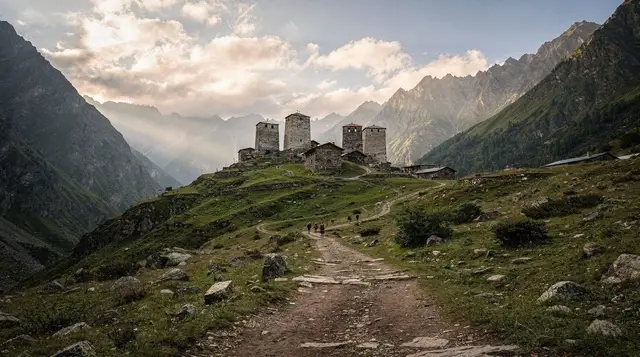
Coverage in Tbilisi, Batumi, Kutaisi and along the main highways is reliable across all three networks, generally running at full 4G speed and rarely dropping below usable in any populated lowland area. It thins noticeably once you climb: Svaneti has working coverage in Mestia and the larger villages along the main road, but signal drops out over higher passes and on the unpaved stretch toward Ushguli. Tusheti is patchier still, with some sections of the approach road and remote villages effectively disconnected.
Kazbegi and the Georgian Military Highway generally hold signal well since the road follows a relatively populated corridor, though the Jvari Pass itself can see brief drop-outs in poor weather. The practical takeaway for anyone heading into genuinely remote terrain: download offline maps before setting out, covered in more detail in Mountain safety in Georgia: rescue, weather and signal, rather than relying on a live connection you may lose at the exact point you need it.
Wi-Fi as a backup
Most hotels, guesthouses and a large share of cafés across Georgia, even in smaller towns, offer free Wi-Fi reliable enough for messaging and basic browsing, which softens the impact of patchy mobile coverage in more remote regions. This is less useful mid-journey on a marshrutka or hiking trail, where a working SIM still matters most, but worth knowing about as a fallback once you have reached a fixed base for the night.
How much data to budget
For typical use — maps, messaging apps, some social media and photo uploads — 10-15 GB comfortably covers a two-week trip for most visitors, and it is worth erring toward the larger bundle if the price difference is small, since running out mid-trip is a minor annoyance easily avoided, with the larger local bundles of 15-30 GB offering headroom that most people never fully use. Anyone planning to stream video or work remotely for extended periods, covered in Remote work and long stays in Tbilisi, should budget considerably more or plan around reliable Wi-Fi rather than mobile data for heavier use.
Buying a SIM after you have already left the airport
Not everyone arrives ready to sort connectivity immediately, and that is fine: Magti, Geocell and Beeline all run shops throughout central Tbilisi, easy to find along Rustaveli Avenue and near Freedom Square, with the same prices and passport requirement as the airport kiosks. Staff in central branches are more likely to speak English fluently than at smaller neighbourhood outlets, worth bearing in mind if you would rather not navigate the setup process through gestures and a translation app.
Outside Tbilisi, Batumi and Kutaisi both have shops for all three networks in their respective centres, so waiting until a later stop on your itinerary rather than sorting a SIM immediately at Tbilisi airport is a perfectly workable approach too.
Topping up mid-trip
Running low on data partway through a trip is straightforward to fix: top-up vouchers and bundle extensions are sold at the same network shops, at many small kiosks and pharmacies displaying the relevant operator’s logo, and increasingly through each network’s own app once your initial SIM is active. Balances and remaining data are checked by dialling a short USSD code specific to each network, printed on the SIM packaging at purchase — worth photographing that packaging before you discard it, since the code is easy to forget and mildly annoying to look up again later.
Tethering and using your phone as a hotspot
All three networks allow tethering on their standard tourist packages without an extra fee or separate hotspot allowance, unlike some countries that meter hotspot data differently from on-device use. This matters for travellers carrying a laptop or tablet without its own SIM, and for groups sharing a single data-loaded phone across several devices rather than buying multiple SIMs — a reasonable way to cut costs for a group of two or three travelling together, provided everyone is comfortable being tied to a single phone’s battery and signal.
Working online: cafés, co-working spaces and connection quality
For anyone planning to work remotely for part of a Georgia trip, Tbilisi in particular has a growing café and co-working scene with consistently strong Wi-Fi, covered in Cafés in Tbilisi you can actually work from — generally a more reliable choice for video calls and heavier uploads than mobile data alone, even with a strong SIM signal. Outside the capital, connection quality for remote work drops considerably once you are away from Batumi and Kutaisi’s own café scenes, worth planning around if a specific working day depends on a stable connection.
Crossing into Armenia, Turkey or Azerbaijan
A Georgian SIM stops working, or switches to expensive roaming rates, the moment you cross into a neighbouring country, the same as any national SIM anywhere. Visitors continuing on to Armenia, Turkey or Azerbaijan as part of a wider Caucasus trip should plan to buy a local SIM on the other side rather than relying on a Georgian one to roam affordably — see Land borders with Armenia, Turkey and Azerbaijan for what else changes at each crossing. The reverse is also true: a SIM from a neighbouring country generally will not give useful data once back inside Georgia, so budget for a fresh Georgian SIM on return if your trip loops back through Tbilisi.
Data for offline hiking apps and safety
For anyone heading into Svaneti, Tusheti or the wider hiking network covered in Guides, gear and mountain rescue in Georgia, download offline maps and any planned hiking routes while still on a strong signal in Mestia, Omalo or Tbilisi rather than assuming a connection will be available once on the trail itself.
A local SIM with decent mountain coverage still matters for the sections where signal does exist — enough to send a location update or call for help if needed — but should never be the sole safety plan for a genuinely remote route, and should always be paired with a downloaded map, a told-someone-your-plan habit, and the wider precautions covered in that safety guide.
Setting up an eSIM before you fly
For visitors who prefer to land with data already working, the process is generally the same regardless of provider: purchase the eSIM plan online before departure, receive a QR code by email, and scan it into your phone’s settings under mobile or cellular plans, usually taking a few minutes provided your phone supports eSIM and is unlocked.
It is worth doing this step before leaving home rather than relying on airport Wi-Fi to complete it after landing, since some airports’ free networks are slow enough to make downloading a new profile frustrating. Confirm your device is eSIM-compatible in advance — most phones from the past several years are, but some region-locked or budget models are not — and keep the physical SIM tray or a backup option in mind in case the eSIM profile fails to activate correctly on arrival, which happens occasionally with any provider.
A rough cost comparison against home rates
For a European visitor whose home provider charges 5-10 EUR a day for Georgia roaming outside an EU allowance, a two-week trip on a local SIM at 15-25 GEL total — roughly 5-8 EUR for the entire stay — represents a substantial saving, often paying for itself within the first day or two of use. North American and other non-EU visitors, whose home plans rarely include any Georgia allowance at all, see an even larger relative saving from switching to a local SIM rather than accepting whatever per-megabyte roaming rate their provider quotes. The only scenario where sticking with a home SIM makes sense is a very short stopover of a day or less, where the hassle of buying and activating a new SIM outweighs the cost difference.
A note on using public Wi-Fi safely
Hotel, café and airport Wi-Fi across Georgia is generally unencrypted or protected by a shared password rather than individual logins, the same setup as most public Wi-Fi anywhere. Anything involving banking, work logins or other sensitive accounts is safer handled over mobile data or a VPN than over an open network, a habit worth carrying into Georgia the same as anywhere else rather than a Georgia-specific risk. With a local SIM’s data as cheap as it is, there is rarely a strong reason to lean on public Wi-Fi for anything beyond casual browsing in the first place.
Frequently asked questions about SIM cards and mobile data
See the FAQ block above for coverage comparisons, passport requirements, roaming and how much data to budget — the short version is that a Magti SIM bought at the airport covers nearly every visitor’s needs cheaply and with the best mountain coverage of the three networks, with eSIM worth paying a premium for only when landing-moment convenience matters more than either price or reach. Whichever route you take, the process rarely takes more than ten or fifteen minutes from arrival to a working connection, one of the more painless parts of arriving in a country most visitors have never been to before.
Which Georgian mobile network has the best coverage?
Magti generally has the widest and most reliable coverage across mountain regions like Svaneti, Tusheti and Kazbegi, where Geocell and Beeline both have noticeably more gaps. In Tbilisi and along the main highways, all three perform similarly well.
Can I buy a Georgian SIM card at the airport?
Yes, kiosks for Magti, Geocell and Beeline all operate in the arrivals hall at Tbilisi International Airport, open for incoming flights, and prices there are close to what you would pay at a city-centre shop rather than a significant airport markup.
Do I need my passport to buy a SIM card in Georgia?
Yes, Georgian law requires SIM registration to a passport, the same as most of the region. Bring the physical passport, not a photo of it, since some shops decline a copy.
Is eSIM available in Georgia?
Yes, both international eSIM providers sold online before you travel and, increasingly, local Georgian operators offer eSIM profiles activated in-country. An eSIM bought before arrival is convenient for having data working the moment you land, at a premium over a local physical SIM bought after arrival.
Does mobile data work in Svaneti and Tusheti?
Coverage exists in Mestia and larger Svaneti villages but drops out on higher passes and remote stretches, particularly toward Ushguli. Tusheti has patchier coverage still, with some villages effectively offline for a stretch of the journey. Download offline maps before heading into either region regardless of network.
How much data do I actually need for two weeks in Georgia?
10-15 GB comfortably covers maps, messaging and moderate social media use for two weeks for most visitors, with the larger local SIM bundles (typically 15-30 GB for 15-25 GEL) offering more headroom than most people use.
Can I use my home country’s roaming instead of a local SIM?
For EU visitors, roaming within EU-plan allowances does not extend to Georgia, which sits outside the EU. Non-EU visitors should check their own provider’s Georgia rates specifically, since they are often far higher than a 10-25 GEL local SIM, and a local SIM or eSIM is nearly always the cheaper option for a stay of more than a day or two.
Transfers and transport on GetYourGuide
Verified deep-linked GetYourGuide tours. Book through these links and we earn a small commission at no cost to you.
Photo: our own image of the location, not the operator’s product photo.