A region that closes for eight months of the year
Tusheti is unusual even by the standards of Georgia’s mountain regions: it is genuinely, physically cut off from the rest of the country for roughly eight months a year, once snow closes the Abano Pass, the single road connecting it to Kakheti and the rest of Georgia.
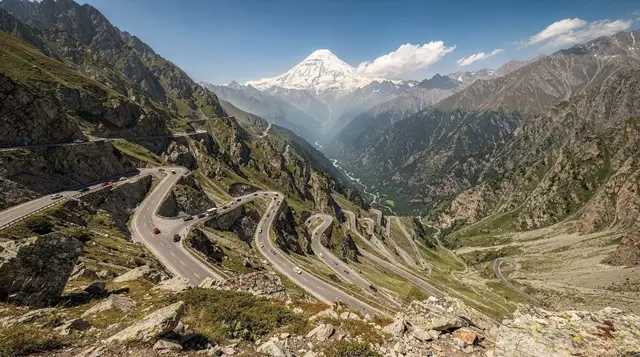
The pass climbs to 2,850m, unpaved for most of its length, with switchbacks and drop-offs that have earned it a reputation as one of the more dangerous regularly-used roads in the country — not through exaggeration, but through vehicle capability and weather, both of which can turn a manageable drive into a genuinely risky one with little warning. The road opens roughly in June and closes again by October, and outside that window Tusheti’s villages empty almost entirely, with most residents relocating to lowland Kakheti for the winter, a seasonal migration that has shaped Tushetian life for generations.
That closure is the single fact that governs any Tusheti trip: there is no visiting in winter, no shoulder-season compromise, and no way to reach the region except by the pass itself or, for those able to pay for it, helicopter. A five-day Tusheti trip by helicopter with an all-inclusive stay is the alternative for travellers who want to see the region without the jeep journey, though it changes the character of the trip considerably compared with the overland route.
Omalo, the region’s de facto capital
Omalo is Tusheti’s main village and the usual first stop after the pass, split between a lower, more populated section and an upper section, Kelis Tsikhe, with a cluster of medieval defensive towers that give the village its most recognisable skyline.
These stone towers, similar in style to those found in Svaneti though built for a different community and history, were used historically both as watchtowers and as refuges during clan conflict, and several still stand largely intact, open to visitors who want to climb them for the view over the surrounding valley. Omalo has the region’s best concentration of guesthouses and functions as the practical base for reaching the rest of Tusheti’s villages on day trips.
Where to sleep and eat
Guesthouses across Tusheti follow a consistent, simple pattern: a family home with a few spare rooms, meals included as part of the nightly rate, and hosts who often speak little English beyond the basics — part of the region’s charm for travellers happy to communicate in gestures and goodwill, and a genuine barrier for those who prefer more polished hospitality.
Omalo has the widest concentration of guesthouses and the closest thing Tusheti has to a choice of standard, while smaller villages like Dartlo or Parsma offer only one or two options each, meaning advance booking matters more here than almost anywhere else covered on this site — turning up without a reservation and expecting a bed is a real risk in high season. Meals are hearty and simple: Tushetian guda cheese — sheep’s milk cheese matured in a sheepskin, a genuinely distinct regional product — features heavily alongside khinkali and whatever the family’s own preserved produce runs to, given how far the region sits from any supermarket.
Dartlo, and why it draws photographers specifically
Dartlo, roughly an hour’s drive or a half-day walk from Omalo, is widely considered Tusheti’s most visually striking village — a dense cluster of stone towers and slate-roofed houses climbing a hillside above the Pirikita Alazani river, largely restored and maintained as one of the region’s better-preserved historic settlements.
It is the village most tour itineraries build around, and for good reason: the combination of architecture and mountain backdrop here is genuinely distinctive even within a region full of striking villages. A helicopter tour built specifically around a Dartlo village visit gives a faster way to see it for travellers short on time, though the overland route through the valley is the more common and considerably cheaper way in.
Why the towers were built where they were
Tusheti’s defensive towers, echoed by similar structures across the border in Chechnya and Dagestan on the same mountain range, date largely from the medieval and early modern period, built by individual clans for refuge during raids and internal conflict rather than as a coordinated regional defence system. Their placement — clustered tightly within villages rather than scattered across open ground — reflects that clan-based origin: each family or lineage group typically maintained its own tower, and the density visible in Dartlo or Omalo’s upper section is a direct record of how many distinct family groups lived in a relatively small settlement.
Many towers fell into disrepair through the Soviet period, when Tusheti’s population thinned considerably as residents relocated to lowland collective farms, and the restoration work visible in Dartlo today is comparatively recent, part of a wider effort to preserve the region’s built heritage as tourism has slowly grown since Georgian independence.
The Abano Pass drive itself
The drive over the Abano Pass deserves its own mention because, for many visitors, it is as memorable as the destination — a multi-hour journey in a purpose-built 4x4 (ordinary rental cars are not permitted and would not survive the road in any case), climbing from Kakheti’s lowlands through forest, then alpine meadow, then bare rock and switchbacks near the summit, with drop-offs close enough to the track that the drive itself is genuinely nerve-testing for some passengers.
Drivers who work this route regularly know its conditions intimately, and hiring one rather than attempting a self-drive is close to the only sensible option — self-driving the pass is technically possible with the right vehicle and experience, but the margin for error is thin and rescue options are limited. A three-day Tusheti jeep tour with accommodation included handles the drive, the driver and the overnight logistics as a single package, which is the standard way most visitors do this trip.
Trekking once you’re there
Beyond the drive itself, Tusheti’s appeal for hikers is its network of trails connecting villages across the region — Omalo to Dartlo, Dartlo onward to Parsma or Girevi, and longer multi-day routes toward the more remote Khevsureti region to the west for hikers with the time and experience for it. Trails here are generally less crowded and less signposted than Georgia’s more accessible hiking regions near Tbilisi, which is part of the appeal for experienced trekkers and part of the reason a guide is worth the cost for anyone without strong route-finding experience.
The most ambitious route, linking Tusheti across the mountains to Shatili and Khevsureti, is a multi-day undertaking for experienced trekkers only, not a casual extension of an Omalo-Dartlo trip. The Tusheti trekking guide covers specific routes, and the hiking gear and guides guide covers what to bring and when a local guide genuinely matters versus when independent hiking is reasonable. The hiking season guide puts Tusheti’s narrow window in context against the rest of the country’s mountain regions, several of which open earlier and close later.
Shepherding culture and what makes Tusheti distinct
Tushetians have practised transhumance pastoralism for centuries — moving sheep flocks between highland summer pasture in Tusheti and lowland winter grazing in Kakheti, the same seasonal rhythm that empties the villages each autumn.
That tradition is still alive rather than a historical footnote: visitors travelling in high summer will regularly pass shepherds and flocks on the trails between villages, and Tusheti’s guesthouse cheese, made from the milk of animals grazing the region’s alpine meadows, has a genuinely different, sharper character from cheese found in lowland Georgia. Guttural, Tush-specific dialect and customs distinct from the rest of Kakheti further mark the region out as culturally its own, a legacy of centuries of relative isolation behind the pass.
Church and shrine etiquette in Tusheti carries its own local rules, distinct in places from the rest of Orthodox Georgia — some shrines and sacred sites historically restricted access for women, a practice still respected by many local families, and visitors should follow guesthouse hosts’ guidance on what is and is not appropriate to approach or photograph rather than assuming standard Georgian church etiquette applies uniformly.
What a Tusheti trip actually costs and takes
Because of the drive alone, a Tusheti trip is not a cheap or quick add-on to a Georgia itinerary — a return jeep trip with a driver typically runs several hundred lari for the vehicle, shared among however many passengers travel together, plus guesthouse accommodation in the region at 40-70 ₾ a night per person including meals, which are usually home-cooked and served family-style. Given the drive alone takes the better part of a day each way, a realistic minimum trip is three days — one day in, one day exploring, one day out — with four or five days giving meaningfully more time to actually see Dartlo and the villages beyond Omalo rather than rushing straight back.
Packing for a trip with no shops past the pass
Once past the Abano Pass, there is essentially nowhere to buy specialist gear, and only limited basic supplies in Omalo itself — anything specific to the trip needs to come from Tbilisi or Telavi beforehand. That means proper hiking boots, layered clothing for a genuine range of temperatures across a single day, rain protection given how quickly mountain weather turns, and a headtorch and basic first-aid kit for anyone planning to hike beyond the immediate villages. Cash is essential too: card payment is unreliable to non-existent across most of the region, so carrying enough lari in small notes for several days of guesthouse stays and meals is standard practice rather than an optional precaution.
Getting to Tusheti
Tusheti is reached from Tbilisi via Kakheti, typically routing through or near Telavi before climbing to the Abano Pass itself — a journey of roughly 8 hours from Tbilisi in total including the pass crossing, almost entirely on unpaved road for the final stretch. There is no marchroutka service over the pass; travellers arrive either by organised jeep tour, by hiring a private driver with an appropriate vehicle, or, for those with the budget, by helicopter directly from Tbilisi. Self-driving is possible only with proper 4x4 experience and an appropriate vehicle, and even then most visitors judge the risk not worth the modest savings over hiring a driver who knows the road.
Combining Tusheti with the rest of Georgia
Given the cost and time commitment, Tusheti tends to anchor a trip rather than slot casually into one — most itineraries that include it build the wider Georgia trip around its narrow June-to-October window rather than the reverse. Travellers comparing Tusheti against Georgia’s other major trekking destination should look at Mestia and Svaneti, covered in the getting to Svaneti guide — both are remote, high-altitude regions with distinctive stone-tower villages, but Svaneti is considerably more developed for tourism and reachable year-round, while Tusheti remains the harder-to-reach, less-visited option.
The Svaneti hiking itinerary gives a sense of what a comparable multi-day trekking trip looks like in that region. Lagodekhi National Park, at the opposite, more accessible end of eastern Kakheti’s hiking options, is a reasonable lower-commitment alternative for travellers who want mountain trekking without Tusheti’s logistics.
Who Tusheti actually suits
It is worth being direct about who gets the most from a Tusheti trip and who might be better served elsewhere. Travellers who want dramatic mountain scenery without the drive, the cost or the physical demand are generally better off with Kazbegi, three hours from Tbilisi on a paved road with a comparable Caucasus backdrop and considerably more accessible infrastructure.
Travellers specifically drawn to remote, low-tourism travel, traditional architecture, and the experience of the journey itself as much as the destination are the ones Tusheti genuinely rewards — this is not a place that optimises for convenience at any point, from the drive in to the guesthouse facilities to the mobile signal, and visitors who arrive expecting otherwise tend to come away frustrated rather than delighted. For everyone else, a shorter, easier highland trip elsewhere in Georgia will likely deliver more satisfaction per day spent.
Frequently asked questions about visiting Tusheti
When exactly is the Abano Pass open?
Roughly June through early October, though the precise dates shift year to year depending on snowfall — always check current conditions before planning a trip near the edges of the season.
Is it safe to drive the Abano Pass yourself?
It is possible with a proper 4x4 and real off-road experience, but most visitors, including many Georgians, prefer hiring a driver who runs the route regularly. The road’s reputation for danger is earned rather than exaggerated.
How many days should a Tusheti trip realistically take?
A minimum of three, given the drive alone consumes the better part of two of those days. Four to five days gives real time to explore beyond Omalo.
Can Tusheti be visited in winter?
No — the Abano Pass closes with the first significant snowfall and the region is effectively inaccessible by road until the following summer.
Is there mobile signal in Tusheti?
Coverage is patchy at best and absent in many villages and along most of the pass road — worth planning around rather than relying on for navigation or emergencies.
How does a Tusheti trip compare in cost to a Svaneti trip?
Tusheti is generally more expensive per day given the driver and vehicle requirements for the pass, though a Svaneti trip covering similar ground with flights or a longer paved drive can end up comparable overall.
Do Tushetian villages have electricity and modern facilities?
Most guesthouses have basic electricity, though supply can be inconsistent, and hot water is not guaranteed everywhere. This is genuinely rustic travel, not a polished mountain-resort experience.