A week in Georgia without a car
What is realistically possible without a car
Georgia’s public transport is more capable than most first-time visitors expect, but it has real limits, and this itinerary is built around what marshrutkas, the intercity train and shared day tours can actually deliver rather than pretending a car adds nothing. Tbilisi, Kazbegi and Kakheti are all comfortably covered without a rental — every part of them in this plan runs on scheduled marshrutkas or organised day tours that pick up centrally. Kutaisi and its canyons work too, via train and a shared day tour once there.
What does not work well without a car is Svaneti’s Ushguli road, Vardzia and the deep south, or Racha — all of them see infrequent public transport, and a budget week is not the place to gamble a day on a marshrutka that may not run. If any of those places matter more to you than staying car-free, Ten days in Georgia, east to west covers them with a rental car instead. For a broader budget-focused route across more of the country, see Ten days in Georgia on a tight budget.
This itinerary is priced at the budget tier deliberately: hostel or basic guesthouse accommodation, mostly self-catering or khinkali-house meals, and group tours rather than private ones for the two day trips. Expect to spend roughly 250–350 € per person for the full week, considerably less than the mid-range versions of the same route; see What a week in Georgia actually costs for how the budget and mid-range tiers compare line by line.
Getting around: the three tools that make this work
Marshrutkas are shared minivans that run fixed routes on a leave-when-full basis rather than a timetable, and they are the backbone of Georgian public transport outside Tbilisi’s own metro and bus network. They are cheap — a few lari for most regional routes — but you should arrive at the departure station with some buffer, since a marshrutka simply does not leave until enough seats are taken. See How marshrutkas actually work for stations, typical fares and the etiquette around paying and getting off.
The Tbilisi–Kutaisi train is the most comfortable single journey in this itinerary, running a handful of times daily at roughly 15–25 ₾ depending on class; see Georgian trains, including the night train to Zugdidi. Shared day tours cover Kazbegi and Kakheti far more reliably than trying to arrange the return leg yourself by marshrutka, particularly for Kazbegi, where afternoon departures back to Tbilisi are much less predictable than the morning outbound run.
Day 1: arrival and the Old Town
Take the 37 bus from the airport (0.5 ₾) rather than a taxi to keep the budget tight from the start — see Tbilisi airport to the city centre for the full comparison. Settle into a hostel or budget guesthouse near the Old Town and spend the afternoon walking Sioni Cathedral, the Bridge of Peace and up into Betlemi. See A self-guided walking route through Tbilisi’s Old Town. Dinner: a no-frills khinkali house rather than a Shardeni Street tourist menu — a full meal with wine for two rarely tops 60 ₾. See Khinkali: how to order and how to eat them.
Day 2: free Tbilisi and the baths
Tbilisi has more free things to do than most visitors realise, and this is the day to use them: the Narikala cable car costs only 2.5 ₾ each way, and much of Rustaveli Avenue, Fabrika’s courtyards and the city’s street art cost nothing to walk past. See Free things to do in Tbilisi for a fuller list. The one worthwhile splurge on a budget trip is the sulphur baths — a shared, non-private pool costs only a few lari, a fraction of a private room, and still gives you the core experience. See Tbilisi’s sulphur baths: prices, private rooms and what to expect for the difference between the shared pools and the private rooms most visitors default to.
Day 3: Kazbegi as a group day tour
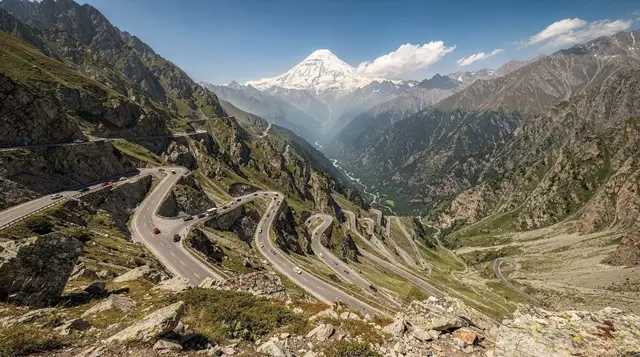
Book a group (not private) tour for Kazbegi to keep the cost down — From Tbilisi: Day Trip to Kazbegi runs at a fraction of a private transfer’s price and covers the same route: Ananuri Fortress, Gudauri and Stepantsminda beneath Mount Kazbek. From Stepantsminda, most group tours include or can add the shared 4x4 taxi up to Gergeti Trinity Church (25–30 ₾ per person if not already included) — walking up takes two to three hours each way and does not fit a day-trip schedule. See Ananuri Fortress and the Zhinvali reservoir and Gergeti Trinity Church: how to reach it. This is genuinely difficult to do independently by marshrutka in a single day given the unpredictable return leg, so booking a tour here is the practical budget choice, not a luxury one.
Day 4: Kakheti by group tour or independent marshrutka
Kakheti can be done either way on a budget.
From Tbilisi: to Kakheti Sighnaghi Bodbe and Telavi Tripcovers Sighnaghi, Bodbe Monastery and Telavi as a group tour with tastings included, generally the simpler choice. The independent alternative is a marshrutka from Tbilisi’s Ortachala station to Sighnaghi (roughly 8–10 ₾, around two hours), followed by walking Sighnaghi’s old town and Bodbe on foot or by short taxi, then a marshrutka back — slower and requiring more planning around departure times, but noticeably cheaper if you are travelling solo and do not mind the extra logistics. See A wine tour of Kakheti: how to plan it and Sighnaghi and Bodbe in a day for both approaches in more detail.
Day 5: Tbilisi to Kutaisi by train
Take a morning train to Kutaisi (roughly 15–25 ₾, about three and a half hours) rather than a more expensive private transfer. See Georgian trains, including the night train to Zugdidi for the schedule pattern. Check into a hostel or budget guesthouse near the centre and use the afternoon for Bagrati Cathedral, a short walk from most central accommodation — see Bagrati Cathedral and why UNESCO delisted it.
Day 6: Sataplia, Prometheus Cave and Martvili Canyon
Canyon Cave Tour Sataplia Prometheus Martvili covers all three sites in one organised group day, which is considerably cheaper per person than trying to arrange three separate taxis to sites that have no direct marshrutka service. See Martvili Canyon by boat and Prometheus Cave for what each stop involves; entrance fees at each site (typically 10–25 ₾) are usually not included in the tour price, so budget for them separately.
Day 7: back to Tbilisi, or fly from Kutaisi
If your return flight is from Tbilisi, take a morning train back (three and a half hours) to leave a comfortable margin for an evening flight. If your flight is from Kutaisi’s own airport instead, use the extra morning for a final look at the market or the riverside before heading to the terminal — see our Kutaisi airport guide for transfer options from the centre.
What you have to give up by not renting a car
Be honest with yourself about the trade-off: Vardzia, Racha and Svaneti’s Ushguli road all become genuinely difficult without a car, since public transport to each runs infrequently and often on inconvenient schedules that do not suit a short trip. This itinerary deliberately routes around all three rather than attempting a rushed, unreliable version of them. If any of them are a priority, either extend the trip and budget for a rental car on those specific legs, or accept a slower, more expensive multi-day approach using local drivers rather than self-driving. See our guided-vs-independent comparison for a broader look at when public transport genuinely suffices and when it starts costing more in time than a tour or driver would in money.
A detailed budget for the week
Accommodation is the biggest lever on a budget trip: a hostel bed runs 20–35 ₾ a night, a basic private guesthouse room 50–80 ₾, against 80–150 ₾ for the mid-range options described in other itineraries on this site. Across seven nights, that difference alone can save 150–300 ₾. Food on this plan leans toward khinkali houses, bakery windows and market produce rather than sit-down restaurants — a full day of eating this way runs 25–40 ₾ per person, roughly half what a restaurant-heavy day costs.
The two group tours (Kazbegi and Kakheti) run 35–55 € per person each at the group rate, against 60–90 € for the private equivalents used in the mid-range itineraries. The Kutaisi train and the canyon tour add a further 40–60 € per person combined. Altogether, a budget traveller doing this exact route should expect to spend 250–350 € per person for the full week, excluding international flights — solo travellers should budget toward the higher end, since hostel dorms are the main lever that benefits from splitting costs with a travel partner.
Where to stay on a budget along this route
Tbilisi has the widest hostel selection of anywhere in Georgia, concentrated around the Old Town and Marjanishvili, with dorm beds from roughly 20 ₾ and private rooms from 50 ₾; see Guesthouses, hostels and hotels: what you get for what differs between the tiers beyond price. Kutaisi’s budget options cluster around the centre near Chavchavadze Avenue and are generally cheaper than Tbilisi’s equivalent tier, since fewer international visitors stay overnight there compared with day-trippers passing through. Booking a night or two ahead is sensible in July and August; outside peak season, walk-in availability is usually fine at both stops.
Common mistakes travelling Georgia without a car
The most common mistake is assuming marshrutkas run on a fixed timetable the way a European regional bus does — they generally leave once full, not at a scheduled time, so build in buffer rather than planning to the minute around a marshrutka connection. The second is trying to save money by taking a marshrutka to Kazbegi and arranging your own return, rather than booking a tour — the unpredictability of the return leg has stranded more than a few budget travellers in Stepantsminda overnight, unplanned and at a much higher cost than the tour would have been.
The third is skipping the sulphur baths entirely to save money, when the shared (non-private) pools cost only a few lari and give most of the experience a private room does at a fraction of the price — this is one of the few places in Georgia where the budget option is nearly as good as the expensive one, not a worse version of it.
Solo travel on this route
This itinerary suits solo travellers particularly well, since group tours, hostels and shared marshrutkas all involve meeting other travellers by default in a way a self-driven road trip does not. Kazbegi and Kakheti group tours in particular tend to attract a similar mix of independent travellers, and it is common to end up sharing a taxi to Gergeti or a table at a khinkali house with people met that same morning. See Travelling Georgia solo for broader safety and practical notes, and Solo female travel in Georgia: what readers report for a more specific account of what solo women travellers have found on routes very similar to this one.
Money and cards on this route
Georgia is increasingly card-friendly in Tbilisi and Kutaisi, but this itinerary’s reliance on marshrutkas and small khinkali houses means carrying cash matters more than it would on a car-and-hotel trip. Marshrutka fares are cash-only in almost all cases, and many of the cheapest, best khinkali houses and market stalls do not take cards either.
Withdraw lari from an ATM soon after arrival rather than relying on exchanging cash at the airport, where rates are generally worse; see Lari, ATMs and cards for where to find reliable machines and what fees to expect. A rough daily cash budget of 40–60 ₾ for transport, snacks and small purchases, on top of pre-booked tours and accommodation, covers most days on this route comfortably.
What this route feels like compared with a driving trip
Travelling this way trades a little flexibility for a slower, more sociable pace: you meet more people on group tours and marshrutkas than you would in a private car, and you spend more time actually in towns rather than passing through them at speed between stops. The days themselves run on a fixed shape — a departure time, a group, a return time — which some travellers find restful after the constant micro-decisions of a self-driven itinerary, and others find slightly less spontaneous. Neither is objectively better; this itinerary simply makes the trade explicit rather than assuming everyone wants the flexibility a rental car buys.
Frequently asked questions about a car-free week in Georgia
Is it really possible to see Georgia’s highlights without a car?
Yes, for the core route in this itinerary — Tbilisi, Kazbegi, Kakheti and Kutaisi’s canyons. Some regions, particularly Svaneti’s Ushguli road, Vardzia and Racha, are genuinely harder without one and are deliberately left out of this plan.
Are marshrutkas safe and comfortable for a week of travel?
They are safe and widely used by Georgians themselves, though comfort varies — expect a full minivan, no fixed timetable beyond “leaves when full”, and driving that can feel brisk on mountain roads. For the two longest single journeys in this itinerary (Kazbegi and Kutaisi), this plan uses a tour and the train respectively rather than a marshrutka, for reliability.
Is a group tour to Kazbegi worth it if I am trying to save money?
Yes — the group rate is a fraction of a private tour or self-arranged transport, and the return leg from Kazbegi is genuinely hard to plan independently in a single day. This is one of the clearest cases where booking a tour is also the cheapest option, not a compromise on budget.
Should I take the train or a marshrutka to Kutaisi?
The train, if the timing works for you — it is more comfortable, similarly priced, and does not depend on waiting for a marshrutka to fill up. Marshrutkas to Kutaisi run more frequently if the train schedule does not suit your day.
How much cheaper is this itinerary than the equivalent mid-range trip?
Roughly 150–250 € per person cheaper across the week, mainly from hostel or basic guesthouse accommodation instead of mid-range hotels, group rather than private tours, and shared rather than private sulphur bath rooms.
Can I add Batumi to this without a car?
Yes, if you extend the trip by two or three days — Batumi is reachable from Kutaisi or Tbilisi by marshrutka or train, and none of it requires a car. It does not fit inside this specific seven-day plan without cutting something else first.
Is public transport reliable enough that I will not miss a flight?
For the fixed points on this itinerary, yes, provided you leave the buffer this plan builds in — morning trains and tours, rather than the last possible connection of the day. The genuine unpredictability sits with marshrutkas specifically, which is why this itinerary uses tours or the train for the two legs (Kazbegi and Kutaisi) where timing matters most, and leaves marshrutkas for the shorter, lower-stakes journeys within Tbilisi and Kakheti.
Best day trips from Tbilisi on GetYourGuide
Verified deep-linked GetYourGuide tours. Book through these links and we earn a small commission at no cost to you.
Photo: our own image of the location, not the operator’s product photo.