Free things to do in Tbilisi
What can you do for free in Tbilisi?
Walk the Old Town, cross the Bridge of Peace, visit Sioni Cathedral and Anchiskhati Basilica, see Legvtakhevi waterfall, browse Dezerter Bazaar and Dry Bridge Market, and spend time at Fabrika's courtyard — all free. Paid extras, like the Narikala cable car or the sulphur baths, are optional add-ons to an otherwise inexpensive day.
A genuinely cheap city to sightsee in
Tbilisi is one of the more affordable capitals in the region to visit, and a meaningful share of its best sightseeing costs nothing at all — churches, markets, the Old Town’s streets and several of its viewpoints are all free, with paid extras like the Narikala cable car or a sulphur bath sitting as optional add-ons rather than necessities. This list covers what a genuinely no-cost, or close-to-no-cost, day or two in Tbilisi actually looks like.
The Old Town itself
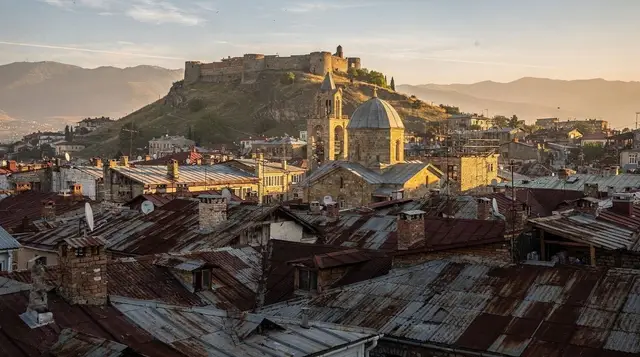
Simply walking the Old Town costs nothing and is, for most first-time visitors, the single best thing to do in the city regardless of budget — narrow lanes, carved wooden balconies, the domed roofline of the sulphur baths, and enough architectural variety packed into a small area that a slow, unstructured wander rewards as much as a planned route does.
Tbilisi: Old Town Guided Walking Tour is the one paid option worth considering even on a tight budget, since a guide adds context to buildings that otherwise pass by unexplained — a reasonable single splurge on an otherwise free day.
Every church in the city
Sioni Cathedral, Anchiskhati Basilica, Kashveti Church on Rustaveli Avenue, and Holy Trinity Cathedral (Sameba) on the opposite hillside are all free to enter, as is every other working Orthodox church across the city. Standard dress expectations apply — see Visiting a Georgian Orthodox church: dress and etiquette — but there is no entrance fee anywhere, which makes church visits one of the most reliable free activities on any Tbilisi itinerary.
The Bridge of Peace and Legvtakhevi waterfall
Crossing the Bridge of Peace costs nothing and gives one of the better photo angles in the city back toward the Old Town’s rooftops. Behind the sulphur baths, a short and level path leads to Legvtakhevi waterfall, a modest but genuinely pretty cascade tucked into a gorge between buildings — free, easy to reach, and skipped by a surprising number of visitors who do not realise it is there. Full detail on both is in Abanotubani: the sulphur bath district explained.
Free viewpoints
Not every good view in Tbilisi requires a cable car fare. The terrace beside Metekhi Church, on the opposite bank from the Old Town, gives a genuine, low, close view over the rooftops and the river, and several spots along Betlemi Street offer similar views on the climb toward Narikala. Narikala Fortress itself is free to enter once you are up there — only the cable car ride is a paid option, with a free walking path from Betlemi Street as the no-cost alternative. See The best viewpoints in Tbilisi for the fuller ranked list, free and paid.
Dezerter Bazaar and Dry Bridge Market
Browsing both of Tbilisi’s best-known markets costs nothing beyond whatever you choose to buy. Dezerter Bazaar is a sprawling, chaotic produce market genuinely used by local residents rather than staged for tourists — worth wandering for the atmosphere and the spice stalls alone; see Dezerter Bazaar: how to shop it. Dry Bridge Market, closer to the Old Town, sells Soviet-era antiques, medals, artwork and curiosities laid out on blankets along the riverside path — more a browsing experience than a place most visitors buy much, but worth the walk regardless; see The Dry Bridge flea market for what is typically on offer.
Fabrika’s courtyard and Chugureti’s street art
Fabrika, the converted Soviet-era factory in Chugureti, is free to enter and wander even without buying anything, and the street art scattered through the surrounding streets costs nothing to see beyond the walk itself. It is a genuinely different side of the city from the Old Town, and one of the better free ways to spend an afternoon once the main historic sights are covered.
Free walking beyond the centre
For visitors happy to walk further, the hiking path up to Mtatsminda from near the park’s base is a genuine free alternative to the funicular, though considerably steeper and longer than anything in the Old Town — see Mtatsminda Park and the funicular for how the paid and free routes compare. Turtle Lake, further along the same ridge, is free to walk around and popular with local residents rather than staged for visitors, a genuinely different pace from the city centre for anyone with a spare afternoon and comfortable shoes.
Free or low-cost cultural moments
Tbilisi’s calendar includes several free public festivals worth timing a visit around if the dates line up, including Tbilisoba in autumn, the city’s largest annual celebration, with free music, food stalls and events across the Old Town — see Tbilisoba and the autumn festivals for what typically happens and when. Outside of festival dates, simply sitting in Rustaveli Garden or one of the Old Town’s small squares in the early evening, watching the city’s ordinary rhythm rather than seeking out a specific sight, is free and, for a lot of visitors, ends up being one of the more memorable parts of a trip.
What is technically not free
A handful of Tbilisi’s better-known sights do charge, and it is worth knowing this before planning a strictly no-cost day: the Tbilisi Botanical Garden charges a modest entrance fee, the sulphur baths charge for a room or a public hall session, and the Narikala cable car and Mtatsminda funicular both charge modest fares for the ride, even though the destinations themselves — the fortress grounds and the park — are free once you arrive. None of these costs are high by regional standards, but they are not zero, and a genuinely free-only day means skipping them in favour of their walking alternatives where one exists.
Freedom Square and Rustaveli Avenue’s exteriors
Walking the length of Rustaveli Avenue costs nothing, and while the Georgian National Museum and the Opera and Ballet Theatre both charge for entry or a ticket, their exteriors — the Parliament building, the theatre’s Moorish-revival facade, Kashveti Church — are all worth seeing from the street without paying anything at all.
Sololaki’s streets, free and worth a slow look
Sololaki, the hillside neighbourhood between the Old Town and Rustaveli, costs nothing to walk and rewards exactly the kind of unhurried, no-particular- destination wandering that suits a free-focused day — Art Nouveau apartment buildings, carved doorways and painted stairwells visible from the street even without stepping inside any of them. It sits close enough to the Old Town and Narikala that adding it to a free walking day requires no special detour, just a willingness to keep climbing a little further once the fortress route below it is finished.
A realistic free day, put together
Start at Freedom Square, walk the Old Town’s core streets and churches, cross the Bridge of Peace for the view, climb Betlemi Street toward Narikala for a free look at the fortress grounds, see Legvtakhevi waterfall on the way back down, and finish the afternoon at Fabrika or one of the markets. Add a genuinely cheap khinkali lunch — 1 to 1.5 GEL per piece — and the entire day, transport aside, can realistically cost close to nothing beyond food.
Tbilisi: Photo and Cultural Walking Tour with Local Guide is worth flagging even on a free-focused itinerary, since a single modestly priced guided walk can add more context to a free day than almost any paid attraction would on its own.
Keeping the rest of the trip cheap too
Free sightseeing goes furthest alongside cheap eating and sleeping. Khinkali at 1 to 1.5 GEL each and khachapuri at 8 to 15 GEL are inexpensive by almost any standard, and a hostel bed or a basic guesthouse room runs 40 to 70 GEL a night in the city centre — see What a week in Georgia actually costs and Guesthouses, hostels and hotels: what you get for the fuller national picture this city-level list sits inside. Travelling this way, a full day in Tbilisi covering the Old Town, several churches, both markets and a couple of viewpoints can realistically come in under 30 GEL per person beyond accommodation, cable car fares and one paid attraction aside.
Before the city wakes up
The single cheapest way to improve a free day in Tbilisi costs nothing at all: start it early. Before about 8am, the Old Town’s lanes are close to empty, the sulphur bath domes photograph without a queue of tour groups in front of them, and Betlemi Street’s climb toward Narikala is a quiet walk rather than a shuffle past other visitors going the same way. None of the sights themselves change — it is the same free Old Town covered elsewhere on this page — but the experience of walking it does, and an early start costs nothing beyond setting an alarm.
Tbilisi: Before City Wakes Up Walking Tour is built specifically around this window, a reasonable single addition to an otherwise free day for anyone who would rather have a guide’s commentary during the quiet hours than work out the same route alone.
Getting between the free sights without spending much
Almost everything on this list sits within walking distance of the Old Town, so the honest transport budget for a free-focused day is close to zero. Where a lift genuinely helps — tired legs at the end of the day, or the stretch out to Fabrika and back — the Tbilisi metro costs 1 GEL a ride on a rechargeable Metromoney card, refundable when you are done, and a short Bolt hop across the centre typically runs 5 to 12 GEL depending on distance and time of day.
Neither is essential for the core route through the Old Town, Sololaki and Narikala, but both are cheap enough that skipping them purely to save a lari or two rarely makes sense once your feet are tired. See Tbilisi metro, buses and the Metromoney card and Taxis, Bolt and Yandex Go for the fuller detail on both options.
Free-day mistakes worth avoiding
A handful of avoidable errors turn an otherwise cheap day into a more expensive or more frustrating one. The most common is assuming a sight is free because it is old or because it looks like a public building — the Georgian National Museum, the Opera and Ballet Theatre and the Tbilisi Botanical Garden all charge, and turning up expecting otherwise wastes time at the entrance rather than saving money. Another is dressing for a beach day and then being turned away from Sameba or Sioni Cathedral for bare shoulders or shorts; carrying even a light scarf solves this without needing a full outfit change.
A third is trying to cover every item on this list in a single afternoon, rushing the Old Town, the markets and Fabrika back to back rather than genuinely lingering anywhere — a free day works better paced across a full day or split over two than compressed for the sake of a checklist. Finally, carry some small change; market stalls at Dezerter Bazaar and Dry Bridge rarely take cards, and a browsing visit that turns into an impulse purchase is easier with a handful of lari already in your pocket.
When a free day works best
Spring and autumn suit this list best, since the Old Town’s walking-heavy route and the climb toward Narikala are more comfortable without either summer heat or winter ice underfoot — see Georgia in autumn: the best season, and why for the fuller case for that window specifically. A summer free day still works, but the midday sun on the Old Town’s stone lanes and the climb up Betlemi Street is genuinely tiring by early afternoon; shifting the walking-heavy parts of this list to morning or early evening and using the middle of the day for a shaded market visit or a café break, rather than pushing through the heat, makes for a noticeably more pleasant day.
Winter thins out the crowds further still and keeps every item on this list free exactly as described, though the churches are unheated and a warm layer under your coat is worth it for anyone planning to linger inside Sioni or Anchiskhati rather than just passing through. See Georgia in summer, and how to escape the heat for how the season specifically affects a walking-heavy free itinerary like this one.
Free things to do with a longer stay
Visitors spending more than a couple of days in Tbilisi can extend this list further without spending more. Sitting through a rehearsal-quality preview or simply people-watching outside the Opera and Ballet Theatre on Rustaveli, even without buying a ticket for a performance, gives a sense of the building’s evening life for nothing. Walking the length of the river on either bank, away from the Bridge of Peace crossing point most visitors use, shows a quieter, more residential side of the city that rarely makes it onto a first-day itinerary.
Vera, the district just west of Sololaki, extends the same free architectural wandering into a slightly less visited neighbourhood for anyone who has not tired of painted stairwells and carved facades after Sololaki itself. None of this requires planning beyond comfortable shoes and a spare afternoon, which is really the underlying theme of a free-focused Tbilisi visit: the city rewards unhurried walking more consistently than it rewards any single paid attraction. A notebook of streets you have not yet covered, added to as you go rather than planned exhaustively in advance, tends to serve a longer, free-focused stay better than a fixed list decided before you arrive.
Frequently asked questions about free things to do in Tbilisi
Is Tbilisi a cheap city to visit?
Yes, by most European or North American standards. A meal costs 25 to 40 GEL, a coffee 5 to 10 GEL, and much of the city’s core sightseeing — churches, walking routes, markets and viewpoints reached on foot — costs nothing at all.
Are Tbilisi’s churches free to visit?
Yes, every working Orthodox church in the city, including Sioni Cathedral, Anchiskhati Basilica, Kashveti Church and Holy Trinity Cathedral (Sameba), is free to enter, with the usual expectation of modest dress and quiet behaviour.
Is Narikala Fortress free to visit?
The fortress grounds themselves are free once you are up there; only the cable car ride up costs money (about 5 GEL), and a free walking path from Betlemi Street is a genuine no-cost alternative.
What free viewpoints does Tbilisi have?
The terrace by Metekhi Church, the Bridge of Peace itself, and several spots along Betlemi Street in the Old Town all give real views over the city without paying for a cable car or funicular.
Is the Tbilisi Botanical Garden free?
No, it charges a modest entrance fee, generally a few lari — cheap by most standards but not free, worth knowing if you are planning a strictly no-cost day.
Can you visit Dezerter Bazaar and Dry Bridge Market without spending money?
Yes, both are free to walk through and browse, and doing so is one of the better free activities in the city even if you buy nothing — Dezerter Bazaar for produce and local life, Dry Bridge for Soviet-era antiques and curiosities.
Old Town walking tours on GetYourGuide
Verified deep-linked GetYourGuide tours. Book through these links and we earn a small commission at no cost to you.
Photo: our own image of the location, not the operator’s product photo.