Chacha: what it is and how not to overdo it
What is chacha?
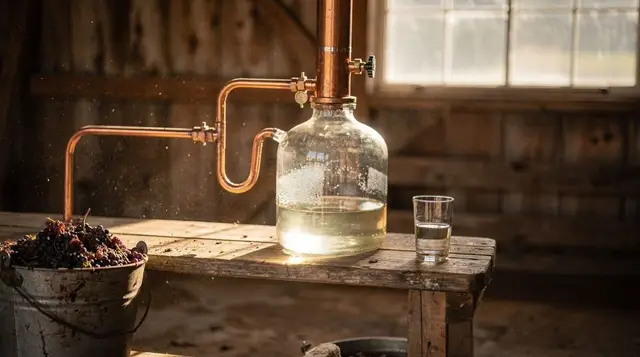
Chacha is a Georgian grape spirit distilled from the pomace left over after winemaking — the skins, stems and pips pressed out of the grapes. It ranges widely in strength, is traditionally home-distilled in villages, and turns up at almost every Georgian meal and wine tasting as a strong closing pour, so treating it like wine and drinking it at the same pace is the most common mistake visitors make.
The pour that catches people out
Nobody plans to be caught off guard by chacha; it just tends to happen anyway. A tasting winds down, the wine glasses are cleared, and a small, innocent-looking clear pour appears that looks like nothing more than a last taste of white wine. It is not. Chacha is a distilled spirit, not a wine, and treating it like one — sipping it at wine pace, in wine-sized amounts — is the single most common mistake first-time visitors make with it. This guide covers what chacha actually is, how strong it really gets, where to try it properly, and how to drink it without regretting the rest of the evening.
What chacha actually is
Chacha is distilled from pomace — the skins, stems and pips left over once grapes have been pressed for wine. Rather than discarding this leftover mass, Georgian winemakers ferment and distil it into a clear spirit, which makes chacha a genuine by-product of the same winemaking tradition covered in A wine tour of Kakheti: how to plan it and Qvevri wine explained — nothing is wasted, and the pomace that would otherwise be composted becomes a second drink entirely.
It is often compared to Italian grappa, and the comparison is fair as far as the production method goes, but chacha sits apart in two ways: it is far more commonly distilled at home, on a small, informal scale in villages rather than only by commercial producers, and it holds a specific ceremonial role at the Georgian supra, the traditional feast, that grappa does not have in Italy. The supra and the tamada explained covers where chacha fits alongside wine in that ritual.
How strong it actually is
This is the detail that matters most. Commercially bottled chacha states its alcohol content on the label, same as any spirit you would buy in a shop elsewhere. Homemade chacha, distilled in a village still without a fixed recipe or standard, varies far more — batch to batch, producer to producer — and that variability is exactly why an unlabelled pour deserves more caution than a glass of wine from the same table. A small sip first, rather than the toast-sized gulp a wine pour might get, is the sensible way to gauge what you have actually been handed before committing to more.
Where to try it properly
Tbilisi is the easiest place to try chacha alongside a proper explanation of what you are drinking, since most cellar and wine-bar tastings in the city pour a small measure of it at the close of a session — see Wine tasting without leaving Tbilisi for where those tastings happen. Tbilisi: Grape to Glass Crazy Chacha Tasting Experience is built specifically around chacha rather than treating it as an afterthought to a wine tasting, walking through how it is made and letting you compare a few different styles side by side.
Old Town walking and boat tours built around food and drink often work a chacha taste into a wider itinerary. Tbilisi: Fabrika and Chughureti Walking Tour with Chacha pairs it with a look at Fabrika and the Chugureti courtyards, and Tbilisi: Old Town Boat Tour with Wine and Chacha Tasting combines both wine and chacha with a river cruise past the Old Town, useful if you would rather taste on the move than sit at a single bar.
Batumi takes a different approach entirely: a chacha crawl there is closer to a pub crawl than a cellar tasting, moving between bars across an evening with unlimited pours rather than a single guided session. It suits a different mood — a night out rather than an education — and pairs naturally with Batumi after dark: casinos and clubs if you are building a wider evening around it.
Out in Kakheti, chacha shows up as a natural extension of a winery visit rather than its own attraction, and Telavi: Georgian Wine and Chacha Tasting with Snacks in Telavi is a straightforward way to try both wine and chacha from the same producer in one sitting, alongside a plate of snacks rather than a full meal.
Buying chacha to take home or to try safely
Quality and strength both vary more between informal, home-distilled batches than between anything bottled and sold in a shop. A bottle bought from a wine shop, a winery you have actually visited, or a producer your guide has vouched for removes most of the guesswork that comes with an unlabelled bottle from an unfamiliar roadside seller — the same logic that applies to Buying Georgian wine to take home applies here, arguably more strongly, given how much more strength can vary between two bottles that look identical.
Chacha and the supra
At a traditional supra, wine carries most of the meal, poured and re-poured through a long sequence of toasts led by the tamada, the toastmaster. Chacha tends to appear at specific moments rather than throughout — often for a closing toast, or a particularly weighty one, where its strength underlines the seriousness of what is being said rather than just adding volume to the drinking.
Understanding that rhythm in advance makes the moment chacha does appear feel less like an ambush and more like part of a structure that has its own internal logic; A supra vocabulary: twenty words that help and The order of toasts at a supra both go further into how that sequence actually plays out.
The morning after
Georgian hospitality runs on generosity, and a host or tamada topping up a glass — wine or chacha — is a gesture of welcome, not an instruction to finish it. Leaving a glass part-full, or turning it upside down at the end of a toast in some settings, is an accepted way to signal you are done without causing offence. If you do misjudge the pace, Surviving a supra: the morning after covers what actually helps the next day, beyond the usual advice everyone already knows.
Commercial versus homemade, in practice
Two very different products both get called chacha, and it helps to know which one you are being handed. Commercially bottled chacha, sold in shops and supermarkets, is produced and labelled to the same standard as any spirit on a shelf, with its strength printed on the bottle and a consistent recipe batch to batch.
Homemade chacha, distilled in villages on small stills without a fixed commercial standard, is the version most visitors actually encounter at a family guesthouse, a wine cellar tasting, or a supra — and it is also the version where strength and quality vary the most. Neither is inherently better; a good homemade batch can be genuinely excellent, but the uncertainty is real, which is why pacing yourself with an unfamiliar pour matters more here than with a shop-bought bottle.
Common mistakes worth avoiding
The single most common misjudgement is treating chacha’s clear appearance as a signal that it is mild — visually it can resemble water or a very pale wine, and that similarity does nothing to reflect its actual strength. A second common mistake is drinking it on an empty stomach; chacha tends to appear during a meal or after wine has already been poured, and skipping food beforehand makes its effects land harder and faster than expected.
A third is refusing a host’s pour outright rather than accepting a small amount and pacing it — in most settings, taking a small sip and setting the glass down half-full reads as perfectly normal, whereas an outright refusal can occasionally be read as impolite depending on the setting and how the toast was framed.
Regional character: Kakheti, Tbilisi and Adjara compared
Chacha is made across the whole wine-producing part of the country, but the way it shows up to a visitor differs by region. In Kakheti, it appears as a natural extension of a winery visit, poured from the same pomace as the wine you have just tasted, often with a direct connection between the specific grapes and the glass in front of you.
In Tbilisi, it is more often framed as its own tasting experience or a closing pour at a cellar or wine bar, detached from any specific vineyard. In Adjara, especially around Batumi, chacha culture leans toward a livelier, bar-crawl format aimed squarely at a night out rather than an educational tasting — a genuinely different mood from a Kakheti cellar, even though the spirit in the glass is fundamentally the same.
Pairing chacha with food
Georgian hosts rarely pour chacha entirely on its own. A small plate of something salty or fatty — cured meat, a hard cheese, pickled vegetables — commonly accompanies a chacha pour, both as tradition and as practical advice, since food alongside a strong spirit blunts its effect more effectively than drinking on its own. See A guide to Georgian cheese for what typically sits on that plate, and Khinkali: how to order and how to eat them if your chacha pour arrives, as it often does, at the tail end of a khinkali-heavy meal.
A quick reference before you go
If you remember nothing else: chacha is a distilled spirit, not a wine, its strength varies far more between homemade batches than commercial bottles, it usually appears toward the end of a tasting or meal rather than at the start, and a small sip first beats a full glass on trust. Keep those four points in mind and the rest of an evening built around it should hold no surprises.
Chacha and Georgia’s wider spirits scene
Chacha is by far the most internationally recognised Georgian spirit, but it is not the only one worth knowing about if spirits interest you beyond wine — Georgia also has a longer-established brandy industry, built along more conventional European lines than chacha’s rustic, often home-distilled tradition. That broader spirits scene sits outside the scope of this guide, but it is worth knowing chacha is the folk, family-scale end of a wider spectrum rather than the only spirit the country produces.
First-timer versus seasoned visitor
A visitor trying chacha for the first time is generally better served by a guided, explained tasting, such as the one described above, or a cellar pour with context from a guide, than by an informal pour handed over quickly during a busy meal, simply because a guide has time to explain strength and pacing before you drink rather than after. A visitor who has already tried it once and knows roughly what to expect can comfortably move on to the more social, faster-paced format of a Batumi chacha crawl, where the point is the evening out rather than the education.
Why chacha exists at all
Chacha is, at heart, a use for a by-product that would otherwise go to waste — the skins, stems and pips left over once grapes have given up their juice for wine. That practical origin matters for understanding why it sits so comfortably alongside Georgian wine culture rather than feeling like a separate, unrelated spirit: it is made from the same harvest, often on the same day, by the same hands, as the wine you may have just tasted a glass of. A winery that pours you both a wine and a chacha is, in a real sense, showing you two products of a single pressing rather than two unconnected drinks.
Chacha in the kitchen, not just the glass
Beyond drinking it straight, chacha occasionally turns up in Georgian cooking too, most often as a splash used to flavour a marinade for grilled meat or worked into a sauce, in much the same way a French kitchen might use brandy. It is not a defining feature of Georgian cuisine the way khinkali or khachapuri are, but if a dish tastes of something warm and slightly boozy beyond the usual herbs and walnut, chacha is a reasonable guess at the source.
A few words that help when it is offered
Knowing how to accept, decline gracefully, or ask what strength a pour is makes the moment easier to navigate, particularly at a supra where the tamada is mid-toast and the room is watching. Georgian words that actually help covers the basic vocabulary worth having ready, and it applies just as much to a chacha pour as to ordering food or asking directions.
Taking a bottle home
If a particular chacha impresses you enough to want a bottle for later, the same logic covered in Buying Georgian wine to take home applies, with one addition: because chacha is a spirit rather than wine, check your destination country’s duty-free spirits allowance specifically rather than assuming it matches the wine allowance, since the two are often calculated separately. Customs, duty free and what you may take out is worth reading before you buy more than a single bottle to carry home.
The honest bottom line
Chacha is worth trying properly rather than treating as a throwaway shot at the end of a wine tasting — it is a genuine part of Georgian drinking culture with its own production method and its own moment at the table, not a novelty stunt for tourists. The only real risk is underestimating it: a clear spirit that looks like water or thin white wine, served in the same small glass as everything else at the table, is easy to drink too fast if you are not paying attention to what it actually is. Slow down, ask what you are being poured before you drink it, and treat an unfamiliar homemade bottle with a little more respect than a glass of Saperavi.
Frequently asked questions about chacha
Is chacha the same as grappa?
They are close cousins — both are pomace brandies distilled from what is left after pressing grapes — but chacha is typically stronger, more often home-distilled, and carries its own specific role at the Georgian supra that grappa does not have in Italy.
How strong is chacha?
It varies considerably. Commercial bottles list their strength like any spirit; homemade batches, not made to a fixed standard, can run considerably higher, which is why an unlabelled pour deserves more caution than a glass of wine.
Where can you try chacha in Tbilisi?
Most wine tastings and cellar visits in the city pour a small chacha alongside the wine, usually at the end. Dedicated chacha tastings exist as their own experience too, and it appears on several Old Town walking and boat tours.
Is a chacha crawl in Batumi different from tasting it in Tbilisi?
Yes. Batumi’s chacha crawls are built around bar-hopping and unlimited pours across an evening, closer to a pub crawl than a Tbilisi-style wine-cellar tasting.
Do Georgians drink chacha at every meal?
No. It is a fixture of the supra, particularly for the tamada’s closing toasts, but everyday drinking is far more wine-centred; chacha tends to appear for celebrations and toasts rather than daily.
Is it safe to buy chacha from a roadside stall?
Quality and strength vary far more between informal, home-distilled batches than between shop-bought or winery bottles. Buying from a shop, a winery you have visited, or a vouched-for producer removes most of that uncertainty.
Qvevri wine tasting and vineyard tours on GetYourGuide
Verified deep-linked GetYourGuide tours. Book through these links and we earn a small commission at no cost to you.
Photo: our own image of the location, not the operator’s product photo.