Amber wine: the skin-contact whites Georgia never stopped making
What is amber wine?
Amber wine is white grape wine fermented with its skins left in, usually for weeks or months in qvevri, which extracts colour, tannin and texture that a normally filtered white wine never picks up. The result looks and tastes closer to a light red than a conventional white, and Georgia has been making it this way for thousands of years, well before the rest of the world started calling the same technique orange wine.
The style the rest of the world just discovered
Skin-contact white wine has become a genuine international trend over the past couple of decades, usually marketed as orange wine, and usually presented as something new. In Georgia it is not new at all — amber wine, made the same way, has been part of the country’s winemaking tradition for thousands of years, continuous rather than revived. Understanding that history changes how the wine reads once you taste it: this is not a stylistic experiment, it is the default way Georgia has always made white wine from certain grapes.
How it is actually made
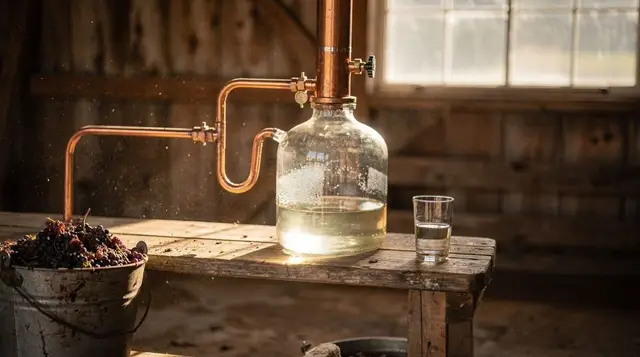
Ordinary white wine is pressed and fermented with the skins removed almost immediately, which is why it stays pale and light-bodied. Amber wine skips that step: white grapes are fermented with their skins, and often stems, left in, typically inside qvevri, the large buried clay vessel used across Georgian winemaking, for anywhere from several weeks to several months. Qvevri wine explained covers the vessel and the method in full; what matters specifically for amber wine is that this extended contact with the skins extracts tannin, colour and texture that a filtered white wine never picks up, pulling the finished wine toward the amber-orange colour that gives the style its name.
What it actually tastes like
The result sits closer to a light red than to a conventional crisp white. Expect real tannin structure — a grip and dryness on the finish that white-wine drinkers do not usually expect — alongside notes that lean toward dried fruit, nuts, honey and a savoury, almost tea-like character rather than the fresh citrus and green fruit typical of a filtered white. It is a genuinely different drinking experience from anything most visitors will have tried before arriving in Georgia, closer in weight to Saperavi: how to read a Georgian red than to a Sauvignon Blanc, even though the grape underneath is a white one.
The grapes behind it
Rkatsiteli is the grape most associated with amber wine, grown widely across Kakheti and known for handling extended skin contact particularly well without becoming unbalanced. Mtsvane, Kisi and Khikhvi are also used, each pulling the finished wine in a slightly different direction — more floral, more aromatic, more textured — though Rkatsiteli remains the benchmark grape most producers and guides reach for when explaining the style to a first-time taster.
Where it comes from
Kakheti is the undisputed heartland of amber wine, particularly the Alazani valley around Telavi and Kvareli, where the combination of Rkatsiteli plantings and an unbroken qvevri tradition has kept the style alive continuously rather than as a modern revival. A wine tour of Kakheti: how to plan it covers the region as a whole; most cellars there pour at least one amber wine alongside their Saperavi, though small family producers tend to offer a wider and more distinctive range than large commercial wineries built primarily around export-friendly reds.
Kakheti: Wine Tour Explore the Art of Qvevri Winemaking is built specifically around the qvevri method rather than treating it as one stop among several, which makes it a useful choice if amber wine and the technique behind it are the actual reason for your trip to Kakheti rather than a side interest.
Trying it without leaving Tbilisi
You do not need to drive to Kakheti to taste amber wine properly. Wine tasting without leaving Tbilisi and Natural wine bars in Tbilisi both cover where the city’s amber and qvevri wines are concentrated, and Wine Tasting Feel the Difference of Qvevri or Classical Wine is built around exactly the comparison that makes amber wine click for first-timers: tasting a qvevri amber wine directly against a conventionally made white from the same or a similar grape, side by side.
Ageing and buying
Amber wine generally ages better than most conventional white wine, thanks to the tannin structure the skin contact provides — the same structural backbone that lets red wine develop over years is present here in a white. That said, this is a general tendency rather than a guarantee for any specific bottle, and styles vary meaningfully between producers, so treat a producer’s own guidance on a particular vintage as more reliable than a blanket rule.
If a bottle catches your interest, Buying Georgian wine to take home covers how to think about carrying it back with you, and amber wine, being less internationally familiar than Saperavi, is often exactly the kind of bottle worth the extra care in packing since you are less likely to find it again once you leave Georgia.
A hands-on alternative: painting your own qvevri
For a different angle on the same tradition, Tbilisi: Qvevri Painting Workshop with Georgian Wine Tasting and Tbilisi: Qvevri Painting Workshop with Wine Tasting both pair a wine tasting with a craft workshop themed around the qvevri vessel itself, a lighter, more hands-on way to engage with the tradition than a straight cellar visit, and a reasonable option for a group that wants an activity alongside the tasting rather than tasting alone.
Amber wine and rtveli
If your trip coincides with rtveli, the autumn grape harvest, note that white grapes — including Rkatsiteli — are typically picked earlier in the harvest season than reds like Saperavi, which means an early-September visit is more likely to line up with amber wine’s harvest specifically than a late-September or October one. Rtveli: joining the grape harvest covers the timing in more detail if catching this particular part of the harvest matters to your trip.
Why it looks the way it does — and why that is not a flaw
First-time tasters sometimes mistake amber wine’s colour for a sign that something has gone wrong — oxidation, spoilage, or simply an old bottle past its best. It is neither. The colour is a direct, intended result of extended skin contact, the same process that gives red wine its colour, applied here to white grapes. A genuinely spoiled wine and a well-made amber wine are easy to tell apart on the palate even if they can look superficially similar in the glass; a good amber wine tastes structured and deliberate, not flat or vinegary. If in doubt at a tasting, simply ask — producers and staff pouring amber wine are well used to explaining the colour to visitors seeing it for the first time.
Serving and pairing
Amber wine is generally served closer to red-wine temperature than to a chilled white, since serving it too cold mutes the tannin and texture that define the style. A tulip-shaped glass, the same kind used for a lighter red, tends to suit it better than a narrow white-wine glass. On the plate, its tannin and savoury character make it a genuinely good match for food that would overwhelm a delicate white: khinkali, khachapuri and Georgian cheese all pair comfortably with it — see Every kind of khachapuri, region by region and A guide to Georgian cheese for what typically sits alongside it at the table.
Amber wine’s international reputation
Over the past two decades, sommeliers and wine writers outside Georgia have increasingly singled out amber and orange wine as one of the more interesting developments in contemporary wine culture, and Georgian producers, along with a handful from Slovenia and Italy’s Friuli region, are usually credited as the reference point for the style internationally. For Georgia specifically, this global attention has functioned less as a discovery than as belated recognition of a technique that never went away domestically — the same qvevri method now praised on international wine lists has simply been standard practice in villages across Kakheti the entire time.
A note on colour range
Not every amber wine looks the same in the glass — colour ranges from a light straw-gold with only a faint tint, from a shorter skin contact, through to a deep, almost tea-brown amber from months of contact and extended ageing. This range is worth expecting rather than assuming every bottle described as amber will look identical; a producer’s own description of how long a specific wine spent on its skins is a more reliable guide to what to expect than colour alone, since lighting in a tasting room can also affect how a wine’s true colour reads in the glass.
Talking about it like you know what you are drinking
A little vocabulary goes a long way at a tasting. Describing an amber wine as tannic, structured or having good grip signals you understand what extended skin contact actually does to a white grape, rather than defaulting to generic praise. Asking how long a particular wine spent on its skins, or which qvevri it came from, tends to prompt a more detailed and interesting answer from a producer or guide than a general question about whether the wine is good — most people pouring amber wine in Georgia are glad to talk process with anyone who shows real curiosity about it.
Amber wine as a lens on Georgian winemaking as a whole
Understanding amber wine properly is, in a real sense, understanding what makes Georgian winemaking distinctive in the first place, more than any other single style can show. Saperavi is an excellent red grape, but red wine made in clay vessels exists in various forms in wine cultures elsewhere too; skin- contact white wine held for months in a buried qvevri, by contrast, is something closer to uniquely Georgian in both scale and unbroken continuity. Visitors who leave Georgia having tasted amber wine properly, and understood roughly why it is made the way it is, generally come away with a clearer sense of the country’s wine tradition as a whole than visitors who focused only on the more internationally familiar reds.
A realistic first tasting
For a first proper introduction to amber wine, a flight of two or three examples side by side, rather than a single glass on its own, gives a far better sense of the style’s range than one bottle can. A lighter, shorter-macerated Kartli or Imereti version alongside a fuller, longer-macerated Kakheti Rkatsiteli shows how much variation sits under the single “amber wine” label, and makes it much easier to identify which end of that range actually suits your own taste, rather than judging the whole category on one producer’s particular house style.
Amber wine and the qvevri method, side by side
It is worth being precise about a distinction that gets blurred often: not all qvevri wine is amber, and not all amber wine is made in qvevri, even though the two overlap heavily in Georgia. A red wine like Saperavi is commonly qvevri-fermented too, without being amber, since amber specifically describes skin contact applied to white grapes rather than the vessel used.
Conversely, a handful of producers experiment with skin-contact whites outside the traditional qvevri, using other vessels while still aiming for an amber-style result. Most of what you will actually be poured in Georgia follows the traditional combination — white grapes, extended skin contact, fermented and aged in qvevri — but knowing the two concepts are separate helps make sense of a producer who describes a wine as one without the other.
A short glossary
A handful of terms come up repeatedly once you start asking about amber wine specifically, and knowing them in advance makes a cellar explanation land faster. Qvevri is the buried clay vessel itself. Marani is the Georgian word for the building or room that houses the qvevri — effectively the wine cellar, though often above ground rather than underground the way “cellar” suggests in English. Skin contact describes the technique itself, leaving grape skins in contact with the juice during fermentation. Hearing a guide use these terms at a tasting will make far more sense once you already know roughly what each one refers to.
Amber wine beyond Kakheti
Kakheti dominates amber wine production, but it is not the only region making it. Kartli, closer to Tbilisi and covered in Ananuri Fortress and the Zhinvali reservoir and the wider Mtskheta, Gori & Kartli area, grows Chinuri, a white grape sometimes made in an amber style with its own distinct, lighter character compared with Kakheti’s Rkatsiteli-based versions.
Imereti, around Kutaisi, tends toward a different qvevri approach with shorter skin contact overall, producing lighter amber wines than Kakheti’s longer-macerated style. Trying versions from more than one region, where you get the chance, shows how much the amber style itself varies before you even get to individual producers within a single region.
Why some visitors take a glass or two to come around
It is genuinely common for a first taste of amber wine to feel unfamiliar rather than immediately enjoyable, particularly for visitors used to crisp, cold, fruit-forward white wine. The tannin on the finish and the savoury, sometimes slightly oxidative character can read as a fault to an unprepared palate rather than as the intended style. Most people who end up genuinely liking amber wine describe a second or third glass, sometimes from a different producer, changing their mind — worth keeping in mind before writing the whole style off on the strength of one unfamiliar first pour at a busy tasting.
The honest bottom line
Amber wine is worth seeking out specifically rather than assuming any Kakheti winery visit will cover it — some tastings lean heavily on Saperavi and a conventional white, leaving amber wine as an afterthought or skipping it entirely. Ask for it by name if it is not already on the tasting list, and treat the tannin and savoury character as a feature to get used to rather than a flaw in an otherwise familiar white wine; approached that way, it is one of the more genuinely distinctive things you can put in a glass in Georgia.
Frequently asked questions about amber wine
Is amber wine the same as orange wine?
The technique is the same, but Georgians call it amber, not orange. Orange wine describes a recent international movement; amber wine describes an unbroken Georgian tradition thousands of years old.
Which grapes make Georgian amber wine?
Rkatsiteli is the most common, known for handling extended skin contact well. Mtsvane, Kisi and Khikhvi are also used, each giving a slightly different result.
What does amber wine actually taste like?
Tannic and structured for a white, with dried fruit, nuts, honey and a savoury character, closer in mouthfeel to a light red than a crisp white.
Where is Georgian amber wine made?
Kakheti is the heartland, especially around Telavi and Kvareli, though qvevri whites are made in smaller quantities elsewhere too.
Does amber wine age well?
Generally better than most white wine, thanks to its tannin structure, though styles vary between producers, so treat this as a tendency rather than a guarantee.
Where can you try amber wine in Tbilisi?
Natural wine bars carry the widest range from small producers, and most Kakheti winery tastings include at least one amber wine alongside Saperavi.
Qvevri wine tasting and vineyard tours on GetYourGuide
Verified deep-linked GetYourGuide tours. Book through these links and we earn a small commission at no cost to you.
Photo: our own image of the location, not the operator’s product photo.