Where to photograph Tbilisi, hour by hour
What is the best time of day to photograph Tbilisi?
Early morning, before 9am, for the Old Town's streets and the sulphur bath domes without crowds, and the hour before sunset for Narikala Fortress and Mtatsminda's wider city views, when the light turns warm across the tiled roofs.
Matched to the light, not just the sight
Tbilisi’s best-known photo subjects — the sulphur bath domes, the Old Town rooftops, the Bridge of Peace — each look genuinely different depending on the hour, and matching your visit to the right light matters more here than in cities with flatter, more uniform architecture. This guide sorts the city’s photo spots by when they actually look their best, rather than just listing them.
Early morning (before 9am): the sulphur bath domes and empty streets
Chreli-Abano’s striped blue-tiled facade and the brick domes of Abanotubani photograph far better before the tour groups arrive — the same view exists all day, but an empty street in soft morning light beats the same shot crowded with visitors every time. The Old Town’s narrower lanes, around Betlemi and Sioni streets, are similarly worth an early pass: the carved wooden balconies catch gentle side light before the sun climbs high enough to flatten the shadows that give the wood its texture. See Abanotubani: the sulphur bath district explained for the full picture of the district beyond the photograph.
Tbilisi: Festive Photo Walk with Local Guide runs early enough to catch this window, useful if you would rather have a guide leading you to the best angles than working it out alone at dawn.
Mid-morning to early afternoon: the Bridge of Peace and Rustaveli’s facades
The Bridge of Peace’s curved glass structure reads most clearly in direct daylight, when its shape and the Old Town backdrop behind it are both sharply visible — a different, complementary shot to its after-dark LED display. Along Rustaveli Avenue, the Parliament building, Kashveti Church and the Opera and Ballet Theatre’s Moorish-revival facade all photograph well in the flatter midday light that suits architecture better than it suits the Old Town’s textured lanes.
Golden hour (the last hour before sunset): Narikala and Mtatsminda
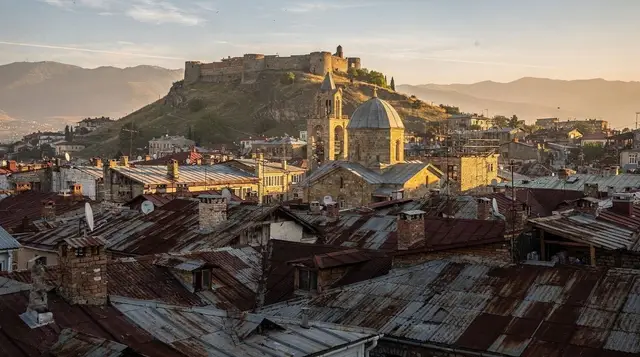
This is the single best window for Narikala Fortress and the wider city panorama from Mtatsminda Park, when warm, low light spreads across the tiled roofs below and the worst of the day’s haze has usually settled. Both spots get busier at exactly this time, for exactly this reason, so arriving twenty minutes before the light peaks secures a better spot than turning up right at the moment everyone else does too.
Tbilisi: Sunset Photo Experience Hills Sea is built specifically around this window on the quieter ridge road beyond Mtatsminda, a good option if a less crowded golden-hour shot matters more than the classic, busier Narikala angle.
After dark: the Bridge of Peace lit up, and Old Town lanterns
Once the sun is down, the Bridge of Peace’s LED lighting becomes the photograph in its own right, cycling through patterns that make it a genuinely different subject from its daytime self. The Old Town’s pedestrianised streets around Erekle II and Shardeni take on a warmer character too, once café lights and string bulbs replace daylight — busier with people, but atmospheric in a way the same streets are not at midday. A tripod and a slower shutter speed help considerably here, given how dim the ambient light gets away from the main strips.
Sololaki: soft, painted-stairwell light
Sololaki’s Art Nouveau courtyards and painted stairwells generally photograph best under the softer, diffused light of an overcast morning or the shaded hours around midday, since direct sun creates harsh contrast against the buildings’ already faded paintwork. This is one of the few spots in the city where a “bad” weather day for other sightseeing can actually be a good photography day.
Chugureti and Fabrika: a different palette
Away from the Old Town’s warm stone and tile, Fabrika’s courtyard and Chugureti’s street art offer a completely different visual register — raw brick, large-scale colour murals, and a younger, more urban crowd than the Old Town’s tourist-heavy streets. It photographs well at almost any hour given the mix of open sky and painted walls, though late afternoon light hitting the murals directly tends to bring out colour saturation better than an overcast morning does here, in contrast to Sololaki’s softer preferences.
Street photography and photographing people
Tbilisi’s markets, particularly Dezerter Bazaar, and the Old Town’s more residential lanes offer genuine street photography opportunities, though it is worth the same courtesy anywhere else: asking before photographing a person up close, rather than assuming it is fine, tends to go over better and often leads to a warmer, more natural portrait than a candid shot taken without acknowledgement. Market vendors in particular vary in how they feel about being photographed while working, and a quick nod or gesture asking permission costs nothing and avoids an awkward moment.
Gear notes for the terrain
The Old Town’s cobblestones and the fortress’s uneven ground make a full tripod setup cumbersome for much of this route; a lightweight travel tripod or simply bracing against a wall covers the low-light evening shots well enough for most purposes. A polarising filter helps cut glare off the river and the sulphur bath domes’ glazed tiles on bright days, and a spare battery is worth carrying given how much walking, and therefore shooting, a full day covering several of these spots involves.
Portraits and staged shoots
Several operators run dedicated photoshoot experiences in traditional Georgian dress or simply with a professional photographer directing portraits at the city’s best angles, worth considering for a couple, family or solo traveller who wants polished portraits rather than only their own landscape and street shots.
Tbilisi: Pro Photoshoot Portraits Couples Families covers exactly this, working around the same golden-hour timing that suits the city’s landscape shots too.
Seasonal notes
Autumn, roughly late September through October, is generally reckoned the most photogenic season — clear air, warm light and turning leaves in the city’s parks combine well with the Old Town’s existing colour palette. Winter gives some of the clearest long-distance views from hillside viewpoints, since summer haze thins out considerably, even if close-up scenes read greyer and colder under a lower winter sun. See Georgia in autumn: the best season, and why for the fuller case for timing a visit around this window.
Photographing inside churches
Photography is generally tolerated inside Tbilisi’s working churches, including Sioni Cathedral and Anchiskhati Basilica, though flash and photographing during an active service are not — worth checking for signage or simply watching what others are doing before raising a camera, since practice varies slightly by church. The same modest dress expectations that apply to visiting apply to photographing inside; see Visiting a Georgian Orthodox church: dress and etiquette for the fuller picture.
Building this into a wider itinerary
None of this requires a dedicated photography-only trip — every spot on this list sits naturally along the same ground covered in Tbilisi in one day: a realistic plan or Tbilisi in three days, and the timing adjustments here mostly mean shifting when you visit a stop you were already planning to see, not adding extra stops. See The best viewpoints in Tbilisi for a version of this list organised by location rather than by time of day, useful as a cross-reference if you are building a route around both sightseeing and photography together.
Drones: check before you fly
Drone use is restricted across much of central Tbilisi, particularly near government buildings and the Old Town’s denser core, and flying without checking current rules risks confiscation or a fine rather than a warning. If aerial shots matter to your trip, check the current regulations locally before bringing a drone rather than assuming permissively.
Putting a one-day photo route together
For a single day built specifically around photography, a reasonable order is: the sulphur bath domes and Old Town lanes at dawn, Sioni Street and Anchiskhati Basilica through mid-morning, the Bridge of Peace at midday, Narikala Fortress for the golden hour, and the Bridge of Peace again after dark for its lit-up evening version — a route that follows the light rather than a strict geographic loop, doubling back where the timing calls for it rather than optimising purely for walking distance.
This is close to, but not identical to, the standard sightseeing route in A self-guided walking route through Tbilisi’s Old Town, adjusted specifically for when each stop looks its best rather than the most efficient path between them.
Sunrise or sunset: which actually matters more here
Sunset gets most of the attention on this list, and for the Old Town’s tiled roofs and Narikala’s panorama it earns it — but sunrise deserves more credit than it usually gets. The light is softer and less saturated than the last hour before sunset, the Old Town’s lanes are genuinely empty rather than merely quieter, and the sulphur bath domes catch a cooler, more even light that suits their tilework better than the warm gold of evening does.
The trade-off is honest: sunset gives the more dramatic, more classically “postcard” shot from Narikala and Mtatsminda, while sunrise gives the better street-level and architectural work in the Old Town itself, without a single tour group in frame. For a single day with only one early or late outing to spare, prioritise sunset at Narikala for the signature panorama and treat an early Old Town pass as a bonus if the trip allows for it, rather than the reverse.
What a photo-focused day actually costs
None of the photography itself costs anything beyond what you would spend sightseeing regardless, but a couple of specific spots on this list carry a fare worth budgeting for. The Narikala cable car runs about 5 GEL each way, the Mtatsminda funicular is similarly modest, and the Sky Walk’s glass-floored platform near the upper cable car station adds a separate ticket on top of the ride up.
A guided photo walk or photoshoot experience typically runs somewhere in the 40 to 90 GEL per person range depending on group size and length, a reasonable outlay against a day of otherwise free or near-free shooting locations. None of this is expensive by regional standards, but it adds up faster than a casual visitor expects if you are riding the cable car up and down more than once to catch two different light conditions in the same day.
Common photography mistakes worth avoiding
The most frequent mistake is timing: arriving at Narikala right at the moment the light peaks, rather than twenty minutes earlier, and finding every good vantage point already claimed by someone else with the same plan. A second is shooting the Old Town’s domes and lanes at midday, when flat, high sun strips the texture out of carved wood and tiled roofs that look considerably better in low, angled light.
A third, more a courtesy issue than a technical one, is photographing Dezerter Bazaar’s vendors or Sololaki’s residents up close without a quick nod or gesture asking first — most people do not mind, but assuming rather than asking occasionally sours what would otherwise be a good interaction and a better photograph besides. Finally, a surprising number of visitors skip a polarising filter entirely and then wonder why the river and the sulphur bath domes’ glazed tiles read as glare rather than colour in bright midday shots — a small, inexpensive fix for one of the more common disappointments reviewing photos back at the hotel.
Phone photography versus a dedicated camera
A modern phone handles most of this list perfectly well, particularly the daylight and golden-hour shots at Narikala, the Bridge of Peace and Rustaveli’s facades, where good light does most of the work regardless of what is capturing it. Where a dedicated camera earns its extra weight is low light: the Old Town’s lantern-lit evening streets, the Bridge of Peace after dark, and Sololaki’s shaded interior courtyards all push a phone sensor toward its limits in ways that show up as noise or blur a larger sensor handles more gracefully.
A tripod or a mini travel tripod matters more with a phone than a camera in this scenario, since bracing a phone steady for a longer night exposure is harder without one than doing the same with a camera’s more secure grip and dedicated shutter button. For most visitors, the honest answer is that a phone covers eighty percent of this list convincingly, and a dedicated camera earns its place mainly for the after-dark shots and for anyone planning to print or heavily crop their favourite images afterwards.
A two-day version for a shorter stay
Visitors with only two days in Tbilisi rather than a dedicated photography trip can still cover the essentials from this list without restructuring a normal sightseeing itinerary around photography specifically. Day one: an early pass through the Old Town and the sulphur bath domes before the crowds, then Narikala at golden hour in the evening, covering the two single best light windows in one day.
Day two: Rustaveli’s facades in the flatter midday light that suits them, Sololaki under the softer light of an overcast morning if the weather cooperates, and the Bridge of Peace lit up after dark on the way back for dinner. This compresses the full list into roughly the same ground already covered in Tbilisi in one day: a realistic plan and its natural second day, adjusted for timing rather than adding extra stops or extra walking distance.
Frequently asked questions about photographing Tbilisi
What is the most photographed spot in Tbilisi?
The view from Narikala Fortress over the Old Town’s tiled roofs and the domed sulphur baths below, generally shot in the hour before sunset when the light is warmest.
Is the Bridge of Peace good for photos during the day or at night?
Both, for different reasons — daytime shows the bridge’s curved glass structure clearly against the Old Town backdrop, while after dark its LED lighting display becomes the subject itself, changing pattern periodically after sunset.
Where can I photograph the sulphur bath domes without crowds?
Early morning, before about 9am, when tour groups have not yet arrived at Chreli-Abano’s tiled facade — the same view exists all day, but the empty street makes a meaningfully better photograph.
Do I need a professional photographer to get good photos in Tbilisi?
No, though several photo tours and photoshoot experiences are available if you want portraits taken for you rather than only landscape and street shots — worth considering for a special occasion rather than a general sightseeing day.
What is the best season for photographing Tbilisi?
Autumn, roughly late September through October, combines clear air, warm light and turning leaves in the city’s parks, generally reckoned the most photogenic season. Winter gives the clearest long-distance views from hillside viewpoints, if colder and greyer close up.
Are drones allowed in Tbilisi?
Drone use is restricted in much of central Tbilisi, particularly near government buildings and the Old Town, and flying without checking current rules risks confiscation or a fine — check regulations before bringing one rather than assuming it is fine.
Old Town walking tours on GetYourGuide
Verified deep-linked GetYourGuide tours. Book through these links and we earn a small commission at no cost to you.
Photo: our own image of the location, not the operator’s product photo.