Tbilisi in one day: a realistic plan
Can you see Tbilisi properly in one day?
You can cover the Old Town, Narikala Fortress, the sulphur baths and part of Rustaveli Avenue comfortably in one full day, roughly 9am to 9pm. That leaves out day trips like Mtskheta or Kakheti wine country, which need at least a half or full extra day of their own.
What actually fits in one day
Tbilisi is compact enough that its main sights sit within about two kilometres of each other, which makes a genuinely unrushed one-day plan realistic rather than the usual travel-guide overreach. What does not fit is anything requiring a drive out of the city — Mtskheta, Kakheti wine country and Kazbegi are all worth a trip, but they need their own dedicated time rather than being squeezed into the same day as the Old Town. This plan sticks to what a single day, roughly 9am to 9pm, can cover properly: the Old Town, Narikala Fortress, the sulphur baths and part of Rustaveli Avenue, with honest timing for each.
Who this plan suits, and who should adjust it
This pace suits a fit adult or couple comfortable with several kilometres of walking, much of it on uneven cobblestone, plus a fair amount of standing around at viewpoints and inside the fortress. Families with young children should expect to move slower and see less — the sulphur bath and Narikala’s steeper sections in particular are harder going with a buggy — and might reasonably swap the afternoon’s Rustaveli stretch for downtime at a park or café instead; see Tbilisi with children for a version of the day scaled to a family’s pace.
Anyone travelling on a tighter budget can drop the private bath room for a shared public hall and skip the guided tour options, bringing the day’s total cost down closer to 40 to 60 GEL per person.
Before you set off: cash, cards and connectivity
Most restaurants and the cable car accept card payment, but small bathhouses, market stalls and some taxi drivers still prefer cash — withdrawing a modest amount of lari at an ATM near your accommodation before setting out avoids a scramble later. See Lari, ATMs and paying by card for which cards work without heavy fees. A local eSIM or a physical SIM bought on arrival is worth arranging before the day starts too, since map navigation between stops matters more here than in a smaller, simpler town — see SIM cards, eSIM and mobile data for the options.
9am–11am: the Old Town on foot
Start at Freedom Square and work down through Sioni Street, Sioni Cathedral, Anchiskhati Basilica and across the Bridge of Peace toward Metekhi, then back through the pedestrianised streets of Erekle II and Shardeni before climbing Betlemi Street toward the fortress. This is the full route covered in A self-guided walking route through Tbilisi’s Old Town, and starting early matters for two reasons: the light is better for photographs and the heat has not yet built in the shadeless lower streets, which matters more than most visitors expect in summer.
11am–12.30pm: Narikala Fortress and the cable car
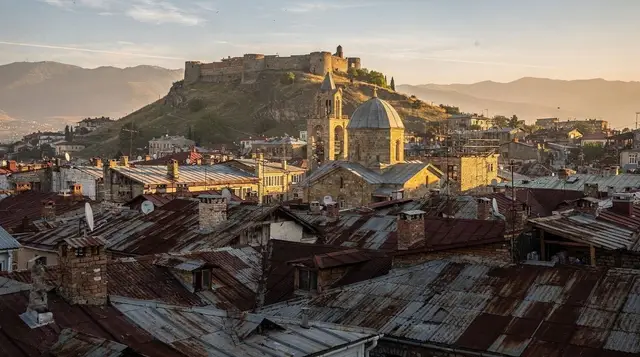
From Abanotubani, take the cable car from Rike Park (about 5 GEL, paid with a Metromoney card) up to Narikala Fortress for the best panorama over the Old Town, then walk the extra five to ten minutes to the Kartlis Deda statue for a wider view still. Full detail, including the free walking alternative if you would rather skip the fare, is in Narikala Fortress and the cable car.
Tbilisi: City of Contrasts Guided Tour with Cable Car Ride combines this stretch with a guide who can explain the fortress’s patchwork history on the spot, useful if you would rather have the context delivered than read it off a sign.
12.30pm–1.30pm: lunch in the Old Town
Come back down into the Old Town for lunch, but move a street or two back from Erekle II and Shardeni, where khinkali and khachapuri cost noticeably more for the same food than they do just off the main tourist strip. Khinkali run 1 to 1.5 GEL each and khachapuri 8 to 15 GEL depending on the type — see Khinkali: how to order and how to eat them and Every kind of khachapuri, region by region if this is your first attempt at either.
1.30pm–3pm: the sulphur baths
Abanotubani’s bathhouses sit at the base of the fortress, making this the natural next stop. A private room runs 60 to 150 GEL an hour split between however many people you bring, or under 20 GEL for a shared public hall if budget matters more than privacy. Full detail on which bathhouse to choose and what a kisa scrub involves is in Abanotubani: the sulphur bath district explained.
Tbilisi: Private Sulfur Bath Experience with Tea or Wine is worth booking ahead rather than walking in and hoping, particularly if this slot falls on a weekend afternoon in peak season.
3pm–5pm: Rustaveli Avenue
From the Old Town, walk or take a short Bolt ride up to Freedom Square and along Rustaveli Avenue, stopping at whichever of the Parliament building, Kashveti Church, the Georgian National Museum or the Opera and Ballet Theatre interests you most — there is not time to do all of them properly in two hours, so pick one or two rather than rushing past everything. See Rustaveli Avenue: what is actually worth stopping for for which of these earns the stop and which does not.
5pm–7pm: rest, or Mtatsminda
If energy is running low by this point, an hour’s break at a café is a reasonable and honest choice rather than pushing through — see Cafés in Tbilisi you can actually work from for options with decent coffee and somewhere to sit. If you still have legs for more, the funicular up to Mtatsminda Park adds another hillside viewpoint and a change of pace from the day’s walking; see Mtatsminda Park and the funicular for whether it fits your remaining energy and time.
7pm onward: dinner and a wine bar
Finish with dinner somewhere proper rather than another quick bite — see Where to eat in Tbilisi for recommendations — followed by a glass of Georgian wine at one of the natural wine bars that have opened across the Old Town and Vera in recent years; see Natural wine bars in Tbilisi for where to go. A meal with wine for two runs roughly 60 to 100 GEL at a mid-range restaurant, more at the better-known spots on Chardin and Shardeni.
What this plan deliberately leaves out
This itinerary does not attempt Mtskheta, Kakheti, Kazbegi or any other day trip — trying to bolt one onto a single city day either rushes the city or rushes the destination, and neither is worth it. If you have more than one day, see Tbilisi in three days for how a day trip fits properly into a longer stay, and The best day trips from Tbilisi, ranked honestly for which ones are worth the extra day.
A compressed version if you arrive late
If your day genuinely does not start until early afternoon — a late morning flight, a slow start after an overnight train — cut Rustaveli Avenue entirely and compress the Old Town walk to its core: Freedom Square down to the Bridge of Peace, then straight up to Narikala by cable car and down into Abanotubani for the baths, finishing with dinner. This half-day version still hits the sights most people come to Tbilisi specifically to see, just without the fuller architecture walk along Rustaveli, which is easy enough to add on a second day or a stopover on the way out of the city.
Solo, as a couple, or with a small group
None of this plan changes much whether you are travelling solo, as a couple or in a small group, though the sulphur bath is worth thinking about in advance: a private room’s price is fixed regardless of how many people share it, so a group of three or four brings the per-person cost down close to what a shared public hall would cost anyway, while a solo traveller pays the full room rate alone unless they are happy with the public hall instead. Solo travellers also tend to move faster through museums and viewpoints without a group’s pace to negotiate, which can free up an extra thirty to forty minutes toward the end of the day — worth banking for Mtatsminda Park if energy allows, or simply an earlier, more relaxed dinner.
Guided tour versus doing it yourself
A single guided day tour covering most of this route costs more than doing it independently, but buys back the planning time and adds context — building history, the fortress’s layered past, the symbolism behind the sulphur bath tiles — that is genuinely hard to piece together from signage alone, since much of the Old Town has minimal on-site information. For a first visit to a city this dense with history, that trade-off is a reasonable one to make for at least part of the day, even for travellers who generally prefer independent sightseeing; a common middle ground is a guided morning in the Old Town followed by an independent, self-paced afternoon at the baths and Rustaveli.
Arriving the same day: from the airport
If your one day in Tbilisi starts with a morning flight in, build in the transfer time from Tbilisi International Airport, roughly 20 to 30 minutes to the centre by taxi or the airport rail link — see Tbilisi airport to the city centre for the options and what each costs, since this can eat into the early-morning Old Town window this plan relies on.
Where this plan tends to go wrong
The most common way this day goes off track is spending too long at the first stop of the morning, lingering in the Old Town’s photogenic streets until the cable car queue for Narikala has built up past a comfortable wait — arriving at Rike Park by 11am rather than closer to noon avoids the worst of it.
A second common slip is booking a bath session on impulse mid-afternoon rather than reserving ahead, only to find the popular private rooms already taken for the rest of the day on a summer Saturday; booking the morning before, even informally by phone, removes this risk entirely. A third is underestimating how much slower Rustaveli Avenue’s museums move once inside them — the Georgian National Museum in particular swallows far more time than its size suggests, and visitors who planned “twenty minutes” often lose the best part of an hour without meaning to.
Staying comfortable: water, toilets and shade
Public toilets are not plentiful in the Old Town, and the ones that exist are concentrated around Rike Park, the cable car station and inside cafés that generally expect a purchase in exchange; budget for a coffee or a bottle of water at each planned stop rather than assuming a free facility will be nearby when needed. Refilling a water bottle at a café is normal practice and rarely refused. Shade is scarce along much of Erekle II and the lower streets around Abanotubani in the middle of the day, so a hat and sun cream matter more here in summer than the relatively short walking distances might suggest, particularly for the stretch between the Old Town and Narikala before the cable car.
The funicular after dark, and why some visitors save Mtatsminda for the evening
Riding up to Mtatsminda Park after dinner rather than in the late afternoon changes the experience considerably — the city’s lights spread out below the viewpoint, and the park itself, with its amusement rides lit up, has a different character after sunset than the daytime version most visitors see. Tbilisi: Old Town Sights Funicular Ride to Mtatsminda Park covers the funicular ride itself if you would rather have the ticket and timing arranged than work it out at the station. Doing this after the wine bar rather than before dinner is a reasonable way to close a long day without adding extra walking, since the funicular station is a short, flat stretch from central Rustaveli.
Doing the day with luggage, before check-in or after check-out
Arriving on an early flight with hours before a hotel check-in, or facing a late departure after checking out, is common enough that this plan is worth adapting for it. Most Old Town and Rustaveli accommodation will store luggage for the day even before or after your booked dates, generally at no extra charge, which removes the need to carry bags through the fortress climb or the bath. If your accommodation cannot help, a handful of paid luggage storage points operate near Freedom Square and Station Square, worth checking in advance rather than discovering the need for one mid-morning with a suitcase in tow.
Frequently asked questions about spending one day in Tbilisi
Is one day enough to see Tbilisi?
One day is enough to see the core of the city — the Old Town, Narikala Fortress, the sulphur baths and Rustaveli Avenue — properly rather than rushed. It is not enough to add a day trip to Mtskheta or Kakheti on top without cutting something from the city itself.
What is the best order to see Tbilisi in one day?
Start in the Old Town before the day heats up, ride the cable car to Narikala Fortress at late morning for clearer light, have lunch and a sulphur bath in the early afternoon, then finish with Rustaveli Avenue and dinner in the evening, when the streets are more comfortable to walk.
How much does a one-day visit to Tbilisi cost?
A realistic day covering the cable car, a shared sulphur bath, two meals and local transport runs somewhere around 80 to 150 GEL per person on a mid-range budget, excluding accommodation, before adding a private bath room or a guided tour.
Should I book a guided tour for a single day in Tbilisi, or go alone?
Either works. A guided walking tour covers the same core sights with added context and can be more time-efficient if you are short on planning time; going alone with a map costs nothing extra and lets you set your own pace, which matters if you want longer at any one stop.
What should I skip if I only have one day in Tbilisi?
Skip the Georgian National Museum’s full collection unless architecture and history genuinely interest you more than the Old Town itself, and skip any day trip out of the city entirely — Mtskheta, Kakheti and Kazbegi all need dedicated time that a single city day does not have.
What if it rains during my one day in Tbilisi?
The sulphur baths and the Georgian National Museum both work well as rain-day substitutes for outdoor Old Town wandering, and Narikala’s cable car generally keeps running in rain, though it closes in high wind regardless of rain. See What to do in Tbilisi when it rains for a fuller backup plan.
Is one day in Tbilisi worth it if I am just passing through on a layover?
Yes, if the layover gives at least six to seven hours outside the airport including transfer time. See A Tbilisi layover: what fits in 24 hours for a version of this plan scaled to shorter windows.
Old Town walking tours on GetYourGuide
Verified deep-linked GetYourGuide tours. Book through these links and we earn a small commission at no cost to you.
Photo: our own image of the location, not the operator’s product photo.