Abanotubani: the sulphur bath district explained
What is Abanotubani and how much do the sulphur baths cost?
Abanotubani is the brick-domed bathhouse district below Narikala Fortress, built around natural sulphur springs that gave Tbilisi its name. A private room with a hot sulphur pool costs roughly 60 to 150 GEL an hour depending on the bathhouse and room, while a shared public hall costs far less, typically under 20 GEL.
The district that gave Tbilisi its name
Tbilisi means, roughly, “warm place,” and the reason sits at the southern edge of the Old Town: a cluster of brick-domed bathhouses built directly over natural sulphur springs that have been in use for well over a thousand years. The city’s own founding legend credits King Vakhtang Gorgasali, whose fifth-century hunting party supposedly found a wounded pheasant that fell into one of the hot springs and was boiled, prompting him to found a city on the spot. Whether or not any of that is literally true, the springs themselves are real and still feed every bathhouse in the district today, unheated and unfiltered, at temperatures that generally run around 40 degrees Celsius straight from the ground.
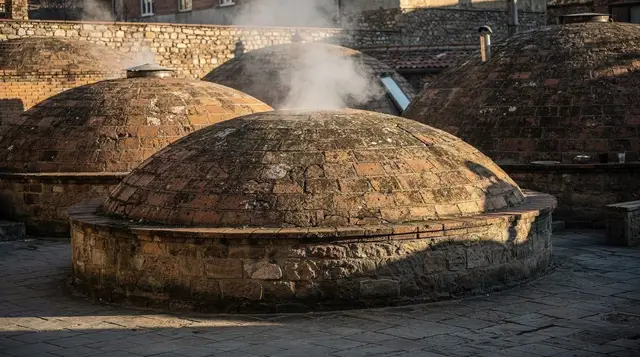
The district is called Abanotubani, and it sits directly beneath Narikala Fortress, a short walk from the rest of the Old Town covered in A self-guided walking route through Tbilisi’s Old Town. The domes themselves — squat, brick, half-buried in the hillside with small round skylights poking through the ground above — are one of the most photographed sights in the city, and worth seeing even if you do not plan to bathe.
A district visitors have written about for centuries
Abanotubani has drawn outside visitors for a long time, not just modern tourists. Alexander Pushkin, passing through Tbilisi in 1829 on his way to the Russo-Turkish war front, wrote in his travel notes that he had never encountered anything as luxurious as the Tbilisi baths, in Russia or Turkey — a line still quoted locally, sometimes with more certainty about the exact wording than the historical record actually supports, but the sentiment reflects a reputation the baths had already built by the early nineteenth century.
Persian and Ottoman travellers before him left similar accounts, drawn by the same unheated, mineral-rich springs still feeding the pools today. Nothing about the plumbing has fundamentally changed since; the domes above the baths are largely nineteenth-century construction over springs used since long before.
Public hall or private room: how the baths actually work
Every bathhouse in Abanotubani offers two tiers of experience. The public hall is a shared pool, segregated by gender, priced under 20 GEL for as long as you want to stay within reason — cheap, communal, and the most traditional way locals themselves have used these baths for generations. It is a fine option if budget matters more than privacy, though be aware standards of upkeep in the public halls vary more than in the private rooms.
Private rooms are what most visitors book: a room to yourself or your group, generally with a sulphur pool, a shower, and a bench or table, rented by the hour. Prices run roughly 60 to 150 GEL an hour depending on the bathhouse and the room’s finish — a plain tiled room at the lower end, a marble or domed period room at a place like the Royal Bath toward the top. Splitting the cost across two or more people brings the per-person price down close to what a mid-range spa treatment would cost elsewhere.
Which bathhouse to choose
Chreli-Abano, also known as the Orbeliani Baths, is the one everyone recognises from photographs — its facade is covered in striped blue-and-white tilework unlike anything else in the district, added during a nineteenth-century renovation with Persian-influenced design. It is also the busiest and, for its more elaborate rooms, among the pricier options, which makes advance booking worth doing rather than assuming.
Bathhouse No. 5 (sometimes signed simply as the “Sulphur Bath”) and the Royal Bath are both quieter alternatives with a plainer, more workaday feel — less Instagram-photogenic from the street, but the water and the experience inside are the same springs. Either is a sound choice if Chreli-Abano’s rooms are booked out, which happens regularly on weekend evenings in peak season.
Tbilisi: Private Sulfur Bath Experience with Tea or Wine books a private room with tea or wine included, which removes the guesswork of picking a bathhouse and turning up hoping for availability.
The kisa scrub: what it actually involves
A kisa is a rough mitt, and the scrub that takes its name from it is a genuinely different experience from a spa exfoliation anywhere else — an attendant scrubs the skin firmly after the heat has softened it, working over the whole body, often followed by a soap-foam massage where the attendant works a thick lather over your skin with sweeping motions. It can feel surprisingly vigorous the first time, occasionally to the point of mild discomfort on ticklish or sensitive areas, but it leaves skin noticeably smoother afterward and is, by most accounts, worth trying at least once. Full detail on what to expect and how to ask for one is in The kisa scrub: what a Georgian bath attendant actually does.
Tbilisi: Sulfur Bath with Wine and Kisa Scrub bundles the private room, the scrub and a drink into one booking, which is the simplest way to try the full experience without arranging each part separately.
Legvtakhevi waterfall: the free stop next door
Behind the bathhouses, a short and level path leads into a narrow gorge to Legvtakhevi waterfall, a modest cascade squeezed between buildings on both sides. It costs nothing to visit, takes a few minutes to reach, and is easy to miss entirely if you do not know to look for the path — worth the short detour before or after a bath, and one of the better free stops in the whole Old Town.
What to bring and what to expect
For a private room, no swimsuit is required since the room is yours alone or shared only with your own group; for a public hall, a swimsuit is expected. Bring flip-flops for the wet stone floors, a hair tie if needed, and be prepared to hand over a towel-and-robe rental fee if you arrive without your own — most bathhouses offer this for a small extra charge rather than expecting you to bring everything.
The heat is real: 40-degree water for an extended soak is more intense than most Western spa experiences, and it is sensible to step out and cool down periodically rather than staying submerged the whole hour. The sulphur smell is noticeable on entry and fades from awareness within a few minutes for most people, though it can linger faintly on skin and swimwear afterward — pack a change of clothes if this bothers you.
Tipping and dealing with attendants
Attendants who perform the kisa scrub or massage generally work for tips in addition to whatever service fee is built into the booking — 10 to 20 GEL per person is a reasonable tip for a scrub and massage, handed directly to the attendant rather than added to a bill. It is worth agreeing what is included in the base price before the scrub starts, since some bathhouses quote the room rental separately from the attendant’s service, and a clearer upfront conversation avoids an awkward negotiation afterward. This is one area where a booking made through a tour operator, rather than walking in cold, tends to remove the ambiguity, since the price quoted upfront already includes the service.
Photographing the domes
The brick domes themselves, with their round skylights breaking the surface of the hillside above, are one of the most reliably good photo subjects in the Old Town, particularly from the raised street level looking down onto Chreli-Abano’s tiled facade. Morning light works best, before the street fills with tour groups; see Where to photograph Tbilisi, hour by hour for the exact timing and angle. The domes are also visible, at a distance, from the Narikala ridge above, which gives a different, wider framing of the whole district against the Old Town rooftops.
Where to eat afterwards
Bathing leaves most people hungry rather than immediately in the mood for a full sit-down meal, and the streets around Abanotubani have a scattering of small cafés suited to exactly that — a khachapuri and a coffee rather than a formal dinner. For a proper meal afterward, the streets around Rustaveli Avenue and the Old Town’s restaurant clusters are a short walk away; see Where to eat in Tbilisi for specific recommendations rather than settling for whichever café is nearest the bathhouse door.
Who should think twice
The heat and mineral content are not advised for pregnancy, for anyone with a heart condition or uncontrolled high blood pressure, or immediately after heavy alcohol consumption — ask the bathhouse staff if in doubt rather than assuming it is fine. Open cuts or skin infections are also generally discouraged from contact with the shared public pools specifically, for hygiene reasons on both sides.
Booking, timing and avoiding a wasted trip
Weekend afternoons and evenings, and pretty much all of the June-to-September peak season, are when private rooms fill fastest — booking a day or more ahead is the safer move rather than turning up and hoping. Weekday mornings are consistently the quietest time, both for availability and for having the district itself feel less crowded with tour groups clustering for photos outside Chreli-Abano.
Tbilisi: Luxury Sulfur Bath Ritual with Pickup Wine includes hotel pickup, useful if you are staying outside easy walking distance of the Old Town and would rather not navigate transit straight after a bath when you are relaxed and unhurried.
How Abanotubani compares to Tskaltubo
Tbilisi’s baths are not the only sulphur-and-mineral bathing experience in Georgia. Tskaltubo, about three and a half hours west near Kutaisi, offers a very different version of the same idea — radon mineral springs inside the shells of abandoned Soviet-era sanatoriums, atmospheric in a completely different way and worth a dedicated trip rather than a comparison stop. See Tskaltubo: radon baths among Soviet ruins if that appeals more than Abanotubani’s Old Town setting, or Thermal springs across Georgia for the full national picture.
Combining with the rest of the Old Town
Abanotubani sits at the base of Narikala Fortress, which makes climbing or riding up for the view before descending for a bath a natural pairing — see Tbilisi in one day: a realistic plan for how this fits into a single-day itinerary alongside the rest of the Old Town walk. If you are staying nearby, see Where to stay in Tbilisi, neighbourhood by neighbourhood for which areas put you closest to the bathhouses.
Frequently asked questions about Abanotubani’s sulphur baths
How much do the sulphur baths in Tbilisi cost?
A private room runs roughly 60 to 150 GEL an hour depending on the bathhouse, the room’s finish and the time of day, with higher-end private rooms at places like the Royal Bath costing more. Public shared halls, where men and women bathe separately, cost under 20 GEL and are the cheapest way to try the experience.
Do I need to book a sulphur bath in advance in Tbilisi?
For a private room at a well-known bathhouse, yes, especially on weekend afternoons and evenings in the June-to-September peak season, when rooms fill hours ahead. Public halls generally do not take bookings and operate on a walk-in basis.
What is a kisa scrub and is it worth adding?
A kisa is a rough mitt used by a bath attendant to scrub off dead skin after the heat has softened it, usually followed by a soap-foam massage. It is genuinely different from a spa exfoliation elsewhere — more vigorous, often startlingly so the first time — and worth trying once as part of the Tbilisi bath experience rather than skipping.
Which Tbilisi sulphur bathhouse should I choose?
Chreli-Abano (Orbeliani Baths), with its striped blue-and-white tiled facade, is the most photogenic and the easiest to find, though also the busiest. Bathhouse No. 5 and the Royal Bath are quieter with a more traditional, less renovated feel; either is a reasonable choice if Chreli-Abano is booked out.
Is it safe to visit the sulphur baths if I am pregnant or have a heart condition?
The water runs naturally hot, generally around 40 degrees Celsius, which is not advised for pregnancy or for anyone with heart or blood pressure conditions without medical clearance first. If in doubt, ask before booking rather than after arriving.
Do the sulphur baths smell strongly of sulphur?
Yes, noticeably, though most visitors find it fades from awareness within a few minutes. The smell is close to the mineral-water smell familiar from natural hot springs elsewhere, not an unpleasant chemical odour, but worth knowing about beforehand if strong smells bother you.
What should I bring to the sulphur baths in Tbilisi?
A swimsuit for public halls (private rooms do not require one), flip-flops, a towel if your bathhouse does not include one in the price, and a hair tie. Most bathhouses rent towels and robes for a small extra fee if you arrive without.
How long does a typical sulphur bath visit take?
An hour is the standard private-room booking and enough time to bathe and have a kisa scrub if you add one. Add fifteen to twenty minutes either side for changing and for sitting to cool down before heading back out into the street.
Sulphur bath and spa experiences on GetYourGuide
Verified deep-linked GetYourGuide tours. Book through these links and we earn a small commission at no cost to you.
Photo: our own image of the location, not the operator’s product photo.