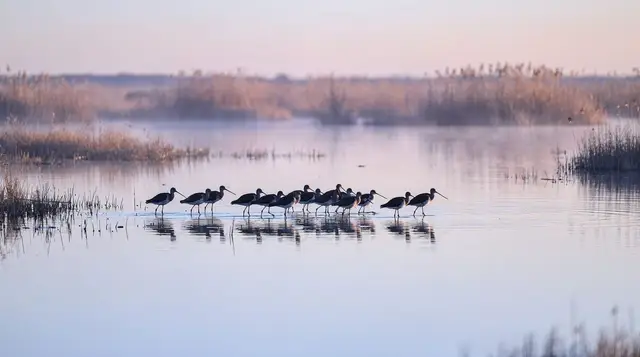
Birdwatching at Kolkheti National Park
Is Kolkheti National Park good for birdwatching?
Yes, genuinely. It is a Ramsar-listed wetland supporting herons, cormorants, pelicans and a wide range of migratory waterfowl, best explored by guided boat through its reed-lined channels. Spring (April-June) and autumn (September-October) migration windows offer the widest variety of species.
Two very different kinds of birding on this coast
Adjara carries a genuine, internationally recognised reputation among birdwatchers that has almost nothing to do with its beaches, and it actually covers two quite distinct experiences that visitors often conflate. The first is Kolkheti National Park, a Ramsar-listed wetland system around Poti and Lake Paliastomi, explored slowly by boat through reed beds and open water in search of herons, cormorants and migratory waterfowl.
The second is the raptor migration above Batumi itself, where the hills funnel hundreds of thousands of birds of prey through a narrow corridor each autumn, watched from fixed hillside points rather than a boat. This guide covers both, since they are frequently grouped together under “birdwatching near Batumi” in casual conversation despite being genuinely different activities requiring different timing, equipment and expectations.
Kolkheti’s wetlands, and what actually lives there
Poti itself is a working port town with little to hold a visitor’s attention, but Kolkheti National Park on its outskirts protects one of the largest surviving lowland wetland systems on the eastern Black Sea coast — marshland, reed beds, riverine forest and the brackish expanse of Lake Paliastomi, recognised under the international Ramsar Convention for its ecological significance.
The park supports a genuinely wide range of resident and migratory birds: herons and egrets working the shallow margins, cormorants diving in the open lake water, and, during the spring and autumn migration windows, a much broader mix of waders and waterfowl using this stretch of coast as a stopover between breeding and wintering grounds. Pelican sightings, while not guaranteed, are recorded here often enough to be a genuine possibility rather than a fanciful claim, and they rank among the more memorable finds for visiting birdwatchers.
Poti: Georgia's Amazon Wetlands Adventure is the standard way to see the wetland, a boat trip through the channels sometimes marketed locally as “Georgia’s Amazon” — a stretch as a direct comparison, but one that does capture the sense of a lush, water-based landscape genuinely unlike anywhere else on this coast.
Why a guide matters more here than elsewhere
Unlike a mountain hike or a fortress visit, where a self-guided approach loses relatively little compared with a guided one, birdwatching at Kolkheti rewards local knowledge disproportionately. Much of the park’s birdlife concentrates in specific channels and reed margins that shift with water levels and season, and are simply not visible from the main tourist boat routes without someone who knows where and when to look.
A guide who works these waters regularly will typically identify several times more species on a given outing than an unguided visitor covering the same stretch of water, and can also help less experienced birdwatchers actually identify what they are looking at rather than seeing an unidentified shape in the reeds and moving on.
From Batumi: Georgian Amazon Kolkheti Park Tour and From Kobuleti: Georgian Amazon Kolkheti Park Tour both run guided versions of this boat trip, the second departing from Kobuleti rather than Batumi or Poti directly, a shorter option for visitors already based on that stretch of coast.
Lake Paliastomi in more detail
At the heart of the park sits Lake Paliastomi, a brackish lagoon connected to the Black Sea by a narrow channel, forming the centrepiece of most boat excursions through the reserve. This is a working ecosystem rather than a manicured scenic lake — reed-lined shores, visible fishing activity, and a slower, quieter pace than anywhere else on this coast — and it rewards birdwatchers and anglers considerably more than visitors purely chasing postcard scenery, who may find it more subdued than expected against the drama of Georgia’s mountains or the polish of Batumi’s Boulevard.
From Kutaisi: Poti and Golden Lake Hike with Guide offers a land-based alternative to the boat trips, typically run from Kutaisi, pairing a walk to a nearby viewpoint with the wetland scenery for visitors who would rather walk than take to the water.
The Batumi raptor migration: a different scale entirely
Separately from Kolkheti’s wetland birding, the hills immediately above Batumi form one of the most significant raptor migration corridors documented anywhere in the world. Each autumn, birds of prey migrating from breeding grounds across Eastern Europe and western Asia toward African wintering grounds are funnelled into a narrow bottleneck here, squeezed between the Black Sea to the west and the rising terrain of the Lesser Caucasus to the east, which concentrates the migration into a corridor only a few kilometres wide rather than the broad front it follows elsewhere.
Honey buzzards make up the bulk of the passage, alongside a wide range of other raptor species, and daily counts during the peak of the September migration can run into the thousands, sometimes considerably more on a good day with favourable wind conditions. Dedicated monitoring work, carried out over successive autumns from hillside watchpoints above the city, has helped establish Batumi’s place among the most important raptor migration bottlenecks anywhere on the planet, comparable in scale to other globally recognised sites.
This is a fundamentally different activity from Kolkheti’s boat-based wetland birding: visitors sit at a fixed elevated watchpoint, scanning the sky rather than the reeds, and the experience rewards a still, patient morning rather than a slow glide through channels. It requires no boat and relatively modest logistics — a short drive or hike up into the hills above the city — but delivers a genuinely different scale of spectacle, with a single September morning capable of producing more individual raptor sightings than most birdwatchers will encounter across a lifetime of ordinary birding elsewhere.
What a boat trip through the wetland actually involves
A standard guided boat trip through Kolkheti’s accessible channels, combined with a stop at Lake Paliastomi, typically runs two to three hours, comfortably fitting into a half day alongside a stop in central Poti or an onward drive toward Batumi or Kutaisi. Boats are generally small, low-powered craft suited to the narrow, reed-lined channels rather than open-water vessels, moving slowly enough that a guide can point out birds as they appear rather than motoring past at speed.
Group sizes vary by operator, and a smaller group generally means a quieter boat and correspondingly better birdwatching, since larger, louder groups tend to push more cautious species further back into the reeds before the boat gets close enough for a good look. For visitors with a genuinely deep interest in the wetland’s birdlife rather than a general half-day curiosity, asking an operator directly about smaller group sizes or a private departure is worth the modest extra cost.
What a beginner can realistically expect to see
Visitors without prior birdwatching experience should set expectations around common, relatively easy-to-spot species rather than assuming every rare migrant will present itself on a single outing. Grey herons and little egrets are close to guaranteed on any reasonable visit, standing motionless at the water’s edge in a way that makes them easy to spot even for a first-time birder, and cormorants are a near-constant presence on the open water of Lake Paliastomi, often visible drying their wings on exposed branches after diving.
Rarer sightings — pelicans, particular wader species during peak migration — are genuinely possible but depend on season, water levels and a measure of luck, and a good guide will manage expectations honestly about which birds are a safe bet and which are a bonus rather than a promise.
When to actually go, for each experience
For Kolkheti’s wetlands, spring migration, roughly April through June, and autumn migration, September through October, both deliver the widest range of species, while midsummer brings real heat, humidity and considerably more mosquitoes, making the marshland less pleasant to explore regardless of bird activity.
For the Batumi raptor migration specifically, September is the peak window, with the heaviest daily counts typically concentrated in the second half of the month, though the migration itself runs across a longer stretch of late summer into autumn at lower volumes. Visitors with a specific, deep interest in birds should ideally plan a Georgia trip around these windows directly rather than treating birdwatching as an afterthought fitted around an unrelated itinerary built for other reasons.
What to actually pack
A wetland boat trip is a slower, more exposed outing than most Georgian day trips, and it is worth packing accordingly: insect repellent matters more here than almost anywhere else on this coast, given the combination of standing water, reed beds and summer heat, and a hat and proper sun protection are essential since the open lake sections offer no shade at all. A light rain layer is worth carrying regardless of season, given how much more rainfall this western, coastal stretch of Georgia receives compared with the drier east around Tbilisi and Kakheti — a pattern also relevant at Mtirala National Park further along the coast.
For the raptor watchpoints above Batumi, warmer layers matter more than insect protection, since September mornings at elevation can run genuinely cool even while the coast below stays warm. Binoculars are essential for both experiences and worth bringing your own rather than relying on rental, which is not a standard, reliably available service at either site. A capable pair of binoculars or a spotting scope makes a considerably bigger difference to a successful day here than at almost any other stop covered on this site.
Why Batumi’s geography creates this bottleneck
The scale of the autumn raptor migration above Batumi comes down almost entirely to geography. Migrating birds of prey generally avoid crossing large bodies of open water where possible, relying instead on rising columns of warm air, or thermals, that only form reliably over land, since a thermal cannot develop over the cooler surface of the sea. Along most of their route south from breeding grounds across Eastern Europe and western Asia, raptors have a broad front of land to spread across.
At Batumi, that broad front collapses: the Black Sea sits immediately to the west, and the rising terrain of the Lesser Caucasus closes in from the east, squeezing the entire migratory front through a corridor only a few kilometres wide directly above the city. The result is a concentration of migrating raptors rarely matched anywhere else in the world, and it is the same geography, in a sense, that gives this coast its heavy rainfall and lush vegetation further inland at Mtirala — moist air and migrating birds alike are funnelled and compressed by the same collision of sea and mountains.
Long-running monitoring, and why it matters
Systematic counting of the Batumi raptor migration has been carried out over successive autumns by dedicated observers working from elevated watchpoints in the hills above the city, building up a long-running dataset that has helped establish just how significant this corridor is on a global scale.
That monitoring work is not simply an academic exercise — it has practical conservation value, tracking population trends for species whose numbers can be difficult to assess reliably on their breeding or wintering grounds alone, and a concentrated migration bottleneck like this one offers a comparatively efficient way to monitor a large geographic population of raptors passing through a single, well-defined corridor each year. Visitors who join a watchpoint during the September peak are, in a small way, observing the same phenomenon that has made Batumi a genuine reference point in global raptor migration research, not simply a pleasant autumn outing.
Getting there
Poti sits on the coastal road roughly midway between Batumi and Kutaisi’s western reaches, about an hour or a little more from Batumi along the coast, passing through or near Kobuleti. There is no passenger airport at Poti itself; the nearest useful airports are covered in Batumi airport and the Turkish alternative and Kutaisi airport transfers, both a broadly similar driving distance away.
The Batumi raptor watchpoints, by contrast, sit in the hills immediately behind the city itself and require only a short drive or a longer uphill walk rather than a separate trip down the coast, making it entirely feasible to combine an early raptor-watching morning with an afternoon back on Batumi’s beaches or the Boulevard on the same day during the September peak.
Conservation status and why the wetland is protected
Kolkheti’s Ramsar listing reflects a genuinely significant conservation status rather than a routine designation — the wetland is one of the largest surviving examples of its type on the eastern Black Sea coast, at a time when comparable lowland wetlands elsewhere along this coastline have been drained, built over or otherwise degraded by agriculture and development over the past century.
The park’s reed beds, marsh and riverine forest function as a critical stopover and wintering habitat for migratory birds using the wider Black Sea flyway, a route connecting breeding grounds across Eastern Europe and beyond with wintering grounds further south, which is part of why its protection matters well beyond Georgia’s own borders and why international bodies have taken a direct interest in its continued preservation.
Is this a trip for families or casual travellers?
Both experiences described here work reasonably well for families and non-specialist travellers, with some caveats. The Kolkheti boat trip is gentle and low-effort, suiting most ages, though very young children may find an unstructured couple of hours scanning reed beds less engaging than a more active outing, and a good guide willing to keep commentary lively rather than purely technical makes a real difference for a mixed-age group.
The Batumi raptor watchpoints require more patience and stillness, and are arguably better suited to older children and adults with at least a passing curiosity about the spectacle, rather than very young children who may struggle with an extended, quiet morning spent scanning the sky. Neither experience demands prior expertise, but the raptor migration in particular rewards visitors willing to sit still and let a guide explain what they are looking at, rather than expecting constant, obvious action.
Combining birdwatching with the rest of a coastal trip
For visitors building a wider western Georgia itinerary, Kolkheti fits naturally alongside other under-visited stops in the region, and it is worth reading the fuller destination coverage at Poti for how it combines with Kutaisi, Martvili Canyon and Tskaltubo further inland. For visitors staying specifically on the coast rather than looping inland, a Kolkheti boat trip pairs well as a change of pace from a Batumi, Kobuleti or Ureki beach stay — a slower, quieter half day that trades sand and sunbeds for reed beds and open water, covered from the swimming side in When the Black Sea is warm enough to swim.
The honest verdict
Kolkheti National Park is a genuine, under-visited highlight for anyone with a real interest in wetland ecology or birdwatching, and it delivers a meaningfully different experience from the rest of this coast’s beach-and-boulevard offering. It is not, on its own, dramatic enough to justify the trip for a visitor with no interest in birds at all, and most general travellers get more out of treating it as a slower half-day add-on than a dedicated full-day destination.
The Batumi raptor migration, by contrast, is genuinely spectacular on its own terms and worth building real time around for anyone travelling through in September, regardless of how much of a birdwatcher they consider themselves — a scale of natural spectacle that few visitors expect to find directly above a Black Sea beach resort.
Frequently asked questions about birdwatching near Poti and Batumi
What birds can you see at Kolkheti National Park?
Herons and egrets in the shallows, cormorants on Lake Paliastomi, and a broad range of waders and waterfowl during spring and autumn migration.
Do I need a guide for birdwatching at Kolkheti?
Not strictly, but strongly recommended — a local guide knows the specific channels where birds concentrate, well beyond what the main boat routes show.
What is the Batumi raptor migration, and is it related to Kolkheti?
A separate phenomenon: the hills above Batumi form one of the world’s most significant raptor migration bottlenecks each autumn, watched from hillside points rather than by boat.
When is the best time for birdwatching near Batumi and Poti?
Spring (April-June) and autumn (September-October) for the wetlands; September specifically for the Batumi raptor migration peak.
Do you need your own binoculars, or can you rent equipment?
Bring your own — rental is not a standard, reliably available service at Kolkheti or the Batumi watchpoints.
Is Kolkheti worth visiting for a non-specialist traveller?
It can be, as a slower, quieter alternative to another beach day, even without a deep interest in bird identification.
Black Sea coast trips on GetYourGuide
Verified deep-linked GetYourGuide tours. Book through these links and we earn a small commission at no cost to you.
Photo: our own image of the location, not the operator’s product photo.