Kutaisi airport: the low-cost gateway
How do you get from Kutaisi airport to Tbilisi or Batumi?
Kutaisi International Airport (David the Builder) sits well outside Kutaisi itself, roughly 3.5 hours from Tbilisi and 2.5-3 hours from Batumi by road. A pre-booked shared or private transfer is the most practical option for either city, since public transport links from the airport are limited around flight arrival times.
Georgia’s budget gateway, and why it isn’t actually in Kutaisi
Kutaisi International Airport, officially named after David the Builder and commonly just called Kutaisi airport, has become the arrival point of choice for a wide range of European budget airlines flying into Georgia, often at fares noticeably below the equivalent route into Tbilisi.
The catch, which trips up a fair number of first-time visitors who book on price alone, is geography: the airport sits outside the city itself, near Kopitnari, and more importantly it is not close to Tbilisi either — roughly 3.5 hours away by road, a genuinely different proposition from Tbilisi’s own airport, which drops you in the capital in under 40 minutes. Understanding this trade-off before you book, and planning the onward transfer properly, is what separates a Kutaisi flight that’s genuinely a bargain from one that eats its savings in an exhausting travel day.
This guide covers who Kutaisi airport actually suits, the realistic transfer options toward Tbilisi, Batumi and Mestia, and how to think about the true cost once the transfer is factored in. For the direct comparison against flying into the capital instead, see flying into Tbilisi or Kutaisi?.
Who Kutaisi airport genuinely suits
Kutaisi airport makes the most sense for three overlapping groups: budget travellers for whom the airfare saving over a Tbilisi flight outweighs a longer, more involved transfer; visitors whose actual destination is western Georgia — Kutaisi itself, the nearby canyons, or onward to Svaneti — rather than the capital; and anyone building a longer, multi-region trip where landing in the west and finishing in Tbilisi, or vice versa, avoids doubling back on the same route.
It suits this last group particularly well as an open-jaw routing: fly into Kutaisi, work your way east through Imereti, Racha or the wine regions, and fly out of Tbilisi at the end, or the reverse, rather than returning to the same airport you arrived at.
It suits these groups less well: anyone on a short trip focused entirely on Tbilisi and easy day trips from the capital, where the extra 3+ hours of transfer time in each direction can eat a meaningful chunk of a short stay, and anyone arriving late at night on a delayed budget flight who would rather not face a long onward drive in the dark on unfamiliar mountain-adjacent roads.
Getting from Kutaisi airport to Kutaisi itself
If Kutaisi is genuinely your destination — perhaps as a base for the canyons and caves or Bagrati Cathedral — the airport sits around 20 minutes away by road. A Kutaisi airport transfer covers this short hop reliably, timed to your flight rather than a fixed schedule, which matters given that a public bus connecting the airport to the city does not always align neatly with every arrival slot, particularly for flights landing outside standard daytime hours.
Getting from Kutaisi airport to Tbilisi
For the roughly 230 km, 3.5-hour run to the capital, a shared transfer between Kutaisi and Tbilisi is the standard option most visitors book, running in either direction and timed around common flight arrival windows.
It costs more than a marshrutka covering the same route — see how marshrutkas actually work for that alternative, departing from Kutaisi’s own bus station rather than the airport directly — but includes a scheduled pickup and a guaranteed seat, worth the difference for anyone landing after a long flight who doesn’t want to negotiate onward transport at an unfamiliar airport. The drive itself runs largely along Georgia’s main east-west highway, a straightforward if long journey rather than a technically demanding one.
Getting from Kutaisi airport to Batumi
If your trip continues to the coast rather than the capital, a private transfer from Kutaisi airport to Batumi covers the roughly 2.5-3 hour run directly, without the detour through Kutaisi city that a public transport route would involve. This is often the more time-efficient choice for anyone whose actual trip is centred on Batumi and the Black Sea coast, since it avoids backtracking through the capital entirely. See Batumi airport and the Turkish alternative for the equivalent picture if you’re comparing which airport to fly into for a coast-focused trip.
Getting from Kutaisi airport to Svaneti
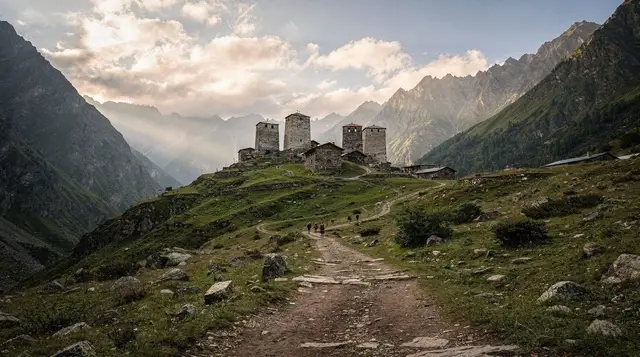
For travellers heading straight into the mountains, a Kutaisi airport transfer to Mestia with scenic stops is a genuinely efficient routing, cutting out a return trip via Tbilisi entirely for anyone whose main goal is Svaneti hiking or the Mestia-Ushguli trek.
The drive itself takes several hours and climbs through increasingly dramatic terrain as it approaches the mountains, long enough that scheduled stops along the way — as the name suggests — are a welcome break rather than an unnecessary delay. See getting to Svaneti for the fuller picture of routes into the region, including from Tbilisi and Zugdidi.
The real cost comparison: airfare plus transfer
The number that actually matters when comparing a Kutaisi flight against a Tbilisi one is not the airfare alone but the airfare plus the realistic cost of the onward transfer to wherever you’re actually going.
Because Kutaisi’s budget-airline fares are frequently low enough to absorb even a shared transfer’s cost and still come out ahead of an equivalent Tbilisi flight, the maths often still favours Kutaisi for cost-conscious travellers — but not always, and it’s worth actually running the comparison for your specific dates and route rather than assuming Kutaisi is automatically cheaper. Our what a week in Georgia actually costs guide breaks down transport alongside the rest of a typical trip budget if you want the wider picture.
Price the Kutaisi flight and the onward transfer to your final stop as one total, using the same dates for the Tbilisi alternative. Check whether the transfer fare is per seat or per vehicle, and note your arrival time, since that decides which options are realistic. If Kutaisi still comes out ahead, you can look at private transfers via Kiwitaxi to fix that part of the cost.
How Kutaisi became a budget hub
Kutaisi’s airport was substantially redeveloped in the early 2010s as part of a deliberate push by Georgia’s aviation authorities to build a genuine low-cost gateway distinct from Tbilisi, offering lower landing and handling fees to attract carriers that would otherwise skip the country entirely.
Wizz Air became the anchor carrier for the new push, building out a network of routes from across Europe that has since drawn other budget operators too, and the strategy has broadly worked: for travellers on price-sensitive European routes, Kutaisi now regularly offers fares meaningfully below the equivalent flight into Tbilisi, sometimes on days when direct Tbilisi options barely exist at all. That history matters for planning purposes mainly because it means Kutaisi’s route network still skews toward specific European markets rather than covering everywhere Tbilisi does, worth checking before assuming a Kutaisi flight exists for your particular home airport.
What the terminal actually offers
Kutaisi’s terminal is small enough to walk end to end in a couple of minutes, with a modest selection of food and drink options, a handful of currency exchange and SIM card counters, and none of the larger retail or lounge facilities a bigger international hub would have.
This is rarely a problem for a straightforward arrival or departure, but it does mean relying less on “I’ll sort it out at the airport” than you might at Tbilisi — buying a SIM, changing money or grabbing a proper meal are all more limited here, and planning around that rather than assuming the same range of options avoids a minor frustration on either end of a Kutaisi flight. Immigration and baggage claim both move quickly given the airport’s smaller passenger volumes, generally faster door-to-door than the equivalent process at Tbilisi on a comparably sized flight.
Booking your transfer in advance
Because Kutaisi airport sits well outside any city with a dense taxi-app network — neither Bolt nor Yandex Go reliably serves the immediate airport area the way they do central Tbilisi or Batumi — booking a transfer before you fly, rather than expecting to arrange one on arrival, is the more reliable approach here specifically.
This matters more for Kutaisi than for Georgia’s other airports precisely because of the distances involved: turning up without a plan for a 3.5-hour drive to Tbilisi is a considerably bigger problem than the same uncertainty over a 30-minute hop from the capital’s own airport. Most transfer bookings can be made well in advance and adjusted or cancelled within a reasonable window if a flight time changes, standard practice worth taking advantage of given how often budget-carrier schedules shift in the weeks before departure.
Weather and the road itself
The main highway between Kutaisi and Tbilisi crosses the Rikoti Pass, the low range separating Imereti from Kartli, and while nowhere near as demanding as the mountain routes toward Kazbegi or Svaneti, it can still see snow and reduced visibility in the coldest months, occasionally slowing transfer times beyond the usual 3.5-hour estimate. The Kutaisi-Batumi road, by contrast, stays mostly at lower elevation and is less prone to winter disruption, though heavy coastal rain in autumn and early spring can still slow the final stretch into Batumi itself.
Neither route regularly closes the way Georgia’s genuine high-mountain passes do, but building a little schedule flexibility around a winter transfer from Kutaisi — rather than a tightly timed same-day onward flight or an important evening reservation — remains sensible. See Georgia in winter for the broader seasonal picture across the country.
Two ways travellers actually use this airport
The open-jaw approach is the one that gets the most value out of Kutaisi’s low fares: fly in here, spend a few days working east through Imereti and its canyons, continue on to Tbilisi, Kakheti or the mountains, and fly home from the capital instead of doubling back. This avoids the return transfer entirely and turns the extra 3.5 hours into forward progress rather than a there-and-back detour.
The second common pattern is using Kutaisi purely as a cheap entry and exit point for a Tbilisi-based trip, accepting the transfer time on both ends as the price of a lower airfare — a reasonable trade for budget-focused travellers on a longer trip, where two 3.5-hour transfers matter proportionally less against ten or fourteen days in the country, but a harder sell on a short long weekend where those hours represent a meaningfully larger share of the total time available.
Practicalities at a small regional airport
Kutaisi’s terminal is considerably smaller and quieter than Tbilisi’s, which has upsides — faster immigration queues, a shorter walk from gate to arrivals — and downsides, including fewer amenities, a smaller selection of currency exchange and SIM card options, and flights that can feel more exposed to delay given the airport’s reliance on a smaller number of budget carriers with tighter aircraft turnaround schedules.
Arriving with at least some lari already in hand, or a card that works reliably for a transfer booked and paid online in advance, reduces dependence on whatever facilities happen to be open at the specific hour your flight lands. Checking your airline’s own on-time performance for the route before building a tight onward connection — a transfer timed precisely to a scheduled landing time — is sensible given how budget-carrier delays can occasionally run to several hours rather than the shorter delays more common with legacy carriers into Tbilisi.
Overnight flights and what to plan around
A number of Kutaisi’s budget routes land or depart at unsociable hours — the practical trade-off airlines make for the airport’s lower operating costs — which shapes a few decisions worth making before you fly. If your flight lands well after midnight, confirming that your booked transfer operates for that specific arrival time, rather than assuming standard daytime service, avoids an unpleasant surprise standing in an empty terminal.
Some transfer operators charge a modest premium for genuinely overnight pickups, reasonable given the driver’s own disrupted schedule, and it’s worth checking this at booking rather than after the fact. For anyone with a very early departure from Kutaisi, arriving in the area the evening before rather than driving through the night from Tbilisi or Batumi removes a significant amount of risk from an otherwise tight connection, since a delayed transfer with no buffer before a budget flight’s fixed departure time is one of the more stressful ways a Georgia trip can start or end.
Comparing Kutaisi to flying directly into Batumi
For travellers whose main interest is the coast, it’s worth weighing Kutaisi against Georgia’s third international airport directly rather than assuming Kutaisi is automatically the better budget option. Batumi airport and the Turkish alternative covers that comparison in full, but the short version is that Batumi’s own airport, when it has a suitable route for your dates, usually beats routing through Kutaisi and adding a further 2.5-3 hour transfer, simply because it removes the extra leg entirely. Kutaisi wins out mainly when its specific route network happens to serve your home airport more cheaply, or more directly, than either of Georgia’s other two options.
Packing and preparing for a longer transfer
A 2.5 to 3.5-hour transfer, longer than most visitors expect after landing, is worth preparing for in small but meaningful ways: keeping snacks and water accessible in hand luggage rather than checked bags, charging devices before landing rather than assuming in-vehicle charging will be available, and downloading offline maps or entertainment in case signal drops in the more rural stretches between the airport and your destination.
None of this is dramatic, but a long-haul flight followed immediately by another several hours in a car is a genuinely tiring combination, and arriving at your first hotel with some energy left over rather than running on empty makes the first evening of a trip noticeably more enjoyable. Travellers who can build in a short break partway through the journey — several transfer operators build one in as standard on the longer routes — generally find the whole day easier to manage than those who push straight through.
Frequently asked questions about Kutaisi airport
Is Kutaisi airport close to Kutaisi city?
Not especially — around 20 minutes outside the city near Kopitnari. Most visitors use it as a gateway to Tbilisi, Batumi or Svaneti rather than staying in Kutaisi itself.
How far is Kutaisi airport from Tbilisi?
Around 230 km, roughly 3.5 hours by road — considerably further than Tbilisi’s own airport, worth weighing against any airfare saving.
Why do so many budget airlines fly into Kutaisi instead of Tbilisi?
Lower airport fees and a deliberate low-cost hub strategy have drawn European budget carriers here, often at fares well below equivalent Tbilisi routes.
Can you get from Kutaisi airport straight to Svaneti or Batumi without going through Tbilisi?
Yes — direct transfers run to both Mestia and Batumi without routing via the capital.
Is there public transport from Kutaisi airport?
Limited — a bus reaches Kutaisi city but doesn’t reliably align with every flight, and there is no direct public bus onward to Tbilisi or Batumi.
How much cheaper is flying into Kutaisi versus Tbilisi, once you add the transfer cost?
Often still cheaper on budget-carrier routes even after adding a shared transfer, but worth checking for your specific dates rather than assuming.
Transfers and transport on GetYourGuide
Verified deep-linked GetYourGuide tours. Book through these links and we earn a small commission at no cost to you.
Photo: our own image of the location, not the operator’s product photo.