The gateway to the mountains, not a destination in its own right
Ananuri is a fortified complex on the western bank of the Zhinvali reservoir, roughly an hour north of Tbilisi along the Georgian Military Highway, and it is almost never anyone’s sole reason to leave the capital. Instead it functions as the natural first stop for every trip heading further north toward Gudauri, Kazbegi or the Georgian-Russian border — close enough to Tbilisi to add barely any detour, and striking enough, with its stone towers rising above bright turquoise water, that skipping it would be a genuine waste for anyone already on the road. Treating it as a 45-minute to one-hour stop rather than a half-day destination is the right way to plan around it.
What the fortress actually is
Ananuri was the seat of the Aragvi eristavis (dukes), a powerful noble family who controlled this stretch of the Aragvi valley from roughly the 13th century until a violent internal feud in 1739 ended their rule — the complex was stormed and burned during that conflict, and its ruins were later restored to the state visible today.
What survives is a genuinely well-preserved defensive complex: a curtain wall studded with towers, a large square tower known as the Sheupovari that served as the last line of defence, and two churches inside the walls, the more visually striking of which, the Virgin’s Church (Assumption Church) built in 1689, carries elaborate carved stone crosses and grapevine motifs across its facade — a level of decorative detail unusual for a building that was primarily a military structure.
The smaller Church of the Mother of God, older than the Virgin’s Church and plainer in its stonework, sits alongside its more ornate neighbour and is easy to overlook on a rushed visit despite predating it by several decades. Both churches remain consecrated and occasionally used for services, so the same modest dress expectations that apply at any working Georgian Orthodox site — shoulders and knees covered — hold here too, even though Ananuri functions primarily as a historical monument rather than an active parish.
The bell tower, standing somewhat apart from the main churches, and the general layout of the complex reward a slow half-hour wander more than a rushed photo stop, even though most visitors on a Kazbegi-bound tour only get the shorter version. Climbing the Sheupovari tower itself is possible via a narrow internal staircase and gives the best elevated view over both the fortress roofline and the reservoir beyond it, though the stairs are steep and the passage tight enough that it will not suit anyone uncomfortable with confined spaces. Full architectural detail, the story of the 1739 siege and a suggested route through the complex is in the Ananuri Fortress guide.
A day trip combining Ananuri with Kazbegi further north is the standard way most visitors see it, bundled into a longer mountain excursion rather than visited alone.
The reservoir, and what was here before it
The Zhinvali reservoir, created in 1985 by damming the Aragvi river for hydroelectric power and Tbilisi’s water supply, is the source of Ananuri’s most photographed feature — the vivid turquoise water framed against the fortress’s grey stone walls. That colour is a function of glacial sediment suspended in the water rather than any special mineral content, and it varies noticeably by season, generally most vivid in the warmer months when water levels and sediment load shift.
What is easy to miss standing at the viewpoint is that the reservoir itself submerged the original village of Zhinvali and a stretch of the old road, meaning the landscape a visitor sees today is considerably younger than the fortress overlooking it — a 20th-century engineering project sitting beside 17th-century stonework.
A private tour covering the reservoir, Ananuri and Gergeti Trinity Church further north is one way to see the full arc of the Military Highway’s most photogenic stretch in a single booking, for travellers who want a private vehicle rather than a group tour.
The eristavi feud that ended it
The 1739 conflict that ended the Aragvi eristavis’ rule at Ananuri is a genuinely brutal piece of local history worth knowing before dismissing the site as just another scenic fortress. A rival branch of the same family, based at nearby Dusheti, besieged Ananuri and reportedly set fire to the tower where the ruling duke’s family had taken refuge, killing most of them; the survivors and their allies took a bloody revenge in turn shortly after.
The Georgian crown, wary of the eristavis’ independent power in the strategically vital Aragvi valley, used the resulting chaos to fold the territory more directly under royal control, effectively ending the family’s semi-autonomous rule over this stretch of the Military Highway corridor. The fortress itself fell into disrepair after that and was restored to its current state only in the Soviet and post-Soviet periods, with active conservation work continuing into recent decades.
The Georgian Military Highway itself
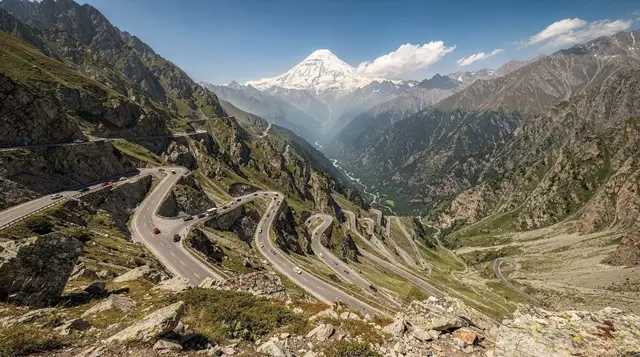
Ananuri sits on the Georgian Military Highway, the historic route connecting Tbilisi to the North Caucasus through the Darial Gorge, formalised and paved by the Russian Empire in the late 18th and early 19th centuries as a military and administrative corridor, though the route itself follows paths used for trade and travel across the mountains for centuries before that. It remains the main road connecting Georgia to Russia today, running through Gudauri and Kazbegi before crossing at the Verkhny Lars border post — one of the very few open land crossings between the two countries, and one that has seen heavy, occasionally days-long queues of Russian traffic since 2022.
That border traffic has no real bearing on a day trip that turns back at Kazbegi, but it explains why the road itself, well beyond Ananuri, is busier with freight and private vehicles than its modest two-lane width suggests it should be. Full detail on the route, its history and what to expect kilometre by kilometre is in the Georgian Military Highway guide.
Visiting: how much time it actually takes
Entry to Ananuri is free, and the complex is compact enough that a genuinely thorough visit — both churches, the tower, and a walk along a short section of the reservoir shoreline for photos — takes well under an hour. There are a handful of stalls selling churchkhela, honey and local snacks in the car park area, useful for a quick break rather than a meal stop. Toilets and basic facilities are available but limited, and the site can get crowded quickly once a few tour buses arrive at once, since nearly every organised Kazbegi or Gudauri tour stops here for roughly the same 20-30 minute window mid-morning.
Weekends see noticeably heavier traffic, both from tour groups and from Tbilisi residents making their own day trips north, and the car park and viewpoint areas can feel genuinely crowded by late morning in peak season. Arriving early, ideally before 10am, or visiting on a weekday, gives a considerably calmer experience of what is otherwise one of the most photographed single stops in the country.
Combining Ananuri with the rest of a Military Highway trip
Ananuri is one leg of a route that typically continues to Gudauri, the ski resort and paragliding base about 40 minutes further on, and then to Kazbegi itself, another 30-40 minutes past that, where Gergeti Trinity Church sits beneath Mount Kazbek.
The Kazbegi as a day trip guide covers whether attempting the full route in a single day from Tbilisi is realistic or overly ambitious depending on season and starting time. A full day tour covering all three stops is the most common way to see the whole route, and it is a long but manageable single day from Tbilisi rather than something that requires an overnight, provided the group leaves the capital by 9am or earlier.
For travellers heading the opposite direction, back toward Tbilisi, Ananuri also pairs naturally with Mtskheta, since both sit on routes radiating out from the capital and several tours combine a Military Highway morning with a Mtskheta stop on the return leg.
The best day trips from Tbilisi, ranked honestly guide places the Ananuri-Gudauri-Kazbegi combination among the most consistently worthwhile full-day options near the capital, alongside the shorter Mtskheta half-day. It also forms the backbone of the five-day Georgia itinerary, which uses the Military Highway route as its dedicated mountain day before continuing on to Kakheti.
Beyond the fortress: Truso Valley and the wider Aragvi region
Travellers with more time than a standard Kazbegi day trip allows can use Ananuri as a jumping-off point for the Truso Valley, a dramatic side valley further north near the border, known for travertine mineral springs and dramatic gorge scenery — a considerably less-visited alternative to the main Military Highway crowds, reachable by a rougher side road rather than the main route. It requires a full extra day rather than an add-on to the standard Ananuri-Gudauri-Kazbegi loop, and is better suited to travellers with a private driver and a genuine interest in getting off the main tourist circuit than to a first-time visitor trying to cover the headline sights in a single trip.
What Ananuri is not
It is worth setting expectations before arriving: Ananuri is not a hiking destination, has no significant onward trail network from the complex itself, and offers no boat access to the reservoir for casual visitors despite how the water might look from the viewpoint. It is a fortress and a photo stop, done well in under an hour, and travellers expecting a half-day attraction on the scale of Vardzia or Uplistsikhe should recalibrate before planning around it as the centrepiece of a day.
When to visit
Ananuri is accessible year-round, since the Military Highway stays open through winter except during the heaviest snow closures further north near Gudauri and the Jvari Pass — Ananuri itself, being lower in elevation, rarely closes. Spring through autumn gives the most vivid reservoir colour and the most comfortable conditions for the short outdoor walk around the complex; winter brings a starker, quieter version of the same view, with the fortress often dusted in snow and visitor numbers considerably lower than in the warmer months — a genuinely different, less-photographed side of the site for anyone travelling the Military Highway to a ski trip in Gudauri rather than a summer mountain day.
How Ananuri compares to Georgia’s other fortresses
Georgia has no shortage of fortified complexes worth a stop, and Ananuri’s particular draw is the combination of the reservoir backdrop with genuinely well-preserved medieval stonework, rather than scale — it is considerably smaller than Rabati Fortress near Akhaltsikhe, whose extensive modern restoration gives it a more polished, arguably over-restored feel, and it lacks the sheer cliff-carved drama of Vardzia further south.
What it offers instead is accessibility: no long detour, no separate day required, and a setting genuinely striking enough to justify the brief stop nearly every itinerary already includes. Visitors who have already seen Rabati or Vardzia sometimes find Ananuri modest by comparison; visitors seeing it first, before either, tend to rate it more highly, since expectations shift with each subsequent fortress on a longer Georgia trip.
Practical notes: parking, photography and facilities
The car park sits directly below the fortress on the highway side, a short uphill walk to the entrance, and fills up quickly once tour buses arrive mid-morning — arriving before 9:30am or after 4pm generally means an easier walk in and considerably fewer people in photographs. The best photo angle of the fortress against the reservoir is from the roadside pull-off just north of the complex itself, slightly elevated above the water, rather than from inside the walls, where the towers are too close to frame well against the water below.
A drone can capture the classic aerial shot of the towers against the turquoise water that circulates widely online, though operators should check current Georgian drone regulations before flying, since rules near infrastructure like the reservoir dam can be stricter than elsewhere in the country.
Facilities at the site itself are basic: a handful of vendor stalls in the car park area, limited toilet facilities, and no real food beyond snacks — a proper meal is better planned for Gudauri or Kazbegi further along the route rather than expected at Ananuri itself. Mobile signal at the fortress is generally reliable, which is more than can be said for stretches of the Military Highway further north, so it is a sensible last point to send messages or download offline maps before continuing into patchier mountain coverage.
Frequently asked questions about visiting Ananuri
Is Ananuri worth a special trip from Tbilisi on its own?
Not really — it takes under an hour to see, so it works best as a stop on a longer Kazbegi or Gudauri day rather than a dedicated round trip.
How long should you plan to spend at Ananuri, and is there an entrance fee?
Entry is free, and 45 minutes to an hour covers both churches, the tower and a walk along the reservoir shoreline for photos at an unhurried pace.
Can you swim in the Zhinvali reservoir near Ananuri?
It is not set up as a designated swimming spot near the fortress, and most visitors treat it purely as a viewpoint rather than a place to get in the water.
Why is the water at Ananuri such a vivid turquoise colour?
Glacial sediment suspended in the reservoir gives the water its distinctive colour, which varies by season and is generally most vivid during the warmer months.
Is Ananuri crowded?
It can be, particularly mid-morning on weekends when multiple tour buses arrive around the same time. An early start or a weekday visit avoids most of the crush.
Can you visit Ananuri without joining a tour to Kazbegi?
Yes — a private driver or a self-drive trip can stop at Ananuri alone and turn back, though most independent travellers find it makes more sense to continue at least as far as Gudauri while already on the road.
Does the Georgian Military Highway stay open in winter?
The section past Ananuri as far as Gudauri and Kazbegi generally stays open, though the road can close temporarily during heavy snow near the higher Jvari Pass further north. Checking conditions before a winter trip is worth doing.
Is Ananuri worth visiting for someone who has already seen Rabati Fortress or Vardzia?
Yes, though expectations should be adjusted — Ananuri is smaller and less elaborately restored than Rabati and less visually dramatic in scale than Vardzia. Its draw is the reservoir setting and the fact that it costs almost no extra time for anyone already driving the Military Highway. Drone photography is generally possible for casual use, though current Georgian regulations near infrastructure like the reservoir dam are worth checking in advance.