Guided tour or independent travel in Georgia?
Should I book guided tours or travel independently in Georgia?
Independent travel works well in and around Tbilisi and on the main highways, where marshrutkas, private drivers and Bolt cover almost everything at a fraction of tour prices. Guided tours earn their cost on specific routes — Tusheti's jeep track, multi-day Svaneti trekking, and anything requiring local knowledge of trail conditions or border-adjacent access — where the alternative is genuinely harder, not just less convenient.
A false binary, but a real decision
Most travellers to Georgia end up doing both — an independent base in Tbilisi with a couple of booked day trips layered on top — which makes “guided or independent” less a single choice than a series of smaller ones made route by route. This guide breaks it down that way: where independent travel is genuinely straightforward and a guide adds little, and where a guide or a booked tour earns its cost through access, safety or simple convenience that independent travel cannot easily match.
Where independent travel clearly wins
Georgia’s core circuit — Tbilisi’s old town, the sulphur baths, Mtskheta, and the main highway towns — is about as easy a country to travel independently as exists in the region. Marshrutkas run frequently and cheaply between major towns, Bolt and Yandex Go cover in-city transport at low, metered fares that remove the haggling risk of an unmetered taxi, and the metro and bus network makes central Tbilisi trivially walkable and connected without a car.
Booking a guided city tour for this stretch of a trip typically buys narration and convenience, not access you could not get yourself — a real value for some travellers, an unnecessary cost for others who would rather read a guide the night before and explore at their own pace.
Renting a car is a genuine independent-travel option too, and a good one for a traveller comfortable with unfamiliar mountain roads and Georgian driving habits — overtaking on blind corners and variable lane discipline are common enough to mention. See Driving in Georgia: rules, roads and habits and Renting a car in Georgia before deciding this route suits you; it is the most flexible option but not the most relaxing one for a first-time visitor.
Where a guide or a booked tour earns its cost
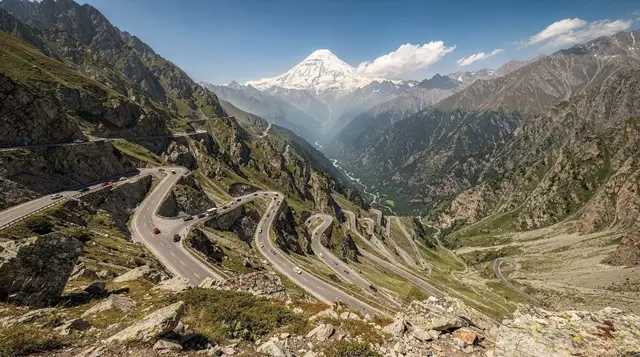
The calculation flips for specific routes where local knowledge, permits or road conditions make independent travel genuinely harder rather than merely less convenient. Tusheti is the clearest example: the Abano Pass road is one of the most dangerous regularly-driven roads in Georgia, closed from October to June, and not a route to attempt without a locally experienced 4x4 driver — see Jeep tours to Tusheti and the Abano Pass for why this one is not really optional.
Multi-day Svaneti trekking, particularly Mestia to Ushguli, is safer and more efficient with a guide who knows current trail and weather conditions, even though the core route between the two villages is walkable independently in good conditions by experienced hikers.
Private 4 Day Georgia Highlights Wine Mountains Culture is a reasonable middle ground for travellers who want the flexibility of a private itinerary without planning every stop themselves — a private driver-guide covers ground a marshrutka schedule cannot, at a cost split sensibly across two or more people. For a shorter commitment, a bundled three-day package covering the same core circuit — Tbilisi, Kazbegi and Kakheti in fixed sequence — suits travellers who would rather not build an itinerary themselves and are happy to trade flexibility for a schedule someone else has already worked out.
Side by side
| Independent travel | Guided tour | |
|---|---|---|
| Best for | Tbilisi, main highways, popular day trips | Tusheti, multi-day trekking, remote logistics |
| Cost for solo travellers | Usually cheaper | Usually more expensive per person |
| Cost for groups of 2–4 | Comparable, sometimes cheaper with a private driver | Comparable, sometimes cheaper per head |
| Flexibility | Full control of schedule and stops | Fixed itinerary, less improvisation |
| Local knowledge | Self-researched | Built in, including current road/trail conditions |
| Language | English gets you far in tourist areas | Not a factor — guide handles it |
| Safety on remote routes | Depends on your own experience | Generally higher, especially Tusheti and high trekking |
| Effort required | More planning, more research | Less planning, less control |
The cost comparison, honestly
For a solo traveller on the standard Tbilisi–Kazbegi–Kakheti circuit, independent travel by marshrutka is close to unbeatable on price — a marshrutka seat to Kazbegi or Kakheti costs a small fraction of a seat on a group day tour, and the schedule flexibility of choosing your own return time is a real advantage on top of the savings. Kazbegi: Day Tour from Tbilisi with Local Tastings illustrates the other side of that trade: a bundled day with tastings and commentary included costs more than the DIY version but removes all the coordination, which is worth paying for to some travellers and not to others.
For groups of two to four, the maths shifts. A private driver for a day, split three or four ways, can land close to or even below the per-person cost of a shared group tour, while delivering a fully custom schedule — start when you want, stop where you want, skip what does not interest you. This is the single biggest argument for guided or private options over strict independence once you are not travelling alone: the group discount effectively cancels out the tour premium.
What a guide actually adds beyond logistics
Cost and access are not the only factors. A good local guide supplies context that is genuinely hard to replicate from a guidebook or a phone screen — why a particular church survived Soviet demolition campaigns and its neighbour did not, what a specific khachapuri regional variant signals about where you are, which winery down a Kakheti backroad is worth the detour this season and which has changed hands and gone downhill.
Old Tbilisi Private Walking Tour and Cable Car is a good example of this kind of value: the cable car and the old town streets are trivially walkable alone, but a private guide’s running commentary on Sololaki’s Art Nouveau facades or the Persian-era bathhouse architecture adds a layer that independent wandering, without prior research, typically misses.
What independent travel actually requires you to arrange
Going independent is not simply cheaper — it also shifts real work onto you, and it is worth being honest about what that work looks like before committing to it. You will need a working plan for SIM cards or eSIM so that maps and translation apps work away from wifi, a rough sense of marshrutka departure points and timing since schedules are not always published online, and cash on hand for towns and villages where card machines are unreliable — see Lari, ATMs and paying by card for where that actually bites.
None of this is difficult, but it is a different kind of effort than booking a tour and showing up, and travellers who dislike that kind of logistics-on-the-fly planning tend to be happier paying for a booked option even where the terrain does not strictly require it.
What a guided package removes, and what it does not
A booked tour removes route planning, transport coordination and the small daily uncertainty of whether a marshrutka is running to schedule. What it does not remove is the trip’s actual pace and content — a fixed-itinerary tour still visits the same churches, the same viewpoints and the same wineries an independent traveller would choose, just on someone else’s schedule and usually with less room to linger somewhere unexpectedly good or skip somewhere that turns out disappointing.
Travellers who value control over their own day, even at the cost of more planning effort, consistently report more satisfaction with independent or private options than with fixed-departure group tours, which is worth weighing against the undeniable convenience the latter offers.
Insurance and the safety net either way
Whichever approach you choose, travel insurance with mountain and hiking cover is worth having specifically because Georgia’s terrain includes routes — Tusheti, high Svaneti trails, anything above 3,000 m — where rescue, if it is needed, is neither instant nor free. A guided tour on these routes typically includes an operator with established rescue contacts and local knowledge of current conditions, which is itself a form of insurance beyond the policy in your bag; an independent traveller on the same route is relying entirely on their own preparation and a phone signal that is not guaranteed in the more remote valleys.
Solo travellers versus groups
Solo travellers face the sharpest version of this trade-off, since they absorb the full “tour premium” without splitting it, but also benefit most from a guided day’s built-in social element — joining a small group tour is, for many solo travellers, as much about company for the day as logistics. Travelling Georgia solo covers this in more depth, including which regions solo travellers manage easily and where a guide adds a safety margin worth paying for rather than just convenience.
The hybrid approach most travellers actually use
In practice, the sharpest split is not “guided trip” versus “independent trip” but a hybrid built route by route: independent in Tbilisi and on the easy highway circuit, booked or private for Tusheti, multi-day Svaneti trekking, and any day where the value of not having to plan clearly beats the cost of paying someone else to. This is also the cheapest overall approach for most travellers, since it avoids paying a tour premium on routes — like a Kazbegi day trip — where independent travel is already easy and cheap, while still buying access and safety on the routes where it genuinely matters.
Accessibility and travelling with children
The calculation shifts again for travellers with mobility needs or young children, where independent travel’s flexibility can matter more than its cost savings. Marshrutkas are cramped, rarely equipped for wheelchairs, and stop on driver discretion rather than a fixed schedule, which makes them harder going for anyone needing more space or reliable timing.
Accessible travel in Georgia covers where a private driver or a booked accessible tour genuinely outperforms the marshrutka network rather than merely being more comfortable. Families with small children tend to land in the same place for a different reason: a private driver who can stop for a tired toddler or adjust the day’s pace on the fly is worth the premium over a fixed-departure group tour that will not wait, a point covered in more detail in Georgia with children.
A worked example: Kazbegi three ways
To make the trade-off concrete, consider a single day trip to Kazbegi done three different ways. A solo traveller taking a shared marshrutka from Didube station pays the least of the three options and sets their own return time, at the cost of navigating an unmarked departure point and a schedule that runs on driver discretion rather than a printed timetable.
The same traveller joining a group tour pays several times the marshrutka fare for a fixed pickup, a guide’s commentary at Ananuri and the church, and no need to find their own way back. Two or more travellers splitting a private driver for the day often land close to the group-tour price per head, but keep full control over how long to stay at each stop and whether to add a detour the fixed itinerary would not include. None of the three is wrong — they simply suit different travellers, budgets and tolerances for uncertainty.
Common mistakes in either direction
The most common independent-travel mistake is underestimating mountain road conditions and renting a standard car for a route that needed a 4x4 and local knowledge — Tusheti above all, but also Svaneti’s rougher side roads and the final stretch to Ushguli in bad weather. The most common guided-tour mistake is the opposite: booking a full guided package for the easy Tbilisi–Kazbegi–Kakheti circuit out of unfamiliarity with the country, paying a real premium for logistics that a marshrutka timetable and a Bolt app would have handled just as well for a fraction of the cost.
The honest bottom line
Neither approach is right across the board, and the traveller who does best in Georgia is usually the one willing to mix them: independent and cheap where the country makes that easy — which is most of it — and guided or private where the terrain, the road conditions or the depth of local knowledge genuinely change what is possible. Treat “guided or independent” as a per-route decision rather than a philosophy to apply uniformly, and the answer becomes obvious for almost every specific day of a Georgia trip.
If a single rule of thumb is useful, it is this: default to independent travel unless a specific route gives you a concrete reason not to — a road you would not want to drive yourself, a trail where local knowledge of current conditions matters, or a group of travellers big enough that a private driver becomes cheaper than the sum of individual marshrutka fares.
Outside those cases, the country’s transport network, English-language signage in tourist areas and dense guesthouse infrastructure make independent travel the default that most visitors, even first-timers, manage without difficulty. Save the guided or private option for the handful of days where it genuinely changes what you can see or how safely you can see it, and the rest of the trip will look after itself at a fraction of the cost a fully guided itinerary would have charged for the same ground.
Frequently asked questions about guided tour or independent travel
Is it easy to travel around Georgia without a guide?
Yes, for the main circuit — Tbilisi, Kazbegi, Kakheti, Mtskheta and the highway towns. Marshrutkas, private drivers and ride-hailing apps cover these routes reliably and cheaply. Remoter regions like Tusheti and multi-day Svaneti treks are where independent travel gets genuinely harder.
Do guided day trips from Tbilisi save money compared to going alone?
Rarely for solo travellers on popular routes like Kazbegi or Kakheti, where a shared marshrutka costs a fraction of a group tour seat. Guided tours earn their price on logistics, commentary and access, not on being cheaper.
Is it safe to drive in Georgia yourself?
Yes for the main highways, though mountain roads like the route to Tusheti’s Abano Pass require serious off-road experience or a hired 4x4 driver rather than a rental car. See Driving in Georgia for the specifics.
Can I hike in Georgia without a guide?
Popular routes like Gergeti Trinity or Chalaadi Glacier are well marked and safe solo in season. Longer or more remote treks, especially anything above 3,000 m or near the Tusheti and Khevsureti border zones, are safer and often better done with a licensed guide.
Do I need Georgian or Russian to travel independently?
No. English is widely understood in Tbilisi’s tourist areas, on the main tour and transport booking platforms, and among younger Georgians generally. It thins out in rural guesthouses, where basic phrases and a translation app cover most gaps.
Are private drivers cheaper than joining a group tour?
For two or more people splitting the cost, often yes, and you get a flexible schedule besides. For a solo traveller, a group tour or a marshrutka is usually the cheaper option, with a private driver mainly justified by convenience or a specific route not covered by tours.
Popular Georgia experiences on GetYourGuide
Verified deep-linked GetYourGuide tours. Book through these links and we earn a small commission at no cost to you.
Photo: our own image of the location, not the operator’s product photo.