Twelve mistakes first-timers make in Georgia
It is not a small country pretending to be a big one
Georgia looks compact on a map — smaller than Ireland, smaller than South Carolina — and that shape does a disservice to how long things actually take here. Mountains fold the country into corridors rather than a grid, and a distance that reads as “close” on a screen can mean three hours of switchbacks in a marshrutka. Most of the mistakes below trace back to the same root cause: treating Georgia like a place you can sample in fast, flat loops, when it is closer in practice to a string of separate valleys that each deserve their own morning or afternoon.
1. Assuming Georgia is somewhere in Eastern Europe. It is not in the EU, not in the Schengen area, and geographically sits in the South Caucasus, between the Black and Caspian seas, closer culturally to Armenia and Azerbaijan than to Poland or Romania. This is not a pedantic distinction — it matters practically.
There is no EU roaming, no Schengen visa rules apply, the currency is the Georgian lari (₾) rather than the euro, and travel insurance policies that quietly exclude “non-EU” or “high-risk” regions occasionally catch this out at the worst possible moment. See visa and entry rules for the actual practicalities: most nationalities get 365 days visa-free, which is generous by any standard, but it is not an EU stamp, and it does not carry EU consumer protections either.
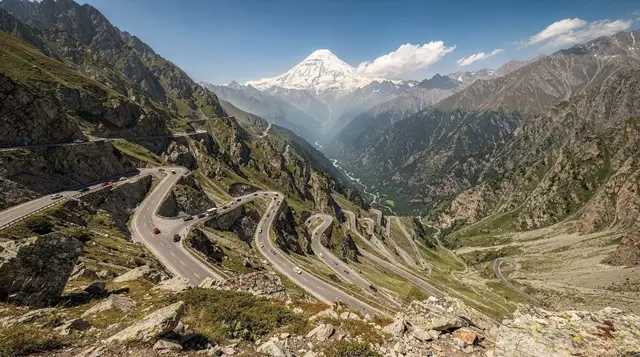
2. Booking Kazbegi as a half-day add-on. The Georgian Military Highway to Kazbegi (also called Stepantsminda) takes about three hours each way from Tbilisi in good conditions, longer if a truck has jackknifed on the Jvari Pass or the Gudauri switchbacks are fogged in, which happens more often than tour operators like to admit. A same-day round trip works, but it means six hours of driving for maybe three hours actually at altitude, and the Gergeti Trinity Church hike or 4x4 up to it needs its own hour.
From Tbilisi: Day Trip to Kazbegi handles the driving logistics properly, with stops at Ananuri Fortress and the Russia-Georgia Friendship Monument built in, which is the sane way to do it in one day if an overnight in Kazbegi is not on the table. Read Kazbegi as a day trip: is it too much? before you commit either way.
3. Not booking a private sulphur bath room ahead of time. Abanotubani’s bathhouses have a public pool option and private rooms, and the private rooms — the ones with the domed brick ceilings everyone photographs — get booked out on weekend evenings, especially around Bathhouse Row’s better-known addresses. Walking up and hoping for an open slot on a Friday night is a real way to end up disappointed. Tbilisi’s sulphur baths: prices, private rooms and what to expect has the numbers — private rooms run roughly ₾60–150 an hour depending on size and time of day, cheaper midweek and before early evening.
4. Underestimating how marshrutkas actually work. These shared minibuses are the backbone of Georgian regional transport, and they are cheap — a Tbilisi-to-Telavi run costs a fraction of a private transfer — but they leave when full, not on a printed timetable, and drivers do not always speak English. Turning up at a marshrutka station without knowing which stand serves which region wastes an hour that a five-minute read would have saved. How marshrutkas actually work covers station layout, rough fares and the etiquette of paying the driver directly.
5. Writing off Kakheti as “just the wine region.” Kakheti does grow most of the country’s wine, but reducing it to tasting rooms skips Sighnaghi’s hilltop lanes, the Alazani valley views, and villages where qvevri fermentation still happens in family cellars rather than tourist-facing ones. A wine tour of Kakheti: how to plan it is worth reading even if wine is not your main interest, because it doubles as a guide to the region generally.
Tbilisi: Kakheti Wine Tour with Tastings Lunch is a straightforward way to see Kakheti’s better-known wineries and Sighnaghi in a single day without driving yourself, which matters given how much tasting is involved.
6. Over-ordering khinkali on the first sitting. Khinkali are dumplings meant to be eaten by hand, holding the twisted knob at the top, sipping the broth inside before biting — and that knob is traditionally left uneaten on the plate, a small ritual that also happens to be how a waiter counts what you had. Ordering fifteen for two people because they looked small on the menu photo is a common first-night mistake; they are denser than they look, and a plate of five or six per person is usually plenty alongside anything else. Khinkali: how to order and how to eat them covers the etiquette and the regional variations (Khevsureti-style versus Kazbegi-style filling, for instance).
7. Assuming Abkhazia or South Ossetia are just another region to visit. They are not. Both territories have been outside Georgian government control since the 1990s and 2008 respectively, and entering either from Russian-controlled territory is illegal under Georgian law, with real legal consequences. There is no legitimate route into either from within Georgia for a typical visitor, and no guide on this site will ever suggest one.
8. Not carrying enough cash for the small stuff. Cards work in Tbilisi restaurants and most Batumi and Kutaisi businesses, but marshrutka drivers, small guesthouses, roadside khinkali stands and rural wine cellars often run cash-only. Withdrawing a reasonable amount of lari on arrival avoids the awkward moment of a driver waving off your card at a fuel stop in the middle of nowhere, and it is worth checking your bank’s foreign withdrawal fees before you land rather than after the third ATM receipt arrives.
9. Packing for one season when Georgia has several at once. Tbilisi in April can be 20°C at midday and close to freezing overnight if you are heading up toward Kazbegi or Gudauri the same week — altitude changes the weather far faster than the calendar does. Packing for Georgia, season by season is worth a genuine read rather than a skim, particularly for anyone planning both a city stay and a mountain excursion in the same trip.
10. Renting a car by default. A rental car is genuinely useful in Kakheti and along the coast around Batumi, where distances between wineries or beach towns are awkward for public transport, but it is close to a liability in central Tbilisi, where parking is scarce and driving habits take adjustment. Many visitors do better with marshrutkas, private drivers for specific day trips, and a car only for the legs where it earns its cost. Renting a car in Georgia and driving in Georgia: rules, roads and habits both lay out where a car actually helps.
11. Wandering into an active church in shorts or a bare-shoulder top. Georgia’s monasteries and cathedrals are working religious sites, not museums, and most expect a level of modesty — headscarves for women are often provided at the door, but shorts above the knee and sleeveless tops usually are not welcome regardless of gender. It is a two-minute adjustment before you go in, and it saves an awkward turn-away at Svetitskhoveli or Gergeti Trinity, both of which see a genuinely steady stream of underdressed visitors sent back to the car for a jumper.
12. Trying to fit Svaneti into a Tbilisi-based day trip. Mestia sits roughly eight to nine hours from Tbilisi by road, or a short flight from Natakhtari or Kutaisi when weather allows — either way, it is not a day trip from the capital by any reasonable measure. Svaneti rewards a minimum of two or three nights, ideally worked into a longer west-Georgia loop through Kutaisi. Getting to Svaneti lays out the flight-versus-road trade-offs honestly, including how often the flights get weathered out.
A closely related habit, worth flagging even outside the numbered list above: booking a different town every single night. Georgia is small enough on paper that it is tempting to build an itinerary that moves hotels daily, but the actual driving and check-in overhead adds up fast in a country where “close on the map” rarely means a short journey. A base-and-loop approach — a few nights in Tbilisi with day trips out, then a few nights in Kutaisi or Batumi for the west — usually beats a different bed every single night, both for sanity and for how much you actually see once you are not packing a bag every morning.
What actually helps before you go
Beyond the specific mistakes above, a few habits save more grief than anything else. Build slack into any itinerary that includes a mountain pass — the Abano and Goderdzi passes close entirely from October to June, and even open routes like the Military Highway can be delayed by weather or roadworks with little warning.
Read is Georgia safe? An honest answer and what a week in Georgia actually costs before you finalise a budget; both temper some of the more alarmist things you may have read online, and both are more useful than a generic packing checklist. And do not skip travel insurance on the assumption that a visa-free stay means the same protections as an EU trip — it does not, and mountain activities in particular are worth checking are actually covered before you sign up for a Kazbegi hike or a Gudauri ski day.
If you are still shaping the trip itself, one week in Georgia is a realistic starting framework that already accounts for most of what is above — it does not rush Kazbegi, does not assume you will drive yourself everywhere, and leaves Kakheti more than an afternoon.
Frequently asked questions about first-time mistakes in Georgia
Do I need a visa to visit Georgia?
Most nationalities — over 95 countries, including the UK, EU, US, Canada and Australia — get 365 days visa-free entry. Check your specific nationality before travelling, since the list does change, but for most visitors this is one of the easiest entry regimes anywhere.
Is one day really not enough for Kazbegi?
A single day works if you accept it as a long, driving-heavy day rather than a relaxed one — roughly six hours on the road for around three hours at altitude. An overnight in Kazbegi itself gives a genuinely different experience, with sunrise views of Mount Kazbek that day-trippers never see.
Can cards replace cash entirely in Georgia?
No. Tbilisi’s restaurants and hotels are card-friendly, but marshrutkas, small guesthouses and rural vendors are frequently cash-only. Carry lari in reasonable amounts, particularly outside the capital.
Is it true you cannot visit Abkhazia or South Ossetia?
Correct. Both are outside Georgian government control, and entering either through Russia is illegal under Georgian law with genuine legal risk. Neither is accessible as part of an ordinary Georgian holiday.
Should I rent a car for the whole trip?
Not necessarily. A car helps most in Kakheti and along the Adjara coast; in Tbilisi itself it is more often a hindrance. Many visitors mix marshrutkas, private day-trip drivers and a car only where the route genuinely needs one.
Best day trips from Tbilisi on GetYourGuide
Verified deep-linked GetYourGuide tours. Book through these links and we earn a small commission at no cost to you.
Photo: our own image of the location, not the operator’s product photo.