A ten-day Georgian road trip
Why a road trip suits Georgia better than most countries
Georgia is compact enough that a ten-day loop by car can genuinely cover the mountains, the wine region, the spa towns of the south and the Black Sea coast without the constant re-planning that public transport demands, and the driving itself — winding mountain roads, roadside fruit stalls, small villages you would never stop in on a scheduled tour — is a real part of the appeal rather than just a way to get between sights.
This route runs a rough clockwise loop out of Tbilisi: north to Kazbegi, east to Kakheti, south to Borjomi and Vardzia, then west to Kutaisi and the coast at Batumi, before the drive back. See Renting a car in Georgia and Driving in Georgia: rules, roads and habits before booking — Georgian driving has a reputation for being assertive rather than dangerous, and the second guide covers what that actually means on the road.
Budget 900–1,300 € per person for the ten days at a mid-range level, sharing a mid-size rental car between two people, covering fuel, tolls, mid-range accommodation and a handful of paid activities along the way. This is directly comparable to Two weeks in Georgia, which covers similar ground at a slower pace with more time in each region; this route trades some of that breathing room for covering more of the country within ten days.
Day 1: Tbilisi to Kazbegi via the Military Highway
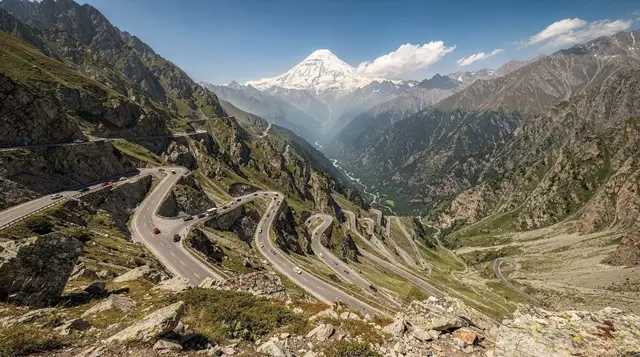
Pick up the rental car in Tbilisi and drive the Georgian Military Highway north, the country’s most dramatic road trip in its own right, through Ananuri Fortress and the ski town of Gudauri before dropping into Stepantsminda beneath Mount Kazbek. See The Georgian Military Highway, kilometre by kilometre for what to expect from the road surface and the passes, since this is the one stretch of the whole loop where weather and season genuinely affect drivability — the Jvari Pass above Gudauri can close briefly after heavy snow even outside deep winter. Overnight in Stepantsminda; walking or driving up to Gergeti Trinity Church is best left to the following morning when light is better for photos.
Day 2: Kazbegi and Juta
Spend the morning at Gergeti Trinity Church, then drive the side road to Juta, a small mountain village that most non-drivers never reach, set beneath the jagged Chaukhi massif with trailheads for some of the country’s best day hikes. See Juta, the Chaukhi massif and the Abudelauri lakes for a walk that fits a single afternoon without needing overnight gear.
Tbilisi: Kazbegi Highlands 4X4 Experience is worth booking instead of self-driving the roughest tracks above Juta specifically, since parts of that terrain are hard on a standard rental car and better left to a local driver who knows the current conditions. Return to Stepantsminda for a second night, or push back toward Tbilisi if Kakheti is your priority the next morning.
Days 3–4: Kakheti’s wine country
Drive east to Telavi, the regional hub, and use it as a base for two days covering Kakheti properly rather than the rushed single-day version most tours run. Day three: Telavi itself and the Alazani valley wineries, plus the Khareba wine tunnel near Kvareli, a genuinely unusual tasting venue carved into a hillside — see Telavi and the Alazani valley wineries for what the day covers.
Day four: Sighnaghi and Bodbe Monastery, both easy to reach by car and worth a full day given Sighnaghi’s hilltop old town and views over the Alazani valley toward the Caucasus. Having your own car here is a genuine advantage over every other route in this series — it lets you choose which small family wineries to stop at along the back roads between villages, rather than following a fixed tour itinerary.
Day 5: Back through Tbilisi toward the south
Rather than a full day in Tbilisi again, treat day five as a driving day with a stop: leave Kakheti in the morning, skirt Tbilisi, and continue south toward Borjomi, breaking the drive at Mtskheta if you have not already covered it, or straight through if time is tight. This is the longest single driving day of the loop, so start early and treat the destination, not the road, as the day’s point.
Days 6–7: Borjomi, Bakuriani and Vardzia
Borjomi is Georgia’s spa town, known for its naturally carbonated mineral water bottled and sold across the country; spend an afternoon at the source itself and in Borjomi-Kharagauli National Park’s lower trails, which are gentle enough to do without planning a full hiking day. See Borjomi water at the source and Trails in Borjomi-Kharagauli National Park for what fits an afternoon.
The next morning, drive on to Vardzia, the twelfth-century cave city carved into a cliff face near the Armenian border — Georgia: Vardzia Cave Tour with Guide is worth booking on arrival rather than exploring the site unguided, since a guide’s context on the monastery’s history and layout adds considerably more than the modest cost. Combine it with Rabati Fortress in nearby Akhaltsikhe, a heavily restored citadel that divides Georgian opinion but is worth seeing regardless — see Rabati Fortress: a restoration that divides Georgians for the history behind the reconstruction before you go.
Day 8: South to Kutaisi
The drive from Akhaltsikhe or Borjomi to Kutaisi crosses through Borjomi-Kharagauli’s forested hills before dropping into Imereti, a genuinely scenic stretch that most travellers on public transport never see, since it is not on the direct Tbilisi–Kutaisi route. Arrive in Kutaisi in the afternoon and use what is left of the day for Bagrati Cathedral before dinner — see Bagrati Cathedral and why UNESCO delisted it for the site’s slightly controversial reconstruction history.
Day 9: Kutaisi’s canyons, then on to Batumi
From Batumi: Martvili Canyon and Prometheus Cave Tour covers Martvili Canyon’s raft trip and Prometheus Cave’s underground boat ride in a single morning, both close enough to Kutaisi to fit before an afternoon drive west to the coast — around three hours to Batumi, considerably more relaxed with your own car than coordinating marshrutka connections for the same distance. Arrive in Batumi by early evening for a first walk along the boulevard; see Batumi Boulevard end to end for a route that covers its best stretches without needing the full length in one sitting.
Day 10: Batumi and the coast, before returning the car
Spend the final full day on Batumi’s coast and, if a jeep is more appealing than another beach afternoon, Batumi: Adjara Waterfalls Gonio Fortress Jeep Tour covers the waterfalls and Roman-era fort in the hills above the city, both easy add-ons with a rental car of your own. For wine drinkers who have not had enough by this point, a proper tasting without leaving the city rounds off the trip well — see Adjarian food in Batumi, beyond the boat-shaped khachapuri for where to pair it with dinner. Return the rental car in Batumi if your onward flight departs from there, or drive back to Tbilisi the following morning — budget a full day for that return leg, since it retraces most of the ground covered over the previous week.
Where to stay along the loop
Stepantsminda’s guesthouses are simple but well set up for the mountain stop; Telavi and Sighnaghi both have a wider range from guesthouses to small boutique hotels, worth booking ahead in summer given how popular Kakheti has become. Kutaisi and Batumi both have straightforward mid-range hotel options near their centres. See Guesthouses, hostels and hotels: what you get for what separates the tiers across the regions this route passes through, since the gap between a guesthouse and a hotel matters more outside Tbilisi than within it.
Budget for the ten-day loop
A mid-size rental car runs roughly 30–50 € a day depending on season and company, plus fuel — expect 150–250 € in petrol for the full loop given the distances covered. Accommodation across the ten nights, mixing guesthouses and mid-range hotels, runs 60–120 ₾ a night per room. The paid activities along the route — the Kazbegi 4x4 add-on, Vardzia’s guided tour, the canyon-and-cave morning near Kutaisi and Batumi’s extras — add roughly 250–350 € per person across the whole trip. Altogether, 900–1,300 € per person for a pair sharing the car and most accommodation costs is a realistic mid-range total.
The best season for this route
Late April to June and September to early October are the strongest windows, avoiding both winter’s mountain-pass closures on the Military Highway and midsummer’s heaviest heat in the south around Vardzia. See When the mountain passes open and close before planning a winter or early-spring version of this loop specifically, since the Kazbegi and Juta legs are the parts of the route most affected by snow, and a shortened route skipping the mountains is the honest alternative if your dates fall outside the reliable window.
What to drop with one less day
If nine days is all you have, combine days three and four in Kakheti into a single longer day covering Telavi and Sighnaghi together rather than splitting them, accepting a more rushed pace through the wine region in exchange for keeping the rest of the loop intact. Cutting a day from the Borjomi–Vardzia leg instead is the other reasonable option, seeing Vardzia without the Rabati Fortress detour.
Fuel, parking and the practicalities of driving this loop
Petrol stations are frequent on every stretch of this route except the more remote sections above Stepantsminda and around Vardzia, so filling up before those legs rather than assuming the next station is close is the safer habit to build early. Parking in Tbilisi and Batumi’s centres is metered and best paid through the local parking app rather than guessed at, while Telavi, Sighnaghi, Borjomi and Kutaisi are all small enough that street parking near your accommodation is rarely difficult to find.
Toll roads are minimal in Georgia compared with much of Europe, so this is not a cost that needs building into the fuel budget above. Speed limits are enforced with fixed and mobile cameras that are more common on the main highways than on the mountain sections of this route, so keep an eye on posted limits through the flatter stretches near Tbilisi and Kutaisi specifically.
Food along the way
Part of the appeal of a road trip over an organised tour is stopping wherever looks interesting rather than at a fixed lunch spot, and this route passes through several regions with genuinely distinct food worth seeking out specifically. Kakheti’s taverns serve some of the country’s best khinkali and grilled meats alongside the wine; the roadside stalls on the Military Highway sell honey, churchkhela and dried fruit that make a better lunch than they sound; and Adjara, once you reach Batumi, has its own style of khachapuri and seafood distinct from anything served further inland.
See Every kind of khachapuri, region by region for what to look out for as the regional styles shift across the loop, and treat an unplanned stop at a roadside stall as one of the genuine advantages of driving yourself rather than following a bus itinerary.
Starting the loop from Kutaisi or Batumi instead
If your flight lands on the coast or in Kutaisi rather than Tbilisi, this loop reverses cleanly: pick up the car in Kutaisi or Batumi, do the western half of the route first — the canyons, Borjomi and Vardzia — then continue east to Kakheti and Kazbegi before finishing in Tbilisi for a Tbilisi-based departure, or looping back to return the car where you started. Most rental companies operating in Georgia allow one-way returns between their Tbilisi, Kutaisi and Batumi branches for a modest additional fee, which is worth checking before booking if a one-way version of this loop suits your flights better than a full circuit back to the start.
Frequently asked questions about a Georgia road trip
Is it safe to self-drive in Georgia, including the mountain roads?
Yes, for a reasonably confident driver — Georgian roads are generally in decent condition on this route’s main stretches, and the driving style, while assertive by Western European standards, is not especially dangerous. The Military Highway above Gudauri is the one section that warrants real caution, particularly after snow.
Do I need a 4x4, or is a standard rental car enough?
A standard car covers this entire route, including the Military Highway, without difficulty in good conditions. The one exception is the rougher tracks above Juta, which is why this itinerary books a local 4x4 tour for that specific detour rather than assuming a rental car can manage it.
How does an international driving licence work in Georgia?
Most nationalities can drive on their home licence for a limited period, though an International Driving Permit is worth carrying alongside it for rental companies and any roadside checks. Confirm your specific country’s requirement before travelling rather than assuming it matches a neighbouring country’s rules.
Is fuel expensive in Georgia?
No, noticeably cheaper than most of Western Europe, and petrol stations are frequent enough on this route that running low is rarely a genuine concern outside the more remote mountain stretches.
Could this route be done in the other direction, starting west?
Yes, particularly useful if your flight lands in Kutaisi or Batumi rather than Tbilisi — simply reverse the order, starting on the coast and finishing at Kazbegi before returning the car in Tbilisi.
What is the most difficult driving on this whole loop?
The climb above Gudauri toward the Jvari Pass on day one, both for the gradient and for the trucks that use the same road as the main freight route toward the Russian border. Slower, patient driving rather than overtaking on blind bends is the right approach, and most of the difficulty disappears once you are past the pass itself.
Should I book accommodation ahead, or decide day to day given the flexibility a car gives?
A mix works best: book Stepantsminda, Telavi or Sighnaghi, and Batumi ahead in peak summer, since good options in all three fill up, but leave Borjomi and Kutaisi more open, since both have enough capacity to find a room on short notice outside the busiest weeks.
Is comprehensive insurance worth adding to the rental?
Yes, and it is usually cheap relative to the peace of mind it buys given the mix of mountain roads, narrower village streets and occasional livestock on rural stretches this loop covers. Check what the base rental price already includes before assuming you need to add cover separately, since some operators build a reasonable level of protection into their standard rate.
How does this route compare to doing the same regions by organised tour?
It covers essentially the same regions as the two-week version of this trip at a faster pace, trading some of that itinerary’s slower, more relaxed days for the flexibility of stopping wherever looks interesting. A car-based ten days suits travellers who want to cover more of the country within a shorter, fixed trip length rather than extending the whole holiday to two weeks.
Trip-planning essentials on GetYourGuide
Verified deep-linked GetYourGuide tours. Book through these links and we earn a small commission at no cost to you.
Photo: our own image of the location, not the operator’s product photo.