The Katskhi Pillar and its solitary monk
What is the Katskhi Pillar?
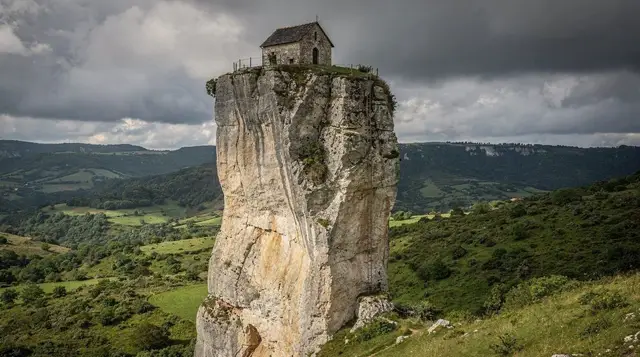
The Katskhi Pillar is a 40-metre natural limestone monolith near Chiatura in western Georgia, topped by a small medieval church that was restored and reoccupied in the 1990s. A single monk, Maxime Qavtaradze, has lived at the top for decades; visitors cannot climb it, but can view it closely and visit a small monastery at its base.
A church that sits where almost nothing else could
The Katskhi Pillar rises abruptly out of farmland near Chiatura, a 40-metre column of limestone with a small stone church balanced on its flat summit — one of the strangest religious sites anywhere in the Caucasus, and one most visitors to Georgia never hear about, overshadowed by Vardzia and Jvari Monastery in most trip planning. It deserves to be better known: the pillar has drawn hermits since at least the 9th or 10th century, on the belief that isolation on an inaccessible rock brought a monk closer to God by removing every practical distraction, including the ability to leave.
The monk who lives on top
The pillar’s church fell into ruin and was largely forgotten for centuries until archaeological climbs in the 1940s and 1990s rediscovered the structures on top — a chapel, a wine cellar, a crypt and what appears to have been a hermit’s cell.
In the mid-1990s, a monk named Maxime Qavtaradze began climbing the pillar and eventually took up residence at the summit, restoring the tiny church and, according to local accounts, living there for extended periods, descending only rarely, originally by ladder and now assisted by an anchored metal staircase installed for safety. His continued presence, now spanning decades, has made the Katskhi Pillar one of the few places in the world where a monastic hermitage of this specific, ancient kind is still actively practised rather than preserved as a ruin.
Public access to the summit itself is not permitted for ordinary visitors — this remains a working hermitage, not a tourist climb — so the experience for almost everyone is viewing the pillar from the ground and visiting the small monastery of nuns and monks established at its base.
Cable Car City Chiatura Katskhi Pillar Wine Tour pairs the pillar with Chiatura’s Soviet cable cars and a wine stop, a sensible combination since both sites sit within a short drive of each other and neither takes a full day alone.
What you can actually see and do
At the base of the pillar, a small working monastery includes a church, accommodation for the resident community, and grounds open to respectful visitors during daylight hours. From here, the pillar itself is best appreciated simply by looking up — the scale is hard to register from photographs, and the sheer, near-vertical faces on every side make clear why this site was chosen for isolation rather than convenience.
Modest dress applies at the base monastery as it does at any active Georgian religious site; see Visiting a Georgian Orthodox church: dress and etiquette for the general rules if this is unfamiliar territory. Photography of the pillar from the grounds is generally fine, though visitors should be mindful that this remains a functioning religious community rather than a photo backdrop, and loud or intrusive behaviour is out of place.
Day Trip to Chiatura with Katskhi Pillar and More covers the pillar as part of a wider Chiatura day trip, useful for travellers based in Kutaisi who want the region’s Soviet and religious history covered together.
Getting there
The Katskhi Pillar sits closer to Kutaisi than to Tbilisi — roughly an hour’s drive from Kutaisi, compared with the better part of four hours from the capital — which makes it a natural fit for travellers already based in western Georgia rather than a standalone Tbilisi day trip. Public transport does not reach the site directly; a rental car, hired driver or organised tour from Kutaisi are the realistic options.
Private Guided Tour from Kutaisi to Chiatura Katskhi is built around exactly this route, a private day trip from Kutaisi covering both Chiatura and the pillar without needing to arrange a self-drive itinerary.
Combining Katskhi Pillar with Chiatura’s Soviet cable cars
Chiatura itself, a few kilometres away, is worth the detour independent of the pillar: a Soviet-era manganese-mining town riddled with ageing cable cars strung between the valley floor and the surrounding cliffs, some still in daily use by residents commuting up to hillside neighbourhoods. Chiatura’s cable cars: the old ones and the new covers which lines still run and what riding one actually involves; pairing this with the Katskhi Pillar gives a single day that covers both Georgia’s ancient hermitic tradition and its Soviet industrial history within a short drive of each other, a contrast few other regions of the country offer this directly.
Kutaisi: Sightseeing Tour to Katskhi Pillar Chiatura is a straightforward option for this exact pairing, aimed at travellers who want both sites covered without self-driving unfamiliar mountain roads.
Pillar hermitages in a wider Christian tradition
The Katskhi Pillar belongs to a specific, ancient strand of Christian monasticism known as pillar or stylite asceticism, in which a hermit lives atop a column or natural rock formation, deliberately cut off from easy contact with the world below. The practice traces back to Simeon Stylites in 5th-century Syria and spread through the Byzantine world over subsequent centuries, though surviving examples of the practice being actively lived, rather than simply preserved as a ruin, are vanishingly rare anywhere today.
Georgia’s own version of the tradition, at Katskhi, is one of the very few places in the world where this specific form of monastic life continues to be practised in anything like its historical form, which is a significant part of why the site draws religious scholars and pilgrims alongside general tourists.
The wider Chiatura and Imereti region
The Katskhi Pillar sits within Imereti, the region built around Kutaisi that also holds Gelati Monastery and Bagrati Cathedral, Georgia’s other major western religious landmarks.
Travellers spending a few days based in Kutaisi rather than passing through on a single day trip have the option of combining the pillar and Chiatura with a wider regional loop — Prometheus Cave and Sataplia Nature Reserve both sit within a similar radius of Kutaisi and offer a different kind of stop, natural rather than religious or industrial, for anyone building a fuller western Georgia itinerary. Canyons and caves in one day from Kutaisi and Day trips from Kutaisi both help place the Katskhi Pillar within this broader set of options rather than treating it as an isolated stop.
Practical details: opening hours and what to expect on arrival
There is no formal ticket booth or fixed opening hours in the way some of Georgia’s more tourist-oriented sites operate — the base monastery functions primarily as a religious site rather than a managed attraction, and visitors are generally free to view the grounds and the pillar during daylight hours. There is no significant food or drink service at the site itself, so plan accordingly if you are travelling independently rather than as part of an organised tour that includes lunch. Parking near the base is informal but generally straightforward outside of peak weekend periods.
Weather affects the visit less than at Georgia’s mountain sites, since Katskhi sits at relatively low elevation, but rain does make the ground around the pillar’s base muddy, and the limestone rock itself can look considerably more dramatic under clear light than under heavy cloud, worth bearing in mind if photography is a priority for your visit.
What the pillar’s story says about faith and isolation
Beyond the physical oddity of a church balanced on a rock column, the Katskhi Pillar’s continued use raises a question that draws as many secular visitors as religious ones: why would anyone choose this level of isolation in the modern era.
Accounts of Maxime Qavtaradze’s decision to take up residence on the pillar describe a deliberate turn away from a difficult earlier life, and the site has since become something of a symbol, within Georgia, of committed religious devotion in an increasingly secular and connected world. Whether or not that framing resonates personally, it is part of why the Katskhi Pillar draws a different kind of visitor than most Georgian monasteries — people who come specifically because of the story, not only for the view.
That contrast — a sight so unusual it draws even travellers with no religious interest at all, paired with a genuine working hermitage rather than a preserved relic — is unusual even by the standards of a country as densely packed with monasteries as Georgia. Most visitors, religious or not, come away describing it as one of the more memorable stops of their trip, less for the scale of what is physically there and more for what it represents: a single, deliberate choice of isolation, still being lived out, in full view of the road below.
Comparing Katskhi to Georgia’s other unusual monastic sites
Georgia has more than one monastery built in a deliberately inaccessible location, and comparing them helps place the Katskhi Pillar in context. David Gareja, the cave monastery complex straddling the contested border with Azerbaijan, shares the same instinct toward isolation but achieves it through cave-cutting into a cliff rather than a single vertical pillar, and remains far larger in scale, with dozens of individual cave cells across the site.
The Vardzia cave city, further south, was built for defence and habitation as much as religious retreat, housing an entire community rather than a single hermit. Katskhi is distinct from both in its scale — a single church and a handful of rooms — and in the fact that its isolation is still actively maintained by one resident rather than existing only as an archaeological curiosity. For a full comparison of all of Georgia’s cave and pillar sites together, Georgia’s cave cities compared covers the wider category.
Soviet history alongside ancient devotion
Chiatura’s cable cars, discussed above as a natural pairing with the pillar, tell a very different story from Katskhi’s own — one of Soviet industrial ambition rather than religious devotion, built to move manganese miners up and down the town’s cliffs efficiently during the mid-20th century. Seeing both within the same day produces an unusual juxtaposition: a thousand-year-old hermitage practice still actively observed, a few kilometres from rusting Soviet-era cable car infrastructure still in daily use by residents.
Soviet mosaics and monuments across Georgia and A Soviet heritage day trip from Tbilisi both cover this wider theme of Soviet-era remnants scattered across the country, of which Chiatura’s cable cars are among the most visually striking surviving examples still functioning rather than preserved as a museum piece.
Is the Katskhi Pillar worth the detour from Tbilisi?
For travellers based purely in Tbilisi without plans to visit Kutaisi or western Georgia, the Katskhi Pillar is a harder sell — the round trip from the capital runs to the better part of eight hours given the distance involved, which is a significant commitment for a site that, once you arrive, occupies perhaps an hour of actual visiting time.
For travellers already routing through Kutaisi, whether heading toward Batumi on the coast or Svaneti in the mountains, the calculation changes entirely: the detour from Kutaisi is short, and the pillar is unlike anything else on a typical Georgia itinerary, which makes it worth the modest extra time for most travellers passing through the region regardless of their broader interest in religious sites.
Photographing the pillar
The pillar photographs best from a moderate distance, where its full 40-metre height and the scale of the tiny church perched on top both register clearly — standing directly at its base loses the sense of proportion that makes the site striking in the first place.
Morning and late-afternoon light both bring out the texture of the pale limestone better than the flat light of midday, and a slightly overcast sky, unusually for outdoor photography in Georgia, can actually help by reducing harsh shadow across the rock face. As at any active hermitage, discretion matters more than the technical quality of the shot — this remains someone’s home and place of worship, not a staged attraction, and photographs should be taken with that context in mind.
Frequently asked questions about the Katskhi Pillar
Can you climb the Katskhi Pillar?
No, not as a visitor. The summit remains an active hermitage occupied by a resident monk, and public access is restricted. Visitors view the pillar from the ground and visit the small monastery at its base.
Who lives on top of the Katskhi Pillar?
A monk named Maxime Qavtaradze has lived there, at least for extended periods, since the mid-1990s, restoring the ruined chapel found on the summit and continuing a monastic tradition of pillar hermitage that dates back roughly a thousand years at this specific site.
How do you get to the Katskhi Pillar?
By rental car, hired driver, or organised tour, generally from Kutaisi (around an hour away) rather than directly from Tbilisi (closer to four hours). There is no direct public transport to the site.
Is the Katskhi Pillar worth visiting?
Yes, particularly for travellers already in western Georgia around Kutaisi or Chiatura — it is a genuinely unusual sight with few equivalents anywhere else, though it rewards a brief, respectful visit rather than a long stay, since there is little to do beyond viewing the pillar and the base monastery.
How old is the Katskhi Pillar hermitage?
Structures on the summit date to roughly the 9th or 10th century, based on the surviving chapel and associated rooms, though the site fell out of use for long periods before its 20th-century rediscovery and its reoccupation in the 1990s.
Can you combine the Katskhi Pillar with other sites in one day?
Yes — it pairs naturally with Chiatura’s Soviet-era cable cars, a short drive away, and several organised tours from Kutaisi combine both in a single day, sometimes with a wine stop added.
What should I wear to visit the Katskhi Pillar monastery?
Modest dress at the base monastery, as at any active Georgian Orthodox site: covered shoulders and legs, and a headscarf for women.
Monastery and fortress tours on GetYourGuide
Verified deep-linked GetYourGuide tours. Book through these links and we earn a small commission at no cost to you.
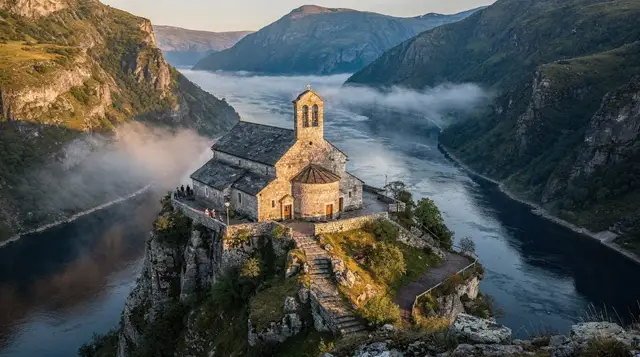
Photo: our own image of the location, not the operator’s product photo.