Sataplia: dinosaur footprints and a glass walkway
What makes Sataplia different from Georgia's other show caves?
Sataplia combines a small karst cave with genuine Cretaceous-period dinosaur footprints, preserved under a glass viewing platform, plus a short forest walking trail with a panoramic tower. It is smaller and quicker to visit than Prometheus Cave nearby, but offers something no other Imereti attraction does: real fossil tracks rather than only rock formations.
The site with actual dinosaurs, not just rock formations
Ask most visitors what they remember from Georgia’s Imereti caves and the answer is usually Prometheus Cave’s boat ride. Sataplia, a smaller reserve a short drive from Kutaisi, offers something genuinely different: real footprints left by dinosaurs during the Cretaceous period, preserved in rock and now viewed from a raised glass platform built directly over the tracks. It is a rare case among Georgia’s natural attractions of an actual scientific find rather than a scenic formation, and it is the reason Sataplia earns a separate visit from Prometheus rather than functioning as a lesser substitute.
The reserve as a whole combines three distinct elements — the dinosaur footprint pavilion, a small karst cave, and a forest walking trail with a viewing tower — which together make for a fuller, more varied hour or two than a single-focus site.
The dinosaur footprints
The footprint site sits under a purpose-built pavilion with a glass floor section, allowing visitors to look down directly at tracks preserved in the rock rather than viewing them from a roped-off distance. Signage explains what is known about the species that left them and the geological context of the Cretaceous-period rock they are set in. This is a genuinely rare thing to see up close in Georgia, and it is the single detail that distinguishes Sataplia from every other cave or canyon covered in this guide series — nowhere else in the region combines a natural attraction with an actual palaeontological find of this kind.
The cave and the forest trail
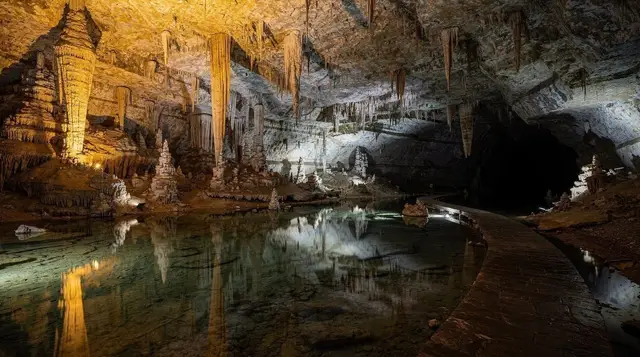
Sataplia’s cave section is considerably smaller than Prometheus, with a shorter walking route past a more modest set of stalactite and stalagmite formations, lit in a similar coloured style. It is worth seeing for comparison but should not be the main reason to visit — the footprints and the surrounding reserve carry the visit. Beyond the cave, a forest path winds through the reserve to a viewing tower with a panorama over the wooded hills and, on a clear day, a distant view toward Kutaisi itself. The full loop through footprints, cave and forest trail typically takes 60 to 90 minutes at an easy pace, noticeably shorter than a Prometheus Cave visit once queueing for the boat there is factored in.
Getting there and combining with Prometheus
Sataplia sits close enough to Prometheus Cave that most visitors see both on the same half-day, and several operators sell the pairing directly. Kutaisi: Day Tour to Caves Sataplia Park Monastery covers exactly that combination, adding a nearby monastery stop alongside the two caves for a fuller half-day without pushing into a full day’s driving. Kutaisi: Ancient Monasteries Sataplia Nature Reserve Tour takes a similar approach with a different mix of religious sites paired with the reserve, worth comparing if the specific monasteries included matter to your interests.
There is no direct public transport to Sataplia, so a taxi, rental car or organised tour remain the realistic options from Kutaisi, a journey of well under half an hour by road.
What it costs
Entrance to Sataplia covers the footprint pavilion, the cave and the forest trail as a single ticket, priced at a moderate level generally comparable to or slightly below Prometheus Cave’s combined walking-and-boat ticket, reflecting the shorter overall visit. Bundled tours that include transport and a guide cost more but remove the need to arrange your own way there, which matters more here than at sites with a direct public transport option.
Sataplia versus Prometheus: which one first?
If time allows for only one Kutaisi-area cave, the honest answer depends on what you are most curious about. Prometheus delivers the more dramatic single experience thanks to its boat ride and larger chambers; Sataplia delivers more variety in a shorter visit, and its dinosaur footprints are genuinely unique among Georgia’s natural attractions rather than a smaller version of what Prometheus already offers. Families travelling with children with any interest in dinosaurs will likely find Sataplia the more memorable stop of the two, while visitors purely after the biggest, most atmospheric cave chambers should prioritise Prometheus. Doing both, given how close together they sit, remains the easiest way to avoid the choice altogether.
Combining Sataplia with Tskaltubo and Tetra Cave
For visitors with more time, Sataplia pairs naturally with a look at nearby Tskaltubo, the Soviet-era spa town a short drive further on, and Tetra Cave, another natural cave in the same district.
Kutaisi: Sataplia Natural Res Tetra Cave Wine Degustation combines Sataplia with Tetra Cave and a wine tasting, a reasonable way to add a genuinely different activity to a day that would otherwise be entirely about caves. Canyon Cave Tour Sataplia Prometheus Martvili goes further still, combining Sataplia with both Prometheus and Martvili Canyon in a single longer day for visitors trying to cover Imereti’s full natural-attraction list at once — see Canyons and caves in one day from Kutaisi for an honest read on how realistic that combination actually is before committing to it.
Family suitability
Sataplia is well suited to families, arguably more so than Prometheus for children with any interest in dinosaurs specifically. The footprint pavilion involves no strenuous walking, the cave section is short, and the forest trail, while involving some uneven ground and a set of stairs up the viewing tower, is manageable for most children with adult supervision. It is a shorter overall commitment than Prometheus, which matters with younger children whose patience for a longer cave walk and a boat queue can run out well before the visit is over.
How the footprints were found and what they tell us
Sataplia’s footprints were discovered in the early twentieth century by a Georgian geologist exploring the karst hills above what is now Kutaisi, though it took decades of further study before the site was developed into the protected reserve and pavilion visitors see today.
The tracks belong to several different dinosaur species that crossed this stretch of ground when it was soft mud rather than exposed rock, later hardened and preserved through the same geological processes that shaped the region’s caves and canyons. Sataplia’s name itself comes from the Georgian word for honey, a reference to wild bees once found nesting in the surrounding cliffs rather than to anything about the dinosaurs — a detail worth knowing since visitors sometimes assume a connection that is not there.
What the cave section adds
Sataplia’s cave, while modest next to Prometheus Cave a short drive away, follows a similarly lit walkway past stalactite and stalagmite formations built up over a comparable span of geological time.
Visiting both on the same day gives a useful sense of scale: Prometheus’s larger chambers and boat ride make Sataplia’s cave feel almost like a preview by comparison, though taken on its own the smaller cave is still a genuine karst formation worth the ten or fifteen minutes it adds to the visit. Neither cave requires prior caving experience or specialist equipment — both are paved, lit, show-cave experiences rather than the unlit scrambling that a genuine specialist caving trip elsewhere in the district would involve.
The viewing tower and forest trail
The forest trail beyond the cave is Sataplia’s most underrated section, a genuinely pleasant walk through mixed woodland that most visitors move through quickly on the way to the viewing tower rather than treating as worth its own time. The tower itself, reached by a set of stairs, gives a wide panorama over the wooded hills of the reserve and, on a clear day, a distant view toward Kutaisi and the surrounding Imereti countryside. It is a modest climb rather than a strenuous one, and the view rewards the short detour even for visitors mainly there for the footprints and the cave.
Combining Sataplia with Kutaisi’s UNESCO sites
Visitors basing themselves in Kutaisi for a few days often pair a half-day at Sataplia and Prometheus with the city’s own UNESCO-listed sights: Gelati Monastery and its mosaics and Bagrati Cathedral and why UNESCO delisted it both sit within a short drive of the centre and add genuine historical depth to a trip that would otherwise be entirely about caves and canyons.
Day trips from Kutaisi sets out the wider menu of options for anyone with more than a single day to give the region, and Overnight vs day trip is worth reading if you are deciding whether Kutaisi deserves a night of its own rather than a rushed pass-through.
What to bring and practical tips
The footprint pavilion and cave stay at a fairly constant, cool temperature similar to Prometheus, so a light layer is worth carrying even in summer. The forest trail and tower involve some uneven ground and a set of stairs, so trainers or walking shoes are more practical than sandals, particularly after rain when the path can turn slippery. There is limited shade around the entrance area, so sun protection matters for the wait before entry even though the visit itself moves mostly through shaded forest and indoor sections. A small shop near the entrance sells drinks and basic snacks, but as with most of the Kutaisi-area attractions in this series, proper meals are better planned for before or after the visit in Kutaisi itself.
Weather and seasonal considerations
Because a meaningful part of the Sataplia visit happens outdoors on the forest trail, weather affects the experience more than it does at the fully indoor Prometheus Cave. Rain makes the forest path underfoot noticeably more slippery and reduces the payoff from the viewing tower, since the panorama depends on visibility that low cloud or mist can significantly reduce.
Spring and autumn bring the most comfortable walking temperatures, while a clear summer morning gives the best combination of good visibility from the tower and manageable heat, since the forest canopy provides shade for most of the trail even in the hottest months. The reserve stays open year-round, since the footprint pavilion and cave section are largely weather-independent in the same way Prometheus Cave is — it is specifically the forest trail and tower that a poor-weather day affects most.
Is Sataplia a tourist trap?
No — it is a genuinely worthwhile, moderately priced site with a real scientific attraction at its centre, and it draws noticeably smaller crowds than Martvili Canyon or even Prometheus Cave on a busy day, since it sits slightly further off the most-travelled tour circuit. The honest criticism, if there is one, is that some visitors arrive expecting a larger, more dramatic cave experience akin to Prometheus and are surprised by how modest Sataplia’s cave section actually is — managing that expectation in advance, by treating the footprints and forest trail as the main draw rather than the cave, sets up a more accurate picture of what the visit delivers.
How Sataplia fits with Georgia’s cave cities
It is worth being clear, as with Prometheus, that Sataplia is a natural site rather than a historical one — a different category from the man-made rock-cut settlements at Vardzia or Uplistsikhe, the rock town near Gori. Georgia’s cave cities compared sets out that distinction in full if you are trying to build a trip that balances natural sites like Sataplia against the country’s rock-cut historical ones.
Comparing Sataplia to dinosaur sites elsewhere
Visitors who have seen larger, more elaborate dinosaur or fossil attractions elsewhere in the world should calibrate their expectations before arriving at Sataplia — this is a genuine, scientifically significant site rather than a manufactured visitor experience, but the scale is modest: a single pavilion over a set of preserved tracks, not a museum with reconstructed skeletons or interactive exhibits. What it offers instead is authenticity: the footprints on display are the real thing, in the exact location they were left, rather than a reproduction or a relocated exhibit, which is a genuinely different kind of experience from a purpose-built dinosaur museum even if the overall visit is shorter and less elaborate.
Frequently asked questions about Sataplia Nature Reserve
What are the Sataplia dinosaur footprints?
Genuine tracks left by dinosaurs during the Cretaceous period, preserved in rock and now viewed from a glass platform built directly over the site within a purpose-built pavilion at the reserve.
Is Sataplia better than Prometheus Cave?
They offer different experiences rather than one being straightforwardly better: Sataplia adds genuine dinosaur footprints and a forest trail with a viewing tower, while Prometheus Cave offers a larger cave system and a boat ride. Many visitors do both on the same half-day.
How long does a visit to Sataplia take?
Around 60 to 90 minutes for the full loop through the footprint pavilion, the cave and the forest trail, shorter than a typical Prometheus Cave visit once queueing there is included.
Is Sataplia suitable for young children?
Generally yes, and arguably a stronger choice than Prometheus for children specifically interested in dinosaurs. The walking involved is moderate, with some stairs at the viewing tower.
How do you get to Sataplia from Kutaisi?
By taxi, rental car or organised tour — there is no direct public transport, though the drive itself is short, well under half an hour from central Kutaisi.
Can you visit Sataplia and Prometheus Cave on the same day?
Yes, easily — they sit close enough together that most operators sell the pairing as a single half-day tour, and it is one of the more efficient combinations in the Kutaisi area.
Do you need a guide to visit Sataplia?
No — the reserve is signposted throughout, with explanatory panels at the footprint pavilion covering the geological and palaeontological background. A guide adds value mainly for deeper context and for handling transport and combining the stop with neighbouring sites, but a self-guided visit works perfectly well for anyone with their own way of getting there.
How much does it cost to visit Sataplia?
Entrance covers the footprint pavilion, cave and forest trail as a single ticket, at a moderate level generally comparable to or slightly below Prometheus Cave’s combined ticket.
Cave and canyon tours on GetYourGuide
Verified deep-linked GetYourGuide tours. Book through these links and we earn a small commission at no cost to you.
Photo: our own image of the location, not the operator’s product photo.