Photographing Georgia without the clichés
The problem with the obvious shot
Search Georgia’s most photographed images and the same handful recur: the Gergeti Trinity Church against Mount Kazbek, Narikala Fortress at blue hour, the balconies of the old town. None of these are wrong to photograph — they’re striking because they’re genuinely striking — but arriving with only that shortlist means competing for the same tripod spot as everyone else at the same hour, and coming home with a version of a photo already taken thousands of times.
This is a guide to the same subjects and a few less obvious ones, approached with more attention to timing, angle and what each place actually looks like outside its single famous view. For the practical list of exact viewpoints in the capital, pair this with Where to photograph Tbilisi, hour by hour.
Tbilisi: the view that isn’t Narikala
Narikala Fortress and the cable car up to it are the default answer to “best view of Tbilisi,” and the view is genuinely good — the old town’s mixed rooflines, the Kura river bending through the city, Metekhi Church on its cliff opposite. But it’s also the most crowded viewpoint in the city at sunset, tripods packed shoulder to shoulder along the same short stretch of wall. The best viewpoints in Tbilisi covers several alternatives with a genuinely different angle on the same skyline, including spots up in Sololaki and around Mtatsminda that get a fraction of the foot traffic.
Sololaki itself, away from any single viewpoint entirely, rewards a slower walk at street level — its Art Nouveau doorways and painted stairwells are covered in Sololaki: Art Nouveau doorways and painted stairwells, and photograph best in the soft, indirect light of late morning rather than the harsh midday sun that flattens the carved stonework.
Kazbegi: timing matters more than the tripod spot
The Gergeti Trinity Church shot is a cliché precisely because the composition is genuinely excellent, and there’s no real way around photographing it — the question is when. Midday light flattens the green hillside and washes out the contrast between church and mountain; the hour after sunrise, when cloud often still clings to Kazbek’s upper slopes and burns off gradually, produces the far more interesting version of the same shot, with the mountain revealing itself rather than sitting there fully exposed.
From Tbilisi: Kazbegi Caucasus Mountains Photo Tour is built specifically around this kind of timing rather than a standard sightseeing schedule, which matters more here than at almost any other single location in the country. For a lighter, faster version aimed more at a phone camera and confident angles than technical timing, From Tbilisi: Kazbegi Instagram Photo Experience covers the same ground with less waiting around for the right light.
Jvari and Mtskheta: the elevated view worth the walk up
Jvari Monastery sits on a hilltop directly above the confluence of the Mtkvari and Aragvi rivers, looking straight down onto Mtskheta and Svetitskhoveli Cathedral below — a composition that most visitors photograph from the monastery car park without realising the far better angle is a short walk along the ridge, away from the crowd gathered at the obvious railing. Jvari Monastery above the confluence covers both the history and the practical access, and the light here is at its best in the late afternoon, when the sun is low enough to pick out the two rivers’ slightly different colours as they meet, a detail that’s invisible in flatter midday light.
Gudauri: the wide shot Kazbegi doesn’t offer
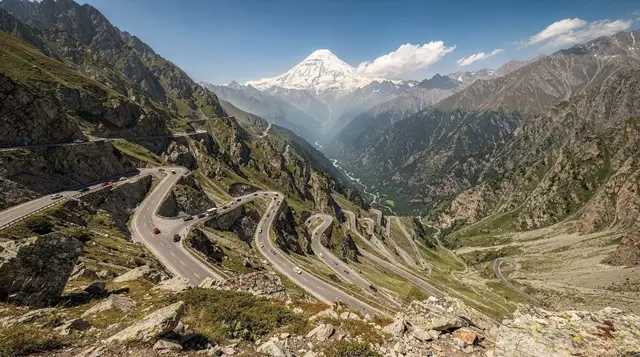
A short drive on from Kazbegi, Gudauri trades the single dramatic church-and-peak composition for a genuinely wide Caucasus panorama — layered ridgelines receding into haze, best photographed with a longer lens compressing the layers rather than a wide-angle trying to capture everything at once. Kazbegi: Gudauri Scenic Photo Day Tour from Tbilisi takes in several of these viewpoints along the Military Highway itself, useful for anyone who wants the mountain scenery without necessarily committing to Kazbegi’s single iconic frame. The road up to Gudauri is itself worth photographing from the switchbacks, particularly in the softer light either side of midday when the valley below isn’t lost in shadow.
Soviet ruins: the ethical question worth asking first
Tskaltubo’s abandoned sanatoriums have become a genuine photography destination in their own right — peeling murals, collapsed ceilings, the specific decayed grandeur that draws photographers from well beyond Georgia. It’s worth reading The abandoned sanatoriums of Tskaltubo before going, both for the practical access questions and for context on what these buildings actually were.
It’s also worth thinking about the ethics of this kind of photography honestly rather than treating decay purely as an aesthetic — the buildings sit within a town that still has a population living around them, some of it displaced communities from the 1990s war in Abkhazia who were housed in the sanatoriums themselves. Photographing Soviet ruins: where the line is sets out that context directly and is worth reading alongside any plan to shoot there.
Racha: the region with the fewest cameras pointed at it
Of all Georgia’s wine regions, Racha sees a fraction of Kakheti’s visitor numbers, which means its vineyard terraces, wooden village architecture and mountain backdrop stay genuinely uncrowded even in peak season. From Kutaisi: Racha Photo Drone Tour with Wine Tasting combines aerial shots of the terraced vineyards with the ground-level village detail that a drone alone would miss, and the region’s relative obscurity means there’s rarely another photographer in frame to edit out afterwards.
Mestia and Ushguli: towers in changing light
Svaneti’s stone defensive towers photograph completely differently depending on season and hour — stark and graphic against a clear autumn sky, moody and half-hidden in the low cloud that settles over the valley through spring. Koruldi Lakes above Mestia offers a genuinely different composition again, looking back down over the town and its towers from above rather than up at them from the streets, and is worth the climb specifically for photographers willing to carry gear up a proper hillside walk.
Mestia and Ushguli, and the towers themselves
It’s worth naming Mestia and Ushguli directly alongside the Koruldi Lakes viewpoint above them, since most of the strongest images from Svaneti come from ground level rather than from altitude.
The towers photograph best either very early, before the village fully wakes and street activity clutters the frame, or in the last hour of light, when the low sun rakes across the stone and throws long shadows that give the clustered towers a sense of depth they lose under flat midday sun. A wider lens capturing several towers together against the peaks behind tends to read better than tight shots of a single tower, which can look like generic old stonework without the mountain context that makes Svaneti distinct.
Batumi: architecture that photographs better after dark
Batumi’s Black Sea boulevard is a strange, deliberately maximalist mix of Soviet-era buildings, Ottoman-influenced facades and genuinely eccentric modern towers, and it’s one of the few places in Georgia that photographs noticeably better after sunset than during the day, once the boulevard’s elaborate lighting comes on and the sea turns from a flat daytime blue to a dark mirror for the skyline. Batumi Boulevard end to end maps the full stretch worth walking, and Batumi itself is worth building an evening around specifically for this — arriving with only daytime shots from a quick stopover misses most of what makes the city visually distinct.
Cave cities and canyons: shooting in difficult light
Vardzia and David Gareja both present a specific technical problem: golden sandstone cliffs riddled with cave openings, shot in harsh midday sun that tends to blow out the highlights on the exposed rock face while leaving the cave interiors as black voids. Arriving as close to opening time as possible, before the sun is directly overhead, gives noticeably more detail in both the rock texture and the shadowed openings. Every UNESCO World Heritage site in Georgia lists the full set of similarly dramatic, similarly light-sensitive locations worth planning around rather than just turning up to at midday.
The Chronicle of Georgia: a monument that photographs better than it reads
Above the Tbilisi Sea reservoir, the Chronicle of Georgia’s towering carved pillars are visually striking regardless of whether you know their history, and photograph particularly well backlit at sunset, when the carved reliefs throw deep shadow across the bronze and stone. The Chronicle of Georgia and the Tbilisi Sea covers the monument’s contested history alongside practical visiting details — it’s a genuinely divisive piece of public art among Georgians, which is worth knowing before treating it as a purely decorative backdrop.
Gear worth carrying, and what to leave behind
A long lens earns its weight far more often in Georgia than a wide-angle does, given how much of the country’s best scenery — the Caucasus ridgelines from Gudauri, the towers of Svaneti against distant peaks, the terraces of Racha — benefits from compression rather than an expansive foreground. A polariser cuts glare usefully on the Black Sea at Batumi and on the rivers around Mtskheta, though it does little for the muted stone of the cave cities.
Weather changes fast in the mountains, and a rain cover for a camera bag has proven more useful on Kazbegi and Svaneti trips than almost any other single piece of gear, given how quickly cloud can roll in over a clear morning. None of this needs to be elaborate — a single versatile zoom covers most of what’s described here — but it’s worth packing with the country’s actual conditions in mind rather than assuming consistently clear mountain light throughout.
Frequently asked questions about photographing Georgia
What’s the best time of day to photograph Gergeti Trinity Church?
The hour after sunrise, when cloud is often still clearing off Mount Kazbek, generally beats midday light, which flattens the contrast between the green hillside and the mountain behind it.
Is it okay to photograph the abandoned sanatoriums in Tskaltubo?
Access is generally tolerated at several of the buildings, but it’s worth reading about the displaced communities who have lived around and sometimes within these buildings since the 1990s before treating the decay purely as an aesthetic subject.
Which region of Georgia is least crowded for photography?
Racha, among the wine regions, and the stretch of Svaneti beyond Mestia toward Ushguli, both see far fewer visitors — and fewer other photographers — than Kazbegi or Kakheti.
Do I need a drone to photograph Georgia’s landscapes well?
No, though it helps for specific subjects like Racha’s terraced vineyards. Most of the country’s best-known compositions, including Gergeti Trinity Church, are shot from the ground.
What’s the best viewpoint for Tbilisi that isn’t Narikala Fortress?
Several spots around Sololaki and Mtatsminda offer a genuinely different angle on the same skyline with far fewer other photographers competing for the same spot at sunset.
Is midday a bad time to photograph Vardzia or David Gareja?
Generally yes — harsh overhead sun blows out highlights on the exposed rock while leaving cave interiors as black shadow. Arriving near opening time gives more even, detailed light.
Best day trips from Tbilisi on GetYourGuide
Verified deep-linked GetYourGuide tours. Book through these links and we earn a small commission at no cost to you.
Photo: our own image of the location, not the operator’s product photo.