Photographing Soviet ruins: where the line is
Tskaltubo is not an abandoned place, it is an inhabited one
The single most important fact about Tskaltubo’s Soviet sanatoriums, the one that changes how you should photograph them, is that several are not empty. Since the early 1990s, families displaced from Abkhazia during the war have lived in some of these buildings — grand radon-bath resorts built for Soviet miners and Politburo members, now home to people who never planned to still be there thirty years later.
Walking through Sanatorium Medea or Tbilisi with a camera and treating the peeling murals and collapsed staircases as pure aesthetic backdrop, while someone’s laundry hangs in a hallway two floors up, is the exact scenario that gives “ruin photography” its bad name. Some buildings have been fully cleared and restored for tourism; others still have residents. Knowing which is which before you go is not optional.
The abandoned sanatoriums of Tskaltubo has the building-by-building breakdown of what is open, what is inhabited, and what has been renovated into a functioning spa again. Kutaisi: Soviet Abandoned Sanatorium in Tskaltubo Day Tour runs with a guide who knows which corridors are genuinely open to visitors and which are someone’s front hall, which solves the access problem more reliably than wandering in alone.
What “respectful” actually means in practice, not in theory
Most guidance on ethical ruin photography stays abstract — “be respectful,” “think about the people affected” — without saying what that changes about the actual visit. A few concrete things do:
Do not photograph residents or their belongings without asking, even from a distance, even if they are technically in a “public” corridor. A shot of someone’s doorway with laundry and a house number taped to it is still a photograph of somebody’s home. If a resident is visible and willing to talk, that conversation is worth more than the photograph, and several Tskaltubo residents have spoken to visiting journalists and photographers about their situation over the years — treating them as backdrop rather than as people with a housing crisis is the failure mode to avoid.
Do not remove anything. Tiles, glass, medical equipment left behind in the bathhouses — all of it gets picked over by souvenir hunters, and the sanatoriums are visibly poorer for it compared with photographs from even five years ago. What is currently protected by benign neglect will not survive active looting dressed up as curiosity.
Do not enter structurally unsound sections for a shot. Several of Tskaltubo’s buildings have partially collapsed floors and roofs, and the incentive to get one dramatic frame from a genuinely dangerous vantage point is exactly how people get hurt in places with no staff, no signage and no mobile signal in some corridors.
Chiatura’s cable cars are a different case entirely
Chiatura sits in a different category from Tskaltubo, because its Soviet-era cable cars are not abandoned — they are still operating public transport, carrying manganese miners and residents up the town’s steep cliffs, alongside a handful of newer cabins installed more recently. Photographing them raises a much simpler question: are you getting in the way of someone’s actual commute for a photo? Chiatura’s cable cars: the old ones and the new explains which lines are functioning transit and which are decommissioned, which matters for both safety and basic courtesy toward the people using them to get to work.
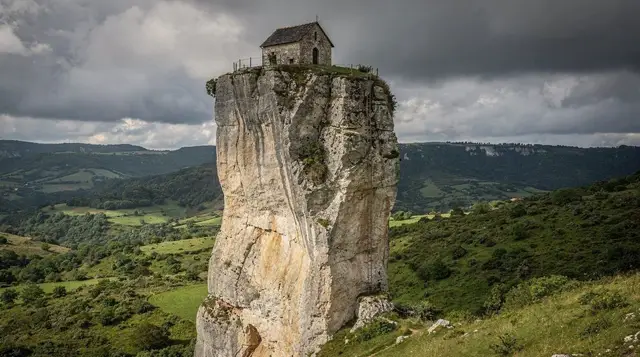
Tbilisi: Chiatura and Katskhi Soviet Tour pairs Chiatura with the Katskhi Pillar, a genuinely different kind of site — a lone rock spire topped by a small monastery where a single monk has lived for decades — and a useful reminder that not everything Soviet-adjacent in this part of Georgia is a ruin. The pillar is a living religious site with its own etiquette (see visiting a Georgian Orthodox church: dress and etiquette), not urbex material at all.
How this compares with ruin photography elsewhere
Georgia is not unique in facing this question — Chernobyl’s exclusion zone, Detroit’s abandoned factories and Pripyat’s apartment blocks have all generated the same debate over the past two decades, and the criticisms levelled at “ruin porn” as a genre are well developed by now. What makes Tskaltubo a sharper case than most of those comparisons is the presence of current residents rather than a fully evacuated zone; Chernobyl’s exclusion zone has no permanent population to consider, which removes one entire layer of the ethical question that Tskaltubo cannot avoid.
Detroit’s ruin photography debates, by contrast, are closer to Tskaltubo’s in that both involve buildings sitting within otherwise-functioning, populated areas, and much of the criticism aimed at Detroit’s photographers over the years — treating poverty and decline as an aesthetic rather than engaging with the people and causes behind it — applies just as directly here.
Who actually benefits from a guided visit, beyond you
It is worth being specific about where the money from a paid tour goes, since that is part of the ethical picture too. Reputable local operators running Tskaltubo and Chiatura tours typically employ Georgian guides from the region itself, several of whom have direct family history with the sanatoriums or the mining industry that built Chiatura’s cable cars, and some portion of that income circulates back into a local economy that has struggled since Soviet-era industry collapsed in both towns.
This is a genuinely different economic relationship from turning up independently with a rental car and a camera, paying nothing to anyone locally, and leaving with photographs but no local benefit at all. It is not a complete answer to the ethical questions above, but it is a real point in favour of booking a guided visit over an independent one, beyond the practical access and safety arguments already made.
The wider question: whose history is this to consume?
There is a harder question underneath the practical rules, and it is worth sitting with rather than resolving too neatly. Soviet ruins across Georgia are, for many Georgians, not a stylised aesthetic but a period their parents or grandparents lived through — occupation, forced collectivisation, the 1989 crackdown, the loss of Abkhazia that put people in Tskaltubo’s sanatoriums in the first place.
A foreign visitor’s interest in “beautiful decay” can sit uncomfortably next to that history if it never engages with what actually happened, treating the peeling paint as texture rather than evidence. April 1989 and August 2008: how Georgia remembers and the Museum of Soviet Occupation, Tbilisi are two ways to put context around the photographs before or after you take them, and reading either one changes what you notice on-site.
None of this means the photography itself is wrong. Documenting these buildings before they collapse further, or before renovation erases them entirely, has genuine value — some of the more serious photographic projects on Tskaltubo have been made in coordination with residents and local historians, and have helped bring outside attention to the housing situation there. The difference between that kind of work and drive-by ruin tourism is usually visible in the details: whether a photographer talks to anyone, whether they know what they are looking at, whether the caption says anything beyond “abandoned Soviet grandeur.”
Soviet mosaics: the lower-stakes version of the same instinct
If the ethics of Tskaltubo feel heavy, Soviet mosaics and monuments across Georgia is a gentler entry point into the same period — bus stop mosaics, factory friezes and monumental sculpture scattered across the country, most of it in public space, uninhabited, and rarely contested in the way a lived-in sanatorium is.
Tbilisi: Discover the Soviet Past Walking Tour covers a chunk of this material within Tbilisi itself, alongside brutalist buildings covered in Brutalist Tbilisi: the buildings worth the detour. This is where “photographing Soviet Georgia” and straightforward architectural interest overlap most comfortably, without the housing-crisis complications that follow Tskaltubo specifically.
For a more deliberately urban-exploration angle, Soviet Bunker Tbilisi Urbex Tour visits a disused underground bunker rather than an inhabited residential building, which sidesteps most of the concerns above — nobody lives in a Soviet-era bunker, and its history is more straightforwardly about Cold War infrastructure than displacement.
Renovation is quietly changing the calculus too
A further complication worth naming: some of Tskaltubo’s grander buildings are now under active renovation, aimed at reopening as functioning spa hotels rather than staying as ruins at all. Sanatorium Iveria and a handful of others have seen serious investment in recent years, and the long-term trajectory for at least part of the site is toward restoration rather than continued decay.
This changes the photography question again — a building mid-renovation, scaffolded and half-restored, raises none of the residency concerns above but also is simply not the same visual subject that drew photographers there in the first place, and the window for photographing the site in its current in-between state is narrower than it might seem. The abandoned sanatoriums of Tskaltubo tracks which specific buildings are currently under renovation and which remain untouched, worth checking close to your visit date since the situation shifts from year to year.
A short, practical checklist
Before visiting any Soviet-era ruin in Georgia, four questions are worth asking: is this building inhabited, even partially? Is it structurally safe to enter, and does that assessment come from someone who actually knows, not just from photos you saw online? Am I able to ask before photographing anyone I encounter, or willing to lower the camera if I cannot?
And do I know enough about what happened here to say something more than “eerie” or “haunting” about it afterwards? A guided visit — through Tskaltubo’s better local operators or a tour like the ones above — answers the first two automatically and makes the third and fourth considerably easier, which is the practical case for not simply turning up alone with a wide-angle lens and no context.
Frequently asked questions about Soviet ruins photography
Is it legal to enter Tskaltubo’s sanatoriums?
It varies by building. Some have been fully restored as functioning spas and welcome visitors normally; others sit in a legal grey area with informal access; a few are private residences where entering without invitation is both illegal and simply wrong. A local guide is the reliable way to know which is which on any given day.
Are people still living in the Tskaltubo sanatoriums?
Yes, in several buildings, mostly families displaced from Abkhazia during the 1992–93 war who were never permanently rehoused. Some buildings have since been cleared for renovation and tourism; others remain informal housing. Treat any inhabited section as someone’s home, because it is.
Is drone photography allowed at these sites?
Rules and enforcement vary and change, and flying a drone over an inhabited building raises the same privacy concerns as photographing residents directly. A guided operator running drone tours, such as the Tskaltubo drone photo tour above, will know current restrictions better than a solo visitor checking online forums.
What should I read before visiting, to have proper context?
The Museum of Soviet Occupation in Tbilisi gives the clearest overview of the period generally. For Tskaltubo specifically, reading about the Abkhazia war and its displaced population before visiting changes the visit meaningfully compared with arriving with no background at all.
Is Chiatura the same kind of visit as Tskaltubo?
No. Chiatura’s cable cars are working public transport, not a ruin, and most of the town is a normal functioning mining community rather than an abandoned site. The photographic interest is real but the ethical questions are different and generally simpler — mainly about not disrupting people’s actual commute.
Monastery and fortress tours on GetYourGuide
Verified deep-linked GetYourGuide tours. Book through these links and we earn a small commission at no cost to you.
Photo: our own image of the location, not the operator’s product photo.