The wine region built on a grape combination found nowhere else
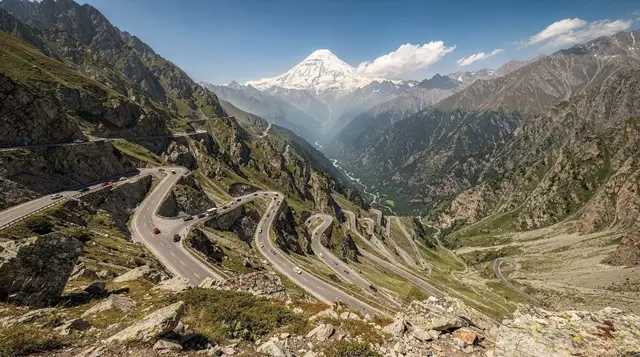
Racha sits in the mountains of northern Imereti, reached by a winding road that climbs from Kutaisi through forested valleys before opening onto the vineyards around Ambrolauri, the region’s small administrative centre. What makes Racha worth the drive, for anyone who’s already done a Kakheti wine tour, is Khvanchkara — a semi-sweet red made from a specific blend of the local Aleksandrouli and Mujuretuli grape varieties, grown almost nowhere outside a narrow band of hillside around the villages of Khvanchkara, Bugeuli and Sadmeli.
Reportedly Stalin’s preferred wine, Khvanchkara carries a reputation in Georgia that outstrips how little of it most foreign visitors have actually tasted, since serious production stays small and much of it doesn’t leave the country in meaningful volume.
The contrast with Kakheti matters for setting expectations. Kakheti has a developed wine-tourism infrastructure — marked routes, tasting rooms built for groups, English-speaking hosts as standard. Racha has almost none of that. Visits here mean knocking on the door of a family cellar, sometimes literally, and being poured wine by whoever happens to be making it that year. It’s a genuinely different, slower kind of wine tourism, and it isn’t for every visitor — anyone wanting a curated, comfortable tasting experience should look to Kakheti or Telavi’s wineries instead.
Ambrolauri and the villages around it
Ambrolauri itself is a small, unhurried town rather than a destination in its own right — a base for exploring the surrounding vineyard villages rather than somewhere to spend a day walking around. The real interest sits in the hillside hamlets nearby, where family producers have been making Khvanchkara for generations, often still in qvevri, the same buried clay vessels used across Georgia for the country’s broader 8,000-year winemaking tradition. A day trip from Kutaisi with wine tasting in Racha is the most practical way to arrange cellar visits without knowing the villages or having a local contact already.
Nikortsminda Cathedral, and the carving that survived
Nikortsminda Cathedral, an 11th-century Georgian Orthodox church a short drive from Ambrolauri, is the region’s single most significant monument — its exterior stonework carved with an unusually dense array of figures, animals and geometric patterns that survived largely intact through centuries in which many comparable Georgian churches lost their decoration to weather, war or later renovation. Inside, faded but legible frescoes cover much of the interior. It rarely appears on organised itineraries outside dedicated Racha trips, which means visitors typically have the building largely to themselves, a genuine contrast to the busier UNESCO sites closer to Tbilisi.
Lake Shaori, and the quieter side of Racha
Lake Shaori, a reservoir set among forested hills, offers a genuinely peaceful stop for anyone wanting a walk or a picnic away from any organised sight — fishing is popular locally, and a handful of simple guesthouses sit near its shore for visitors extending a Racha stay into an overnight or two. It’s not a dramatic destination on its own, but it captures the region’s broader appeal: green, undeveloped, and almost entirely free of other tourists.
Getting there, and why a guide or driver helps
Racha’s roads are mountainous and, in stretches, in rougher condition than the main highways elsewhere in Georgia, which makes a private driver or organised tour a genuinely practical choice rather than just a convenience — public transport options thin out considerably once past Ambrolauri, and reaching individual family cellars without local knowledge of which villages are producing that year is difficult.
A private SUV tour from Kutaisi covering Racha and neighbouring Lechkhumi handles both the driving and the introductions. For visitors wanting a more structured tasting itinerary across several producers, a wine cellars tour through Racha’s specific microzones goes deeper than a general sightseeing day.
Racha sits roughly 3-3.5 hours from Kutaisi and closer to 5-6 hours from Tbilisi by road, which puts it well beyond a comfortable day trip from the capital. Most visitors reach it as an extension of time already spent in Kutaisi or the wider wine tasting circuit, rather than a standalone stop bolted onto a Tbilisi-based trip. A one-day trip to Racha from Kutaisi is realistic for a first taste of the region, though an overnight allows for a proper cellar-hopping pace without rushing back for a long evening drive.
Lechkhumi, Racha’s wine-country neighbour
Immediately west of Racha, the smaller Lechkhumi district produces its own respected reds, most notably Usakhelauri, made from a rare grape variety grown on a handful of steep hillsides and priced accordingly for its scarcity. The two regions are usually visited together given their shared road access from Kutaisi, and several of the wine-focused tours into Racha route through Lechkhumi’s villages as part of the same day.
What a Racha visit doesn’t include
There’s no equivalent here to Kakheti’s Sighnaghi old town, no polished monastery circuit, and relatively little in the way of restaurants or organised activities beyond wine and hiking. Visitors expecting a full day of curated sightseeing will find Racha thin; visitors wanting genuinely undeveloped mountain wine country, with the trade-offs that implies, will find it delivers exactly that. It’s worth being honest about which kind of traveller this region suits before committing two or three days to it over, say, extending time in Kakheti or Svaneti.
Photography, and the harvest season specifically
Racha’s harvest (rtveli) in September and early October is a genuinely good window for visitors interested in seeing wine production happen rather than just tasting the finished product, and it coincides with some of the most comfortable hiking and driving weather of the year. See the broader rtveli harvest guide for what participating actually involves across Georgia’s wine regions.
A region shaped by isolation
Racha’s relative obscurity on the tourist map isn’t an accident of marketing — it reflects centuries of genuine geographic isolation. Mountain passes historically cut Racha off from lowland Georgia for stretches of the year, and the region developed its own dialect variations and local customs somewhat apart from the rest of Imereti as a result. That isolation also shaped its wine: because Racha’s producers rarely had easy access to wider Georgian or export markets, Khvanchkara and other local wines developed and stayed largely as a regional product made for local consumption and domestic reputation rather than for scale production, a genuinely different history from Kakheti’s centuries of larger-scale, more export-oriented winemaking.
Hiking beyond the vineyards
Racha’s mountains offer genuine hiking beyond the wine-focused day trips, though infrastructure for it remains minimal compared to Svaneti or Kazbegi — trails around the higher villages near Ambrolauri and toward the Lechkhumi border reach genuinely remote alpine terrain with essentially no other hikers on them.
This isn’t a region with marked, maintained trekking routes in the way Svaneti has developed; a local guide familiar with the specific paths is close to essential for anything beyond a short walk near Lake Shaori, since trail marking is sparse to non-existent. For visitors specifically drawn to hiking rather than wine, the mountains and hiking theme covers Georgia’s more developed trekking regions for comparison.
What a Racha visit costs
Racha remains inexpensive by Georgian standards, in keeping with its low tourist infrastructure — a private cellar tasting typically costs a modest per-person fee or is included informally as part of a purchase, considerably cheaper than a structured Kakheti winery visit.
A day tour with wine tasting from Kutaisi runs a moderate cost per person given the driving distance involved, while an overnight in one of Ambrolauri’s simple guesthouses costs well under equivalent lodging in Georgia’s more developed tourist towns. The largest practical cost is often transport itself, given how far Racha sits from any major population centre — worth factoring in when comparing a Racha detour against extending time in a region with lower transport overhead.
Sadmeli, Bugeuli and the specific Khvanchkara villages
The precise villages that give Khvanchkara its name and reputation — Khvanchkara itself, along with Bugeuli and Sadmeli — sit on south-facing hillsides near Ambrolauri with the specific microclimate conditions that support the Aleksandrouli and Mujuretuli grapes. Visiting these villages directly, rather than only tasting Khvanchkara in an Ambrolauri restaurant, gives a genuinely different sense of scale — small terraced plots tended by individual families rather than anything resembling an industrial vineyard, a contrast worth experiencing directly for anyone who has only encountered Georgian wine through Kakheti’s larger commercial estates.
Comparing Racha to Kakheti, honestly
For a visitor deciding whether Racha deserves a place in a Georgia itinerary already featuring Kakheti, the honest comparison runs like this: Kakheti offers a more complete, comfortable wine-tourism experience, with organised tastings, English-speaking hosts, a genuinely walkable old town in Sighnaghi, and a far wider range of wines to sample across dozens of producers.
Racha offers none of that polish, but it offers something Kakheti increasingly can’t — genuine scarcity and a sense of discovery, tasting a wine most visitors to Georgia will never encounter, poured by the person who actually made it, in a region that sees a fraction of Kakheti’s visitor numbers. Neither is the objectively better choice; they serve different kinds of travellers, and a visitor with limited time and a preference for comfort should default to Kakheti, while one with more time and a taste for the unpolished should consider Racha seriously.
Weather and road conditions through the seasons
Racha’s mountain roads are considerably more affected by weather than Georgia’s main highways, and winter snow can make some of the smaller village roads genuinely difficult or impassable without appropriate vehicles and local knowledge. Late spring brings the risk of landslip on some stretches after heavy rain, a lingering effect of the steep terrain and less-developed road maintenance compared to routes serving more heavily touristed regions. Late summer and early autumn offer the most reliable driving conditions, coinciding usefully with both comfortable hiking weather and the September-October harvest season that gives visitors the best chance of seeing wine production happening rather than just tasting the finished product.
Local food beyond the wine
Racha’s food culture carries its own specific traditions within Georgian cuisine, most notably Rachuli lori, a cured, smoked pork product distinct from preparations found elsewhere in Georgia, and a style of khinkali often made slightly differently from the Tbilisi standard. Family guesthouses in and around Ambrolauri typically serve home-cooked meals built around whatever the household has on hand that season, a more genuinely local experience than the standardised tourist-restaurant menus found in Georgia’s more developed destinations, and one more reason an overnight stay rewards the extra effort of getting here over a rushed day trip.
Combining Racha with a longer Imereti stay
For travellers already spending several days around Kutaisi covering Martvili Canyon, Tskaltubo and Prometheus Cave, adding an overnight or two in Racha extends that Imereti stretch into genuinely varied territory — canyons and caves, Soviet-era ruins, and mountain wine country within a compact geographic area rarely covered together in a single trip.
The wine-lover’s Georgia itinerary builds Racha in alongside Kakheti and Kartli specifically for travellers who want to see the full spread of Georgian wine regions rather than only the best-known one. This kind of extended Imereti stay rewards travellers with ten days or more in Georgia far more than a rushed week that treats the region as a single overnight stop between Tbilisi and Batumi.
A note on driving yourself
Self-driving in Racha is possible for confident drivers comfortable with mountain roads, switchbacks and occasional unpaved stretches, and it does offer the flexibility to stop at whichever cellar looks promising rather than following a fixed itinerary. That said, without fluent Georgian or a local contact, finding which specific family cellars are open and pouring on a given day is genuinely difficult without help — many operate informally, without signage or fixed hours, relying on word of mouth and prior arrangement rather than a marked wine-tourism route of the kind Kakheti has developed. A driver-guide familiar with the region removes that uncertainty and is worth the added cost for most first-time visitors.
A final word on expectations
Racha rewards patience and a genuine interest in wine and mountains over a checklist approach to sightseeing. There’s no single unmissable monument here in the way Vardzia or Mtskheta offer elsewhere in Georgia — the appeal is cumulative, built from small cellar visits, quiet mountain roads and a slower pace than almost anywhere else covered on this site.
Visitors expecting a single dramatic photo stop will likely leave underwhelmed; visitors willing to spend two unhurried days tasting wine in family courtyards and walking quiet hillsides tend to rank Racha among the more memorable stops of a longer Georgia trip, precisely because so few other travellers make the same effort to get there.
Frequently asked questions about visiting Racha
What is Khvanchkara, and why is it well known in Georgia?
Khvanchkara is a semi-sweet red wine made from Aleksandrouli and Mujuretuli grapes grown in a small area around Ambrolauri. It’s one of Georgia’s few well-known naturally semi-sweet wines and carries a reputation domestically that outpaces its international recognition, since production stays small.
Is Racha worth visiting if I’ve already done a Kakheti wine tour?
Yes, for a genuinely different experience — Racha has almost none of Kakheti’s organised tasting-room infrastructure, and visits happen through small family cellars in a much quieter mountain setting.
How far is Racha from Kutaisi and Tbilisi?
Roughly 3-3.5 hours from Kutaisi and 5-6 hours from Tbilisi by road, which makes a Kutaisi base far more practical for a Racha trip.
Do I need a car or driver to visit Racha?
Strongly recommended. Public transport thins out past Ambrolauri, and the mountain roads plus the need for local knowledge of which cellars are open make a private driver or tour genuinely useful here.
Is Nikortsminda Cathedral worth the detour?
Yes, particularly for anyone interested in Georgian medieval stone carving — its exterior reliefs are unusually well preserved and it’s rarely crowded.
What’s the best time to visit Racha?
Late spring through early autumn for road conditions and comfortable weather; September and early October specifically for the wine harvest.
Can Racha be done as a day trip?
From Kutaisi, yes, though it’s a full day with significant driving. An overnight allows a more relaxed pace across several vineyard villages.
Is there anywhere comfortable to stay overnight in Racha?
A modest number of guesthouses operate in and around Ambrolauri and near Lake Shaori — simple rather than luxurious, in keeping with the region’s low-key character.