A wellness weekend from Tbilisi
Can you do a proper wellness weekend from Tbilisi?
Yes. A realistic version pairs one evening at a sulphur bathhouse in the city with a day trip or overnight to either Borjomi (2.5 hours away, better for mineral water and a gentle pace) or Tskaltubo (3.5 hours, near Kutaisi, for radon baths and Soviet-era sanatoriums). Trying to fit both into one weekend usually means too much driving and not enough actual rest.
A weekend, not a single afternoon
A single sulphur bath in Abanotubani is an easy add-on to any Tbilisi visit, but it’s not the same as a proper wellness weekend, and treating it that way undersells what’s actually possible with two or three days. Georgia has enough hot water spread across the country — Tbilisi’s sulphur springs, Tskaltubo’s radon-carbonate baths, Borjomi’s mineral water — that a genuine weekend built around soaking, slower food, and less walking than a typical sightseeing trip is a realistic thing to plan, not a stretch. This guide lays out a version that actually fits into two or three days without turning into a driving marathon.
The plan below deliberately avoids the trap of most Georgia itineraries, which tend to pack in as many sights as possible per day. A wellness weekend only works as advertised if you actually protect the slower pacing — that means fewer stops, more time in the water, and being honest with yourself about how much driving you’re willing to do on what’s meant to be a restful couple of days. If you’re the kind of traveller who finds unstructured time stressful rather than relaxing, it’s worth knowing that about yourself before committing to this kind of trip over a more conventional sightseeing weekend.
Evening one: Tbilisi, before you leave
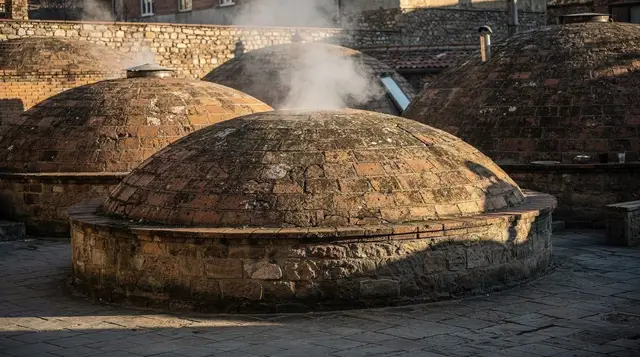
Start in the city itself, the evening before you head out. A private room at one of the bathhouses in Abanotubani is the easiest way to begin — see Which Tbilisi bathhouse to choose if you want to pick deliberately rather than the first one you pass — and doing it the evening you arrive, rather than saving it for the end of the trip, sets a slower pace for the rest of the weekend.
Adding the kisa scrub here is a reasonable way to start the weekend properly tired rather than merely relaxed. Tbilisi: Girls Wellness Day with Pilates and Massage and Tbilisi: Private Romantic Day with Spa Wine Photos both bundle the bath with a massage or a bit more structure than booking a room alone, useful if you’d rather not plan the details yourself on your first evening.
Day two: choosing Borjomi or Tskaltubo
This is the fork in the plan, and it’s worth picking deliberately rather than trying to do both.
Borjomi, about 2.5 hours from Tbilisi, suits a weekend built around a gentler pace — Central Park, the free mineral water fountains, the outdoor mineral pool and a quiet town rather than a packed itinerary. See Borjomi water at the source for the full detail on what to actually do there. A reasonable Borjomi day looks like: late morning arrival, a walk through Central Park and a taste of the fountains, lunch in town, the afternoon at the mineral water pool, and a slow evening rather than anything strenuous. If you have the extra time, a short detour to Bakuriani the next morning adds a change of scenery, forested and cooler than Borjomi itself, before heading back to Tbilisi.
Tskaltubo, closer to 3.5 hours and effectively the same drive as Kutaisi, suits a weekend for anyone as interested in the town’s abandoned Soviet sanatoriums as in the radon baths themselves — a stranger, more atmospheric couple of days rather than a purely restful one. See Tskaltubo: radon baths among Soviet ruins before committing, since the sanatorium visits need more planning than a straightforward bath.
Tskaltubo: Sulfur Bath Experience with Pick Up covers a bath session there directly if you’ve picked that route. A Tskaltubo day runs differently from a Borjomi one — expect to spend the bulk of it walking through the central park and a selection of the abandoned sanatorium buildings, with a bath session either before or after rather than as the centrepiece, and less of the purely restful pacing that a Borjomi weekend offers. Both destinations work as an overnight rather than a same-day round trip if you want the weekend to actually feel relaxed rather than spent mostly in transit; basing yourself in Kutaisi for a Tskaltubo-focused weekend also opens up nearby canyons and caves as a possible extension if you decide you want more than the sanatoriums and a bath.
Day three (if you have it): slow down, don’t add a third stop
The temptation on a three-day weekend is to squeeze in a third destination — Vardzia, Kutaisi’s canyons, Bakuriani. Resist it if rest is actually the goal. A better use of a third day is simply more time at whichever spa town you chose: a second bath session, a slower breakfast, a short walk rather than a long drive. If you do want to extend the trip into a fuller multi-day route, Georgia: All Inclusive 4 Day Wellness Tour is built specifically for that longer version, covering several days across more than one spa town rather than asking you to string it together yourself.
What it costs
Expect roughly ₾60-150 for a private bath hour in Tbilisi, ₾150-300 a night for a mid-range hotel outside the capital, and modest transport costs by marshrutka or shared transfer between towns — all well below what an equivalent spa weekend would cost in Western Europe. A packaged multi-day tour costs more than piecing it together yourself but removes the need to book transport, hotels and bath sessions separately, which matters more here than for a simple city day trip given the overnight stay involved.
Add roughly ₾30-60 per person if you’re including a kisa scrub on top of any bath session, and budget separately for meals — a casual lunch or dinner outside Tbilisi generally costs less than the equivalent in the capital, which helps offset the transport and accommodation costs of leaving the city for a night or two. All told, a two-night wellness weekend for two people, mid-range throughout, is realistic on a budget well below what the same kind of trip would cost in most of Western Europe, even before accounting for how much cheaper Georgian accommodation generally runs compared with a comparable spa weekend abroad.
What to pack
Beyond normal weekend luggage, a swimsuit, flip-flops or sandals for wet bathhouse floors, and a lightweight towel cover the bathing side of the trip — some houses and pools include towels, but having your own removes any uncertainty. For a Tskaltubo-focused weekend, add sturdy closed shoes for walking through the sanatorium buildings, since sandals aren’t practical on uneven, sometimes glass-strewn floors. Cash in lari is worth carrying regardless of destination, since card acceptance outside Tbilisi is less consistent than within the capital, particularly at smaller bathhouses and family-run guesthouses.
Winter versus summer
This kind of weekend works in any season, and winter arguably suits it better — hot mineral water against cold air is a large part of the appeal, and Borjomi shows up specifically in A winter week: Gudauri, Tbilisi and the baths for exactly this reason. Neither Borjomi nor Tskaltubo depends on a mountain pass that closes in winter, unlike some of Georgia’s more remote regions, so this is a reliable year-round plan.
Summer brings the trade-off of longer daylight and easier logistics against more competition for rooms and bath slots, particularly around Tskaltubo and Borjomi on weekends when Tbilisi residents make the same trip you are. Booking accommodation and, if relevant, a private bath room a few days ahead is worth doing in July and August specifically; the rest of the year, more spontaneous planning is realistic without much risk of finding everything booked out.
Solo, as a couple, or with a group
This kind of weekend adapts easily to different travel styles. Solo travellers get the most flexibility, since neither Borjomi nor Tskaltubo requires company to enjoy, and public transport between towns works fine without a car. Couples are the most natural fit for the private-room, slower-pace version of this trip, and several of the packages referenced above are explicitly built around exactly that.
Groups of friends or a small family should think about room sizes in advance — a group of four or more sharing a single private bath room works in Tbilisi, but check that any hotel or guesthouse outside the capital can actually accommodate the group size before booking, since smaller towns generally have fewer large rooms available than Tbilisi does.
Building it into a longer Georgia trip
If a weekend is only part of a longer visit, this fits naturally into the middle of a longer itinerary rather than needing to be planned in isolation — see One week in Georgia or Ten days in Georgia, east to west for how a couple of spa days can sit alongside the rest of the country. For the wider comparison of where else in Georgia hot water surfaces, in case Borjomi and Tskaltubo aren’t quite what you’re after, Thermal springs across Georgia covers the full picture, and Spa hotels worth the money in Georgia is worth reading before you book accommodation for either leg of the weekend.
A sample two-night version, hour by hour
To make the plan concrete: Friday evening, arrive in Tbilisi and head straight to a bathhouse in Abanotubani for a private room and kisa scrub, then dinner nearby in the Old Town. Saturday morning, depart for Borjomi, arriving by early afternoon; spend the rest of the day in Central Park, the fountains and the mineral pool, then a relaxed dinner in town. Sunday morning, a slow breakfast and a short walk before heading back to Tbilisi, arriving with enough of the afternoon left to rest before onward travel or a flight. Swap Borjomi for Tskaltubo in this plan and the shape stays the same, just with more time spent walking the sanatorium grounds on Saturday and Sunday morning instead of sitting by a pool.
Why this beats a single day trip
It’s worth being explicit about why spreading this over a weekend beats trying to squeeze Borjomi or Tskaltubo into a single long day from Tbilisi, which plenty of tours offer. A single-day version means several hours of driving on top of whatever time you spend actually bathing or walking, which for many visitors ends up feeling more like a transport day with a stop attached than a restful one.
Spreading the same destination over two days, with a night away from Tbilisi, removes the return-drive fatigue entirely and leaves a full, unhurried day in between rather than a few compressed hours. The extra cost of an overnight stay is, for most travellers, well worth trading against arriving back in Tbilisi tired from a long day of driving rather than actually rested.
Getting there without a car
Both Borjomi and Tskaltubo are reachable without renting a car, though the logistics differ slightly. Marshrutkas to Borjomi leave from Didube station in Tbilisi and take roughly 2.5 to 3 hours, costing a small fraction of what a private transfer or guided tour runs; Tskaltubo is usually reached via a Kutaisi-bound marshrutka followed by a short local taxi or transfer for the final stretch, since direct services are less frequent.
A private transfer or driver for either route costs considerably more than the marshrutka but removes the need to navigate Didube’s station and its departure boards, which can be genuinely confusing on a first visit. See How marshrutkas actually work and Renting a car in Georgia for the fuller picture if self-driving appeals more than public transport or a booked transfer for this specific trip.
Mistakes that undo the pacing
The whole point of this weekend is a slower pace than a typical sightseeing trip, and a few common choices work against that without visitors quite noticing until they are tired again. Trying to fit both Borjomi and Tskaltubo into the same short weekend is the biggest one — the honest fork earlier in this guide exists because attempting both usually means two half-satisfying stops rather than one properly restful one.
Booking a same-day round trip rather than an overnight is a second: the return drive fatigue undoes a meaningful share of whatever relaxation the day provided. A third is scheduling a demanding sightseeing day, such as a full Old Town walk, immediately before or after the wellness stretch, rather than treating the weekend as genuinely separate from the trip’s more active days.
Borjomi versus Tskaltubo, side by side
For a direct comparison rather than reading both sections separately: Borjomi is closer, at roughly 2.5 hours each way, and suits travellers who want a straightforwardly restful couple of days built around a park, mineral water and a quiet pace. Tskaltubo is further, at roughly 3.5 hours, and suits travellers equally interested in the abandoned Soviet sanatoriums as in the radon baths themselves — a stranger, more atmospheric weekend rather than a purely calm one.
Borjomi has the more established, easier-to-book accommodation scene; Tskaltubo’s restoration is still ongoing, which means more variation in quality between individual properties. If forced to choose on rest alone, Borjomi wins; if forced to choose on a genuinely distinctive experience, Tskaltubo does.
Booking accommodation for the overnight leg
Whichever destination you choose, book the overnight accommodation before you leave Tbilisi rather than arriving and looking for a room on the spot, particularly in summer when both towns see a mix of international visitors and Georgian domestic tourists competing for the same limited stock. Borjomi has the more established range of guesthouses and hotels within easy walking distance of Central Park, which makes a last-minute booking somewhat more forgiving there than in Tskaltubo, where the restoration of individual sanatorium buildings means the number of genuinely comfortable rooms is smaller and fills faster relative to demand.
A room a short walk from Central Park in Borjomi, or one of the working sanatorium hotels in Tskaltubo, is worth paying slightly more for over a cheaper option further out, given how much this weekend’s whole appeal depends on not needing a taxi or a long walk every time you want to reach the water.
What not to bring
A wellness weekend needs less than a typical sightseeing trip, and overpacking for one works against the slower pace that is the whole point. Hiking boots, a daypack full of guidebooks, or a schedule of back-to-back sights all belong to a different kind of trip; leave them in Tbilisi if you can, or at least leave the itinerary-planning mindset behind along with them.
The one exception worth repacking specifically for this weekend, beyond the swimwear and closed shoes already mentioned, is a book or something else genuinely unrelated to sightseeing — the whole design of this plan is built around having unstructured time, and turning up without anything to fill it sometimes tempts travellers back into planning a third stop they had already agreed to skip. A power bank and a phone charger are worth packing too, given how much of the appeal of both towns lies in a slower pace that includes photographs and messages home rather than a device left flat by the second evening.
Frequently asked questions about a Georgian wellness weekend
The questions below cover how to choose between destinations, what to skip, and what it realistically costs.
Should I pick Borjomi or Tskaltubo for a wellness weekend?
Borjomi suits a gentler, more scenic weekend built around Central Park, its mineral water and a relaxed pace. Tskaltubo is the pick if the abandoned Soviet sanatoriums interest you as much as the bathing itself, since the two are inseparable there.
How many days do I actually need for this?
Two full days plus the evening you arrive works for either Borjomi or Tskaltubo on its own. Three days gives you room to add a slower pace, an extra bath session, or a short walk in the surrounding countryside without feeling rushed.
Is it better to book everything separately or as a package?
For a first visit, a packaged multi-day wellness tour removes the logistics of arranging transport and bath bookings separately, which matters more here than for a simple city day trip since it involves an overnight stay outside Tbilisi.
What should I skip if I only have one full weekend?
Skip trying to combine both Borjomi and Tskaltubo — pick one. Also skip adding a third destination like Vardzia or Kutaisi’s canyons unless you’re comfortable with long driving days and less actual time resting.
Is a wellness weekend from Tbilisi expensive?
Not by Western European standards. A private bath session in Tbilisi runs roughly ₾60-150 an hour, a mid-range hotel outside the capital is typically ₾150-300 a night, and transport between towns by marshrutka or shared transfer is inexpensive compared with a private driver.
Can I do a wellness weekend in winter?
Yes, and it’s arguably better in winter — the contrast between cold air and hot mineral water is part of the appeal, and Borjomi in particular gets a mention in several winter Georgia itineraries for exactly this reason. Mountain passes further afield close in winter, but Borjomi and Tskaltubo stay accessible year-round.
Sulphur bath and spa experiences on GetYourGuide
Verified deep-linked GetYourGuide tours. Book through these links and we earn a small commission at no cost to you.
Photo: our own image of the location, not the operator’s product photo.