Which Tbilisi bathhouse to choose
Which is the best sulphur bathhouse in Tbilisi?
Chreli-Abano (also called the Orbeliani Baths) is the most photographed, with its tiled Persian-style facade, but it is also the priciest and busiest. Plainer houses along the same street, and the newer Gulo's Thermal Spa, cost less and often have better-maintained rooms, at the cost of the ornate architecture.
The district has more than one option, and they’re not the same
Ask a Tbilisi tour guide which sulphur bathhouse to pick and you’ll usually get a name — Chreli-Abano — without much explanation of why, or of the half-dozen other houses along the same short street in Abanotubani. They all draw from the same springs, so the water itself is essentially identical everywhere. What differs is the room, the price and how recently the building was renovated, and those differences are large enough to change whether a visit feels like a treat or a slight disappointment.
This guide compares the main options honestly, on those three points, rather than repeating whichever name shows up first in a search. For the general logistics of booking, cost and etiquette, see Tbilisi’s sulphur baths: prices, private rooms and what to expect first; this page is specifically about choosing between houses.
Most first-time visitors end up picking based on whichever photo they saw before arriving, which usually means Chreli-Abano by default. That’s not a bad choice, but it’s worth knowing it’s a choice rather than the only option, since a plainer house next door can offer a comparable or better room for noticeably less, and the newer, more modern-fitted houses trade the historic look for consistency that some visitors end up preferring once they’re actually in the water rather than looking at it from outside.
Chreli-Abano (the Orbeliani Baths): the famous facade
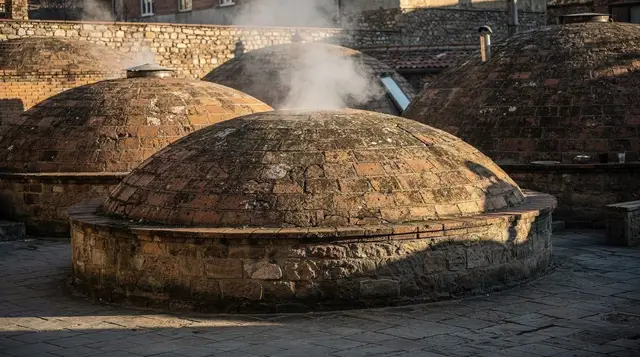
This is the bathhouse that appears in almost every photograph of Abanotubani, recognisable by its brick, minaret-topped domes and a tiled entrance built in a Persian style unlike anything else on the street. It’s also, generally, the most expensive private room in the district, and the busiest, which means less flexibility on timing during peak hours. The premium buys you the domed ceiling above the pool and the most striking architecture of any house here — not a materially different bathing experience, since the water comes from the same springs everyone else uses. If the building itself is the reason you’re visiting, it’s worth the extra lari; if you mainly want a quiet soak, it is the house most likely to leave you queuing.
Chreli-Abano’s rooms also come in a wider range of sizes than most other houses in the district, from a compact option for two through to larger rooms that comfortably accommodate a group of four to six, which is part of why the price range within this single house can be wider than the gap between it and its cheaper neighbours. If you’re set on this house specifically for the architecture, ask about room sizes rather than assuming there’s only one tier of private room on offer — a smaller room here can occasionally undercut the larger rooms at supposedly cheaper houses nearby.
The plainer houses along the same street
Several less photogenic bathhouses sit within a few doors of Chreli-Abano, generally at a lower price for a comparable private room, sometimes with less ornate tiling and a smaller footprint. Condition varies more here than the brand name suggests — some rooms have been refitted recently and are in better shape than you’d expect from the plain exterior, others are more tired. It’s reasonable to ask to see the room before booking, particularly at these smaller houses, since the gap between a recently redone room and one that’s overdue a refit is the single biggest factor in whether ₾60 or ₾100 an hour feels like good value.
Lisi Alternative Private Sulfur Bath with Hotel Pickup books a private room with hotel pickup included, which removes the guesswork of finding and comparing houses on foot if your time in Tbilisi is limited.
These smaller houses are also, generally, the easiest to book on short notice, since they don’t carry the same name recognition that fills Chreli-Abano’s diary first on a busy weekend. If your schedule in Tbilisi is tight and you’d rather guarantee a slot than hold out for the most photogenic option, this is where flexibility tends to pay off — arriving without a booking on a weekday afternoon, several of these houses will usually have a room free within a short wait, something that’s far less reliable at the more famous address.
Gulo’s Thermal Spa: the modern option
Among the newer entries in the district, Gulo’s Thermal Spa trades the century-old tiled interiors for a more contemporary fit-out — cleaner surfaces, more consistent maintenance, and rooms that feel closer to a modern spa than a historic hammam. It’s a reasonable pick if the ornate architecture matters less to you than a reliably well-kept room, though it won’t give you the domed-ceiling photo that draws people to Chreli-Abano in the first place. Several operators build the kisa scrub directly into a package here; Tbilisi: Sulfur Bath with Wine and Kisa Scrub is one such option, pairing the bath with the scrub and a glass of wine in a single booking.
It’s also a sensible pick for group bookings such as a hen party or a birthday, since the more consistent maintenance means less risk of an underwhelming room on the day, and several operators build multi-person packages specifically around this kind of newer, larger facility rather than the smaller historic rooms elsewhere in the district.
The public halls, at any house
Every bathhouse in the district also runs a public hall, split by gender, for a few lari entry — plainer than any private room, shared with whoever else is bathing that hour, and by a distance the most local way to use the baths. If budget matters more than privacy, or you want the experience Tbilisi residents actually have day to day rather than the version built for visitors, the public hall at almost any of these houses is worth trying at least once, and it’s the cheapest way by far to say you’ve bathed in Abanotubani.
The full category of baths and spa activities in and around Tbilisi is rounded up at Things to do: baths and spas, worth a browse if a single bathhouse visit leaves you wanting more.
One detail that catches visitors out: not every house’s public hall operates on exactly the same hours as its private rooms, and a hall can sometimes close earlier in the evening even when private bookings are still available. If the public hall specifically is what you’re after, it’s worth confirming its hours separately from the general opening times quoted for the house as a whole, rather than assuming they match.
Deciding between them
Three questions do most of the work: how much does the architecture matter to you, how much are you willing to pay for it, and how flexible is your schedule around peak hours. If the answer to the first is “a lot,” Chreli-Abano earns its premium. If it’s “not much,” one of the plainer houses or Gulo’s Thermal Spa gets you the same water and ritual for less, usually with an easier booking on a busy weekend. Either way, adding the kisa scrub changes the visit more than which house you pick — see The kisa scrub: what a Georgian bath attendant actually does before you decide whether to add it at the counter or skip it entirely.
If you’d rather have someone walk you past every house and explain the differences in person before you commit to a room, Tbilisi: Sulfur Baths District Walking Tour does exactly that, finishing with time free to book wherever appealed most. A more photo-focused option, Tbilisi: Photo Walk Sulfur Bath Energy Healing Massage, combines a look at the district with a bath and a short massage, useful if you want the visit itself to double as a Tbilisi photo stop.
A short history of why the district has several houses at all
Abanotubani’s bathhouses weren’t all built at once or by the same people — the district grew over centuries as different owners built houses over different points where the springs surfaced, which is part of why the buildings vary so much in scale and style even though they draw on the same water. Some of today’s houses date to renovations carried out well into the 20th century, others preserve older brickwork behind more recent tiling, and a few of the newer entrants, like Gulo’s Thermal Spa, are recent enough to be built specifically around visitor expectations rather than evolving from a centuries-old structure.
None of this changes how the water feels once you’re in it, but it does explain why comparing two houses purely on “which is more historic” is less useful than it sounds — almost every building here has some genuine age to it, just distributed differently between the foundations, the domes and the tiling you actually see.
What a room actually buys you at different price points
At the lower end of the ₾60-150 range, expect a smaller room, a modest pool sized for two, and fewer extras — towels may or may not be included, and the room itself may show more wear. In the middle of the range, rooms tend to be larger, more consistently maintained, and more likely to include towels and slippers without asking.
At the top of the range, usually at Chreli-Abano or a house’s premium room tier, you’re paying for scale — a bigger pool that comfortably fits four, higher ceilings, and often the more ornate tiling that makes for the better photograph. None of these tiers changes the water’s temperature or mineral content, which is worth remembering if you’re deciding between a ₾70 room and a ₾140 one purely to save money rather than because the cheaper room is genuinely inadequate for your group size.
Reading online reviews with a critical eye
Online reviews of Tbilisi’s bathhouses are useful but inconsistent, partly because visitors often review the district as a whole rather than the specific house or even the specific room they used — a five-star review might describe a premium room at Chreli-Abano, while a two-star review of the “same” house describes a smaller, cheaper room booked by someone expecting the premium experience for a fraction of the price.
When reading reviews, look for mentions of the specific room size, price paid and whether a scrub was included, rather than treating a single star rating as representative of the whole building. Reviews that specifically flag cleanliness or maintenance issues are worth taking more seriously than generic complaints about price, since price expectations vary far more between visitors than actual room condition does.
A short checklist before you book
A few questions, asked before you commit to a room rather than after, save most of the disappointment that shows up in visitor complaints about Tbilisi’s baths: What’s the hourly rate, and does it change on weekends? Are towels and slippers included, or charged separately? How large is the pool, and does it comfortably fit your group? Is the kisa scrub available that day, and does it need booking separately?
And, if it matters to you, how recently was the room last renovated — a plain exterior doesn’t always mean a plain interior, and vice versa. None of these questions takes more than a minute to ask, and asking them up front avoids the single most common complaint about Abanotubani, which is a gap between what a price seemed to include and what it actually did.
What doesn’t change between houses
Prices sit in roughly the same ₾60-150-an-hour band across the district for a standard private room, regardless of which name is on the door — the famous house doesn’t always mean the most expensive room, and a plain exterior doesn’t guarantee a bargain either. Ask the hourly rate before being shown a room, confirm whether towels are included, and treat any first quote as a starting point rather than fixed. The full breakdown of costs, booking and etiquette that applies to every house in the district is in Tbilisi’s sulphur baths: prices, private rooms and what to expect.
The kisa scrub, if you add it, is also broadly consistent between houses in what it involves and what it costs — the ₾30-60 range holds regardless of which building you’re in, and the technique itself doesn’t vary meaningfully by house. What does vary, beyond the room and the price, is how busy a given attendant’s schedule is on a given day, which is really the deciding factor in whether you can add a scrub on arrival or need to have booked it in advance.
Making a weekend of it
A single bathhouse visit is usually an hour or two inside a longer Tbilisi day, but it doesn’t have to be. A wellness weekend from Tbilisi strings a bath visit together with a trip out to Borjomi or Tskaltubo, and Thermal springs across Georgia covers where else in the country the same kind of mineral water surfaces, if Abanotubani leaves you wanting more than one bathhouse can offer.
For where to stay close enough to walk to any of these houses, Where to stay in Tbilisi, neighbourhood by neighbourhood is worth reading before you book a room, and Abanotubani: the sulphur bath district explained covers the wider district beyond the baths themselves — the mosque, the waterfall, and the walk up toward Narikala Fortress and the cable car. Most of the houses sit within a short walk of some of the better casual restaurants in the Old Town, worth a look in Where to eat in Tbilisi for somewhere to eat afterwards.
Frequently asked questions about Tbilisi’s bathhouses
The comparisons above cover the main trade-offs; the questions below fill in the details that come up most often once you’re actually choosing between houses.
Is Chreli-Abano worth the extra price?
For the facade and the domed ceiling above the pool, yes, if that’s what you’re paying for. For the water itself, which comes from the same springs as every other house in the district, no — you’re paying for the building, not a different bathing experience.
What is Gulo’s Thermal Spa and how is it different?
It’s a newer, more modern-fitted bathhouse in the district, generally with cleaner, more recently renovated rooms than some of the older houses, though it trades the historic tiled interiors for a plainer, more contemporary look.
Do all the bathhouses use the same water?
Yes. Every house in Abanotubani draws from the same underground sulphur springs, so the mineral content and temperature don’t meaningfully differ between houses. What differs is the room, the price and the condition of the building.
Which bathhouse is cheapest?
The public halls, open to anyone for a few lari entry, are the cheapest way to bathe in Abanotubani at any house that offers one. For a private room, prices vary less by brand name than by room size and how recently it was renovated — ask before booking rather than assuming the famous one is priciest.
Which bathhouse should I pick for a first visit?
A mid-priced house with a recently renovated private room gives you the full experience — your own pool, a lockable room, no rush — without paying the premium that Chreli-Abano charges purely for its facade. See the comparison above for how to weigh that trade-off.
Can I see inside a bathhouse before booking a room?
Most houses will let you glance at an available room before committing, especially outside peak hours. If a house won’t show you the room, treat that as a reason to compare elsewhere.
Are the newer bathhouses less authentic?
They’re less historic in appearance, but the water, the ritual and the kisa scrub are the same regardless of how old the tiles are. Whether that trade-off matters is really a question of what you’re visiting Abanotubani for — the architecture or the bath itself.
Sulphur bath and spa experiences on GetYourGuide
Verified deep-linked GetYourGuide tours. Book through these links and we earn a small commission at no cost to you.
Photo: our own image of the location, not the operator’s product photo.