Minankari: Georgian cloisonné enamel
What is minankari?
Minankari is Georgian cloisonné enamel: fine metal wire soldered onto a base to form small compartments (cloisons), each hand-filled with coloured enamel powder and fired repeatedly at high heat until the glass fuses and polishes smooth. It is one of Georgia's oldest continuous crafts, with roots going back over a thousand years in religious and royal metalwork.
A craft older than most souvenirs realise
Minankari is the Georgian name for cloisonné enamel: a technique where a metalworker solders fine wire onto a metal base — usually silver or gold — to create small compartments called cloisons, each of which is then hand-filled with powdered coloured glass (enamel) and fired in a kiln at high heat until it melts and fuses to the metal and to itself. The piece is fired multiple times, one layer of colour at a time in many cases, then ground and polished smooth so the wire and the fused enamel sit flush against each other. It is slow, exacting work, and the craft in Georgia has documented roots going back over a thousand years, closely tied historically to church metalwork and royal regalia rather than to everyday decoration.
For most of that history, minankari was not a souvenir craft at all. It belonged to court and church workshops, commissioned for specific objects rather than produced for sale, which is part of why the surviving medieval examples are concentrated in museum and church treasuries rather than passed down as family jewellery. The craft’s modern life as something a visitor can watch, try and buy is a comparatively recent development, built on artisans who trained in the older tradition and adapted it to smaller, faster, jewellery-scale pieces without abandoning the same wire-and-fire technique their predecessors used on altar crosses.
Why it looks the way it does
The cloisonné technique produces a very specific visual signature: crisp metal outlines separating areas of saturated, slightly translucent colour, often used to depict religious figures, crosses, birds and floral or geometric patterns drawn from Georgian folk and ecclesiastical art.
Because each cell is filled and fired by hand, genuine minankari carries small, honest irregularities — a wire line that is not perfectly straight, a slight variation in colour depth between two cells meant to match — that machine production cannot easily replicate without deliberately faking them. Under close inspection, this is usually the fastest way to separate real work from an imitation: perfect uniformity is a sign of a stamped or printed piece rather than a hand-fired one.
What separates real minankari from tourist-shop imitations
Tbilisi’s souvenir shops sell a great deal of jewellery labelled “minankari” that is not made using the cloisonné process at all — instead it is stamped or printed with a pattern that visually references enamel work without the wire cells or the repeated hand firing. This is not automatically dishonest; some of it is sold as costume jewellery at a correspondingly low price. The problem arises when it is priced or presented as though it were genuine hand-fired work.
A few checks help: run a finger lightly over the surface — real cloisonné has a faint but perceptible ridge where the wire meets the enamel, while a printed or stamped piece is completely flat. Ask directly whether the piece was made using wire cloisons and hand firing, and a workshop selling genuine work will usually be able to describe its own process specifically rather than giving a vague answer.
Tbilisi: Enamel Workshop Take Home Jewelry puts you inside an actual working process rather than asking you to judge a finished piece from behind a shop counter — you lay the wire, choose and apply the enamel colours, and take home a piece you watched go through the kiln yourself.
Where to find genuine workshops in Tbilisi
A cluster of small studios and workshops in and around Tbilisi’s Old Town practise minankari as a living craft rather than a museum piece, some run by families with the technique passed down across generations, others by younger artists who trained under established masters. These workshops typically combine a small retail counter selling finished pieces with a working bench visible from the shop floor, which is itself a reasonable way to judge authenticity — a workshop willing to show you the wire-laying and firing process in progress has little reason to also be selling fakes on the same counter.
Tbilisi: Ceramic Workshop in Historic Building sits in a similar category of Tbilisi craft experience, worth combining with a minankari visit if you are building a day around hands-on Georgian crafts rather than picking just one.
What a hands-on session actually involves
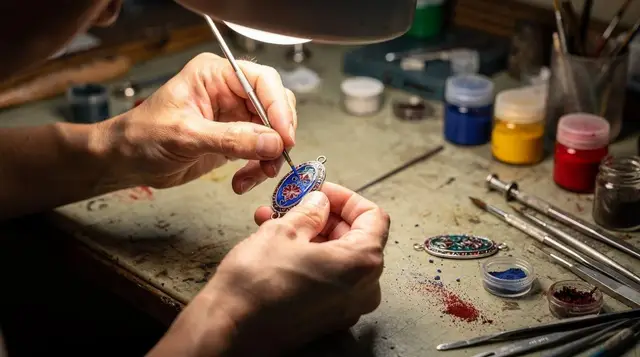
A typical visitor minankari session runs one to two hours and starts with choosing or sketching a simple design — a small pendant shape is the standard starting point for a first attempt, since intricate figurative work takes years to master. You then bend and place the fine wire onto the metal base yourself under guidance, fill each resulting cell with your chosen enamel colours using a fine tool, and the workshop fires the piece in the kiln while you wait or continue with a second piece. Cooling, polishing and mounting (as a pendant, earring or small charm) typically happen while you watch, and most visitors leave with a finished, wearable piece rather than something requiring further work at home.
Create Your Own Ceramic Piece at Ma Ceramic Studio is a different medium — clay rather than metal and enamel — but shares the same appeal: a souvenir you make with your own hands rather than select off a shelf, useful to know about if minankari alone does not fill an afternoon.
Pricing: what is reasonable and what is a markup
A small hand-fired pendant or a simple pair of earrings from a genuine Tbilisi workshop typically starts around 40-50 GEL, with prices climbing into the hundreds of lari for larger, more intricate pieces involving many colours and finer wire work — the price broadly tracks the hours of hand labour involved rather than the raw material cost, since silver and enamel powder themselves are not especially expensive.
A hands-on workshop session where you make your own simple piece typically costs somewhat more than buying an equivalent finished item, reflecting the instruction and kiln time rather than the material itself. Treat any minankari-labelled piece priced dramatically below this range with scepticism — it is very likely a printed or stamped imitation rather than genuinely fired enamel, whatever the shop card says.
The medieval originals behind the modern craft
The pieces that anchor minankari’s reputation are not in shops at all but in museum collections: the Georgian National Museum’s Treasury, on Rustaveli Avenue, holds medieval enamelled icons, crosses and reliquaries — some dating back close to a thousand years — that represent the technical peak of the historical craft, made for churches and royal courts rather than for sale.
Seeing these before or after a workshop visit changes how a modern piece reads: the same wire-and-fire logic sits behind both, and the medieval work makes clear how demanding the technique is at its most ambitious, with dozens of tiny cells forming a single face or figure. A stop at the Treasury pairs naturally with a walk down Rustaveli Avenue, and is one of the better arguments for treating a minankari purchase as connected to something older than the workshop itself.
Step by step: how a piece is actually made
The process starts with a flat metal base, almost always silver for jewellery-scale work, onto which the artisan solders fine wire — traditionally silver or gold wire, bent by hand into the outline of the design. Once the wire framework is fixed, each resulting cell is packed with powdered enamel, mixed with water into a workable paste, using a fine brush or pick to avoid air pockets that would show as flaws after firing.
The piece then goes into a kiln at a temperature high enough to melt the enamel into glass, typically requiring several firing cycles as colours are built up in layers or as different enamel types (which melt at different temperatures) are added in sequence from highest to lowest melting point. After the final firing, the surface is ground flat and polished so the wire and glass sit level, and the piece is cleaned, mounted with a jump ring or pin back, and finished. A simple pendant can realistically be completed in the single hands-on session workshops offer visitors; a complex figurative icon piece, of the kind held in museum collections, can take a trained artisan many days.
How minankari compares to Georgia’s other hands-on crafts
Minankari sits alongside a handful of other Georgian crafts that visitors can watch or try themselves, and each rewards a different kind of interest. Pottery and qvevri workshops involve shaping clay rather than working with wire and fire, and generally suit visitors after a more physical, tactile session. Carpets, felt and textiles come from a different regional tradition again, rooted more in Georgia’s mountain areas than in Tbilisi’s urban workshop scene, and involve wool rather than metal or clay at all. Comparing all three before choosing which to try is a reasonable way to spend an afternoon planning, particularly if only one fits into a tight schedule.
Buying as a gift: what to ask before you commit
Minankari travels well as a gift precisely because it is small, durable and visually distinctive, but a purchase intended for someone else raises slightly different questions than one for yourself. Ask the workshop whether the piece can be shown with any documentation of its origin — some studios provide a small card or certificate noting the maker, useful both for insurance purposes on a higher-value piece and as a way of passing on the story to whoever receives it. If buying for someone with metal sensitivities, confirm whether the base metal is sterling silver or a lower-grade alloy, since this is not always obvious from the finished piece alone and matters more for jewellery worn against skin regularly than for a display piece.
Minankari’s place in Georgian religious art
Because of its historical association with church metalwork, minankari pieces depicting crosses, icons or saints carry particular weight in Georgian religious life, and some visitors buy a small enamel cross specifically as a gift tied to that tradition rather than as decorative jewellery. If you plan to visit working churches during your trip, Visiting a Georgian Orthodox church: dress and etiquette is worth reading alongside any purchase of religious minankari, since the same respect that applies inside a church building reasonably extends to how a religious image is treated once it leaves the workshop.
Caring for an enamel piece once you get it home
Fired enamel is glass fused to metal, which makes it more resilient to everyday wear than many people expect but not indestructible: a hard direct knock can chip the enamel surface in a way that is difficult to repair outside a specialist workshop, so it is worth treating a minankari piece more like a small ceramic object than an ordinary metal pendant when packing it for the flight home. Wrapping it separately in soft cloth inside a hard case, rather than loose in a pocket of a suitcase, avoids the most common damage. Cleaning is straightforward — a soft cloth and mild soap and water are enough; avoid ultrasonic jewellery cleaners, which are safe for solid metal and stone but can stress the bond between enamel and wire over repeated use.
Fitting a workshop visit into a Tbilisi day
A minankari session sits comfortably alongside the rest of an Old Town day rather than requiring a dedicated separate trip. Tbilisi in one day: a realistic plan and Free things to do in Tbilisi both cover the walking routes a workshop visit slots into naturally, and Sololaki’s Art Nouveau streets make a scenic approach on foot if your workshop sits in or near that neighbourhood. For a longer stay, Tbilisi in three days has enough slack to fit a hands-on craft session without crowding out the city’s major sights.
Combining a minankari visit with the rest of Old Town
Most minankari workshops sit within easy walking distance of Tbilisi’s other Old Town craft stops, which makes it straightforward to fold a visit into a wider shopping or cultural walk rather than treating it as a single-purpose errand. Pottery and qvevri workshops covers the ceramics studios in the same part of the city, several of them a short walk from a working enamel studio.
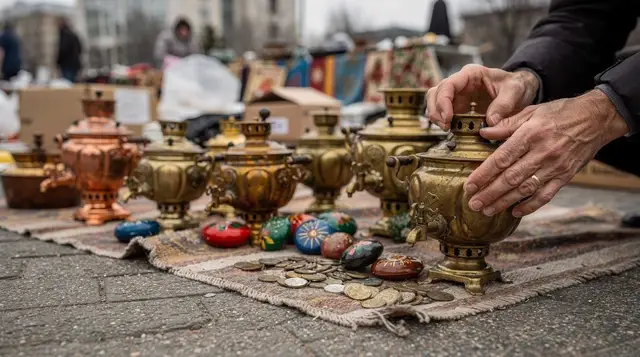
For antiques and secondhand crafts rather than new work, The Dry Bridge flea market is a different kind of stop entirely, and occasionally turns up older enamel pieces worth a careful look given everything above about telling real from imitation. For the wider picture of what else is worth buying across the city, see Shopping in Tbilisi: markets, malls and design shops, and for souvenirs beyond crafts specifically, Souvenirs worth carrying home.
Booking a workshop session ahead of time
The best-known Old Town minankari studios can book up, especially on weekends and through the summer season, so reserving a slot a day or two in advance is generally the safer approach rather than assuming a walk-in session will be available. Smaller or newer studios sometimes have more flexibility for same-day bookings, though the instructor’s own experience level is worth asking about directly if the quality of guidance matters as much to you as simply having a slot to fill.
Frequently asked questions about minankari enamel
What does minankari mean?
Minankari comes from the Georgian word for enamel, and refers specifically to the cloisonné technique, where fine wire outlines each colour area before enamel is applied, as opposed to champlevé or other enamelling methods that carve the compartments directly into the metal.
How can you tell real minankari from an imitation?
Genuine hand-fired minankari shows slightly uneven wire lines under close inspection and a certain depth and variation to the colour surface, since each firing is done by hand at a real workshop. Machine-stamped imitations sold under the same name look flatter and more perfectly uniform, and are usually priced noticeably lower.
How much does minankari jewellery cost?
A small hand-fired pendant or pair of earrings from a real Tbilisi workshop typically starts around 40-50 GEL, rising into the hundreds of lari for larger, more elaborate pieces with intricate colour work. Machine-made imitations cost a fraction of that but are a fundamentally different, much lower-effort product.
Can you watch minankari being made in Tbilisi?
Yes. Several working studios in the Old Town both sell finished pieces and run short hands-on sessions where visitors design and fire their own simple piece, usually taking one to two hours from wire-laying through the final firing and polishing.
Is minankari the same as Byzantine or Russian cloisonné enamel?
It shares the same core cloisonné technique — wire cells filled with enamel and fired — as Byzantine and later Russian enamel work, and historians trace real cross-influence between these traditions. Georgian minankari developed its own recognisable colour palette and motifs, often drawing on Georgian religious and folk imagery, that set it apart visually.
What is minankari traditionally used for?
Historically, minankari decorated religious objects — icon frames, crosses, chalices — and royal or noble regalia, reflecting its status as a prestige craft tied to the church and court. Today it is mostly seen in jewellery: pendants, earrings, rings and small decorative plaques, alongside the occasional religious piece made for a church rather than a shop.
Shopping and craft tours on GetYourGuide
Verified deep-linked GetYourGuide tours. Book through these links and we earn a small commission at no cost to you.
Photo: our own image of the location, not the operator’s product photo.