Scams, overcharging and minor annoyances
Is Georgia a dangerous place for scams and petty crime?
No — violent and organised crime targeting tourists is rare, and Georgia's honest-planner reputation among visitors is largely deserved. The real issues are smaller and more mundane: unmetered taxi overcharging, a handful of inflated tour prices, and the ordinary friction of a country where not everyone speaks English, none of which amount to genuine danger.
The honest headline: Georgia is not a dangerous place to scam you
Georgia’s reputation among independent travellers as an honest, low-hassle country is largely deserved, and it is worth saying plainly before working through the list below: none of what follows is comparable to the organised tourist-targeting fraud found in some other popular destinations. There is no widespread fake-police scam, no epidemic of pickpocketing in crowded areas, and no network of staged “friendly local” schemes designed to separate visitors from their money — the categories of fraud that dominate warnings about some other popular destinations simply don’t show up with any frequency in visitor reports about Georgia, forum threads, or the experience most travellers actually come home describing.
What does happen, routinely, is smaller and more mundane — a handful of price inflation tricks aimed at people who don’t yet know what things should cost, plus the ordinary friction of travelling somewhere the signage is in a different alphabet. See Is Georgia safe? An honest answer for the broader safety picture beyond money and overcharging specifically.
Unofficial taxis: the single most common issue
By a wide margin, the most frequent complaint from visitors involves unofficial taxi drivers — usually clustered at Tbilisi International Airport arrivals, at the main train station, and loitering near major sights such as the old town or Freedom Square — who approach directly and quote a fare well above what the trip should cost. This isn’t illegal under Georgian law and the drivers aren’t running a con in the technical sense; they are simply charging whatever a given visitor will agree to pay, which for someone who has just landed and has no reference point can be three or four times the going rate.
The fix is close to foolproof: use the Bolt app (Georgia’s dominant ride-hailing platform, far more widely used than Uber) for any taxi journey, which fixes the price before the car arrives and removes the negotiation entirely. See Taxis, Bolt and Yandex Go for how to set the app up and what a normal fare looks like. If you do need to negotiate with a driver directly — in a small town without app coverage, for instance — agreeing the fare out loud before getting in, and knowing roughly what the distance should cost from Lari, ATMs and paying by card, avoids most of the friction.
Batumi: Tbilisi Private Transfer sidesteps the entire airport taxi negotiation by fixing a price in advance, which is worth the modest premium on a first arrival specifically because you have no baseline yet for what a fair fare should be.
Marshrutka and driver overcharging away from Tbilisi
The same dynamic shows up, less frequently, with marshrutka conductors and private drivers in smaller towns and at trailheads — Kazbegi, Mestia and Sighnaghi are the three places this comes up most in visitor reports, usually around a driver offering a “special price” for a same-day return trip that’s noticeably above the normal fare. How marshrutkas actually work covers standard route pricing so you have something to compare against, and asking your guesthouse host what a given trip should cost before you book one with a driver who approaches you directly is the most reliable single habit that avoids this category of overcharging.
Restaurant bills: service charges you might not notice
A newer pattern, mostly in Tbilisi’s more tourist-facing restaurants, is a service charge added automatically to the bill — legitimate, and usually disclosed somewhere on the menu in small print, but easy to miss if you’re not looking for it. The actual issue isn’t the charge itself, it’s tipping on top of it without realising one is already there, which means paying roughly double the intended tip without meaning to. Restaurant etiquette, service charges and tipping covers exactly how to check a bill before adding anything extra, which takes about five seconds and saves the confusion entirely.
Souvenir shops and market price inflation
Dezerter Bazaar and the souvenir stalls around the old town and the Narikala cable car station occasionally run two price levels — one for locals, a higher one for anyone who looks like a first-time tourist — for items like chacha, spices, felt goods and small crafts. This is not universal and not aggressive; a polite question about the price, and a mild hesitation, is often enough to see it adjusted, and fixed-price shops, supermarkets and reputable craft cooperatives don’t do this at all. Knowing a rough benchmark price beforehand, from a guide like Souvenirs worth carrying home or a quick question to your guesthouse host, removes the guesswork.
Wine tour quality, not fraud
Kakheti’s wine tourism industry has grown fast, and while outright fraud is close to nonexistent, quality and value vary a lot between operators marketed similarly. A tour billed as visiting “boutique family wineries” can turn out to be a high-volume operation set up for tour-bus traffic, with a tasting fee well above what an independent visit to the same winery would cost booked directly. This is a quality issue rather than a scam, but it produces the same disappointed outcome, so booking through a specific, named operator recommended in A wine tour of Kakheti: how to plan it, rather than the first flyer handed to you on a Sighnaghi street corner, is worth the extra five minutes of research.
Kazbegi and mountain excursion jeep drivers
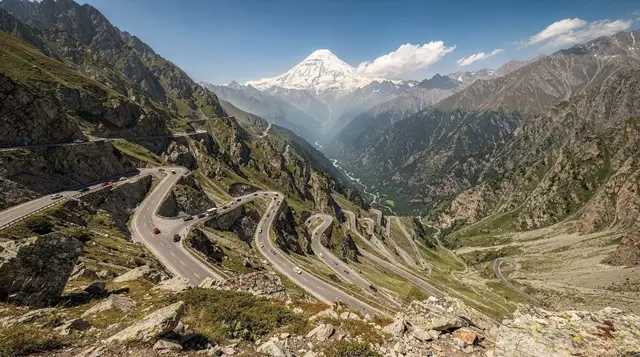
A specific version of the taxi-overcharging problem shows up around Stepantsminda (Kazbegi), where the road up to Gergeti Trinity Church is steep enough that most visitors take a shared or private 4x4 rather than walk. Drivers cluster near the town centre and the going shared-jeep rate is fairly consistent, but a driver who senses you don’t know the normal price will sometimes quote a private rate as if it were the only option, or claim the shared jeep has “just left” when it hasn’t.
Asking at your guesthouse what the current shared rate is, and being willing to wait a few minutes for another group to fill a shared jeep rather than accept an inflated private one, resolves this in practice almost every time. The same dynamic, at a smaller scale, applies to jeep excursions into Juta and the Truso valley, where genuinely limited vehicle numbers can be used to justify a price that has little to do with actual scarcity on a normal day.
Monastery and church photography, dress and “donations”
At working monasteries and churches — Jvari, Svetitskhoveli, Gelati and the many smaller ones across the country — a legitimate dress code applies (covered shoulders and knees, headscarves for women at some sites, provided at the door if you arrive without one) and this is not a scam, just a genuine expectation worth reading up on beforehand in Visiting a Georgian Orthodox church: dress and etiquette so you aren’t caught out.
Where friction sometimes occurs is around photography: some monasteries restrict photography inside the church itself, and very occasionally a monk or attendant will ask for a “donation” tied specifically to taking photos, which sits in a grey area rather than being an outright scam — a genuine donation box exists at most sites, and giving something small there is normal practice regardless of photography, so treating any request calmly and respectfully, and simply putting the camera away if asked, avoids an awkward moment turning into a worse one.
Border and long-distance transport touts
At land border crossings — with Armenia, Turkey or Azerbaijan — and occasionally around the bus station serving them, informal drivers and “fixers” sometimes approach with offers to speed up the crossing or arrange onward transport at an inflated price. The crossings themselves are straightforward for the nationalities that qualify for visa-free entry, and paying anyone to “help” with a process that costs nothing and takes a predictable amount of time is rarely worth it. If you do want a pre-arranged transfer across a border, booking it through a known operator in advance, rather than agreeing with someone who approaches you in the queue, keeps the price and the service predictable.
Haggling culture: what’s normal and what isn’t
A related point worth being upfront about: haggling is a normal, low-stakes part of shopping at markets like Dezerter Bazaar and buying souvenirs, and mild price negotiation is not itself evidence of a scam — it’s simply how those transactions work, the same as in many countries around the Mediterranean and the wider Caucasus.
The distinction that matters is between ordinary haggling (where the first price is somewhat elastic and a bit of back-and-forth is expected and enjoyed by both sides) and a genuinely inflated tourist price that has little relationship to the real value of the item. Asking a local for a benchmark, as mentioned above, is the practical way to tell the two apart without assuming bad faith in every transaction, which would make shopping in Georgia far more stressful than it needs to be — the overwhelming majority of vendors, at markets and shops alike, are simply doing ordinary business.
Small annoyances that aren’t scams at all
A few things that catch first-time visitors off guard are simply cultural or infrastructural friction rather than anything aimed at extracting money:
-
Card machines that don’t work. Common in smaller restaurants and rural guesthouses, not a scam — see Lari, ATMs and paying by card for how to plan around it.
-
Street dogs. Tbilisi has a visible population of tagged, vaccinated stray dogs (most wear an ear tag showing they’ve been through a municipal programme); they are generally calm and used to people, but giving them space rather than approaching is still sensible.
- Squat toilets and inconsistent public facilities, particularly outside Tbilisi, where a small coin fee for a public toilet is normal and worth carrying change for.
-
Slow or nonexistent Wi-Fi in some rural guesthouses, which a local SIM or eSIM solves more reliably than hoping the property’s connection holds up.
-
Language gaps in bureaucratic settings — a bank branch, a police station if you ever need one — where English fluency is not guaranteed even in Tbilisi, and patience matters more than volume.
What the actual crime picture looks like
It’s worth putting the overcharging issues above in context against genuine crime, since the two get conflated in some online forum threads. Georgia has consistently ranked among the safer countries in the wider region for violent crime and street theft affecting visitors, a reputation that predates and outlasts any individual bad review of a specific taxi ride.
Pickpocketing exists, as it does everywhere with crowds — the Dry Bridge flea market and the busiest stretches of Rustaveli Avenue on a summer evening are the closest thing to a pickpocket risk area, and ordinary bag awareness in a crowd is sufficient precaution. Opportunistic theft from an unlocked car or an unattended bag on a beach in Batumi happens occasionally, the same as it would in most countries, and is worth avoiding with the same common sense you’d apply anywhere. None of this amounts to a pattern that should change how you plan a trip, beyond the ordinary vigilance any city deserves.
If a theft does happen, filing a police report (needed for any travel insurance claim — see Health, pharmacies and insurance for the wider insurance picture) is straightforward at any local police station, and Tbilisi’s tourist police unit can help with the process in English if the nearest station doesn’t have an English speaker available.
Reporting a genuine problem
If something does go seriously wrong — a driver becomes aggressive over a fare dispute, a shop refuses to honour a stated price, or anything that crosses from annoyance into genuine harassment — Georgia’s tourist police (a dedicated unit, present in central Tbilisi, Batumi and other major tourist areas, generally English-speaking) is a more useful first call than the general police line, and the country takes its international tourism reputation seriously enough that legitimate complaints are taken seriously in response. Keeping a note of a driver’s licence plate or a shop’s name and location makes any follow-up faster.
Solo travellers and extra caution
None of the issues above are meaningfully worse for solo travellers than for groups, but the general advice in Travelling Georgia solo — sharing your rough plans with someone, being a bit more deliberate about transport after dark in unfamiliar areas, and trusting the same instincts you’d use travelling solo anywhere — applies here as it does anywhere else. Georgia’s low general crime rate makes this a smaller concern than in many popular destinations, not a larger one.
Private Airport Transfer Tbilisi Tour Unlimited Data SIM is a particularly useful option for a solo traveller’s first night, since it removes both the taxi negotiation and the “how do I get connected to navigate” problem in one booking, at a point in the trip when you’re tired and have the least local knowledge to fall back on.
A private guide as insurance against most of this
Authentic and Secret Tbilisi Private Tour Price for 1 to 3 People and Old Tbilisi Private Walking Tour and Cable Car both put a knowledgeable local guide between you and the situations described above for a day — fair prices, no negotiation, no guesswork about what things cost — which is a reasonable way to build confidence early in a trip before navigating the rest independently.
Frequently asked questions about scams in Georgia
What is the most common tourist scam in Georgia?
Unofficial taxi drivers quoting inflated fares at the airport, stations and major sights, rather than using a meter or the Bolt app. It isn’t illegal, just a price aimed at people who don’t know the real fare — booking through an app or agreeing a price first avoids it.
Are Tbilisi’s taxis safe to use?
Yes physically — violent incidents are very rare. The issue is financial: unmetered street taxis overcharge tourists routinely. Bolt fixes the price before you get in and is the more reliable option on both counts.
Do restaurants in Georgia add hidden service charges?
Some now do, particularly in tourist-facing Tbilisi restaurants, and it isn’t always obvious. Check the bill for an existing service line before adding a tip on top of it.
Is it safe to drink tap water in Georgia?
In Tbilisi and most cities, yes — generally safe and often good-tasting mountain water. In some rural areas, bottled water is the safer default.
Are there dangerous neighbourhoods in Tbilisi?
Not in the way that phrase implies elsewhere. Tbilisi is safe by international comparison; ordinary urban caution covers what’s needed.
How do I avoid getting overcharged at markets and souvenir shops?
Ask a Georgian friend or your guesthouse host what something should cost before you shop. Fixed-price shops and supermarkets are rarely inflated; markets and unlicensed drivers are where a second opinion helps most.
Should I worry about wine tour scams in Kakheti?
Genuine fraud is rare, but quality and pricing vary a lot between operators marketed similarly. Booking through a known operator, rather than the first flyer handed to you, avoids most disappointment.
Trip-planning essentials on GetYourGuide
Verified deep-linked GetYourGuide tours. Book through these links and we earn a small commission at no cost to you.
Photo: our own image of the location, not the operator’s product photo.