Georgia is not Eastern Europe, and other geography arguments
A country between two seas, not two blocs
I have had some version of this conversation more than once with people packing for Georgia: “so it’s basically like visiting Eastern Europe, right, similar vibe to Romania or Ukraine?” It is a reasonable guess from outside — Georgia was part of the Soviet Union, its older buildings carry Soviet-era concrete and mosaics, and Cyrillic-adjacent stereotypes about the wider region get applied indiscriminately. But the guess is wrong on nearly every axis that matters, and the gap between the assumption and the reality is worth working through before you land, because it changes what you should expect from the food, the language, the religion and the politics of the place.
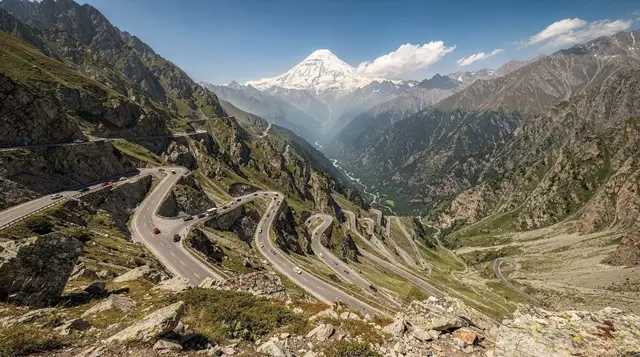
Georgia sits in the South Caucasus, a mountainous strip of land between the Black Sea and the Caspian Sea, bordered by Russia to the north, Turkey and Armenia to the south, and Azerbaijan to the southeast. Geographically and culturally, it belongs to a distinct region — the Caucasus — that has its own identity separate from both Europe and the Middle East, shaped for millennia by exactly the empires and trade routes that passed through this narrow land bridge rather than by the plains and forests further north and west that define “Eastern Europe” in the usual sense.
Not Slavic, not Orthodox in the same way
The single biggest misconception is linguistic and ethnic. Georgians are not a Slavic people, and Georgian is not related to Russian, Polish or Ukrainian at all — it belongs to the Kartvelian language family, a small group found nowhere else on earth, written in its own alphabet that predates the Cyrillic script used across the actual Eastern European bloc.
If you want the detail on that alphabet and why there are technically three historic versions of it, The Georgian alphabet, and why there are three of them goes into it properly. A short walk through Georgian words that actually help will make the distinction obvious within the first page — nothing about Georgian sounds, spells or conjugates like a Slavic language.
Religion complicates the picture rather than simplifying it. Georgia is genuinely Orthodox Christian, and has been since the early 4th century — one of the oldest Christian states anywhere, predating most of what we now call Eastern Europe’s conversion by centuries. But the Georgian Orthodox Church is autocephalous, meaning self-governing, separate from the Russian Orthodox Church despite sharing the broader Orthodox communion, and Georgians are often quick to point out that shared religion has not meant shared politics, particularly given the events of August 2008.
Walking into any of the country’s monasteries makes the age of this tradition tangible in a way that the word “Orthodox” alone does not convey — see every UNESCO World Heritage site in Georgia for where the oldest and most significant of them stand.
Tbilisi: Old Town Guided Walking Tour is a reasonable way to get this history explained on the ground rather than from a blog post, with a guide walking you past Narikala Fortress, Metekhi Church and the older streets of Tbilisi itself while filling in exactly this kind of context.
A crossroads, not a periphery
Eastern Europe, as a category, generally describes lands that sat at the edge of larger European empires — Habsburg, Ottoman, Russian — absorbing influence from the centre outward. Georgia’s history reads differently: it was itself a crossroads on the Silk Road, fought over and ruled in turn by Persian, Byzantine, Arab, Mongol, Ottoman and Russian powers, each of which left a genuine layer rather than a dominant one. Old Tbilisi’s mix of Persian-influenced balconies, Armenian church architecture and Soviet-era apartment blocks side by side is not decorative eclecticism; it is the direct legacy of that positioning between empires rather than at the margin of one.
Tbilisi: Georgian National Museum Guided Tour is a useful complement to a walk through the streets, since the museum’s archaeological and manuscript collections make the Silk Road, Persian and Byzantine layers of Georgian history concrete in a way that architecture alone does not always convey.
This is also why food, wine and hospitality culture in Georgia look distinct from anything typically associated with Eastern Europe. Qvevri winemaking — fermenting and ageing wine in large buried clay vessels, explained properly in qvevri wine explained: 8,000 years in a clay pot — is documented archaeologically back roughly 8,000 years in this region, among the oldest evidence of winemaking anywhere, and UNESCO recognised it as intangible cultural heritage in 2013.
Eight thousand years of wine, and what that claim really rests on unpacks how solid that number actually is. None of this maps onto vodka-and-beer stereotypes of the wider post-Soviet space; Georgian drinking culture centres on wine and the ritualised supra feast, with its own toastmaster (tamada) tradition — see the supra and the tamada explained — that has no real Eastern European equivalent, structurally or socially.
It is worth being specific about what “no real equivalent” means here. A supra is not a dinner party with a few toasts sprinkled in; it is a structured, hours-long social institution with an assigned leader, a conventional sequence of subjects, and an expectation of genuine participation from every guest at the table. Nothing quite like it exists in the vodka-and-zakuski drinking culture that outsiders sometimes project onto the wider post-Soviet space, and conflating the two — assuming a Georgian feast will feel like a Russian or Ukrainian one, just with different food — tends to catch first-time guests off guard.
Not the EU, not Schengen, and why that matters practically
Beyond the cultural argument, there is a hard legal one: Georgia is not a member of the European Union and is not part of the Schengen area, despite having formally applied for EU candidacy. Roaming charges that vanish inside the EU do not vanish here. The currency is the Georgian lari (₾), not the euro. If you are coming from an EU country and mentally filing Georgia under “similar rules to Croatia or Bulgaria,” recalibrate — read visa and entry rules: 365 days, and the fine print for what actually applies, which for most nationalities is a generous 365-day visa-free stay, better than most EU member states offer non-EU visitors, but governed by entirely separate rules.
Soviet history without Eastern European conclusions
Georgia was part of the Soviet Union from 1921 (with a brief independent interlude in 1918–1921) until 1991, and that seven-decade period left real marks — the mosaics, the brutalist apartment blocks, the Stalin Museum in Gori, the abandoned sanatoriums of Tskaltubo. Soviet mosaics and monuments across Georgia is worth a look if this layer of the country interests you visually, since it is genuinely widespread and, in places, actively disappearing as buildings are renovated or demolished.
It is tempting to fold all of this into a general “post-Soviet Eastern Europe” bucket, but Georgians themselves generally frame that period as occupation rather than shared heritage, a distinction that hardens further after the 2008 war with Russia over South Ossetia. The Museum of Soviet Occupation in Tbilisi states this framing explicitly in its name and its exhibits, and it is a useful corrective for anyone arriving with the assumption that Georgians feel some lingering nostalgic kinship with Russia because of the Soviet decades — an assumption that sometimes gets made, not always fairly, about parts of actual Eastern Europe, and that tends to land badly in conversation here.
A language family with almost no relatives
One detail that rarely makes it into the standard “Georgia is not Slavic” explanation is just how isolated the Kartvelian language family actually is. Georgian is the largest and most widely spoken of only four related languages — the others being Svan, Mingrelian and Laz, all spoken by smaller communities within Georgia and, for Laz, in a strip of northeastern Turkey. None of the four has any established relationship to any language family outside this small group; historical linguists have proposed and largely abandoned various theories linking Kartvelian to Indo-European, Semitic or Basque, and the honest current answer is that it is simply its own thing, unrelated to its neighbours in any demonstrable way.
That isolation is itself a small piece of evidence for how distinct the region’s development has been — a language family this old, surviving this intact, in a corridor that dozens of empires marched through over millennia, is not the pattern you would expect from a place absorbed into a larger linguistic sphere the way most of actual Eastern Europe eventually was by Slavic expansion.
So what is Georgia, if not Eastern Europe?
The most accurate short answer is South Caucasus, sometimes grouped with the wider Caucasus region alongside Armenia and Azerbaijan — three countries with distinct languages, distinct alphabets in Georgia’s and Armenia’s case, and overlapping but genuinely separate histories. If your trip has room for it, pairing Georgia with a look at Armenia sharpens the comparison rather than blurring it further; see Georgia or Armenia: which first? and, for a combined trip, two weeks across Georgia and Armenia.
None of this is pedantry for its own sake. Getting the region right changes practical expectations — the currency, the roaming, the entry rules — and it changes what you notice once you are here: an alphabet found nowhere else, a wine tradition older than most countries’ recorded history, and a religious and political identity built from resisting absorption into larger neighbours rather than sitting quietly at the edge of one. Georgia rewards being met on its own terms rather than as a stand-in for a region it never really belonged to.
Frequently asked questions about Georgia’s geography and identity
Is Georgia part of Europe or Asia?
Geographically it straddles the boundary, with the Caucasus mountains often cited as a dividing line. Culturally and politically, Georgia positions itself as European and has applied for EU membership, but it is not currently part of the EU or Schengen area.
Is Georgian a Slavic language?
No. Georgian belongs to the Kartvelian language family, unrelated to Russian, Polish, Ukrainian or any Slavic language, and uses its own script rather than Cyrillic or Latin.
Does Georgia use the euro?
No, the currency is the Georgian lari (₾ / GEL). Euros are not accepted for everyday purchases, and EU roaming agreements do not apply.
Is Georgia in NATO or the EU?
Neither, as of now, though Georgia has applied for EU candidacy and pursues closer ties with both institutions. This is an active and often debated topic in Georgian politics.
Why do people confuse Georgia with Eastern Europe?
Mainly its Soviet-era history (1921–1991) and general unfamiliarity with the South Caucasus as a distinct region. The Soviet period left visible architectural and historical marks, but Georgia’s language, alphabet, religious structure and pre-Soviet history are all substantially different from the countries typically grouped as Eastern Europe.
Best day trips from Tbilisi on GetYourGuide
Verified deep-linked GetYourGuide tours. Book through these links and we earn a small commission at no cost to you.
Photo: our own image of the location, not the operator’s product photo.