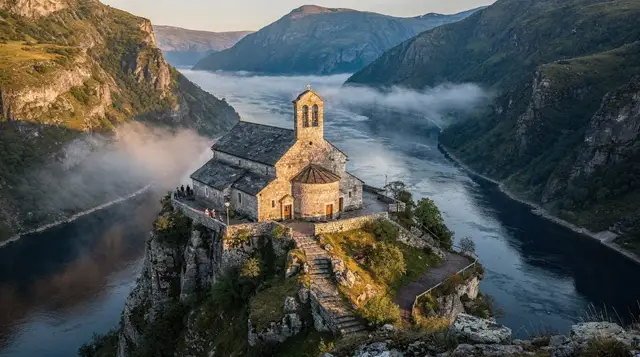
Bodbe Monastery and St Nino's spring
What is Bodbe Monastery known for?
Bodbe Monastery, just outside Sighnaghi, holds the grave of St Nino, the 4th-century woman credited with bringing Christianity to Georgia. A steep path from the monastery grounds leads down through forest to her holy spring, where visitors bathe or collect water, a walk of about 20-30 minutes each way.
Georgia’s most important female saint, buried outside a wine town
Every organised trip to Sighnaghi advertises the town’s walls, its views over the Alazani valley and its reputation as “the city of love” for Georgia’s lowest marriage-registration bar. Fewer explain why the convent 2 km outside town matters as much as it does: Bodbe Monastery holds the grave of St Nino, the woman credited with converting Georgia to Christianity in the early 4th century, making it one of the most significant pilgrimage sites in the country, on a level with Svetitskhoveli Cathedral in Mtskheta rather than a minor add-on to a Kakheti wine day.
For Georgian visitors especially, Bodbe carries a weight that is easy for foreign travellers to underestimate walking in expecting only a scenic monastery stop. It is a genuine pilgrimage destination, visited by Georgians specifically for its religious significance rather than only its setting, and treating it with the same seriousness — quiet voices, an unhurried pace, proper dress — that a Georgian visitor would bring goes a long way toward experiencing the site as it is meant to be experienced rather than as a photo stop between wineries.
Who St Nino was, briefly
According to Georgian tradition, Nino arrived from Cappadocia in the early 4th century and, through a mix of healing and preaching, converted the Kartli royal family to Christianity — an event that set Georgia on a path to becoming one of the earliest Christian states in the world, alongside Armenia. She is said to have spent her final years at Bodbe, and the monastery grew up around her grave, which sits inside the main cathedral church rather than in a separate shrine.
The story recurs throughout Georgian religious sites: the vine-branch cross she is said to have carried, reportedly bound with her own hair, is kept at Svetitskhoveli Cathedral in Mtskheta, giving the two sites a direct historical link despite sitting on opposite sides of the country.
Visiting the monastery grounds
Bodbe functions as an active convent, with resident nuns, and the grounds are kept in noticeably better order than many Georgian religious sites — manicured gardens, a working bakery selling bread to visitors, and views over the Alazani valley toward the Caucasus that rival anything from Sighnaghi’s town walls.
The main cathedral church, where St Nino’s grave sits, dates in its current form to the 9th century with later rebuilding, and modest dress is required throughout: covered shoulders and legs for everyone, a headscarf for women. See Visiting a Georgian Orthodox church: dress and etiquette if you are unsure what that means in practice — Bodbe, as an active convent rather than a museum site, enforces it more consistently than most.
Kakheti: City of Love Sighnaghi Bodbe Monastery Tour covers Bodbe alongside Sighnaghi’s town centre in a single organised half-day, a straightforward option if you are not driving yourself.
The spring: a steep walk down and back up
Below the monastery, a marked path drops steeply through forest to St Nino’s holy spring, where pilgrims and tourists alike bathe or fill bottles with the water, believed by the devout to have healing properties. The walk down takes roughly 20 to 30 minutes depending on pace, and the return climb — the part visitors consistently underestimate — takes noticeably longer and is genuinely tiring in summer heat, since there is little shade on the steepest section.
Small changing structures near the spring itself allow for a degree of privacy, though facilities are basic. Bathing is done in simple robes rather than swimwear, in keeping with the site’s religious character rather than treating it as a swimming spot. Anyone with knee or mobility issues should think carefully before attempting the descent, since the path is uneven in places and there is no vehicle access to the spring itself.
From Tbilisi: to Kakheti Sighnaghi Bodbe and Telavi Trip builds Bodbe into a wider Kakheti day covering Sighnaghi and Telavi, useful if the spring walk is one stop among several rather than the sole reason for the trip.
Combining Bodbe with Sighnaghi and Kakheti’s wineries
Bodbe sits close enough to Sighnaghi — about 2 km, a short taxi ride or a walkable but uphill route back into town — that almost every visitor treats the two as a single stop. Most organised Kakheti wine-tour itineraries build in 30–45 minutes at Bodbe as a detour from the tasting-focused parts of the day, which is enough time for the monastery grounds but tight if you also want the spring walk. If the spring genuinely interests you, budget closer to 90 minutes for Bodbe alone and plan the wine tastings around that rather than the reverse.
Wine Tour to Kakheti Sighnaghi Bodbe Wine Tasting is built with this balance in mind, giving Bodbe proper time alongside Sighnaghi’s wine culture rather than treating the monastery as an afterthought.
For a broader look at Sighnaghi itself — the walls, the museum, the town’s own history beyond the marriage registry reputation — see Sighnaghi and Bodbe in a day. Wine-focused travellers may prefer to start from A wine tour of Kakheti: how to plan it and work Bodbe in as one stop among a longer route through Telavi and Kvareli.
When to visit
Bodbe’s gardens are at their best in spring and early summer, when the grounds are green and the Alazani valley view below is at its clearest before summer haze sets in. Fewer visitors arrive before mid-morning, which also means cooler conditions for the spring walk — a genuine consideration in July and August, when the climb back up from the spring in full heat is the part of the visit people complain about most.
Autumn brings its own advantages: the harvest season across the surrounding vineyards adds a practical reason to combine Bodbe with a Kakheti wine day, and the clearer autumn light typically gives better long-distance visibility over the Alazani valley toward the Caucasus than the hazier conditions common in high summer. Winter visits are quieter still, though the spring walk becomes considerably more slippery underfoot after rain or an overnight frost, and anyone attempting it in those conditions should allow extra time and take particular care on the steeper switchbacks.
The two St Ninos: Georgia versus the wider Orthodox world
St Nino’s story is specifically Georgian in its details even though she is recognised across the wider Orthodox world as an important early Christian missionary. The account of her arrival from Cappadocia, her healing of the Kartli queen, and her eventual conversion of King Mirian III sits at the very foundation of Georgian national identity as a Christian country, predating similar conversion stories elsewhere in the region by decades.
Georgia’s claim to be among the earliest Christian states anywhere in the world rests substantially on this narrative, and Bodbe, as her traditional burial place, carries weight in Georgian religious life well beyond what its relatively modest physical scale might suggest to a first-time visitor expecting something closer to Svetitskhoveli Cathedral in scope.
Sighnaghi and Bodbe as a single visit
Almost every visitor pairs Bodbe with the town of Sighnaghi itself, and the order matters less than making sure both get proper time — Sighnaghi’s preserved 18th-century walls and cobbled streets reward an unhurried wander as much as Bodbe’s gardens do. Many travellers walk between the two, since the road connecting them offers open views over the Alazani valley along the way, though the walk is uphill returning to Sighnaghi and best attempted with time and daylight to spare rather than as a rushed shortcut between stops. Sighnaghi and Bodbe in a day sets out a realistic schedule for covering both properly without feeling rushed at either.
Combining Bodbe with a longer Kakheti wine route
For travellers building a full Kakheti day rather than a Sighnaghi-focused half-day, Bodbe fits naturally alongside stops further north around Telavi, Alaverdi Cathedral and the wineries lining the Alazani valley. A single long day covering all of this is possible with an early start, though it leaves relatively little slack for lingering at any one stop; splitting the region across two days, with Bodbe and Sighnaghi as one half and Telavi’s wine country as the other, is the more relaxed option for anyone not working to a tight schedule. A weekend in Kakheti lays out a version of this split trip in full.
Getting to Bodbe from Tbilisi
Sighnaghi, and by extension Bodbe, sits roughly 2 hours from Tbilisi by road, making it a realistic single-day trip on its own or, more commonly, one stop within a wider Kakheti itinerary. Marshrutkas run from Tbilisi to Sighnaghi, though schedules are less frequent than on the main Kazbegi or Mtskheta routes, and most independent travellers find a rental car or hired driver more convenient for reaching Bodbe itself, since there is no public transport running the final 2 km from town.
Driving in Georgia: rules, roads and habits covers what self-driving this route involves, while Marshrutka or private driver? weighs up the alternative for travellers without their own transport.
Tbilisi: Sighnaghi Bodbe Monastery Zipline Tour is a different, more active way to see the area around Bodbe and Sighnaghi, combining the monastery visit with a zipline through the surrounding valley — an option worth knowing about for travellers who want more than a walking itinerary out of a Kakheti day.
Bodbe’s gardens and the wider grounds
Beyond the church and the spring, Bodbe’s grounds themselves are worth setting aside time for — a working convent garden maintained by the resident nuns, with fruit trees, roses and a small bakery that sells bread and occasionally other baked goods to visitors passing through.
The combination of manicured grounds and a genuinely dramatic valley view below makes Bodbe one of the more visually rewarding monastery stops in Georgia, distinct from the starker, more austere character of sites like Jvari Monastery above Mtskheta. Benches scattered through the grounds encourage a slower visit than the 20–30 minutes some tour schedules allow, and travellers with any flexibility in their day should try to claim more time here than the minimum.
What to know before you go
Bodbe is a functioning religious community first and a tourist site second, and this shapes several practical details worth knowing in advance. There is no significant food service on site beyond the small bakery, so plan a proper meal in Sighnaghi itself before or after the visit. Restrooms exist near the main entrance but are basic. Mobile signal is generally reliable given the proximity to Sighnaghi, useful if you are coordinating a driver or taxi pickup after the visit. Weekday mornings tend to be quieter than weekend afternoons, when the site draws more domestic Georgian visitors alongside international tourists, particularly around any religious feast days tied to St Nino specifically.
Visiting with children or limited mobility
Bodbe’s main grounds and church are flat and easily manageable for families with young children or anyone with limited mobility, unlike many of Georgia’s mountain or cave sites, which makes it a comfortable stop to include on a mixed-ability trip. The walk down to the spring is the one part of the visit that changes this calculation entirely: the path is steep, uneven and has no vehicle access, so it is worth treating the spring as optional rather than assuming the whole family will manage it together. Splitting the group — some visiting the spring while others remain at the monastery gardens — is a reasonable compromise that several visitors use rather than forcing everyone down the full path.
A note on the name “city of love”
Sighnaghi markets itself heavily on its reputation as Georgia’s easiest place to get married, thanks to a 24-hour registry office that has drawn couples, including a number of high-profile international ones, for spontaneous weddings over the years. Bodbe benefits indirectly from this reputation, since couples and wedding parties often visit the monastery as part of the same trip, drawn by its significance and its setting rather than the marriage-registry angle itself. It is worth knowing this context if you visit and find the grounds unexpectedly busy with a wedding party or two — a fairly regular occurrence rather than a coincidence.
Frequently asked questions about Bodbe Monastery
How far is Bodbe Monastery from Sighnaghi?
About 2 km, a short taxi ride or a walk that is manageable on the way there but uphill and warmer on the way back into town.
How long does the walk to St Nino’s spring take?
Around 20 to 30 minutes down, and noticeably longer back up, since the return climb is the genuinely tiring part. Budget at least an hour for the round trip if you want time at the spring itself.
Is Bodbe Monastery still active?
Yes, it functions as a working convent with resident nuns, which is why the dress code and general conduct expectations are enforced more strictly than at some purely historical sites.
Do you need to pay to enter Bodbe Monastery?
No, entry to the monastery grounds and church is free, in keeping with Georgian Orthodox practice at active religious sites. There is no charge to walk down to the spring either.
What should I wear to visit Bodbe Monastery?
Modest dress throughout: shoulders and legs covered for everyone, and a headscarf for women, generally available to borrow at the entrance for anyone who arrives without one.
Is the walk to St Nino’s spring suitable for everyone?
Not entirely — the path is steep and uneven in places, with no vehicle access, so anyone with knee problems, mobility issues or travelling with very young children should weigh the climb back up carefully before setting off.
Can you swim at St Nino’s spring?
Visitors bathe in the spring water in simple robes as an act of devotion or tradition rather than for recreation, and basic changing facilities exist nearby, though conditions are simple rather than resort-like.
Is Bodbe worth visiting if I am not religious?
Yes — the gardens, the valley views and the walk to the spring have value independent of the religious significance, and the site’s importance to Georgian history is worth understanding even for secular visitors.
Monastery and fortress tours on GetYourGuide
Verified deep-linked GetYourGuide tours. Book through these links and we earn a small commission at no cost to you.
Photo: our own image of the location, not the operator’s product photo.