Betania and Shiomgvime: two monasteries most visitors miss
What are Betania and Shiomgvime?
Betania and Shiomgvime are two 12th-century Georgian Orthodox monasteries within about 30-40 minutes of Tbilisi and Mtskheta. Betania sits alone in a wooded gorge with rare surviving medieval frescoes; Shiomgvime is a monastic complex cut into a limestone canyon, still home to a small community of monks.
Not everything near Mtskheta makes the coach-tour list
Mtskheta draws every organised day trip out of Tbilisi for Svetitskhoveli Cathedral and Jvari Monastery, both UNESCO-listed and both, deservedly, essential stops. What the standard itinerary usually skips is a pair of monasteries within a 30 to 40 minute drive of the same area — Betania and Shiomgvime — that see a fraction of the visitors despite dating from the same 12th-century golden age of Georgian monastic building under kings David the Builder and his successors. Neither requires much extra effort if you already have a car for the day; both reward the detour.
Betania: frescoes hidden in a gorge
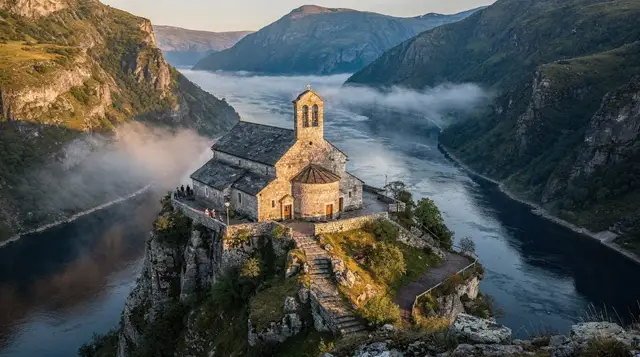
Betania sits alone in a wooded ravine south of Tbilisi, reached by a narrow road that discourages coach buses and keeps visitor numbers low even by the standards of Georgia’s less-visited sites. The main church, built in the late 12th or early 13th century, holds one of the best-preserved sets of medieval Georgian frescoes anywhere in the country, including a rare donor portrait believed to depict King George III and his daughter, the future Queen Tamar — a genuinely unusual survival, since so much medieval Georgian religious art was damaged or painted over during later centuries of invasion and, in some cases, Soviet-era neglect.
The monastery fell into obscurity for long stretches of its history and was effectively rediscovered by scholars only in the 19th century, which may be part of why its frescoes survived in better condition than more prominent, more heavily restored sites. It remains a working monastery today, with a small resident community, and the same modest dress expectations apply as at any active Georgian church — see Visiting a Georgian Orthodox church: dress and etiquette if you need the full rundown.
From Tbilisi: Mtskheta Walking Tour Along the Aragvi River is a good base for the wider area if Betania is a self-driven add-on to an otherwise organised Mtskheta day — the walking tour covers the town itself, leaving the gorge detour to be handled separately by car or taxi.
Shiomgvime: a monastery cut into limestone
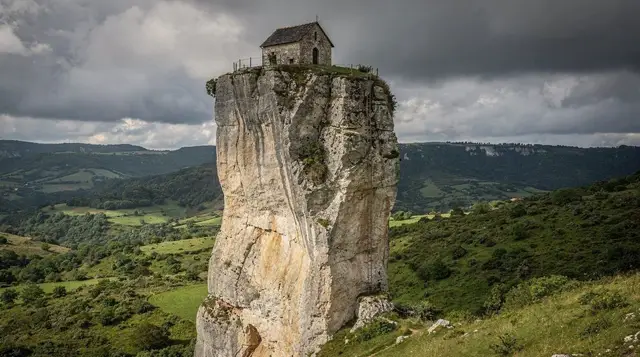
Shiomgvime, closer to Mtskheta itself and named for the 6th-century hermit monk Shio, sits built into and against a limestone canyon wall, its main structures dating largely to the 12th-century rebuilding under David the Builder, who is closely associated with the site alongside Gelati and several other major Georgian monasteries of the period. The setting is dramatic in a different way from Betania’s quiet gorge — sheer pale rock rising directly behind the monastery buildings, with caves in the cliff face that housed the earliest hermit monks before the more formal complex was built around them.
Shiomgvime remains an active monastery with a resident community of monks, and it has historically served as one of the more significant centres of Georgian monastic life, at times housing a substantial number of monks and functioning as a centre of religious scholarship. The complex includes the main church, a refectory, and remnants of an old water-supply system carved into the canyon — practical infrastructure that speaks to how self-sufficient these communities needed to be.
Tbilisi: Shiomgvime Monastery Limestone Canyon Tour covers the site directly, useful for travellers who want Shiomgvime specifically rather than folding it into a broader Mtskheta itinerary.
Getting there and combining the two
Both sites sit close enough to Mtskheta and to each other that a single day covering Svetitskhoveli, Jvari, Betania and Shiomgvime is realistic for anyone with a rental car or a private driver, though it makes for a full day rather than a relaxed half-day loop. Neither monastery is served by regular public transport, which is precisely why they see far fewer visitors than Mtskheta’s main UNESCO sites — reaching them takes deliberate effort rather than simply joining the nearest coach tour.
Journey Through Timechronicle of Georgia Ancient Mtskheta and Mtskheta: Jvari Samtavro Zedazeni Tour both cover the wider Mtskheta area in depth and can be combined with a separate, shorter visit to Betania or Shiomgvime for travellers assembling their own full day rather than following a single fixed tour.
For a broader look at how much can realistically be covered around Mtskheta in a single visit, see Mtskheta in half a day; Betania and Shiomgvime both extend that half day into a fuller one if you have the time and transport to add them.
Why these sites stay quiet
Betania’s narrow access road and Shiomgvime’s position slightly off the main Mtskheta circuit are both practical reasons the two see far fewer visitors than Svetitskhoveli or Jvari, but the deeper reason is simply that most organised tours are built around a fixed, well-known set of stops, and neither site has the same instantly recognisable profile as Georgia’s UNESCO-listed monuments. For travellers who have already done the standard Mtskheta circuit, or who prefer sites without a coach-tour crowd, both are worth the extra effort precisely because they see so few other visitors.
The 12th century: Georgia’s monastic golden age
Both Betania and Shiomgvime belong to a remarkable period of Georgian history often called the golden age, spanning roughly the reigns of King David the Builder in the early 12th century through Queen Tamar at the turn of the 13th, when a unified and increasingly powerful Georgian kingdom poured resources into church-building, monastic scholarship and territorial expansion across much of the South Caucasus.
Gelati Monastery near Kutaisi, founded by David the Builder himself, is the best-known product of this era, but the same wave of confidence and patronage produced dozens of smaller monasteries across the kingdom, of which Betania and Shiomgvime are two of the better-preserved examples close to Tbilisi. Understanding this context changes how both sites read: not simply old churches, but physical evidence of a specific, ambitious period in Georgian history that also produced the country’s most celebrated queen and its most expansive medieval borders.
Shio and the origins of Georgian monasticism
Shiomgvime’s founder, Shio, was one of the Thirteen Assyrian Fathers, a group of monks traditionally credited with establishing organised monasticism in Georgia in the 6th century, arriving from Antioch to reinforce and formalise the Christian faith that St Nino had brought two centuries earlier.
Shio is said to have sought increasing solitude over his life, eventually withdrawing into a cave in the limestone canyon where the monastery now stands, living out his final years as a hermit before the more formal monastic complex grew up around the site of his cave. This origin story places Shiomgvime among the oldest continuously significant monastic sites in Georgia, even though most of what survives above ground today dates from the later 12th-century rebuilding rather than Shio’s own era.
What to bring and practical notes
Neither site has significant visitor infrastructure — no cafés, limited signage in English, and basic parking rather than a managed visitor centre — which is part of their appeal for travellers tired of more heavily developed sites but also means planning ahead matters more here than at Mtskheta’s main attractions. Bring water, since neither site sells refreshments, and plan a proper meal in Mtskheta or Tbilisi around the visit.
Comfortable walking shoes help at both sites, though neither demands the sustained climbing that a site like Uplistsikhe or Gergeti Trinity does. Photography is generally permitted in the grounds of both monasteries, with the usual restraint expected inside the churches themselves.
Combining a visit with wider Tbilisi day trips
Betania and Shiomgvime both work well as an extension to an existing Tbilisi-area day trip rather than a dedicated excursion in their own right. Travellers already spending a day around day hikes from Tbilisi or a broader look at the capital’s surroundings can fold either monastery in without significantly restructuring their plans, provided they have a car or driver rather than relying on public transport.
For travellers who prefer a single, well-organised day covering Mtskheta’s main sites alongside these quieter alternatives, combining an organised Mtskheta tour with an independent taxi or driver detour to Betania or Shiomgvime affords the best of both — structured time at the UNESCO sites, and flexible time at the quieter ones.
How Betania and Shiomgvime compare to each other
Choosing between the two, if time only allows one, comes down to what you are looking for. Betania rewards visitors interested in art and quiet isolation — its frescoes are the genuine draw, and the gorge setting means very few other visitors most days.
Shiomgvime rewards visitors more interested in dramatic setting and a sense of ongoing monastic life — the limestone canyon backdrop is more immediately striking than Betania’s wooded ravine, and the resident community is generally larger and more visible in the day-to-day life of the site. Neither is difficult to reach relative to the other, so the choice comes down to preference rather than logistics; travellers with a full day and a car can reasonably see both without feeling rushed at either.
Why these sites matter beyond their frescoes and canyons
Betania and Shiomgvime are also useful correctives to a common assumption among first-time visitors to Georgia — that the country’s religious history is concentrated entirely in a handful of famous, UNESCO-listed sites. In reality, Georgia’s countryside is dense with monasteries of real historical and artistic significance that never made any international heritage list, simply because the formal inscription process has only examined a fraction of what the country holds.
Every UNESCO World Heritage site in Georgia covers what has been formally recognised, but Betania and Shiomgvime are a reminder that the list is a starting point for understanding Georgian religious architecture, not a complete inventory of what is worth seeing.
A quieter alternative to Georgia’s busiest religious sites
For travellers who have already spent time at Georgia’s most-visited churches and want something with fewer other tourists, Betania and Shiomgvime offer a genuinely different experience from Svetitskhoveli Cathedral or Jvari Monastery on a busy day.
Neither site sees anything close to the visitor volume of Mtskheta’s main attractions, and the relative quiet allows for a slower, more contemplative visit — worth factoring into your itinerary if the crowds at Georgia’s headline sites have started to feel like part of the experience rather than a backdrop to it. This is also part of why both sites reward independent travel over a fixed coach-tour schedule, since a rushed fifteen-minute stop undersells what makes them worth visiting in the first place.
Seasonal considerations
Betania’s wooded gorge setting means the site changes noticeably with the seasons — vivid green in spring and early summer, richly coloured in autumn, and starkly bare but atmospheric in winter, when the low sun through leafless trees can make for striking photographs of the church itself. Shiomgvime’s canyon setting is less season-dependent, since the pale limestone backdrop dominates the view in any season, though summer heat reflects noticeably off the exposed rock face during the hottest parts of the day. Both sites are open and accessible year-round, without the seasonal closures that affect some of Georgia’s higher-altitude sites.
Planning a full day around Kartli’s monasteries
Travellers with a genuine interest in Georgian monastic architecture, rather than a single quick stop, can build an entire day around Kartli’s religious sites without ever leaving the region immediately surrounding Tbilisi and Mtskheta. A realistic route might begin with Svetitskhoveli and Jvari in the morning, move to Shiomgvime around midday given its proximity to Mtskheta, and finish at Betania in the early afternoon before the light in its wooded gorge begins to fade.
This kind of day rewards travellers who find the differences between Georgia’s monasteries as interesting as the highlights themselves — the shift from Svetitskhoveli’s grand cathedral scale, to Jvari’s austere hilltop setting, to Shiomgvime’s canyon-carved complex, to Betania’s hidden, fresco-filled quiet, covers a genuine range of what medieval Georgian religious architecture produced within a surprisingly small geographic area.
Frequently asked questions about Betania and Shiomgvime
How far are Betania and Shiomgvime from Tbilisi?
Both sit within roughly 30 to 40 minutes of Tbilisi by car, close enough to combine with a wider Mtskheta day trip without major detours.
Do you need a car to visit Betania and Shiomgvime?
Effectively yes — neither site is served by regular public transport, and Betania in particular is reached by a narrow road that discourages larger vehicles. A rental car, hired driver or private tour are the realistic options.
Are Betania and Shiomgvime still active monasteries?
Yes, both have small resident religious communities today, and the same dress and behaviour expectations apply as at any active Georgian Orthodox site.
What is special about Betania’s frescoes?
Betania holds one of the best-preserved sets of medieval Georgian frescoes in the country, including a rare donor portrait believed to show King George III and his daughter, the future Queen Tamar.
Is Shiomgvime the same as Jvari Monastery?
No — Jvari sits on the hilltop above Mtskheta and is part of the UNESCO-listed Historical Monuments of Mtskheta. Shiomgvime is a separate, later monastery built into a limestone canyon nearby, not part of that UNESCO listing.
Can you visit Betania and Shiomgvime in the same day as Mtskheta’s main sites?
Yes, for travellers with a car and a full day to spend. Combining all four sites — Svetitskhoveli, Jvari, Betania and Shiomgvime — makes for a long but realistic day rather than a relaxed half-day loop.
Is there an entry fee for Betania or Shiomgvime?
No, entry to both is free, in keeping with standard practice at active Georgian Orthodox monasteries.
Monastery and fortress tours on GetYourGuide
Verified deep-linked GetYourGuide tours. Book through these links and we earn a small commission at no cost to you.
Photo: our own image of the location, not the operator’s product photo.